.png)


Key Takeaways
- Discovery now happens in AI answers: Buyers now form an opinion before they visit your site directly. They are asking AI for the best tools to solve their problem, then going to the platform AI recommends. If you are not in that AI answer, you are not in the consideration set at all.
- Optimize your content for how AI reads and cites: Statistics, tables, cited sources, and answers placed in the top 30% of the page are more likely to be cited. Focusing on persuasive copy, keyword density or a brand-led narrative will not help you get cited in AI anymore.
- Invest in brand mentions across PR, Reddit, and YouTube: AI engines count how often your brand shows up across the web, including places with no links attached. A Reddit thread or YouTube transcript carries more citation weight than a high-authority backlink.
- Refresh your existing content every 90 days or risk losing AI citations: AI models actively prioritize recency to avoid "hallucinating" or stating outdated facts. Update your existing content every quarter.
It's only Q2 of 2026, and the GEO playbooks from last year already feel outdated.
New platforms launch every quarter, solving pain points your buyers didn't even know they had. And when those buyers turn to AI for help picking a tool, they go with whatever AI recommends the most. The problem is, AI just surfaces five or ten options. But those are not the only tools that exist. There are plenty of others out there. Who knows how many strong tools don't get leads because they aren't cited at all?
Say your brand is in those AI answers today. Just because it is there today, you can't assume it'll be there tomorrow. Citation patterns shift month to month, which is far messier than it was when we only had to compete within Google's SERP.
According to Forrester, 94% of B2B buyers now use generative AI in their buying process, and 33% are choosing vendors they had never considered before simply because the brand surfaced in an AI answer.
But the real question is, how is AI making buyers choose those vendors? What reassurance and credibility are they finding inside an AI answer that a SERP doesn't provide anymore?
That's why we put together this article with 90+ GEO statistics for 2026. It's pulled from our 75K LLM Traffic Report, which covers 100+ B2B SaaS companies, our very own B2B SaaS Marketing Benchmarks Report with GEO Readiness Scores across 15 verticals, and case study data from clients like FlowForma and Signeasy. We also drew on third-party sources, including the foundational GEO research by Princeton and IIT Delhi, as well as Forrester, G2, McKinsey, Salesforce, and more. Let's start with how buyers use AI to build their shortlists.
GEO Statistics on How B2B Buyers are Using AI Chatbots to Shortlist Vendors
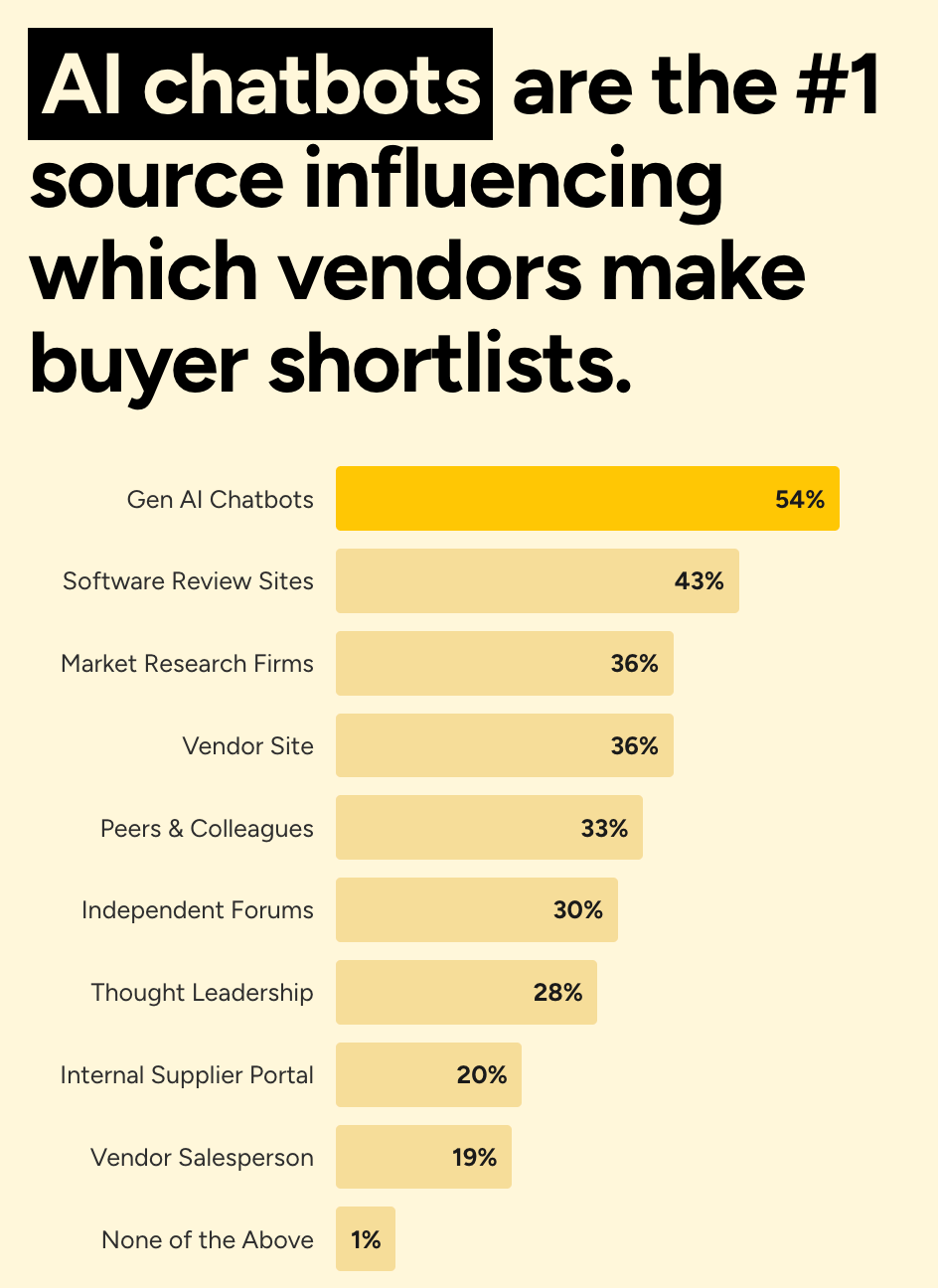
The data below shows how often your buyers search on AI chatbots, how they do it, what platforms they use, and what that means for your visibility.
How Many Buyers Start Their Research With AI
- 51% of B2B software buyers now begin their research with an AI chatbot. That number was 29% in April 2025, which means AI-first research nearly doubled in just 12 months. (G2 Answer Economy Report)
- 71% of buyers rely on AI chatbots at some point in their software research. AI is in play at every stage of evaluation, not just the start. (G2 Answer Economy Report)
- Forrester now reports that GenAI is the single most-cited meaningful interaction type for researching purchases, ahead of vendor websites, product experts, and sales conversations. (Forrester State of Business Buying 2026)
How AI is Reshaping Vendor Shortlists
- 69% of buyers chose a different software vendor than originally planned because of AI chatbot guidance. Two out of three software deals are being reshaped by an AI conversation before the buyer ever lands on a vendor site. (G2 Answer Economy Report)
- 33% of buyers have made purchases from vendors they'd never heard of before AI surfaced them in their search. AI-driven recommendations are now strong enough to pull entirely new brands into the consideration set. (G2 Answer Economy Report)
How AI Mentions Affect Buyer Trust
- 85% of buyers think more highly of you when an AI chatbot recommends your brand. That mention serves as both an endorsement and a PR win. Even buyers who already know you trust you more once AI confirms it. (G2 Answer Economy Report)
- Additionally, 80% of buyers say AI chatbots accelerated their purchasing decision. Most report feeling more confident in their final choice when AI cites the tool they bought. (G2 Answer Economy Report)
- At the same time, Trustradius reports that 90% of buyers still click through to verify what AI tells them. Though AI mentions you, they still visit your site, your G2 page, or a third-party article to confirm what the AI said is true. (TrustRadius via 6sense)
How AI is changing the buying process itself
- 41% of B2B buyers are now using deep research tools for structured software evaluations. With 10-20 page reports generated per query, buyers arrive at sales calls with a structured competitive analysis already in hand. (G2 Answer Economy Report)
- The typical B2B buying group now includes 13 internal stakeholders and 9 external influencers. That's 22 people forming an opinion on your category. (Forrester State of Business Buying 2026)
What Does This Mean for You?
Start tracking which AI platforms mention your brand and which don't. Run weekly tests across ChatGPT, Perplexity, and Gemini using the same buyer questions your sales team hears in discovery calls.
Map every mention to the page AI is citing, and which competitor pages win the ones you miss. That gives you the list of pages to fix first.
GEO Statistics on What Earns AI Citations (and What Doesn't)
The first thing to understand about AI citations is that the rules are very different from those we have for Google's SERP. The page that ranks #1 on Google for your category keyword may not appear even in a single ChatGPT answer. The page nobody links to may be the one Perplexity cites every time.
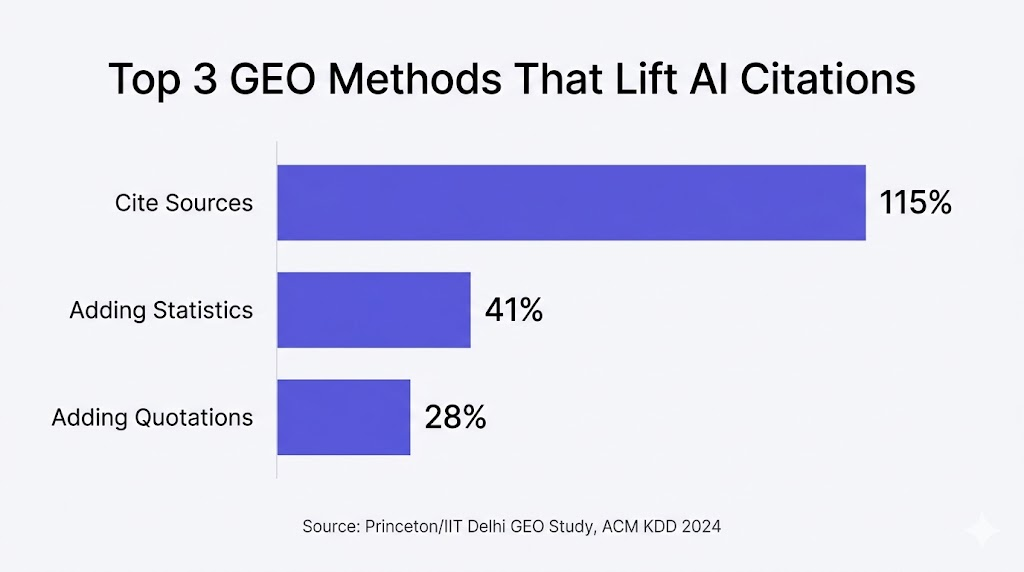
Here's what the research says actually works.
- Adding statistics to a page lifts AI visibility by 41%. This was the single most effective optimization tested in the GEO study, which ran 9 different content modification strategies across 10,000 queries. Adding inline quotations from credible sources lifts AI visibility by 28%. This was the second most effective technique tested. (Aggarwal et al., Princeton/IIT Delhi, ACM KDD 2024)
- Similarly, TripleDart found that stats-format pages on a single TripleDart client portfolio earned 35+ AI citations on ChatGPT and Perplexity over 8 months, with one stats page driving 129 LLM sessions in a single month. Statistics have now become a citation magnet. (TripleDart 75K LLM Traffic Report)
- Listicles account for 21.9% of all AI citations. When Wix Studio's AI Search Lab analyzed over 1 million citations across ChatGPT, Google AI Mode, and Perplexity, listicles came out on top across all three platforms. (Wix)
- 44.2% of all LLM citations come from the first 30% of a page. Kevin Indig's analysis of 1.2 million ChatGPT responses found a "ski ramp" distribution. It says that the middle of an article receives 31.1% of citations, while the final third receives just 24.7%. If your strongest claim is buried below the fold, AI is unlikely to find it. (Growth Memo, February 2026)
- Pages with tables and structured data get cited 2.5x more often than unstructured content. AI engines extract information through pattern matching, and tables provide explicit data relationships that they can cleanly pull into an answer. (NectivDigital)
- Pages ranked 5th in search see a 115% increase in visibility when they cite external sources. GEO optimization rewards the middle of the pack the most. Top-ranked pages already have visibility. Mid-rankers are the ones with room to grow. (Aggarwal et al., Princeton/IIT Delhi, ACM KDD 2024)
- Long-form articles (think explainers, how-tos, and deep-dives written as flowing prose) are cited 2.7 times more often than other formats for informational queries. Listicles, the "Top 10" or "Best X" style posts structured as numbered lists, dominate commercial-intent queries with 40% of citations in that category. (Wix)
- Third-party listicles earn 80.9% of citations in professional services categories. Self-promotional listicles ("Why we're the best CRM") get just 19.1%. AI engines have caught on to self-promotional lists. When a vendor ranks itself on its own "best of" list, the citation weight drops. (Wix)
- Keyword stuffing performs 10% worse than doing nothing at all. Princeton researchers tested it specifically because it dominated SEO for two decades, and they found it actively hurts performance in generative engines. The most effective traditional SEO move has now become a liability. (Aggarwal et al., Princeton/IIT Delhi, ACM KDD 2024)
- Across our 75K LLM Traffic Report covering 100 B2B SaaS brands, 65% of LLM traffic lands on three page types: Homepage, Feature/Solution pages, and Long-Form Blogs. Bottom-funnel pages, such as Free Trial, Demo, Comparison, and Pricing, receive less than 5% of traffic. LLMs are directing buyers to top- and middle-funnel content, where they research the brand and product before any conversion step. (TripleDart 75K LLM Traffic Report)
- 80% of LLM citations don't rank in Google's top 100 for the original query. This is one of the most disorienting findings for SEO teams. The page Google has decided isn't even worth ranking is often the page AI considers most worth citing. The two systems are reading different signals. It also found that only 12% of AI citations overlap with Google's top 10 results. Ahrefs' analysis of citation patterns found that the other 88% of AI citations come from sources that Google's algorithm doesn't rank highly or doesn't rank at all. (Ahrefs)
- Combining the top three Princeton methods (statistics, quotations, citations) yields a compounding lift in citation share beyond that of any single method. The paper shows that the strongest gains came from pages that did all three at once. (Aggarwal et al., Princeton/IIT Delhi, ACM KDD 2024)
Pulling All of This Together
If you look back at the stats above, you may notice what's missing. Backlinks and domain authority barely show up. The signals you've spent years chasing on Google are no longer the ones doing the heavy lifting in AI.
That's the part most teams are missing. AI isn't just another search engine to optimize for. It reads differently, rewards differently, and ranks differently. The old playbook still works for Google, but it won't carry you in LLMs on its own.
The good news? You don't have to start over. You just have to start writing for a reader who cares more about evidence than authority.
Statistics on Why Brand Mentions Now Matter More Than Backlinks
For 20 years, SEO ran on backlinks. The more high-quality websites that link to your page, the higher Google ranks you. Most B2B SaaS marketing teams built their entire content strategy around earning those links.
AI engines look at a different signal. They count how often your brand shows up across the web, including places with no link attached. A mention inside a Reddit thread or a YouTube transcript can carry as much weight as a backlink from a high-authority site.
Brand Mentions Are Now the Strongest Predictor of AI Visibility
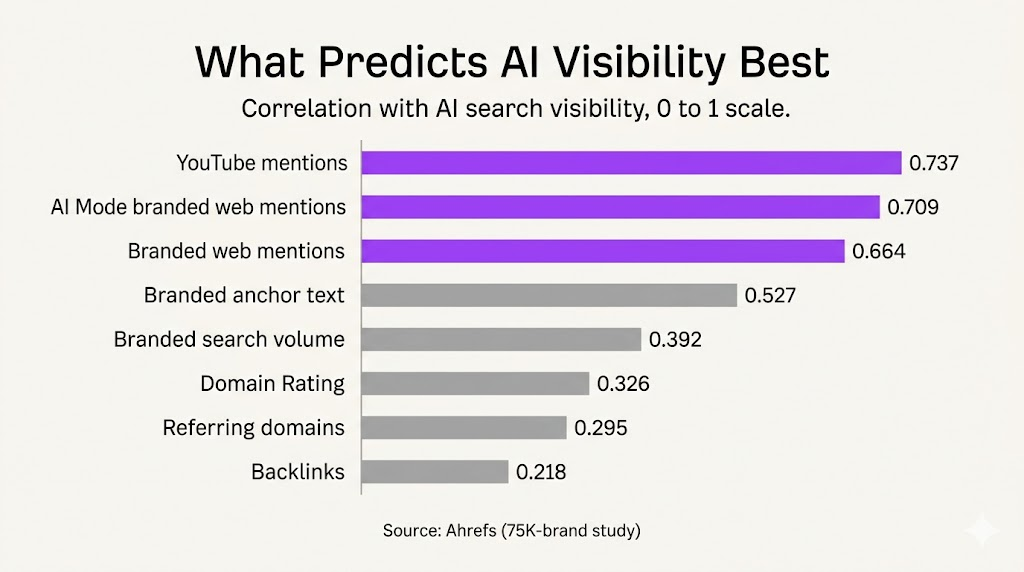
- Branded web mentions correlate with AI Overview visibility at 0.664, the strongest off-site signal Ahrefs measured across 75,000 brands. (Ahrefs)
- Google has a separate AI search experience called AI Mode, which sits apart from AI Overviews. It uses a more conversational format. For AI Mode, brand mentions correlate with visibility at 0.709. That is even higher than the 0.664 correlation Ahrefs found for AI Overviews. The newer the AI surface, the more it relies on brand-mention signals. (Ahrefs)
- Branded search volume is the third-strongest predictor, with a coefficient of 0.392. The more people Google your brand name, the more likely AI engines are to mention you, regardless of whether those searches produce backlinks. (Ahrefs)
- Branded anchor text correlates with AI visibility, with a correlation coefficient of 0.527. When publications link to your brand using your brand name as the anchor text, AI engines pick up that as a citation signal. Generic anchors like "click here" no longer work. (Ahrefs)
- The brands earning the most web mentions receive up to 10x more AI Overview citations than those one tier below them. Brands that build a strong mention base early end up earning even more citations later, while brands with thin mention coverage stay invisible. (Ahrefs)
Backlinks Still Matter, Just Not the Way They Used To
- Backlinks correlate with AI visibility at just 0.218 (about three times weaker than brand mentions). The metric SEO teams have spent two decades optimizing for has been demoted. (Ahrefs)
- Domain Rating, the SEO score that measures how authoritative a domain looks based on its backlink profile, correlates with AI visibility at 0.326. That's roughly half the strength of brand mentions. DR still has some predictive power for AI citations, but it is less than what most SEO teams are used to assuming. (Ahrefs)
- Referring domains correlate with AI visibility at 0.295. This is the SEO metric that captures the diversity of sites linking to a brand, and it sits below organic traffic in predictive power for AI citations. (Ahrefs)
- Only 37.9% of URLs cited in AI Overviews also appear in the regular SERP top 10 for the same query. The other 62% sit between positions 11-100 (31.2%) or outside the top 100 entirely (31%). Ranking and being cited are increasingly separate problems. (Ahrefs)
YouTube and Earned Media Drive the Most Citations
- YouTube is now the most-cited domain in Google's AI Overviews, and its citation share has grown 34% in the last six months. A brand absent from YouTube is invisible in a growing share of the AI answer surface. (Ahrefs)
- YouTube mentions correlate with AI visibility at 0.737, which is the highest single correlation Ahrefs has measured. Both Google and OpenAI train on YouTube transcripts. A brand's appearance in video titles, descriptions, and transcripts predicts AI citation more reliably than anything else. (Ahrefs)
- Earned media accounts for 82% of AI citations, and 94% of all AI citations come from non-paid sources overall. Paid placements barely register. PR is now a citation-acquisition channel. (Muck Rack)
Press Releases Have a New Reader: AI
- Journalism accounts for 20-30% of all AI citations, and that share rises to 49% for queries that imply recency. AI engines lean heavily on news outlets when buyers ask questions about anything that might have changed recently. (Muck Rack)
- Press release citations in AI answers have grown 5x since July 2025. Muck Rack's tracking shows that ChatGPT and Gemini in particular have started pulling from press releases at much higher rates, especially when the release contains data, statistics, or named sources. (Muck Rack)
- Out of every 100 journalists B2B PR teams pitch, only 2 are journalists AI engines actually cite. The other 98 are writers AI has never read. Most B2B PR budgets are aimed at the wrong people. (Muck Rack)
Two-Thirds of AI Citations Are Off-Limits to Marketers
- 67% of ChatGPT's top 1,000 most-cited pages are out of reach for marketers. Two-thirds are sites like Wikipedia, app store listings, and organizational reference pages that PR teams cannot realistically pitch. The remaining 32.3% is where actual outreach competes. This means the citation surface plays out inside a much smaller pool than most teams realize. (Ahrefs)
- Half of all AI citations come from content published within the last 11 months. Roughly 4% come from content published in the prior week. AI engines weigh recency heavily, which means even strong brand mentions decay if they are not refreshed. (Muck Rack)
From our work with Signeasy, growing brand mentions across third-party sources lifted LLM-cited pages from 3 to 55+ in six months, alongside an LLM session count that grew from 20 a month to 800 a month.
Growing brand mentions across third-party sources directly drove the LLM citation growth. The two outcomes are connected. Without mention coverage, AI citations rarely follow.
Across the 100 B2B SaaS brands in our 75K LLM Traffic Report, ChatGPT drove 70 to 80% of LLM traffic across most page types. Brand mentions earn citations across all four major LLMs, but ChatGPT is the one sending the most traffic to your site after the citation lands.
What You Understand from This
The activity that earns AI citations is largely the activity SEO teams have ignored for the last decade. None of the items below were prioritized when backlinks were the goal, because none produced clean dofollow links at scale.
- Guest bylines
- Podcast appearances
- Journalist relationships
- Third-party listicles
- YouTube creator partnerships
- Reddit presence
- Review platform investment.
Now they are the strategy.
Most B2B SaaS teams still spend most of their content and SEO budget on link-earning work. Move part of that budget into PR, third-party placements, and creator partnerships. Start with one quarter, track which citations move, and rebalance from there.
GEO Statistics for Refresh Cadence and Content Freshness
Traditionally, a blog post went up, ranked over time, and earned its keep for years. The page from 2022 was still pulling traffic in 2024.
In AI search, pages start losing citations the moment you stop updating them. And the drop happens fast, much faster than what SEO teams are used to. As a result, refreshing your content is now mandatory. It is the work that keeps your pages visible in AI answers month after month.
Here is what the data says about how AI engines weigh freshness.
- AI-cited content is 25.7% fresher than content ranked in traditional Google search results. Ahrefs analyzed 16.975 million citations across ChatGPT, Perplexity, Gemini, Copilot, and AI Overviews and found that AI engines pull from URLs that are, on average, a full year newer than those that show up in Google's organic SERPs. (Ahrefs)
- The average AI-cited URL is 1,064 days old (about 2.9 years). The average URL ranking in Google's organic SERP is 1,432 days old (about 3.9 years). (Ahrefs)
- ChatGPT shows the strongest preference for freshness among all AI platforms tested. It cites URLs that are 393 days newer than Google organic results in its in-text references and 458 days newer in its citations. (Ahrefs)
- Perplexity citations average 1,166 days old, and Gemini citations average 1,118 days old. Both are meaningfully fresher than traditional Google search results, though slightly less aggressive about freshness than ChatGPT. (Ahrefs)
- Google AI Overviews actually cite content that is, on average, 16 days older than the regular Google SERP. The platform behaves more like traditional search than its peers, which means AI overview optimization is closer to standard SEO than ChatGPT or Perplexity optimization. (Ahrefs)
- ChatGPT and Perplexity order their in-text citations from newest to oldest. Within a single AI answer, the most recently published source gets cited first. This means that recency affects where in the answer your citation appears. (Ahrefs)
- AI engines look at two dates when deciding whether to cite a page. The day it was first published, and the day it was last updated. Even an old article gets treated as fresh if you have updated it recently. The takeaway is that you do not need to publish a brand-new article to earn an AI citation. You can refresh an existing one, and AI engines will treat it like new content. (Ahrefs)
- AI engines apply the freshness preference evenly. Whether your page shows up as the first citation in an AI answer or the tenth, the average page age is roughly the same. In a regular Google search, the oldest pages tend to rank highest because they have had the most time to build authority. AI does not reward that kind of seniority. A fresher page can land in any citation slot, regardless of how long the brand or domain has been around. (Ahrefs)
What the Data Says You Should Do
An article you published in 2022 can still earn citations today if you refresh it. The last-updated date is what controls AI visibility.
Audit your top 30-50 highest-traffic blog posts and sort them by last-updated date. Anything older than 90 days goes into the refresh queue.
GEO Performance Statistics Across 15 B2B SaaS Verticals
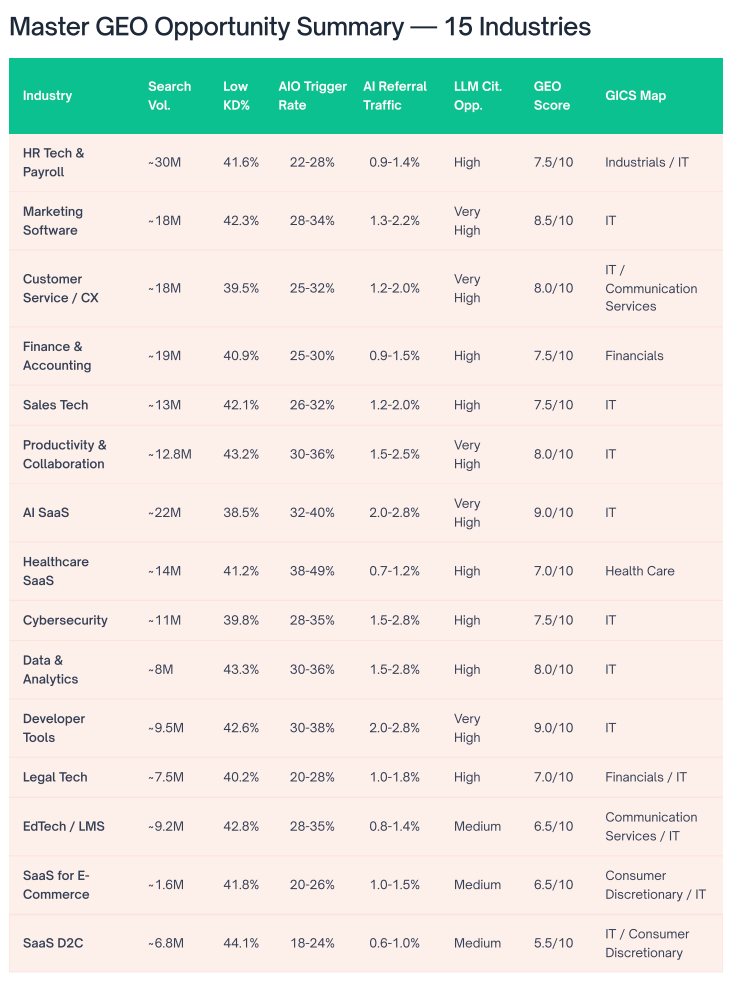
Some B2B SaaS verticals are getting hit hard by AI search right now. Others are barely affected. Your investment in GEO should align with the vertical you are working in.
To clarify, we developed a GEO Readiness Score for 15 B2B SaaS industries in our 2026 Benchmarks Report. Each vertical was scored from 5.5 to 9.0 out of 10 based on AI overview trigger rates, AI referral traffic, content fit, and LLM session activity.
A vertical score of 9.0 has nearly twice the AI search opportunity as one with a score of 5.5. So the work you should be doing in a high-scoring vertical is very different from the work that makes sense in a low-scoring one.
Here is how the verticals stacked up.
- AI SaaS and developer tools both score 9.0/10, the highest of any verticals we measured. Developers and AI practitioners are the heaviest LLM users of any professional cohort, and queries in these categories trigger AI Overviews at rates between 30 and 40%. (TripleDart Benchmarks Report)
- Marketing Software scores 8.5/10, with AI referral traffic ranging from 1.3% to 2.2%. Marketing tool buyers ask many comparison questions. These comparison queries are exactly what LLMs love answering with citations. (TripleDart Benchmarks Report)
- Customer Service / CX, Productivity & Collaboration, and Data & Analytics all score 8.0/10. Buyers in these categories ask a lot of "how do I" questions. Productivity & Collaboration in particular sees 1.5 to 2.5% AI referral traffic, led by Project Management. The "features" and "comparison" queries that dominate the category are also the top triggers for ChatGPT searches. Productivity tools also have the highest share of easy-to-rank keywords of any vertical at 43.2%. (TripleDart Benchmarks Report)
- Healthcare SaaS has the highest AI Overview trigger rate of any B2B SaaS vertical (38 to 49%), but its AI referral traffic is the lowest in the dataset at just 0.7 to 1.2%. AI engines treat healthcare topics as high-stakes, so they cite fewer sources per answer, and the ones they do cite are usually large, well-established brands like Mayo Clinic or Cleveland Clinic. That makes it harder for newer healthcare SaaS brands to break in. (TripleDart Benchmarks Report)
- The IT sector gets 2.8% of its traffic from AI. That's nearly 3x the all-industry average of 1.08%. If your B2B SaaS vertical sits under IT, your starting position for AI referral traffic is much stronger than average. (Conductor AEO/GEO Benchmarks Report 2026)
- AI referral traffic varies a lot by industry. Tech sits at 1.34%, Finance at 0.94%, Healthcare at 0.87%, and B2B services at 0.76%. So even outside the IT-heavy categories, your industry choice shapes how much AI traffic you can realistically expect. (TripleDart Benchmarks Report)
- Technology brands see 12.3 AI citations per 1,000 queries. This is the highest citation rate among measured industry verticals. This is helpful for B2B SaaS marketing leaders trying to set realistic GEO benchmark targets for their own brand. (TripleDart Benchmarks Report)
- SaaS D2C scores 5.5/10, the lowest of any vertical we measured, and SaaS for E-Commerce sits just above at 6.5/10. The irony is that D2C actually has the strongest SEO conditions of any category, with 44.1% of its keywords in the low-difficulty range. The GEO score stays low because D2C buyers tend to start free trials quickly rather than ask AI for a recommendation, which keeps AI engines out of the buying journey. (TripleDart Benchmarks Report)
- Legal Tech and Healthcare SaaS both score 7.0/10, despite very different AIO trigger rates (20-28% for Legal vs 38-49% for Healthcare). Legal, Finance, Health, Insurance, and SMB together account for 55% of all LLM session activity. So even when the trigger rate is moderate, the volume of AI sessions in those verticals keeps the GEO score elevated. (TripleDart Benchmarks Report)
- EdTech / LMS scores 6.5/10. LinkedIn CPL in this vertical is $64, the lowest of any B2B SaaS category, which makes paid channels a strong play here. GEO opportunity is moderate because consumer EdTech queries crowd out the B2B ones in AI answers. So invest in LinkedIn first, GEO second. (TripleDart Benchmarks Report)
- AI Overviews trigger on 25.1% of all Google queries. Roughly one in four searches now produces an AI Overview before the regular SERP, and the rate climbs sharply for informational queries in healthcare, technology, and finance. (TripleDart Benchmarks Report)
- 67% of enterprises now use ChatGPT for research. In cybersecurity specifically, buyers are asking AI for threat intelligence and vendor evaluations. Original research reports do unusually well in this vertical because AI engines lean on proprietary data, and threat intel is one of the few areas where every brand has unique numbers to share. (TripleDart Benchmarks Report)
- HR Tech & Payroll scores 7.5/10. The AIO trigger rate is average at 22-28%, and that average rate applied to such high search volume still produces a lot of AI answers in this category. Compliance and benefits queries are especially active in AI search. (TripleDart Benchmarks Report)
- Combined AI traffic across all platforms is still only 0.07 to 1.1% of organic traffic volume. AI is high-quality and growing fast, but it is not a replacement for organic (at least for now). The vertical investment thesis has to account for that volume reality. (TripleDart Benchmarks Report)
- AI traffic is growing 527% year-over-year. Even though AI volume is small today, that growth rate matters more than the current number. A vertical with 1% AI traffic share today could easily reach 5% or higher by next year. (TripleDart Benchmarks Report)
- Bottom-funnel content (case studies, pricing pages, comparison pages) gets the highest AI referral traffic percentage across all 15 verticals, with one case study showing 124,000 ChatGPT sessions in 6 months from comparison content alone. The pages most B2B SaaS teams under-invest in are the ones AI engines reward most consistently. Build comparison and case-study libraries before you write more blog posts. (TripleDart Benchmarks Report)
What the Data Says You Should Do
Find your vertical on the readiness score. Let that number guide how much you invest in GEO. A 9.0 score means treating GEO as a top priority. A 6.5 means giving GEO a smaller share of your budget while keeping SEO and paid in the lead.
Also, check whether your category has high AIO trigger rates with low AI referral traffic.
If your vertical scores are below 7.0, GEO still belongs in your plan. Setting up the basics now keeps you ready when AI traffic in your category grows.
How We Approach GEO at TripleDart
Every number below comes from our work with 100+ B2B SaaS clients and from how Slate, our GEO platform, runs against that data day-to-day.
What's Happening to Organic Traffic When AI Overviews Show Up
- Across our portfolio of 100 B2B SaaS brands, organic clicks dropped 57.07% on pages where AI Overviews appeared. That kind of click loss is the biggest hit to organic traffic we’ve ever measured. (TripleDart 75K LLM Traffic Report)
- Impressions on those same pages went up 19.58%. The visibility is still happening, but only in the AI answer instead of on the destination page. (TripleDart 75K LLM Traffic Report)
- 84% of our dataset consisted of top-of-funnel keywords, and these were the queries that triggered AI Overviews most heavily. Informational content is where AI search hits hardest. (TripleDart 75K LLM Traffic Report)
How LLM Traffic Is Growing Across Platforms
- LLM-driven traffic across our portfolio grew 47.27% month-over-month in April 2025. The absolute volume is still small, but that growth rate is why GEO investment compounds quickly. (TripleDart 75K LLM Traffic Report)
- ChatGPT is driving the majority of LLM traffic in our programs. Perplexity growth slowed to 5.46% month-over-month in April 2025 after peaking in November 2024, while Gemini grew 27.47% in March and 17.34% in April. Claude generates fewer than 100 visits per month per client. (TripleDart 75K LLM Traffic Report)
That order shapes how we prioritize. ChatGPT gets the biggest share of GEO work, Perplexity and Gemini sit in the middle, and Claude is a lower priority for standard B2B SaaS programs (even though its session value is high and its developer audience is concentrated).
Where LLM Traffic Is Coming From
- India alone saw a 59% spike in LLM sessions in a single month, growing from 1,855 sessions in March 2025 to 2,954 in April 2025. The India growth curve is sharper than any other market we tracked, which is why we have built India-localized GEO programs into our default delivery model for global clients. (TripleDart 75K LLM Traffic Report)
- LLM-driven traffic shows a 36.9% bounce rate, just under Google organic at 37.4%. The numbers are close, which means LLM visitors arrive with at least as much intent as organic visitors. They are not casual browsers. (TripleDart 75K LLM Traffic Report)
What Kinds of Pages LLMs Actually Send Traffic to
- Bottom-funnel pages, including Free Trial, Demo, Comparison, and Pricing, account for less than 5% of LLM traffic across our portfolio. LLMs are not yet sending high volumes of bottom-funnel traffic. Prioritize TOFU and MOFU content for citation visibility. (TripleDart 75K LLM Traffic Report)
- Perplexity contributes 25 to 30% of long-form blog and listicle traffic. Perplexity's strength on research-heavy content shapes how we brief listicle and stats content for clients targeting deep-research buyer cohorts. (TripleDart 75K LLM Traffic Report)
How We Run GEO at Scale with Slate
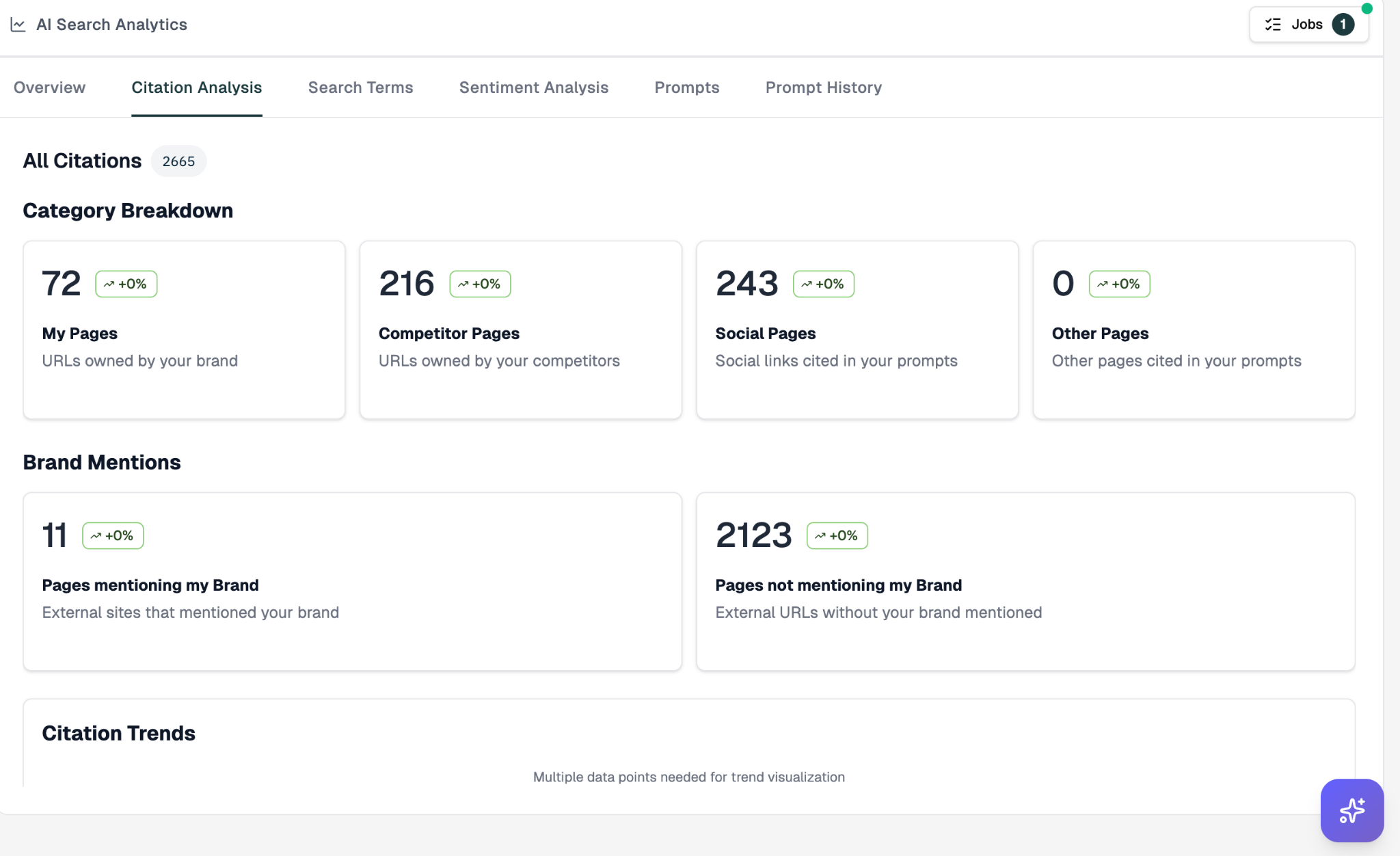
- Slate, our proprietary GEO platform, refreshes 50 to 90+ pages per month per client workspace. The cadence is built around a 90-day freshness window. Important pages do not go longer than three months without an update. This keeps it from losing AI citations. (TripleDart Generative Engine Optimization Services)
- Slate also tests 50+ buying scenarios per week across ChatGPT, Gemini, and Perplexity for every active client. The testing shows three things: which client pages are getting cited, where competitors are winning citations, and which buyer questions the client is missing entirely. (TripleDart Generative Engine Optimization Services)
What This Looks Like in Client Results
- FlowForma's AI search visibility grew 7x in six months. Sessions from ChatGPT, Perplexity, and Gemini climbed from 90 a month to 664. Long-form blogs drove most of that traffic, with 827 sessions in total. Listicles came next at 390, then landing pages at 161. (TripleDart FlowForma case study)
- Meegle increased its AI citations by 134%. The lift came from restructuring existing content into topic clusters that LLMs could read more easily. No new content was produced for this result. The citation growth showed up in ChatGPT and Perplexity within the first quarter. (TripleDart Meegle case study)
- Phyllo's conversion events grew 1,850%. The work was built around topic cluster modeling and pillar pages. Both organic and AI-driven sessions grew together, showing how a strong SEO architecture drives GEO performance. (TripleDart Phyllo case study)
What the Data Says You Should Do
If your traffic looks anything like the 100-brand average we measured, you've already lost more than half of your AIO-affected clicks. Most of your LLM traffic is also landing on page types you probably aren't optimizing for AI yet.
SEO and GEO have stopped being separate workstreams. They run as one program now.
We built Slate because doing this manually at scale isn't realistic. Whether you use Slate or build your own system, three things matter most.
- Refresh your high-priority pages every 90 days.
- Run weekly tests across ChatGPT, Gemini, and Perplexity to see where you're getting cited and where you're missing.
- Optimize for the page types and platforms where your audience is actually showing up.
From Stats to a Working GEO Program
Back to the question we opened with. What reassurance and credibility are buyers finding inside an AI answer that a SERP doesn't provide anymore?
Here's the answer: A shortlist that feels already vetted.
Buyers don't have to sort through ten blue links, compare vendor-written pages, and guess who will solve the pain point they have. AI has done that work for them. So when your brand appears in an AI answer, it isn't just visibility. It's been pre-qualified for the buyer before they ever see it.
Brands earning AI citations today are running structured programs that refresh content on a 90-day cycle, build mentions across third-party sources, and track citations every week across ChatGPT, Perplexity, and Gemini.
That kind of program is hard to set up in-house. It needs new tooling, new measurement, and a weekly cadence that most marketing teams do not have the time or the platform to run on top of their existing SEO and paid work.
This is what we do at TripleDart. We have built GEO programs for 50+ B2B SaaS brands, and our results include 7x AI search visibility for FlowForma, 134% citation growth for Meegle, and 800 monthly LLM sessions for Signeasy. Our Generative Engine Optimization services page shows how the program works, including how we use our proprietary platform Slate to refresh content at scale.
If you want to see what a GEO program looks like for your brand, book an intro call. You will walk away with a clear view of where your AI visibility currently sits and what would move it.
How We Compiled This Information
The statistics in this article come from two TripleDart primary research reports:
our 75K LLM Traffic Report (8 months of analytics across 100 B2B SaaS brands) and our B2B SaaS Marketing Benchmarks Report 2026 ($250M+ in ad spend across 200+ websites and 19 industries).
We supplemented this with third-party research from Princeton's foundational GEO study, Forrester, G2, Muck Rack, Ahrefs, Wix Studio, Conductor, Averi, SE Ranking, Growth Memo, Nectiv, McKinsey, and Growth Unhinged. Every statistic in this article is from late 2025 or 2026.
Frequently Asked Questions
1. What is the difference between GEO, AEO, and AI SEO?
GEO covers visibility inside AI engines like ChatGPT and Perplexity. AEO focuses on direct-answer formats, including AI Overviews. AI SEO is the umbrella term covering both.
2. Can my team run a GEO program in-house, or do we need an agency?
In-house works if you have content team bandwidth for monthly refresh cycles, LLM-segmented analytics, and weekly scenario testing across AI platforms. Most teams lack all three.
3. What tools do I need to track GEO performance?
A starter stack includes a citation tracker (Ahrefs Brand Radar, Profound, or Otterly.ai), share-of-voice tracking, and a custom GA4 setup with regex filters for LLM referrers.
4. My GEO competitor is already winning citations in our category. How do I catch up?
Start by auditing which competitor pages AI is citing for your top buyer queries. Then build better, fresher, more data-rich versions of those pages, plus mentions on the same third-party sources.
5. My leadership wants ROI proof before approving the GEO budget. What do I show them?
Pull LLM-driven sessions and conversion rates from GA4. Tie those numbers to pipeline outcomes so leadership sees revenue impact alongside the visibility data.


.webp)
.webp)
.png)


.png)



.webp)





.webp)

.webp)




%20(1).png)


.webp)
.webp)
.webp)



%20Ads%20for%20SaaS%202026_%20Types%2C%20Strategies%20%26%20Best%20Practices%20(1).webp)




.webp)






.webp)



![Creating an Enterprise SaaS Marketing Strategy [Based on Industry Insights and Trends in 2026]](https://cdn.prod.website-files.com/632b673b055f4310bdb8637d/6965f37b67d3956f981e65fe_66a22273de11b68303bdd3c7_Creating%2520an%2520Enterprise%2520SaaS%2520Marketing%2520Strategy%2520%255BBased%2520on%2520Industry%2520Insights%2520and%2520Trends%2520in%25202023%255D.png)



















.webp)


%20Agencies%20for%20B2B%20SaaS%20Compared%20(2026).webp)

.webp)
%20with%20Hubspot.webp)





.png)


.png)

.png)
.png)
.png)

.png)












.webp)

.webp)
.png)
.png)



.webp)




.png)
















%20Tools%20in%202026_%20Vetted%20List.webp)
![How to Measure AEO Success: 12 Metrics Beyond Clicks [2026 Framework]](https://cdn.prod.website-files.com/632b673b055f4310bdb8637d/6a0d664b326187e99b3d5960_6%20-%20The%20Ultimate%20Guide%20to%20Measuring%20AEO%20Success%20in%202026.png)
![7-Step Workflow for AEO-Ready Content [2026 Framework]](https://cdn.prod.website-files.com/632b673b055f4310bdb8637d/6a0d55ea88913ede1d3a7123_5%20-%20Workflows%20for%20Optimized%20AEO-Ready%20Content%20Creation.png)
.png)
![How to Structure Content for AEO and GEO [With Templates]](https://cdn.prod.website-files.com/632b673b055f4310bdb8637d/6a0c6a56eb700472e635ff33_1%20-%20How%20to%20Structure%20%20Content%20for%20AEO%20and%20GEO%20%20Summaries%20(2026).png)





.png)
.png)







.png)

.png)
.png)


%2520Agencies%2520(2025).png)

![Top 9 AI SEO Content Generators for 2026 [Ranked & Reviewed]](https://cdn.prod.website-files.com/632b673b055f4310bdb8637d/6858e2c2d1f91a0c0a48811a_ai%20seo%20content%20generator.webp)
.webp)
.webp)


.png)




.webp)