How to Find and Fix Meta Ads Audience Overlap Using Claude and MCP

Key Takeaways
- Audience overlap is an active budget drain, not a quarterly optimization check. By the time CPMs spike, weeks of compounding cost have already accumulated.
- Meta's native Audience Overlap tool was not built for this. It compares two saved audiences at a time, with no performance context and no visibility into ad set targeting configs.
- Excluding only purchasers from prospecting is not enough. Website visitors, trial users, and signups already in your retargeting funnel need to be excluded too.
- Running the same lookalike across campaigns with different objectives is the worst overlap pattern. It sends conflicting optimization signals to Meta's algorithm and degrades performance in both campaigns simultaneously.
- Overlap data without performance data is just an observation. The fix list comes from combining targeting structure analysis with cost-per-result numbers to see which overlaps are actually costing the most.
Three prospecting ad sets. Same account. Same geo. Each one targeting SaaS decision-makers in the US.
Week one looked fine: $52 cost per registration across the board. By week four, that number was $91. Nothing had changed in the creatives. Nothing had changed in the bids. The landing pages were identical.
The problem was buried in the targeting.
One ad set used 1% lookalike audiences built from website visitors. Another used interest and job-title stacking for CMOs, VPs, and founders. The third combined a purchaser lookalike with those same interests and job titles. All three were fighting for the same 40,000 people in the Meta auction, and the account was paying three times to reach them.
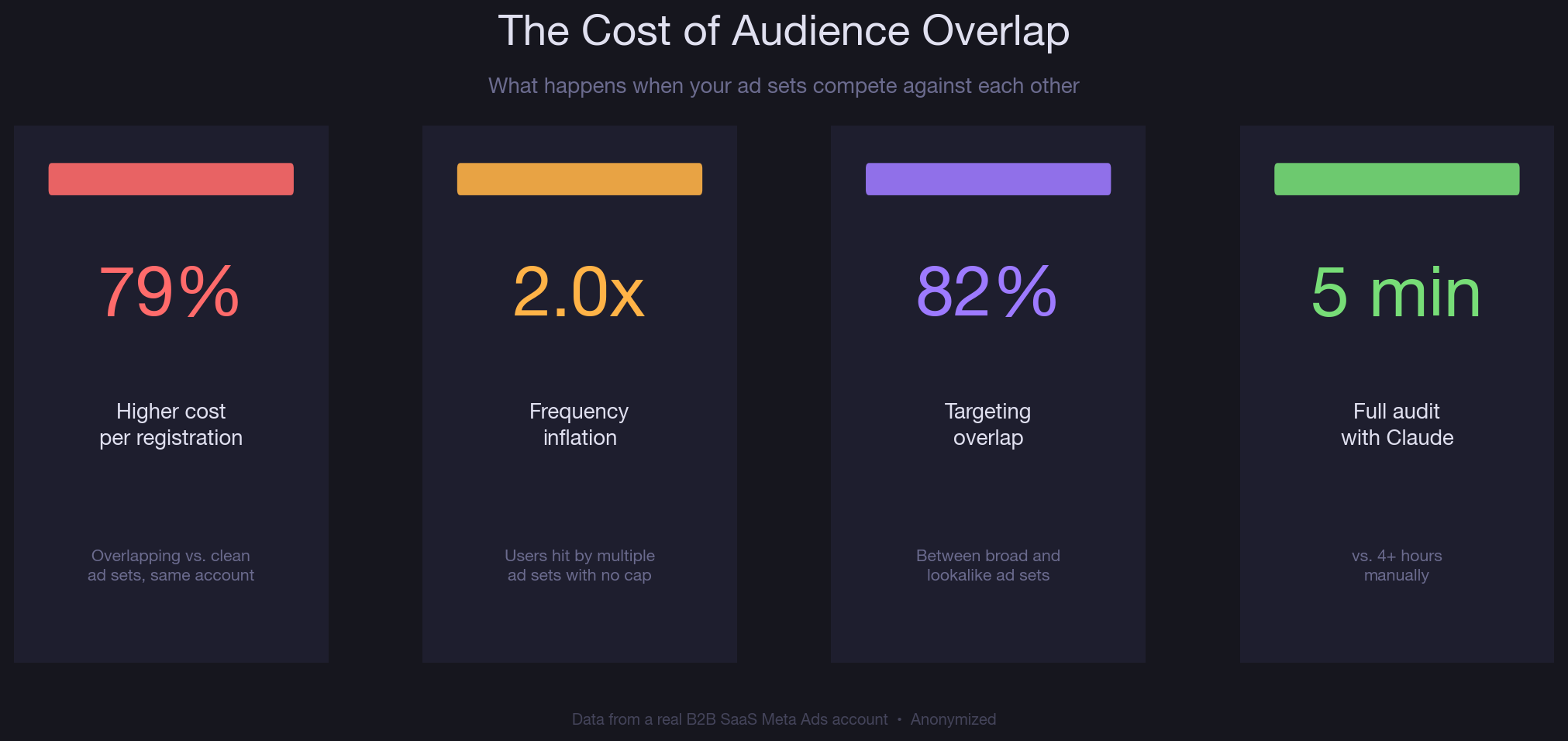
We pulled the ad set configs using Claude and the Meta Ads MCP and found that 82% of targeting criteria between the broad and lookalike ad sets were identical. The ad sets with the highest overlap were paying 79% more per registration than the retargeting ad set with clean audience boundaries.
Why does this go undetected?
Because Meta's native Audience Overlap tool compares exactly two saved audiences at a time and shows a Venn diagram with a percentage. It does not compare ad set targeting configs. It does not factor in lookalike seed overlap, interest-category duplication, or job-title stacking. And it definitely does not connect overlap to cost-per-registration data.
If you run four campaigns with three ad sets each, you are looking at 66 pairwise comparisons. Nobody does that manually.
Claude connected to the Meta Ads MCP (we walk through the full setup in our complete guide to AI-powered paid social management) pulls every ad set's targeting in one call, maps the overlaps, cross-references performance data, and tells you which overlaps are actually bleeding money.
Not "these audiences share some users." More like "these two ad sets share 82% of their targeting, sit in the same campaign, and the overlapping one pays $90 per registration versus $50 for the clean one."
This article gives you the exact prompt sequence, the MCP calls Claude makes under the hood, a prioritization framework for which overlaps to fix first, and the exclusion hierarchy that prevents overlap from coming back.
What Audience Overlap Costs You (With Numbers)
Overlap is not a minor optimization opportunity. It compounds. Here are the three ways it drains your budget, backed by data from a real account.
You bid against yourself in the same auction
When two ad sets in the same account target overlapping users, Meta picks a winner for each impression. Your losing ad set gets delivery suppressed. Your winning ad set pays a higher CPM because you just created artificial competition. In the account we audited, the two prospecting ad sets with 82% targeting overlap had CPMs of $16.78 and $20.82.
The retargeting ad set with clean boundaries? $22.53 CPM, but on a much smaller, warmer pool that converted at nearly double the rate. If you are running Advantage+ campaigns, the problem gets worse because Meta expands targeting dynamically into overlapping territory.
Attribution becomes noise
When a user sees ads from your lookalike ad set on Monday and your interest-based ad set on Wednesday, Meta credits the conversion to whichever ad showed last within the attribution window.
Your "best performing" ad set might just be the one that won the last impression on users already primed by the other. You scale the winner, kill the "loser," and watch overall performance drop because you just removed the first touch that was doing the real work.
This is especially damaging for B2B SaaS lead quality tracking, where the full journey from impression to SQL can span weeks.
Frequency compounds across ad sets
Each ad set has its own frequency cap. There is no cross-ad-set frequency limit by default. A user in three overlapping audiences sees your ads from all three. In the account we audited, retargeting frequency was already at 2.03 over 30 days, and the lookalike ad set was at 1.70 on just 33,000 reached users.
Add the broad and interest ad sets, and some users were seeing 5-6 impressions per week from the same brand. That is exactly how creative fatigue starts, and it compounds fast.
How to Detect Audience Overlap with Claude and MCP
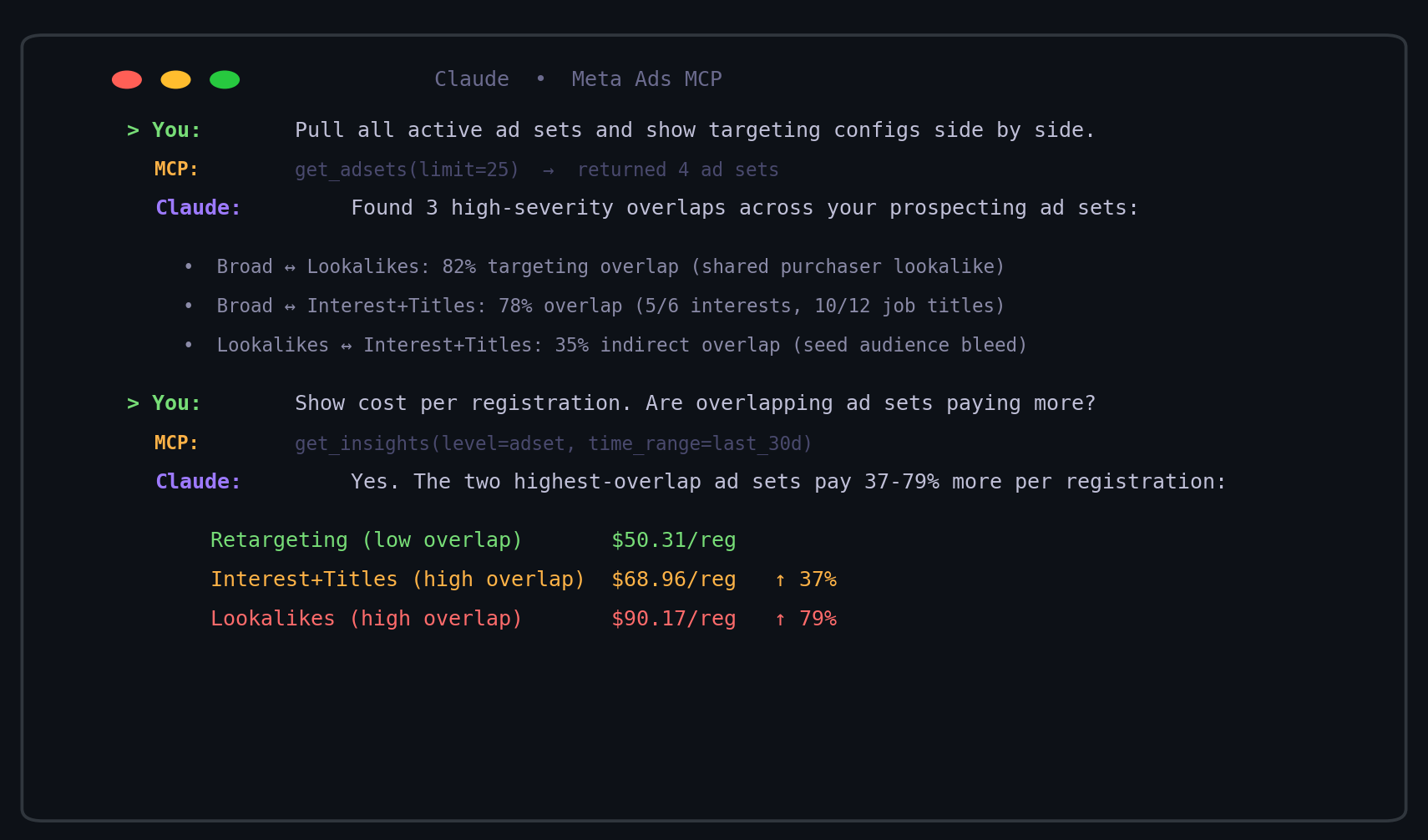
Here is the full prompt sequence. Each step builds on the previous one. The MCP calls happen automatically; you just ask the question in plain English. Here is a preview of the full conversation flow:
Step 1: Pull every ad set and its targeting config
Start with this prompt:
"Pull all active ad sets for my account. For each one, show me the full targeting config: custom audiences, lookalike audiences, interests, work positions, geo targeting, and exclusions. Format as a comparison table."
Claude calls get_adsets and returns the raw targeting payload for every ad set. Here is what a real output looks like (anonymized):
- Retargeting ad set uses four custom audiences: 180-day website visitors, 180-day pageviewers, a duplicate website visitor audience (different ID, same name), and 180-day signups. Excludes purchasers.
- Lookalike ad set uses five 1% lookalike audiences built from pageviewers, website visitors, past purchasers, signups, and recent purchasers. Same exclusion.
- Interest + job title ad set targets six interests (AI, Marketing, SaaS, Entrepreneurship, Business software, Microsoft Office) plus twelve C-suite and VP work positions. Same exclusion.
- Broad prospecting ad set uses a 1% purchaser lookalike AND the same interest/job-title stack from the interest ad set. Same exclusion, but running on an awareness objective instead of conversions.
The overlap is already visible in the raw data. The broad ad set is a Frankenstein: it contains a lookalike audience from the lookalike ad set and interest targeting from the interest ad set. It overlaps with both.
Step 2: Map the overlaps
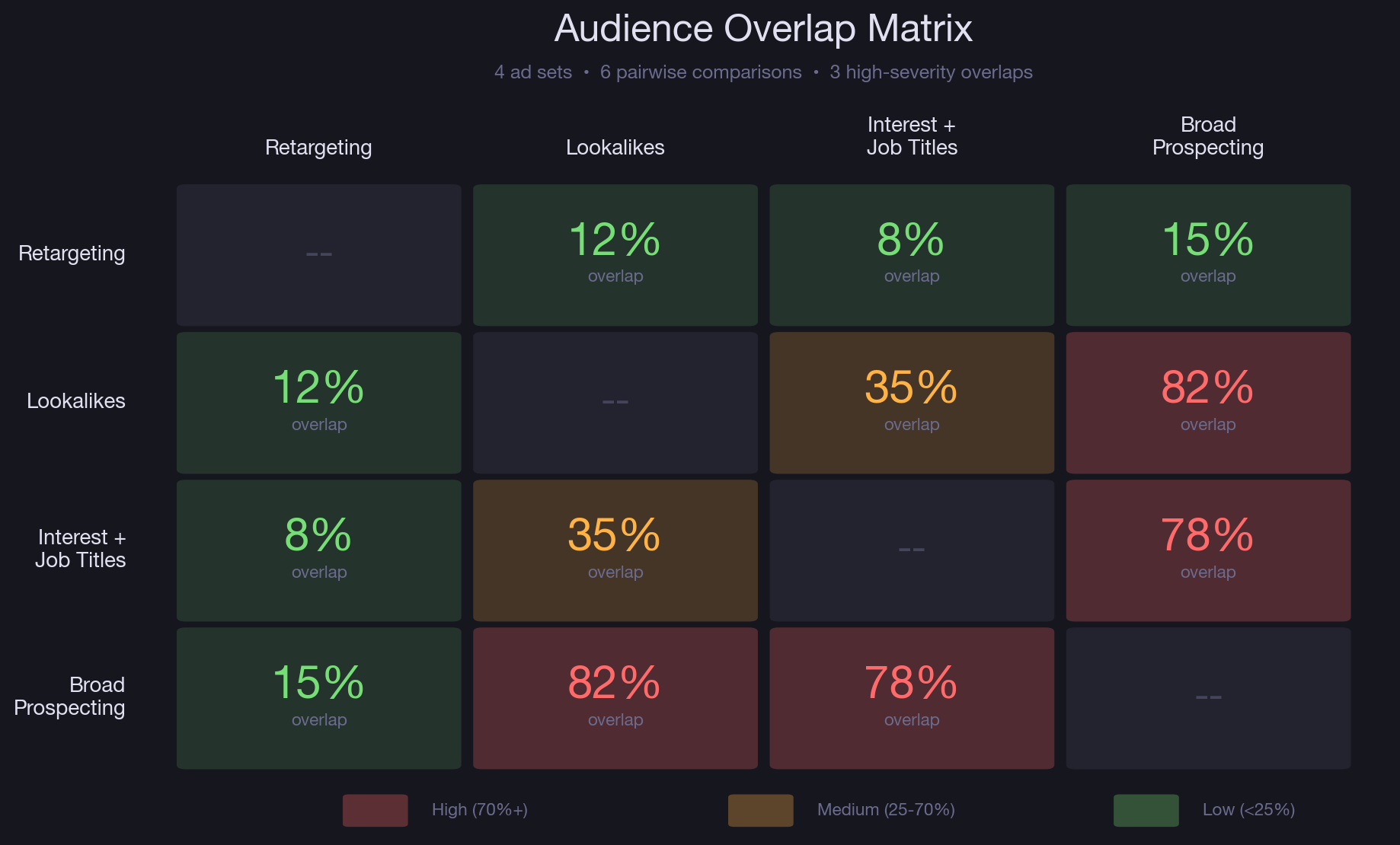
"Compare targeting across all four ad sets. Flag shared custom/lookalike audiences, overlapping interests and job titles, and identical geo/age targeting. Rank each pair by overlap severity: high, medium, low."
Claude produces an overlap matrix. Here is the output from a real account:
Step 3: Quantify the damage with performance data
"Pull last-30-day performance for each ad set: spend, reach, frequency, CPM, CPC, cost per registration, and total registrations. Show me if overlapping ad sets are paying more."
Claude calls get_insights at the adset level. The numbers confirm the hypothesis:
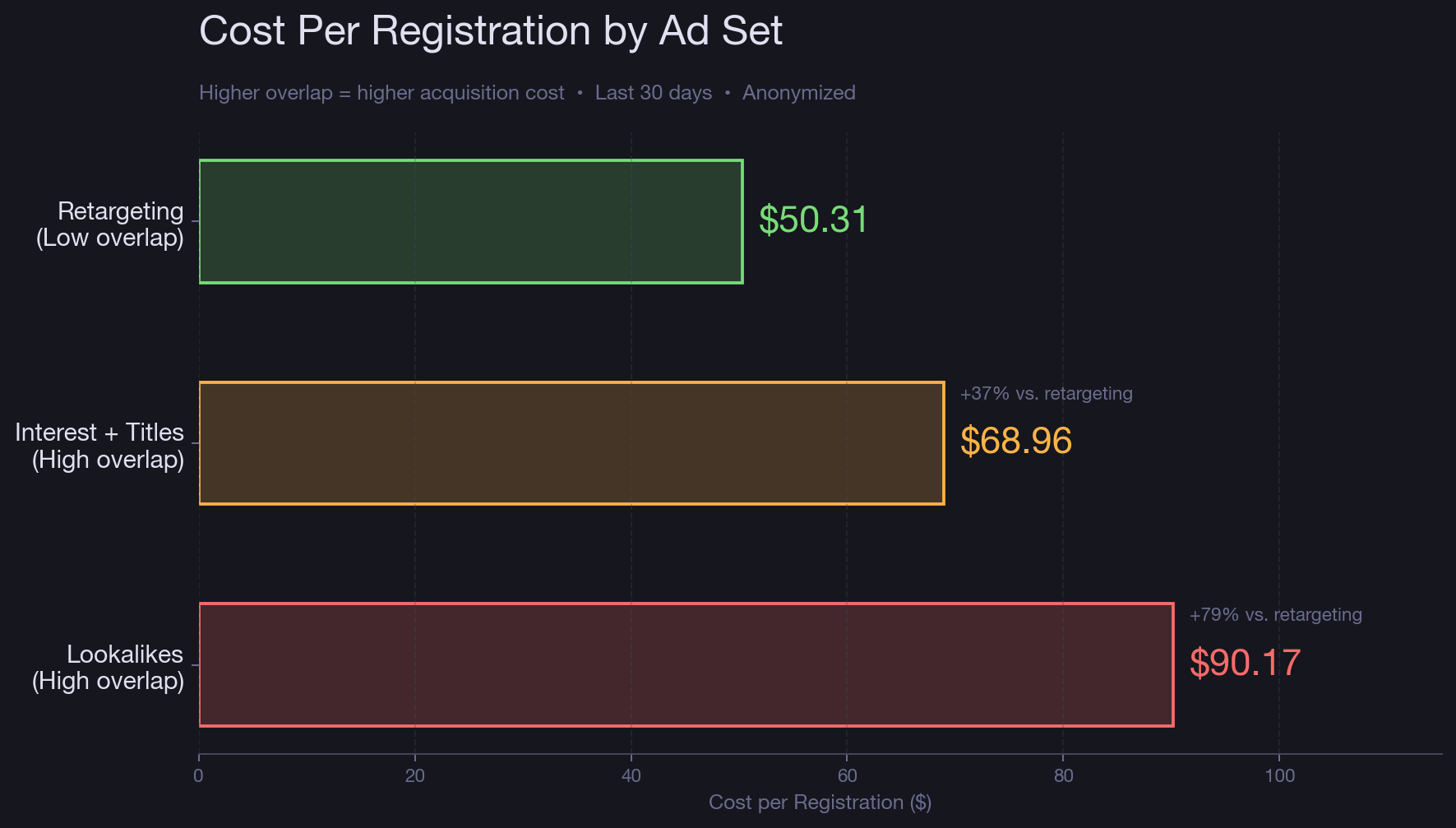
The lookalike ad set pays $90.17 per registration, 79% more than retargeting. Its reach pool is just 33,068 users, and it is already at 1.70 frequency. The broad ad set spent $1,263 optimizing for reach on an audience that overlaps 82% with the lookalike conversion campaign.
That is money teaching Meta to serve cheap impressions to users you are already trying to convert in another campaign. If you are not pulling this data regularly, our guide to AI-powered Meta Ads reporting covers how to automate the full performance pull.
Key Takeaway: Overlap does not just waste money on duplicated reach. It actively degrades conversion efficiency by splitting the algorithm's learning signal across competing ad sets.
Step 4: Get a prioritized fix list
"Based on the overlap analysis and performance data, give me specific fixes ranked by estimated budget impact. Include which audiences to exclude, which ad sets to consolidate, and any campaign structure changes."
Claude produces a prioritized action plan:
- Remove the purchaser lookalike from the broad ad set. It already lives in the lookalike conversion campaign. Running it in awareness splits the learning signal and inflates auction costs. Estimated impact: $400-600/month saved.
- Add cross-exclusions between prospecting ad sets. Exclude the lookalike audiences from the interest+titles ad set, and vice versa. Force each ad set to find genuinely unique users.
- Remove the duplicate website visitor audience from retargeting. Two audiences with the same name but different IDs. One is stale. Removing it cleans up the audience list and reduces confusion.
- Exclude the full retargeting pool from all prospecting. Currently only purchasers are excluded. Website visitors and signups are not. Prospecting campaigns are spending to reach users already in the retargeting funnel.
Multi-Account Overlap: What Agencies Need to Watch
Overlap gets messier when you manage multiple accounts. If you run Facebook ads for SaaS across regions, here is a real scenario to watch for.
A SaaS company runs two Meta ad accounts: one targeting the US, one targeting India. Separate accounts, separate budgets. Should be no overlap, right?
"Pull ad sets from both accounts. Compare targeting structures. Are there shared audience definitions, overlapping job titles, or patterns that could conflict if these accounts ever target the same geos?"
Claude flags three structural risks:
- Identical job-title targeting across accounts. Both accounts target Owner/Manager/CEO, Co-Founder and COO, Founder/Manager, Executive Director, Owner and CEO, and Owner/Managing Director. The India account adds Managing Director and Chairman. If geo targeting ever expands or overlaps (users who travel), these accounts collide.
- Advantage+ audience expansion on multiple ad sets. The India account enables advantage_audience: 1 on three ad sets in the same campaign. Advantage+ lets Meta expand beyond defined targeting. Three ad sets with it enabled all expand into each other's territory, creating invisible overlap. We covered how this interacts with campaign structure in our Advantage+ deep dive.
- Naming inconsistency hides duplicates. The India account has two ad sets both named "Lookalike Audience" with different configs. One uses a 1% SQL/Customer lookalike; the other relies entirely on Advantage+. In Ads Manager, they look identical. In the MCP output, the targeting mismatch is obvious.
This kind of cross-account structural audit is impossible in Ads Manager. You would need to open each ad set in each account, screenshot the targeting, and compare side by side. Claude does it in one prompt.
You can also spy on competitors' Facebook ads to see if their targeting patterns risk colliding with yours. For a full walkthrough of how to run a complete Meta Ads account audit in 15 minutes, including overlap, creative fatigue, and budget pacing, see our dedicated guide.
Four Mistakes That Make Audience Overlap Worse
1. Enabling Advantage+ without exclusions
Advantage+ audience expansion (advantage_audience: 1) tells Meta to look beyond your defined targeting. Useful in isolation. Dangerous when three ad sets in the same campaign all have it enabled, because they all expand into each other's territory. The overlap is invisible in your targeting settings because it happens at delivery time. Always pair Advantage+ with explicit audience exclusions.
2. Building lookalikes from overlapping seeds
A 1% lookalike of "website visitors 180 days" and a 1% lookalike of "pageviewers 180 days" will overlap heavily because pageviewers are a subset of website visitors. Same problem with "signups" and "past purchasers." Overlapping seeds produce overlapping lookalikes. Use Claude to map your seed audience hierarchy before building new ones. Our step-by-step guide to creating lookalike audiences in Meta Ads Manager covers how to structure mutually exclusive seeds.
3. Only excluding purchasers from prospecting
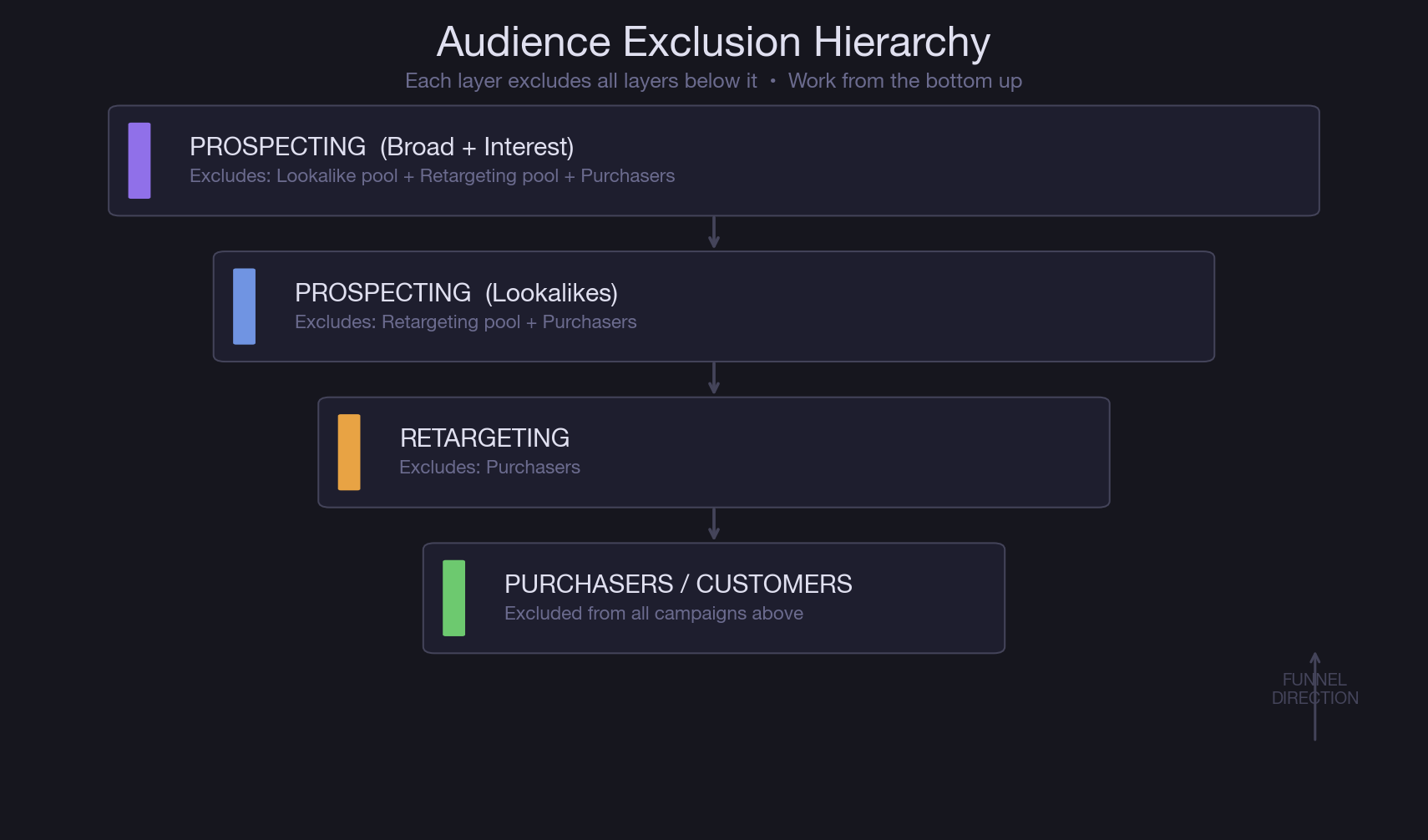
Most teams exclude past purchasers from prospecting and call it done. But website visitors, trial signups, and users already in retargeting are not excluded. These people are already in your funnel. Prospecting spend on them is wasted because retargeting is already doing the work. Build your exclusions from the bottom of the funnel up.
4. Running identical targeting across different objectives
The broad prospecting ad set in the account we audited used the same lookalike audience as the conversion campaign, but optimized for reach. This is the worst overlap pattern. The awareness campaign floods users with cheap impressions. The conversion campaign then bids higher for the same users. Meta's delivery algorithm gets conflicting optimization signals on the same audience, and both campaigns underperform. If your budget pacing looks healthy but CPAs are climbing, this is often the hidden cause.
Best Practices for Preventing Audience Overlap
- Run the overlap audit weekly. Audiences change as Meta updates interest categories and your custom audiences grow. You can even pair it with a weekly budget recommendation workflow to catch both overlap and pacing issues in one pass.
- Name ad sets so overlap is visible. Use prefixes: RT_ for retargeting, PROS_LLA_ for prospecting lookalikes, PROS_INT_ for interest targeting, PROS_BROAD_ for broad. When names encode audience type, conflicts are obvious at a glance.
- Build an exclusion hierarchy. Purchasers excluded from retargeting. Retargeting pool excluded from prospecting. Lookalike audiences excluded from interest-based ad sets. Work from the bottom of the funnel up, as shown in the diagram above.
- Consolidate before you scale. If two ad sets share 70%+ of their targeting, merge them. Running both at higher budget amplifies the overlap cost. Let Meta optimize within one larger ad set instead. This applies to Google Ads and LinkedIn Ads too, not just Meta.
- Monitor cross-ad-set frequency. Pull frequency by ad set using Claude and flag any user pool being hit by multiple ad sets. Ads Manager shows per-ad-set frequency, but cross-ad-set frequency is the metric that matters.
- Use mutually exclusive seeds for lookalikes. Purchasers who never trialed. Trial users who never purchased. Website visitors who never converted. Distinct seeds produce distinct lookalikes.
Stop Competing with Yourself
Audience overlap is not a dashboard metric you check quarterly. It is an active drain running right now, on every account where two ad sets target similar people. Every day it runs, you pay more per impression, you muddy your attribution, and you train Meta's algorithm on conflicting signals.
The fix takes five minutes. Pull targeting. Map overlaps. Check the numbers. Apply the exclusion hierarchy. Claude and the Meta Ads MCP do the heavy lifting; you make the decision.
This is one piece of a larger system. Overlap detection works alongside creative fatigue monitoring, budget pacing alerts, and lead quality tracking to give you a complete picture of account health. When you run all four on a weekly cadence, the compounding leaks stop.
If you want to see how overlap is affecting your Meta Ads account, or if you need help building an exclusion architecture across multiple campaigns and accounts, talk to TripleDart.
FAQ
What is audience overlap in Meta Ads?
Audience overlap happens when two or more ad sets in the same account target users who fall into multiple audiences simultaneously. Your ad sets compete against each other in the auction, driving up CPMs and CPAs while making it impossible to tell which targeting strategy is actually working.
How do I check audience overlap in Meta Ads Manager?
Go to Audiences, select two saved audiences, click Actions, then Show Audience Overlap. Meta shows a Venn diagram with the overlap percentage. The problem: this only compares two audiences at a time, only works with saved audiences (not ad set targeting configs), and does not show how overlap affects cost or delivery.
Can Claude detect audience overlap automatically?
Yes. Claude connected to the Meta Ads MCP pulls every ad set's targeting configuration in one call, including custom audiences, lookalike audiences, interest categories, job titles, and geo filters. It compares all of them simultaneously, flags overlaps by severity, and cross-references performance data to show which overlaps are costing you money.
What is the difference between audience overlap and audience fragmentation?
Overlap means multiple ad sets target the same users (fix: add exclusions or consolidate). Fragmentation means you split a viable audience into pieces too small for Meta to optimize (fix: merge small ad sets into larger ones). Both hurt performance, but the fixes are opposite.
Does Advantage+ audience expansion cause overlap?
Yes. When advantage_audience is enabled, Meta expands targeting beyond your defined audiences. If multiple ad sets in the same campaign all have Advantage+ enabled, they expand into each other's territory. The overlap is invisible in your targeting settings because it happens at delivery time. Always pair Advantage+ with explicit exclusions.
How often should I audit for audience overlap?
Weekly. Custom audiences grow every day as new users visit your site and take actions. Meta updates interest categories. Advantage+ shifts delivery. A monthly check misses the weeks where overlap quietly inflates costs. Save your prompt as a template and run it Monday mornings.
How do I fix audience overlap between prospecting and retargeting?
Add your retargeting custom audiences (website visitors, pageviewers, signups) as exclusions on all prospecting ad sets. Most teams only exclude purchasers, which leaves the rest of the retargeting pool exposed. Build exclusions from the bottom of the funnel up: purchasers excluded from retargeting, retargeting pool excluded from prospecting lookalikes, all lower-funnel pools excluded from broad prospecting.
Can audience overlap happen across different Meta ad accounts?
Not directly in the auction, since each account bids independently. But if two accounts owned by the same company target the same audiences in the same geo, they will compete. Claude can compare targeting structures across accounts to flag this risk before it impacts performance.

summarize with ai


