Getting visitors to your website is great. But if your prospects land on your site and leave without taking action, you're missing out on potential customers. Conversion Rate Optimization (CRO) is the work of turning those visitors into trials, demos, and signups - not just traffic on a dashboard.
Even small tweaks - refining your website's design, sharpening calls to action, and removing friction from the user experience - can pull more revenue from the traffic you already have, without paying for a single new click.
In this article, we walk through Conversion Rate Optimization for SaaS businesses end-to-end - what CRO is, why it compounds, the 2026 benchmarks worth measuring against, the strategies that move the needle, the metrics that matter, and how to build a program that keeps lifting numbers month after month.
What is CRO in SaaS?
CRO is the systematic discipline of lifting the percentage of visitors who take a meaningful action - signing up for a trial, requesting a demo, activating an account, or upgrading a plan. It's how SaaS teams squeeze more pipeline out of every traffic dollar.
Conversion Rate Optimization is the process of increasing the percentage of visitors who take action on a website or app. For SaaS businesses, this means driving more users to sign up for trials, request demos, and activate accounts.
The discipline draws on our SaaS growth marketing playbook, which treats conversion as a compounding habit rather than a one-time fix.
The strategy focuses on understanding how users interact with your site and identifying potential barriers that affect conversions. It involves analyzing data, identifying problem areas, and testing changes to improve results. Minor tweaks in design, messaging, or user experience can greatly impact conversion rates.
For SaaS, CRO often includes:
- A/B testing different layouts, headlines, and call-to-action buttons
- Personalizing content based on user behavior and interests
- Simplifying the signup process to reduce friction
- Tracking user behavior with analytics to spot patterns and drop-off points
Why is Conversion Rate Optimization (CRO) Important for a SaaS Company?
CRO matters in SaaS because growth is a compounding game, not a one-shot sale. Every percentage point you lift on activation, trial conversion, or expansion translates into recurring revenue that pays back for years.
SaaS businesses don't just rely on one-time purchases. They grow through subscriptions, renewals, and long-term customer relationships. Every step in the journey affects revenue - a poor experience can cause churn, while a great one creates upsell opportunity.
CRO improves the overall customer journey, turning more visitors into subscribers, more free users into paying customers, and upgrading entry-level customers to higher plans. Mapping that journey using a structured SaaS customer journey framework helps you see where the leaks are.
Take the example of Rezolve.ai, a Gen AI employee service desk company that struggled to convert website traffic into valuable leads despite strong product traction. Their site attracted visitors, but sign-ups remained low.
To address the issue, TripleDart devised a tailored strategy for Rezolve.ai, including overhauling content to focus on bottom-of-the-funnel (BOFU) content, conducting a content audit, and optimizing existing pages. Technical SEO adjustments improved site health, while dynamic banners, relevant CTAs, and exit-intent pop-ups closed the conversion gap.
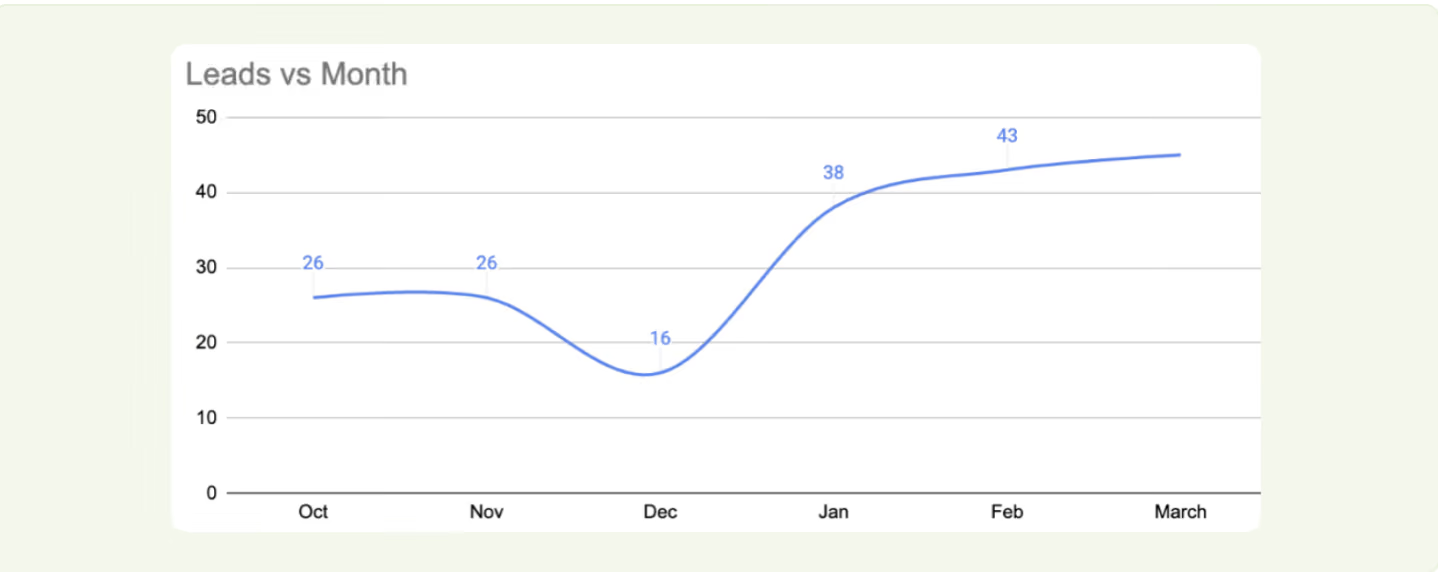
The results were remarkable in six months: organic search clicks grew by 105% and contact form submissions increased by 136%. These improvements boosted both traffic and lead conversion for Rezolve.ai.
Agency Data Insight
"Across our B2B SaaS portfolio, the single highest-impact CRO move in the first 90 days isn't a redesign - it's a structured Day-3 / Day-7 / Day-14 onboarding nudge cadence inside the trial."
The teams that wire activation reminders into in-app + email lift trial-to-paid by 30-40% relative to their pre-program baseline, before touching the marketing site.
Putting it together, here are three reasons CRO matters for SaaS.
1. It Leads to Revenue Growth
CRO helps identify where users lose interest or fail to complete key actions. By making targeted improvements, businesses keep users engaged and increase conversions.
Growth in SaaS comes from multiple touchpoints. Every optimized step in the user journey leads to better acquisition, activation, and retention. Small optimizations create compounding results over time.
2. It Helps You Increase LTV and ARPU
SaaS companies focus on Lifetime Value (LTV) and Average Revenue per User (ARPU). Even a small lift in conversions and user experience can translate into more subscribers, longer retention, and greater overall revenue.
A study by Bain & Company suggests that a 5% increase in customer retention can boost profits by up to 95%. CRO plays a critical role in reducing churn and maximizing LTV. Even minor tweaks in messaging, pricing pages, or checkout flows can result in long-term revenue growth.
3. It Optimizes the Entire Customer Journey
A SaaS buyer journey doesn't stop with activation. CRO improves each stage of the journey:
- Acquisition: Optimizing landing pages and calls to action attracts more high-intent users
- Activation: Better onboarding experiences get users engaged faster
- Retention: Personalized recommendations and UX improvements keep users coming back
- Expansion: Strategic upsells and pricing adjustments increase customer lifetime value (CLV)
A well-optimized funnel means fewer users drop off before reaching the next step. Instead of relying on costly acquisition campaigns, SaaS companies generate more revenue from their existing traffic - the same logic that powers our SaaS lead generation approach.
What Do the 2026 SaaS CRO Benchmarks Look Like?
The honest answer: average B2B SaaS performance has barely budged in five years, but top-decile teams have pulled away aggressively. The gap between average and elite is now where the entire CRO opportunity lives.
According to a Foundry CRO benchmark study, the average SaaS landing page converts at just 3.8% - well below the cross-industry median of 6.6%. That's a structural gap, not a minor one. SaaS pages are dense, technical, and frequently overstuffed with features instead of outcomes.
Growthspree's 2026 funnel benchmark report is even more revealing on the funnel-stage view. Average B2B SaaS visitor-to-lead lands at 1.5-2.5%, but top-decile teams convert at 8-15%. MQL-to-SQL averages 32-40%, with elite teams hitting 55%+. Demo-to-opportunity sits at 60-80% average versus 90%+ for the best.
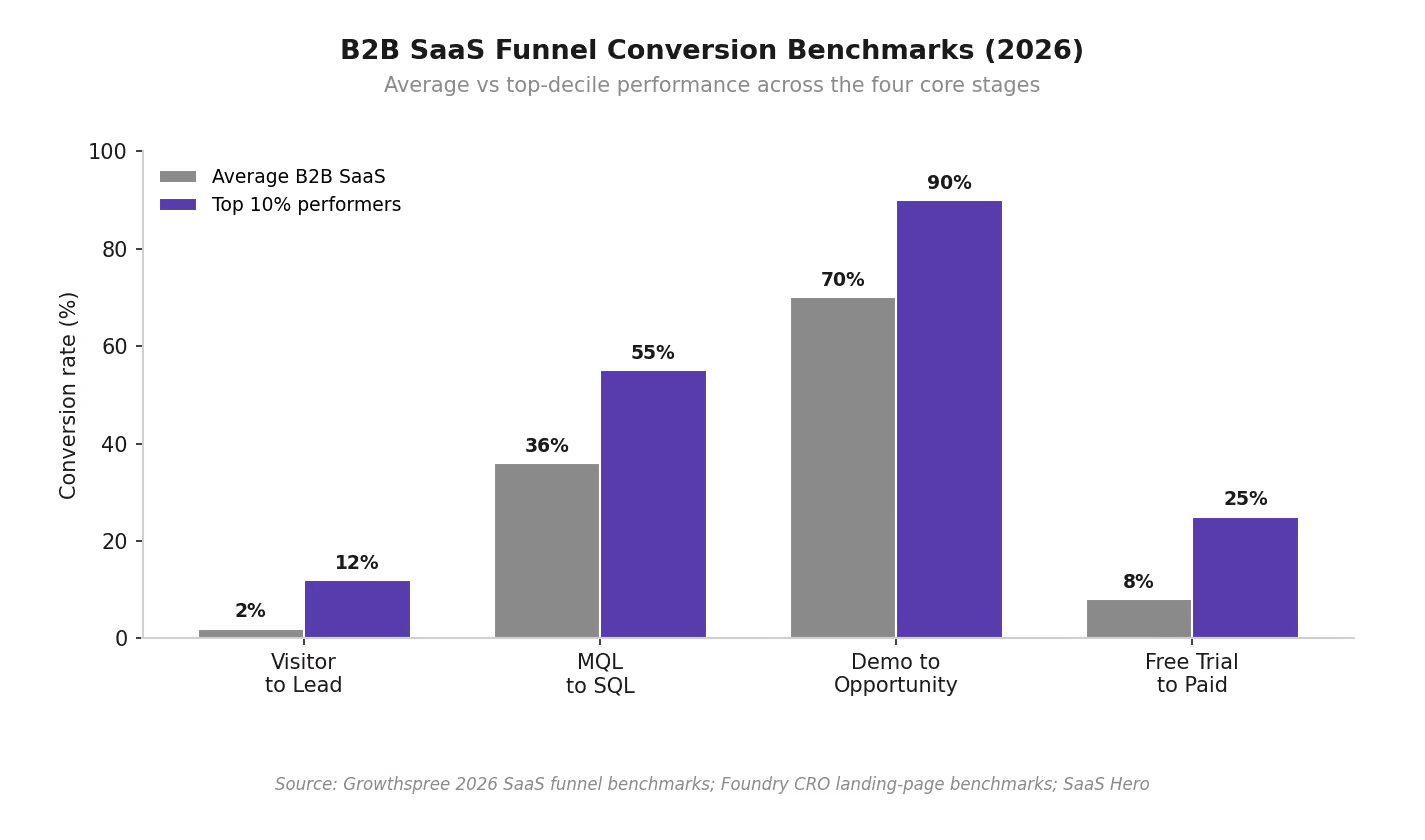
On the trial side, Userpilot's SaaS conversion guide puts the median free-trial-to-paid at 8% as of January 2026. Opt-in trials (no card required) average 18.20%; opt-out trials (card required upfront) jump to 48.80%. Trial structure is doing more work than copy in most cases.
The signal across all of these benchmarks: average is cheap to clear, elite is where the compounding lives. Most SaaS sites are leaving 3-5x conversion potential on the table because they're optimizing the surface (button colors) instead of the structure (trial mechanics, pricing transparency, onboarding cadence).
SaaS Conversion Rate Optimization Strategies
Now that the case for CRO is clear and the 2026 benchmark gap is on the table, here is a step-by-step guide to closing it. Eight strategies, ordered roughly by where most SaaS teams should start.
1. Identify Key Conversion Points
Start by identifying the key actions users take for your product - free trial sign-ups, demo requests, registration. Use analytics tools to understand user behavior and map the journey they follow to reach those key actions.
For example, identify where users abandon the process:
- Are they quitting the sign-up form?
- Is the demo request page too complex?
Recognizing drop-off points lets you make targeted changes to reduce friction and increase conversions.
Funnel analysis helps uncover these points of disengagement and highlights areas of friction. Once identified, you can apply solutions tailored to address them. Some users may need in-app guidance to understand features or your pricing page better. Focusing on UX and UI improvements is often the right answer in cases of more complex issues.
2. Improve the User Experience (UX)
User experience plays a direct role in conversions. When users land on your website, they should be able to navigate it easily, without confusion or frustration.
Here are a few steps you can take to improve your users' overall experience:
- Ensure your website is fast and responsive. Slow load times or a poor mobile experience drive high bounce rates and low conversions.
- Implement A/B testing to experiment with different layouts, features, and content. This shows which elements attract users and lead to conversions. Optimize images, remove unnecessary scripts, and use caching.
- Use heatmaps to track where users click and how they navigate your site - this gives you informed decisions on where to make improvements.
- Gather insights from surveys, reviews, and support tickets to address pain points.
A better UX translates into a more engaging user experience, which directly boosts conversions. Always keep the user's needs and journey in mind.
You can take this further by simplifying the sign-up process and eliminating friction during registration.
3. Simplify the Sign-Up Process
A complicated sign-up process leads to abandonment. The fewer steps a user must take, the higher the chances they complete the process.
According to a study by the Baymard Institute, the average online shopping cart abandonment rate stands at 70.19%. Only three out of every ten customers who add items to their cart complete the checkout. The same dynamic plays out in SaaS sign-up forms.
To address this, reduce form sizes wherever possible. Request only the information necessary to get users going. Provide social sign-ins through Google, Microsoft, or Slack to bypass long forms entirely - users instantly create an account using an existing account, slashing friction.
Make sure that calls to action (CTAs) are clear and visible so users can easily go to the next step. A friction-free sign-up experience leads to more trial sign-ups and higher conversion rates.
4. Optimize Landing Pages
Landing pages can make or break your funnel. They should clearly communicate your value proposition and address the reader's specific challenges - which means knowing your SaaS ideal customer profile cold before writing a single headline.
Here are key elements for effective landing pages:
- Compelling headlines: Clearly state the problem your SaaS solves. Avoid jargon or vague messaging
- Strong CTAs: Use action-driven buttons like "Start Free Trial" or "Get Started Now"
- Trust signals: Include customer testimonials, case studies, and security badges
- Relevant visuals: Show product screenshots or explainer videos to demonstrate value
By making landing pages more targeted and focused, you increase the chances of visitors taking the next step - whether signing up for a trial or learning more about your product. This is the same logic behind how we optimize blogs for conversions at the article level.
Portfolio Benchmark
"For a B2B SaaS client we work with, splitting one generic landing page into role-based variants - one for security buyers, one for IT ops, one for engineering leads - lifted demo requests by roughly 60% within the first quarter, with no change to ad spend."
The pattern repeats across our portfolio: role-specific landing pages convert 2x cleaner than generic ones, and the lift is biggest at the visitor-to-MQL stage.
5. A/B Testing
A/B testing means comparing multiple versions of your marketing content and assets to identify which one performs better based on user interactions and conversions.
By testing different in-app journeys, you can compare user pathways. This helps identify which flows drive users to the activation point quickly and which ones cause friction or confusion.
Here's how to apply A/B testing:
- Test different headlines, button colors, and page layouts. Your messaging styles can be problem-focused, benefit-driven, or data-backed. Even small changes can increase conversions
- Test multiple email sequences. Experiment with subject lines, timing, and content length to improve trial-to-paid conversions
- Compare onboarding flows. Measure whether step-by-step guides improve engagement
- Experiment with pricing page structures. Test monthly vs. annual plans and different discount placements
- Analyze test results before making permanent changes. Avoid assumptions and rely on data-driven decisions
Run tests for at least two weeks to collect statistically significant results. Test one variable at a time to isolate the factor driving changes. Use heatmaps to track user interactions before making major layout adjustments.
6. Lean Into Personalization
Personalization helps you convert more visitors by dynamically changing content to match customer requirements.
For example, you can show different landing page versions based on where the user is in the buying journey. If a user has been to your website before, highlight features they might be interested in. If they've signed up for a trial, offer them more resources to maximize their experience.
Personalization strategies can be applied across various SaaS marketing channels and touchpoints:
- Dynamic CTAs: Show different CTAs based on user intent and customer profile. SMB accounts can be directed to a free trial, whereas enterprises can be directed to demos
- Email automation: Send personalized follow-ups based on trial usage. If a user hasn't explored a feature, nudge them with helpful resources tailored to their behavior
- Behavior-based product recommendations: Guide users toward relevant features based on their activity. If a user frequently visits a specific feature page, suggest similar features or helpful tips related to that section
Many eCommerce stores do the same thing by personalizing the shopping experience. They suggest products based on past searches, purchases, and preferences. The more you personalize, the more relevant the user experience, leading to higher engagement and conversion rates.
7. Use Exit-Intent Popups
Exit-intent popups are a great way to stop visitors from bouncing. These popups appear when a user is about to leave your website. They can offer incentives like discounts, free trials, or reminders to stay and complete the desired action.
Plus, you can capture users about to abandon the conversion process at the last minute. The popups are non-intrusive and can be designed to appear at the exact moment users are about to leave, so you don't miss the opportunity.
8. Implement a Data-Driven Approach
The final piece of the puzzle is using data to drive continuous improvements in your SaaS CRO efforts. Implementing analytics tools - Google Analytics, Heap, Hotjar, or AI-citation trackers - helps track user behavior, identify challenges, and assess how users interact with your site.
Regularly monitor key performance indicators (KPIs) such as bounce rates, conversion rates, and engagement metrics. Use this data to identify areas of improvement and make changes based on user actions, not gut feel.
Maximize Your SaaS Conversions With TripleDart
Stop leaving pipeline on the table. Our team builds full-funnel CRO programs - from landing pages to onboarding flows to pricing experiments - that lift trial-to-paid and demo conversion month after month. From bootstrapped Series A to global enterprise B2B SaaS, we've shipped the program.
Book a strategy call
Which Conversion Metrics Should SaaS Teams Track?
Tracking conversion metrics is essential for understanding how effectively your SaaS business is turning visitors and leads into paying customers. The five metrics below cover the full funnel - skip any of them and you'll optimize the wrong layer.
Here are the most important conversion metrics for SaaS companies.
1. Conversion Rate
The conversion rate tracks how many users take a desired action - signing up for a free trial, requesting a demo, or completing a registration. This helps assess the performance of your website, landing pages, and marketing efforts.

Typical SaaS conversion rates fall between 1% and 3%. If you're seeing rates lower than this, it may be time to revisit your acquisition strategies, user messaging, or site design to remove friction points.
2. Lead-to-Customer Conversion Rate
This metric shows the percentage of leads that convert into paying customers. It helps you evaluate how well your sales team is closing leads and whether your lead qualification and nurturing processes are effective.
For SaaS businesses, this conversion rate typically ranges from 2% to 5%. If your conversion rate is below this, your sales pipeline needs improvement, or prospects aren't receiving enough value during their journey.
3. Free Trial-to-Paying Customer Conversion Rate
Free trials are a common strategy to allow users to experience your product before committing to a paid plan. Tracking how many free trial users eventually become paying customers gives insight into the effectiveness of your free trial and product retention.
For most SaaS products, converting 15% to 30% of free trial users to paying customers is a common range. Lower conversion may indicate trial users aren't seeing enough value or your onboarding process needs improvement.
4. Churn Rate
The churn rate measures the percentage of customers who cancel their subscriptions within a certain time period. A high churn rate can signal customer dissatisfaction or a mismatch between the product and their needs.
If your churn rate is higher than 5%, customers may not be finding lasting value in your product, or you're missing opportunities to retain them through customer support, engagement, or additional features.
5. Customer Acquisition Cost (CAC)
The CAC tracks the total expense of acquiring a new customer, including all marketing, sales, and advertising costs. CAC helps you measure the efficiency of your customer acquisition efforts and understand the financial viability of your business.
The ideal CAC to LTV ratio is around 1:3 - for every dollar spent on acquiring a customer, the business should earn three times that amount in lifetime value.
If your CAC is disproportionately high, it's time to reevaluate your marketing spend or sales process to ensure you're getting an adequate return on investment.
Best Practices to Improve SaaS Conversion Rates
To increase SaaS conversions, deploy strategies that focus on capturing, retaining, and growing your user base. Here's how you can improve conversion rates and increase revenue at every stage of the lifecycle.
1. Simplify Your Signup Flow
A complicated signup process kills conversions. The more friction users face, the more likely they are to drop off before experiencing your product's value. Make it easy by offering one-click signup options through Google or Slack. Reduce form fields to only what's necessary.
If your signup has multiple steps, add a progress bar to show users how close they are to completion. Small changes like A/B testing your call-to-action buttons - "Start Free" versus "Try Now" - can also make a difference in engagement.
2. Optimize Free Trial Activation
Signing up for a free trial isn't enough. Users need to experience your product's value immediately. Start with a well-crafted welcome email outlining key steps. Use in-app walkthroughs to highlight essential features without overwhelming them.
If users don't engage within the first few days, send reminder emails with personalized suggestions based on their initial activity. Adding tooltips and contextual help within the app can guide users toward key actions, increasing the likelihood of conversion.
3. Personalize the User Experience
A generic experience leads to disengagement. Tailor onboarding and messaging based on user behavior. If a trial user explores a specific feature, highlight case studies or tutorials related to that function.
Use dynamic website content that adapts based on industry, role, or company size. AI-driven chatbots and personalized email sequences keep users engaged by offering relevant guidance. The more relevant the experience, the higher the chances of conversion.
4. Improve Pricing Page Clarity
Confusing pricing structures create uncertainty and hesitation. Make sure your pricing page is transparent and easy to understand. Highlight the differences between each plan with a simple comparison table. Use real-world examples or case studies to show how different businesses benefit from specific plans.
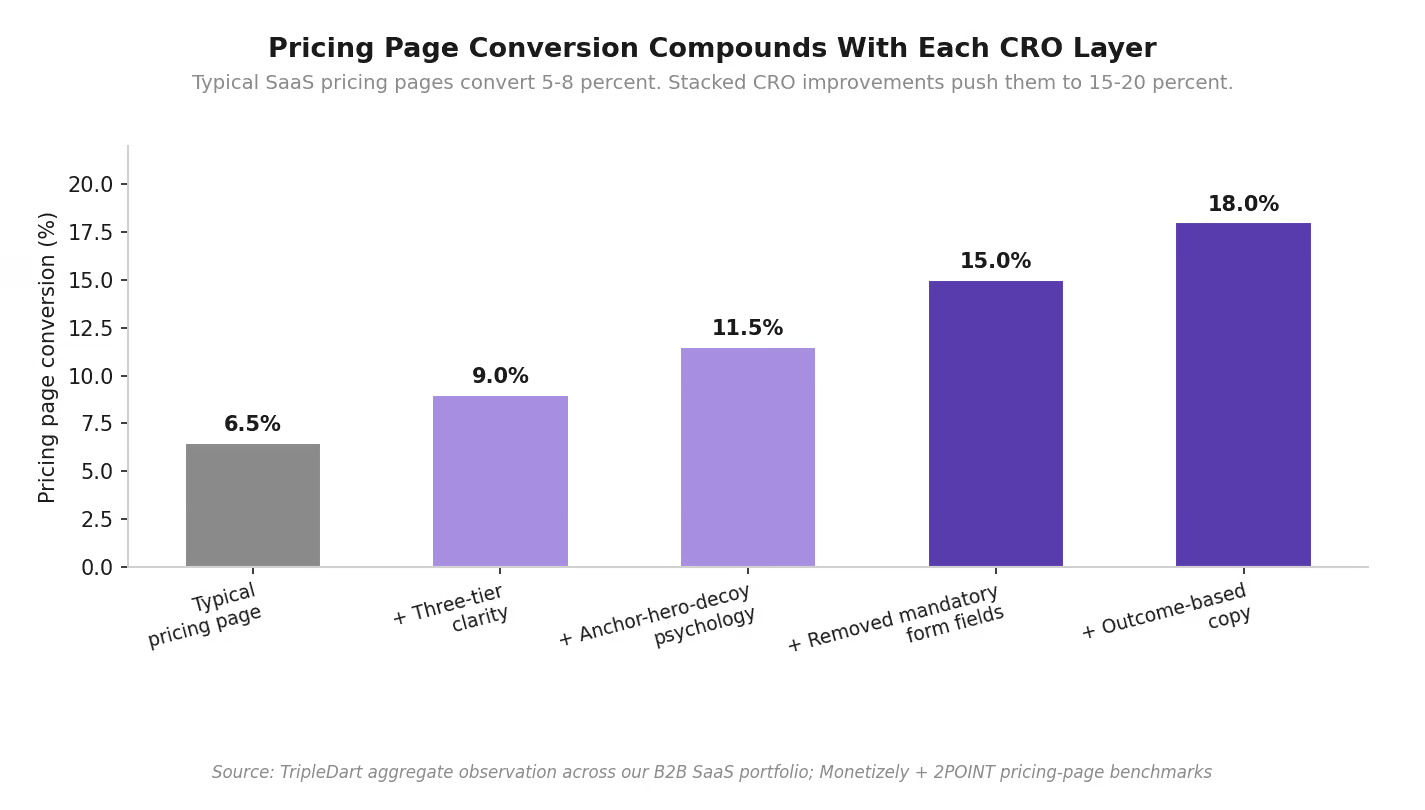
If possible, offer an interactive calculator to help potential customers estimate costs based on their needs. A well-structured pricing page reduces friction and helps users make confident decisions. The chart below shows how each layer of pricing-page CRO compounds.
5. Add Social Proof and Trust Signals
People trust real experiences more than marketing claims. Showcase testimonials, case studies, and user reviews prominently on key pages. If well-known companies use your product, display their logos as credibility boosters. Highlight customers' specific results - "Increased conversions by 35% in three months."
Trust badges, such as security certifications or compliance seals, also help reassure users that your SaaS is reliable and safe.
6. Reduce Drop-Offs With Exit Intent Strategies
Not every visitor converts on the first visit, but you can capture their interest before they leave. Use exit-intent popups to offer last-minute incentives - a free trial extension, a discount, or a downloadable resource. If users abandon a signup or checkout form, send automated follow-up emails reminding them to complete the process.
Retargeting ads can also bring back users who visited but didn't convert. Keeping them engaged increases the chances of bringing them back into your funnel.
How Do You Build a Compounding CRO Program in 2026?
The strategies above each move the needle on their own. The real lift comes when you wire them into a monthly testing cadence - because compounding wins beat one-off redesigns by a wide margin over a 12-month horizon.
According to Designrush's 2026 CRO statistics roundup, companies that run continuous, month-over-month CRO programs lift conversion 2x faster than companies that rely on quarterly redesigns. The shape of the curve matters - one big push plateaus within a quarter, while a steady test cadence keeps compounding past the 12-month mark.
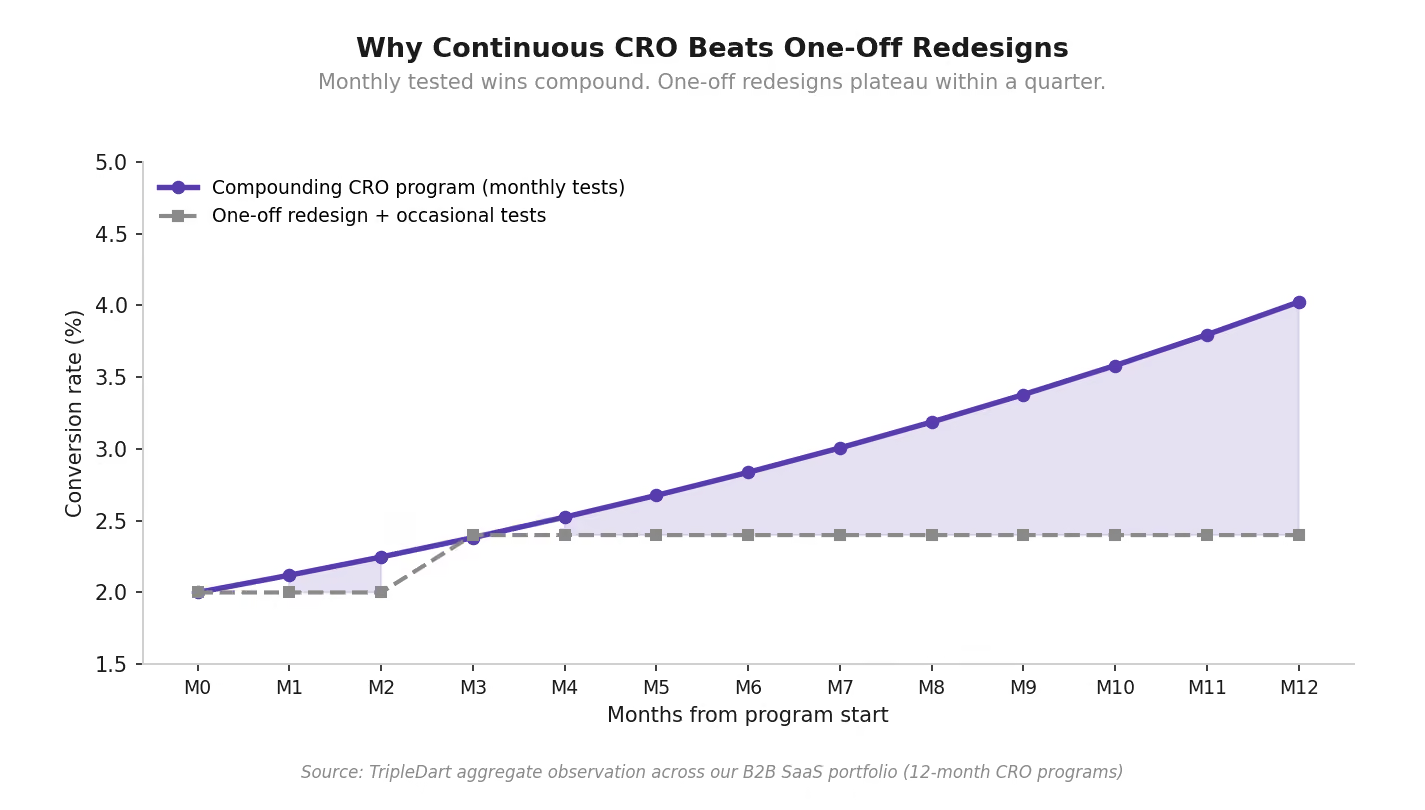
Here's the operating loop we recommend for SaaS teams that want compounding CRO, drawn from how we run programs across the TripleDart SaaS portfolio:
- Quarterly: Re-baseline the funnel benchmarks. Identify the single weakest stage and focus testing there for the next 90 days
- Monthly: Ship 2-4 tests against the priority stage - landing page variants, pricing copy, onboarding nudges, exit-intent flows
- Weekly: Review test results, declare winners after 2+ weeks of statistically significant data, and stack the winners into the next variant
- Daily: Monitor real-time analytics for anomalies, regressions, or one-off spikes worth investigating
Agency Data Insight
"For an enterprise B2B SaaS client we work with, a 12-month compounding CRO program lifted full-funnel visitor-to-paid by 2.3x while CAC stayed flat - the entire lift came from existing traffic, not new ad spend."
The pattern is consistent across our portfolio: teams that run monthly test cadences for a full year out-perform teams that ship quarterly redesigns by a 2-3x margin.
The honest truth: most SaaS teams underinvest in CRO because the wins look small per test. Compounded across 12 monthly cycles, they're enormous - the difference between an average 2% conversion rate and an elite 5% one is mostly cadence, not creativity.
Get Started With Conversion Rate Optimization With TripleDart
More traffic doesn't always mean more revenue. While driving visitors to your website is crucial, converting them into trial users and demo requests is even more important.
Did you know businesses using Conversion Rate Optimization see roughly 10% conversion uplift from AI-driven personalization alone, per recent Designrush 2026 data? Stack that with onboarding cadence, role-based landing pages, and pricing transparency, and the program pays for itself inside a quarter.
As a SaaS-focused agency, TripleDart understands the unique challenges of the SaaS industry. We collaborate closely with businesses from bootstrapped to enterprise-scale to achieve their goals and thrive in a competitive market - from BOFU content audits to landing page rebuilds to onboarding instrumentation.
Work With Us
Stop optimizing button colors. Build a CRO program that compounds across visitor-to-lead, MQL-to-SQL, trial-to-paid, and expansion - the full B2B SaaS funnel. Across the full B2B SaaS lifecycle, we've shipped the program.
FAQs
What Is the Ideal Conversion Rate for a SaaS Website?
The ideal conversion rate varies but typically ranges between 1-3% for most SaaS websites, with top-decile performers hitting 8-15% on the visitor-to-lead stage per 2026 benchmarks. Higher rates are achievable through systematic optimization of landing pages, signup flow, and trial activation.
How Can I Improve My SaaS Website's User Experience for Better Conversions?
Focus on fast load times, smooth navigation, clear CTAs, and mobile responsiveness, while regularly gathering user feedback and conducting A/B tests to identify areas for improvement. Pair UX work with role-based landing pages so each ICP sees content tuned to their buying context.
What Are the Most Important Metrics to Measure in SaaS CRO?
Key metrics include overall conversion rates, lead-to-customer conversion rates, free trial-to-paying customer conversion rates, churn rate, and customer acquisition cost (CAC). Track CAC:LTV ratio at 1:3 as a health benchmark, and monitor MQL-to-SQL plus demo-to-opportunity for the sales handoff.
How Often Should I Conduct A/B Testing for My SaaS Website?
A/B testing should be an ongoing process, with tests conducted regularly - ideally 2-4 per month per priority funnel stage - to continually optimize website elements such as CTAs, layouts, copy, and onboarding flows. Run each test for at least two weeks to reach statistical significance.
What Tools Can I Use for SaaS Conversion Rate Optimization?
Tools like Google Analytics 4, Heap, Optimizely, Hotjar, Slate, and PostHog can help you track user behavior, run A/B tests, monitor AI citation impact on conversions, and optimize your website's performance end-to-end. Pick one analytics platform and one experimentation platform - don't sprawl tooling.
Which SaaS Companies Benefit Most From CRO?
Every B2B SaaS company benefits from CRO, but the ROI is highest for teams with consistent paid traffic and a free-trial or demo-led motion. If you're spending on Google Ads or LinkedIn and your trial-to-paid sits below 8%, CRO will pay back faster than incremental ad spend.
How Long Before I See Results From a CRO Program?
Most SaaS teams see early wins within 4-6 weeks (signup flow, landing page copy), with compounding lifts visible by month 3-6. A full 12-month program typically lifts visitor-to-paid 2-3x for teams starting from average benchmarks - the curve compounds, so consistency matters more than creativity.
How Does TripleDart Help With Conversion Rate Optimization for SaaS?
TripleDart runs full-funnel CRO programs for B2B SaaS - landing page rebuilds, pricing-page optimization, onboarding instrumentation, and monthly testing cadences. We've shipped these programs across the full B2B SaaS lifecycle, from bootstrapped Series A to global enterprise. Book a strategy call.