.png)

![How to Measure AEO Success: 12 Metrics Beyond Clicks [2026 Framework]](https://cdn.prod.website-files.com/632b673b055f4310bdb8637d/6a0d664b326187e99b3d5960_6%20-%20The%20Ultimate%20Guide%20to%20Measuring%20AEO%20Success%20in%202026.png)
Key Takeaways
- AEO measurement tracks how often AI engines like OpenAI, Google, and Perplexity AI cite and recommend your brand - not just clicks and rankings.
- Traditional SEO dashboards miss AI-driven buyer journeys because many AI interactions happen without users visiting your website.
- The 12-metric AEO framework helps B2B SaaS teams measure AI visibility, citation quality, engagement, pipeline influence, and revenue impact.
- Core visibility metrics like AI Citation Rate, AI Share of Voice, and AI Overview Inclusion Rate are essential for tracking competitive presence in AI search.
- Business impact metrics such as AEO-attributed conversions, AI-influenced revenue, and Cost Per AI Citation (CPAC) help connect AI visibility to pipeline growth.
- Teams can start with manual AI citation audits and gradually scale into dedicated AEO tracking tools and automated dashboards.
- TripleDart helps B2B SaaS companies build end-to-end AEO measurement systems that track AI citations, benchmark competitors, and connect AI search visibility directly to revenue outcomes.
57% of B2B software buyers say they discovered a new vendor in the last year through an AI-generated answer - ChatGPT, Perplexity, or Google AI Overviews. Only 18% of those vendors were tracking it. That gap is where measuring AEO success metrics stops being a reporting exercise and starts being a competitive advantage.
Most marketing teams are still running dashboards built for a clicks-and-rankings world. Rankings, organic sessions, CTR, bounce rate - useful signals, all of them, but completely blind to Answer Engine Optimization performance. When a prospect asks ChatGPT "What's the best project management tool for remote teams?" and your brand gets cited in the answer, that interaction never shows up in Google Analytics. It's invisible. And it's happening thousands of times a day.
This article delivers a structured AEO measurement framework organized into three tiers: Visibility, Quality, and Business Impact. Twelve metrics total, with formulas, tool recommendations, and a staged maturity model so teams can start measuring regardless of their current resources. Only 23% of marketing teams currently measure brand visibility inside AI search results, even though 63% say AI-generated answers are influencing their prospects' research. The teams that build measurement systems now will have a data advantage that compounds over time.
This guide is practical, not theoretical. By the end, you'll know exactly what to track, how to track it, and how to present it to leadership in a way that connects to pipeline and revenue. Let's get started.
What Is AEO Measurement and Why Do Traditional SEO Metrics Fall Short?
AEO measurement is the practice of tracking how often, how accurately, and how favorably AI-powered answer engines cite, reference, or recommend your brand and content. It's a distinct discipline from SEO reporting, and the distinction matters because the user journey works differently.
72% of CMOs say their current SEO dashboards under-report the impact of AI-powered search experiences because they lack metrics for AI citations and brand mentions in answers. That's not a tool problem. It's a paradigm problem. Traditional SEO KPIs were designed for a world where success meant a user clicking from a search result to your website. In AEO, your content may inform an AI-generated answer without ever generating a click.
Here's how the two measurement systems compare:
Your current dashboard isn't wrong. It just has blind spots. The eight rows above are exactly where those blind spots live.
The Fundamental Shift: From Rankings to References
In traditional SEO, the success model is linear: rank in position one, earn a click, convert the visitor. In AEO, success means being the source AI engines trust, earning a brand mention or citation, and influencing the buyer's thinking - whether or not they ever visit your site.
Here's a concrete example. Your SaaS company publishes a detailed pricing comparison page. In the SEO world, success means ranking number one for "project management software pricing." In the AEO world, success means ChatGPT citing your pricing data when a user asks "How much does project management software cost?" - even if that user never clicks through. The influence happened. The brand impression landed. But your analytics dashboard recorded nothing.
This is the shift from rankings to references. It requires a new measurement system, not a renamed version of the old one.
Why 2026 Is the Inflection Point for AEO Measurement
Three developments have converged to make AEO measurement operationally viable this year. Google AI Overviews now appear on the majority of informational queries. ChatGPT search has a substantial user base. And Perplexity has grown significantly as a research tool for B2B buyers.
Dedicated AEO tracking tools have also emerged and are functional enough for production use: Otterly.ai, Peec AI, and Profound are all actively used by marketing teams today. And Google Search Console has begun surfacing AI Overview performance data natively, giving teams their first platform-level measurement capability.
The timeline looks like this:
- 2024: AI Overviews launch broadly; measurement is entirely manual
- 2025: First dedicated AEO tools emerge; GSC begins AI Overview data
- 2026: Tool ecosystem matures; AEO measurement becomes operationally viable at scale
By 2026, 80% of B2B marketing leaders will implement dedicated AEO tracking alongside traditional SEO reporting. Teams that start now build the data advantage.
What Are the 12 Metrics That Matter in the AEO Measurement Framework?

The 12 metrics are organized into three tiers that mirror the AEO funnel:
- Tier 1 - Visibility Metrics (Metrics 1-4): Are you showing up in AI answers?
- Tier 2 - Engagement and Quality Metrics (Metrics 5-8): How well are you showing up? Is the citation positive, accurate, and authoritative?
- Tier 3 - Business Impact Metrics (Metrics 9-12): Is your AI visibility driving measurable business results?
This structure serves two purposes. It provides a logical progression from awareness to revenue, and it maps to the maturity model later in this article - teams at the Crawl stage focus on Tier 1, while advanced teams track all three tiers. You don't need to implement all 12 on day one.
What Are the Visibility Metrics in Tier 1 and How Do You Determine if You Are Showing Up?
Visibility is the foundation of AEO measurement. If your brand isn't appearing in AI-generated answers, nothing else matters. These four metrics answer the most basic question: when someone asks an AI engine a question relevant to your business, does your brand show up?
Metric 1: AI Citation Rate
AI Citation Rate is the number of times your brand or content is cited by AI engines divided by the total number of relevant queries you're tracking. What counts as a citation varies by platform: a direct URL link, a brand name mention, a data attribution, or a recommendation all qualify.
AI Citation Rate = (Number of AI citations for your brand ÷ Total relevant queries tracked) × 100
For B2B SaaS brands with established content programs, a 15-25% citation rate across tracked queries is a strong starting point in 2026. The most important benchmark, though, is your own baseline over time. Tracking can be done manually by querying AI platforms directly, or via dedicated tools covered later in this article. This is the single most important AEO metric for teams just starting out.
Metric 2: AI Share of Voice
AI Share of Voice (SOV) measures your brand's citation frequency relative to competitors for a defined set of queries. It's the AEO equivalent of traditional search visibility scores, and it's the metric that makes AEO performance legible to executives because it maps directly to competitive positioning.
AI Share of Voice = (Your brand's AI citations ÷ Total AI citations for all tracked brands) × 100
Here's a concrete example: you track 100 queries across ChatGPT, Perplexity, and Google AI Overviews. Your brand is cited in 23 answers. Competitor A appears in 31. Competitor B appears in 18. Your AI SOV is 23%, Competitor A's is 31%, Competitor B's is 18%. Build a competitive tracking spreadsheet with columns for Query, Your Brand Cited (Y/N), Competitor A Cited (Y/N), Competitor B Cited (Y/N), Platform, and Date. Run this consistently and you'll have AEO competitive benchmarking data that most teams don't have at all.
On Reddit's r/aeo community, practitioners tracking AI SOV manually report checking brand surfaces every few days and calculating share of voice as their primary KPI. The consensus: AI SOV is the metric that most clearly shows whether your AEO efforts are moving the needle relative to the market.
Metric 3: AI Overview Inclusion Rate
This metric is specifically about Google's AI Overviews. Track two things: what percentage of your target keywords trigger an AI Overview, and when an AI Overview appears, how often is your content sourced within it.
Google Search Console has begun surfacing AI Overview impression and click data in 2026. To access it: go to the Performance report, filter by Search Appearance, and select AI Overview. This gives you impression and click data for pages appearing in AI Overviews. Supplement GSC data with third-party tools like SEMrush's AI Overview tracking or Ahrefs' SERP feature monitoring for more granular visibility. Our guide on how to rank in AI Overviews covers the content signals that drive inclusion.
Metric 4: Platform Coverage Breadth
Most teams only check Google. But AI search is a multi-platform environment. This metric measures your brand's presence across all major AI platforms: Google AI Overviews, ChatGPT, Perplexity, Claude, Gemini, and Microsoft Copilot. Each platform has different source preferences - a brand that dominates in Perplexity citations may be invisible in ChatGPT.
Your buyers use different AI tools depending on their workflow. Measuring only one platform gives you an incomplete picture of your brand visibility in AI search.
How Do Engagement and Quality Metrics in Tier 2 Help Assess Your AEO Performance?
Being cited is necessary but not sufficient. Tier 2 metrics assess the quality of your AI presence - whether citations are positive, accurate, authoritative, and driving meaningful engagement. These metrics help you optimize how you appear, not just whether you appear.
Metric 5: Citation Sentiment and Positioning
Not all citations are equal. An AI engine might mention your brand as the top recommendation, one option among many, or even in a negative context. This metric tracks two dimensions: sentiment (positive, neutral, or negative) and positioning (primary recommendation, secondary mention, or footnote/comparison point).
Use this scoring rubric to quantify citation quality:
A good citation looks like: "For mid-market project management, [Your Brand] is widely recommended for its intuitive interface and strong integrations." A harmful one looks like: "While [Your Brand] offers project management features, users frequently cite its steep learning curve and limited reporting compared to [Competitor]." Both are citations. Only one helps your pipeline.
Metric 6: Content Authority Score
This is a composite metric that assesses how AI engines perceive your content's trustworthiness as a source. It's not a single number from a tool. It's a qualitative assessment based on proxy indicators that correlate with being cited by AI engines:
- Original research, data, or surveys
- Named expert authors with credentials
- Consistent citation across three or more AI platforms
- Structured content with clear headings, tables, and definitions
- Regular content updates (freshness signals)
- High E-E-A-T indicators on the page
Audit your most-cited content to identify patterns, then replicate those patterns across your content library. Our SaaS content marketing team has found that original research and structured formatting are the two signals most consistently associated with AI citation across platforms.
Metric 7: Answer Accuracy and Alignment
This is both a quality metric and a brand safety metric. When AI engines cite your content, the answer they generate may not accurately reflect your original intent. AI can misquote data, take statistics out of context, conflate your product with a competitor's, or attribute incorrect claims to your brand.
For each citation you discover, compare the AI-generated answer to your original source content. Score accuracy on a simple scale: Accurate, Partially Accurate, Inaccurate, or Harmful Misrepresentation. For inaccurate or harmful citations, follow this protocol:
- Document the inaccuracy with screenshots
- Review your source content for ambiguity or easy misinterpretation
- Update source content for clarity and precision
- Submit feedback to the AI platform where available
- Monitor for correction in subsequent queries
No other measurement framework addresses this. An AI engine telling users your product is "hard to use" or "expensive compared to alternatives" is actively damaging your brand at scale - and most teams have no system for catching it.
Metric 8: Referral Traffic Quality from AI Sources
When AI engines send traffic via citation links, measure the quality of that traffic compared to traditional organic search. Track four indicators for AI-referred visitors: pages per session, average session duration, bounce rate, and conversion rate.
To identify AI referral traffic in GA4:
- Go to GA4 → Admin → Data Streams → confirm referral sources are being captured
- Create a new Segment: Source contains "chatgpt.com" OR "perplexity.ai" OR other AI referrers
- Apply segment to Engagement and Conversion reports
- Compare AI referral segment to organic search segment
- Set up a custom Exploration report for ongoing monitoring
Our guide on how to track AI and LLM chatbot traffic in GA4 walks through the full setup. AI referral traffic typically shows different behavioral patterns than organic search traffic - often higher intent but lower volume. That higher intent makes conversion rate the most important quality signal to watch.
Is AEO Visibility Driving Results in Tier 3?
Tier 3 connects AEO visibility to revenue, pipeline, and cost efficiency - the language leadership speaks. These are the metrics that justify AEO investment in budget conversations. They're also the hardest to measure, so we'll give you the best available methodologies and be honest about where attribution gets imperfect.
B2B companies that track AI answer visibility as a distinct KPI see, on average, a 19% higher marketing-sourced pipeline growth than those relying on rankings and organic traffic alone. The measurement itself drives better decisions.
Metric 9: AEO-Attributed Conversions
An AEO-attributed conversion is any demo request, free trial sign-up, or other conversion event where AI search was part of the user's journey. Three attribution models apply:
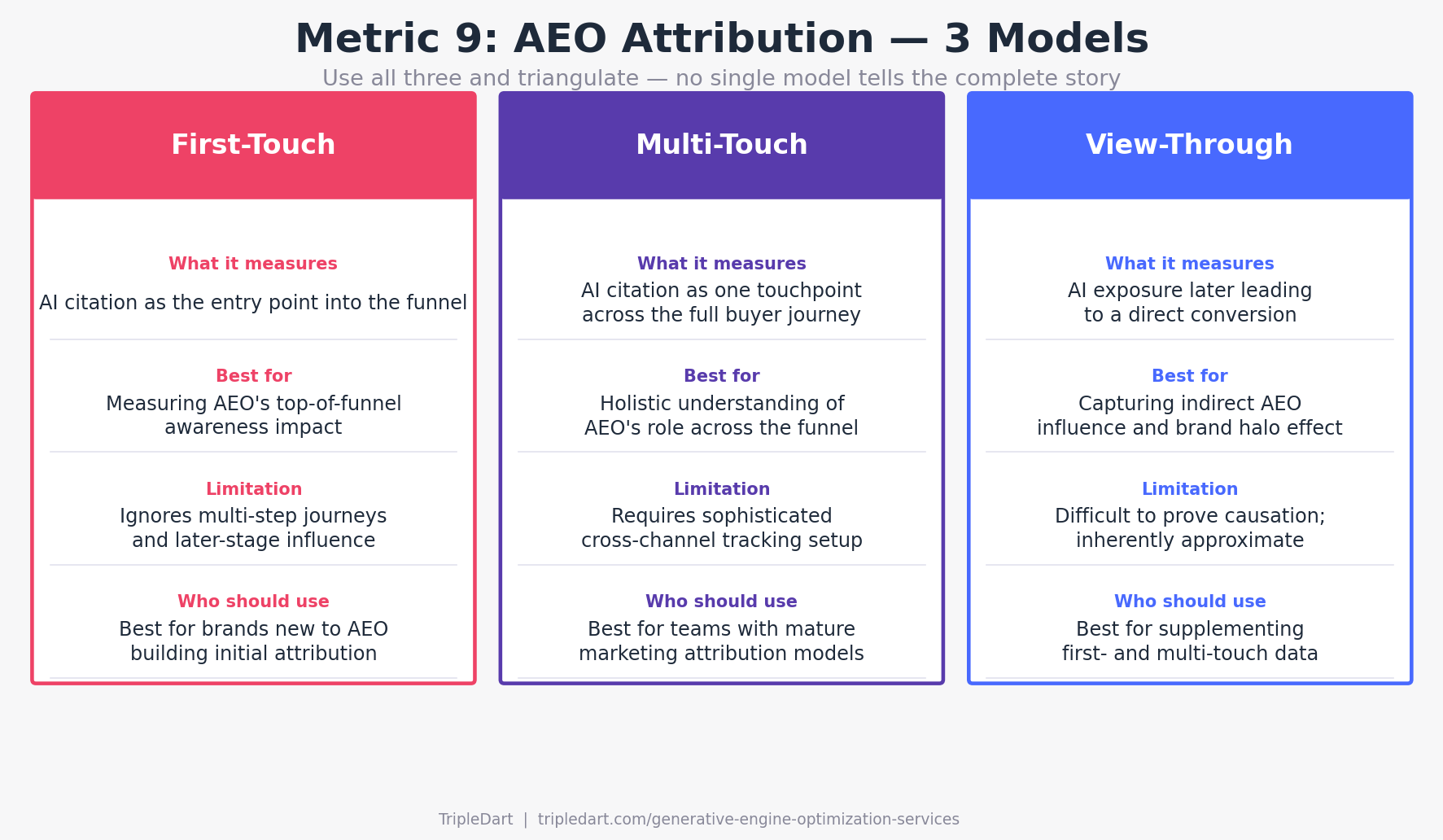
Use multiple models and triangulate. For content likely to be cited by AI, create UTM-tagged landing pages so that when AI engines link to your content, the traffic is trackable: ?utm_source=ai_search&utm_medium=citation&utm_campaign=aeo_2026. Tag leads that arrive via AI referral sources in your CRM for downstream pipeline tracking. Our marketing analytics agency team builds these attribution systems regularly - the UTM strategy is the fastest way to get started.
Metric 10: AEO-Influenced Pipeline and Revenue
Extend beyond conversions to pipeline value and closed revenue. The distinction between AEO-sourced revenue (first touch was an AI citation) and AEO-influenced revenue (an AI citation appeared somewhere in the buyer's journey) mirrors the marketing-sourced vs. marketing-influenced framework most B2B teams already use.
Implement this in your CRM:
- Salesforce: Create a custom field on the Opportunity object - "AI Search Influence" (picklist: AEO-Sourced / AEO-Influenced / None)
- HubSpot: Create a custom Deal property with the same structure
- Add "How did you first hear about us?" with "AI search (ChatGPT, Perplexity, etc.)" as an option on demo request forms
AEO-Influenced Revenue = Sum of closed-won revenue on deals tagged "AEO-Influenced" or "AEO-Sourced"
Train your SDRs and AEs to ask during discovery calls whether the prospect encountered the brand via AI search. This qualitative data often surfaces influence that attribution models miss entirely.
Metric 11: Cost Per AI Citation (CPAC)
CPAC is an efficiency metric that helps teams understand the economics of their AEO investment.
Cost Per AI Citation (CPAC) = Total AEO Investment ÷ Total AI Citations Earned
What to include in your CPAC calculation:
- Content creation costs (writing, editing, design)
- Technical optimization (schema, structured data)
- AEO monitoring tool subscriptions
- Agency or consultant fees for AEO work
- Team time allocated to AEO auditing and optimization
In early 2026, expect CPAC to range widely - $50 to $500 or more per citation depending on industry competitiveness and content investment. The goal is to track the trend line downward over quarters, not to hit a specific number immediately. CPAC will be high initially and should decrease as teams build AEO-optimized content libraries.
Metric 12: Brand Search Lift from AI Exposure
This metric captures the halo effect of AI citations on brand awareness. The hypothesis: if AI engines consistently mention your brand in relevant answers, more people will search for your brand by name.
Track branded search volume trends in Google Search Console and correlate with AI citation activity:
- Export weekly branded search impressions from GSC
- Export weekly AI citation counts from your tracking system
- Plot both on the same timeline chart
- Look for directional correlation (a 2-4 week lag is common)
- Use this as supporting evidence in executive reports
Supplement GSC data with Google Trends data for your brand name. Correlation is not causation, but it's one of the strongest available proxies for AEO's brand awareness impact - and it's a story executives find compelling when you can show the lines moving together.
How Do You Build Your AEO Measurement Baseline?
Before you can track progress, you need a starting point. The baseline doesn't need to be perfect. It needs to be consistent and repeatable. The goal is a snapshot of your current AI visibility that you can measure against in 30, 60, and 90 days.
Step 1: Define your AEO query universe.
Select 50-100 queries that matter most for your brand's AI visibility. Selection criteria: commercial intent (queries that indicate buying interest), search volume (queries people actually ask), competitive importance (queries where competitors are likely being cited), and AI answer likelihood (informational and comparison queries are most likely to trigger AI answers). Start with your top 50 pipeline-driving keywords, then add 25-50 question-format and comparison queries.
Step 2: Conduct your first AI visibility audit.
Take your query list, check each query across four or five AI platforms (Google AI Overviews, ChatGPT, Perplexity, Claude, Gemini), and document results in a standardized format. For each query/platform combination, record: whether your brand was cited, the citation type (URL, brand mention, data reference), sentiment (positive/neutral/negative), positioning (primary/secondary/footnote), and accuracy. Budget 4-6 hours for your first full audit of 50 queries across five platforms.
Step 3: Set benchmarks and tracking cadence.
Once you have your first audit complete, you have your baseline. Set benchmarks for each Tier 1 metric: your current AI citation rate, your AI SOV vs. key competitors, your AI Overview inclusion rate, and your platform coverage breadth. Then establish a tracking cadence: weekly spot-checks on your top 10 queries, monthly full audits, and quarterly strategic reviews. Assign ownership - someone on the team needs to own AEO measurement the same way someone owns the SEO dashboard.
How Does TripleDart Help B2B SaaS Teams Measure and Improve AEO Performance?
TripleDart is an AI-native SEO agency for B2B SaaS, and AEO measurement is one of the core capabilities we've built into our proprietary AI workflows through Slate. We don't just track whether your brand appears in AI answers - we diagnose why it's appearing (or not), what the citation quality looks like across platforms, and which content investments will move your AI SOV in the next quarter.
We work with B2B SaaS marketing teams to build the full measurement stack: query universe definition, baseline audits, Looker Studio dashboards that combine GSC AI Overview data with GA4 referral tracking, CRM tagging for AEO-influenced pipeline, and monthly reporting that connects AI visibility to revenue. The 12-metric framework in this article is the same framework we use with clients.
If your team is running on a traditional SEO dashboard and you know there's AI search influence you're not capturing, we can help you build the measurement system from scratch. Talk to our team to see what AEO measurement looks like in practice.
FAQs
1. What is the most important AEO metric to start tracking?
AI Citation Rate is the right starting point. It answers the most fundamental question - is your brand showing up when AI engines answer questions relevant to your business? - and it's measurable with nothing more than a query list and an hour of manual auditing. Once you have a citation rate baseline, you can layer in AI Share of Voice to understand competitive positioning, then move to Tier 2 and Tier 3 metrics as your measurement practice matures.
2. How is AEO measurement different from traditional SEO reporting?
Traditional SEO reporting tracks clicks, rankings, and organic traffic - all signals that require a user to visit your website. AEO measurement tracks citations, mentions, and brand references inside AI-generated answers, which may influence a buyer's decision without ever generating a click. The two systems measure different parts of the buyer's journey. You need both, but most teams currently only have one.
3. Can I measure AEO without dedicated tools?
Yes. A structured manual audit process - a defined query list, consistent platform checks in incognito browsers, and a standardized tracking spreadsheet - gives you actionable AEO data without any tool spend. Dedicated tools like Otterly.ai, Peec AI, and Profound add scale and automation, but they're not a prerequisite for getting started. Many teams run effective AEO measurement programs manually for the first three to six months before investing in tooling.
4. How often should I audit my AI citation performance?
Weekly spot-checks on your top 10 priority queries, monthly full audits across your complete query list, and quarterly strategic reviews where you assess trends and adjust your content strategy. The weekly cadence catches significant changes quickly. The monthly cadence gives you the trend data you need for reporting. The quarterly review is where you connect AEO performance to content investment decisions.
5. What's the difference between AI-sourced and AI-influenced revenue?
AEO-sourced revenue means the first touchpoint in a buyer's journey was an AI citation - they asked ChatGPT or Perplexity a question, your brand was cited, and that's how they entered your funnel. AEO-influenced revenue means an AI citation appeared somewhere in the buyer's journey, but wasn't necessarily the first touch. The distinction mirrors the marketing-sourced vs. marketing-influenced framework most B2B teams already use for demand gen attribution. Track both, because AEO-influenced revenue will almost always be larger and tells a more complete story about AI search's role in your pipeline.
6. How does TripleDart help with AEO measurement?
As an AI-native SEO agency for B2B SaaS, TripleDart builds AEO measurement programs using Slate, our proprietary AI workflows, to go well beyond basic citation tracking. We set up the full stack: query universe definition, multi-platform citation audits, GA4 and GSC configuration for AI referral tracking, CRM tagging for AEO-influenced pipeline, and executive dashboards that connect AI visibility to revenue. If you're running on a traditional SEO dashboard and know you're missing AI search influence, talk to our team about building the measurement system that captures it.

.png)



.webp)










.webp)





.webp)


.webp)
.png)





%20(1).png)


.webp)
.webp)
.webp)





%20Ads%20for%20SaaS%202026_%20Types%2C%20Strategies%20%26%20Best%20Practices%20(1).webp)




.webp)








.webp)



![Creating an Enterprise SaaS Marketing Strategy [Based on Industry Insights and Trends in 2026]](https://cdn.prod.website-files.com/632b673b055f4310bdb8637d/6a218bacea463474377dfd32_34%20-%20Creating%20an%20Enterprise%20SaaS%20Marketing%20Strategy.png)
































.webp)




%20Agencies%20for%20B2B%20SaaS%20Compared%20(2026).webp)

.webp)
%20with%20Hubspot.webp)


_%20Expert%20Reviews%20%26%20Comparisons.png)







.webp)





_%20Comparison%2C%20Strengths%2C%20and%20How%20to%20Choose.png)










.webp)




.webp)




.webp)























%20Tools%20in%202026_%20Vetted%20List.webp)


![7-Step Workflow for AEO-Ready Content [2026 Framework]](https://cdn.prod.website-files.com/632b673b055f4310bdb8637d/6a0d55ea88913ede1d3a7123_5%20-%20Workflows%20for%20Optimized%20AEO-Ready%20Content%20Creation.png)
.png)
![How to Structure Content for AEO and GEO [With Templates]](https://cdn.prod.website-files.com/632b673b055f4310bdb8637d/6a0c6a56eb700472e635ff33_1%20-%20How%20to%20Structure%20%20Content%20for%20AEO%20and%20GEO%20%20Summaries%20(2026).png)







.png)
.png)













.webp)


%20Agencies%20in%202027.webp)
.webp)
![Top 9 AI SEO Content Generators for 2026 [Ranked & Reviewed]](https://cdn.prod.website-files.com/632b673b055f4310bdb8637d/6a2a3e3105bc1a127aae4e8e_34%20-%20Top%209%20AI%20SEO%20Content%20Generators%20for%202026%20%5BRanked%20%26%20Reviewed%5D.webp)