.png)


You probably saw the clips yesterday.
On Tuesday, 20th May, at Google I/O 2026, Liz Reid (Google's head of search) walked on stage and pulled the cover off a new search box.
Bigger. Longer. Conversational. Multimodal. Agentic.
The keynote headline most outlets ran with was almost verbatim from Google's own framing.
Biggest change to the search bar in 25 years:
- AI agents inside Google search.
- Gemini 3.5 Flash as the new default AI Mode model rolling out today.
- Free generative UI for everyone in summer.

That's a lot for one keynote.
The story
The data Google leaned on to justify the rebuild was the headline most marketers missed.
AI Mode passed one billion monthly users a year after debut.
The broader AI Overviews surface now sits at 2.5 billion monthly. Last quarter's search volume hit an all-time high. And per Google's own framing, queries are "more than doubling every quarter."
If you're wondering why the search box itself needed a redesign, that's the answer.
Then there's the agent piece. Reid framed it as a workflow on stage. You tell search to watch a market sector with specific parameters. The agent maps out a monitoring plan and pings you when conditions move.
That's a feature.
It's also a signal about where Google thinks the search session is going.
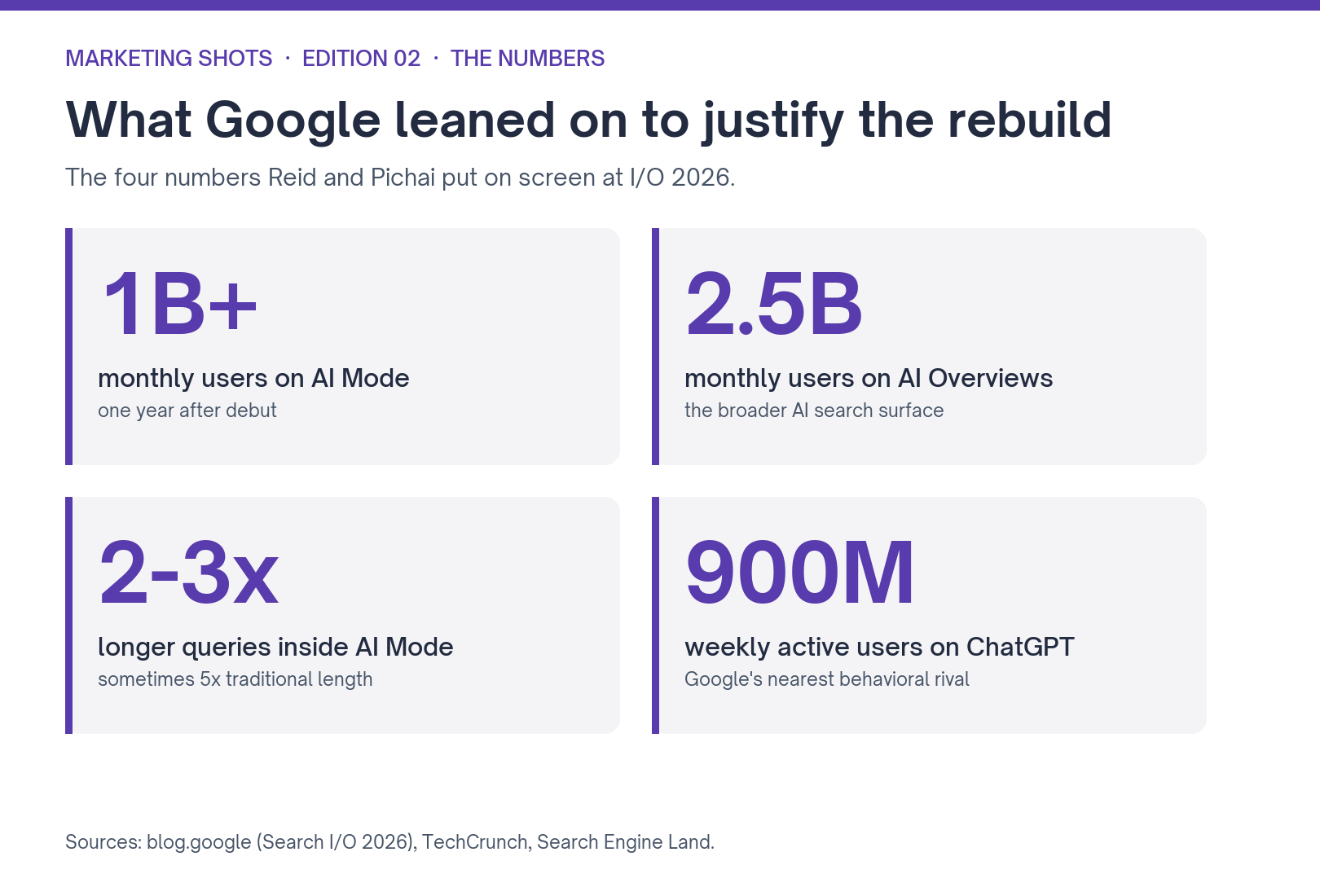
The four numbers Reid and Pichai put on screen. Sources: blog.google, TechCrunch, Search Engine Land.
Why now, and what this could be a result of
Two things drove the timing. Both have been building for a year.
The first is competitive pressure on the interface itself.
ChatGPT crossed 900 million weekly active users by early 2026. Perplexity has spent two years training a subset of high-intent users to type long, conversational queries into a chat box. Pichai pointed out at an earlier May launch that AI Mode queries are two to three times longer than traditional Google searches. Sometimes five times that length.
So the Tuesday keynote was Google admitting where the front door has moved. The new search box is shaped like a chat box because that is what users now expect when they go looking for an answer.
The second reason is harder to read out loud.
AI Overviews have already pulled human click-throughs down hard. Chartbeat tracked roughly a 33% decline in publisher Google traffic from December 2024 to December 2025. Seer Interactive's study of 25.1 million impressions found 93% of AI Mode sessions end with no click out to an external site.
Yup. 93%.
More of the search session is now happening inside Google's own surface than at any point in the last decade.
And the rebuild keeps it that way. Going bigger on AI Mode is the move when a billion users are already inside it. The alternative is watching a chunk of them open a Perplexity tab instead.
What this means for the work
For any brand treating search as a click-through funnel, this is a hard quarter. Clicks out drop and sessions inside Google get longer. The brand cited inside the AI answer matters more than the brand ranked #1 on a SERP that fewer people look at.
For brands measuring AI citation share, the announcement is a tailwind.
Across the 250+ B2B SaaS accounts we run, the pattern has been consistent enough to plan around:
- Schema lifts citation share on Google's surfaces and off them: FAQ and Organization markup carry a measurable lift across AI Overviews, AI Mode, ChatGPT, and Perplexity. The lift is bigger on the non-Google surfaces, which is the part Google's developer guide last week understated.
- Answer-first prose under buyer-question H2s reads better to the citation engines than to keyword-targeted page structures: This was the lift we kept seeing 18 months before AI Mode hit a billion users.
- Agent rendering becomes mandatory work, not bonus work: When search agents go live this summer, half the B2B SaaS sites we audit will not parse cleanly. Pricing pages and feature pages rendered in client-side JavaScript become invisible to the agents that book, monitor, compare, and shortlist on the buyer's behalf.
- Cross-engine citation tracking moves into the weekly dashboard: Tracking AI and LLM chatbot traffic in GA4 is the floor. Citation share across Perplexity, ChatGPT, Claude, Gemini, and AI Mode is the ceiling.

The four moves we have in the quarterly plan for B2B SaaS accounts measuring AI citation share.
How this lines up with last week's GEO guide
A week ago, Google's developer docs published their first official AI search optimization guide.
Their message was clean. GEO is just SEO under a different name, so do the basics well and skip the hacks.
Our Edition #01 covered it - Our pushback was that the foundation is SEO, the bigger work is GEO, and the metric Google was pointing at (rankings) is no longer the metric that matters.
Tuesday's keynote made the second half of that argument out loud.
When AI Mode hits a billion users and the search box is rebuilt around conversation, "do good SEO" stays the floor. Being the brand the AI cites when the answer is rendered becomes the ceiling.
So both Google statements from the last two weeks read together.
Do the SEO basics. And start measuring whether AI Mode is citing you. Because the next two years of search traffic lives inside the answer.

Week 1: Google's developer guide. Week 2: the I/O search-bar rebuild. Both read together.
Google's I/O announcement reads as Google catching up to a behavior pattern its rivals already shaped. The interface is the late part of the story. Where the work sits is the metric change, and that arrived a year ago.
If tracking AI citation share is on your quarterly plan, grab a call. Happy to compare notes.
Until next time.
.webp)

.webp)
.webp)
.png)


.png)


.webp)



.webp)

.webp)




%20(1).png)


.webp)
.webp)
.webp)



%20Ads%20for%20SaaS%202026_%20Types%2C%20Strategies%20%26%20Best%20Practices%20(1).webp)






.png)


.png)



.webp)


![Creating an Enterprise SaaS Marketing Strategy [Based on Industry Insights and Trends in 2026]](https://cdn.prod.website-files.com/632b673b055f4310bdb8637d/6965f37b67d3956f981e65fe_66a22273de11b68303bdd3c7_Creating%2520an%2520Enterprise%2520SaaS%2520Marketing%2520Strategy%2520%255BBased%2520on%2520Industry%2520Insights%2520and%2520Trends%2520in%25202023%255D.png)



.png)













.webp)


%20Agencies%20for%20B2B%20SaaS%20Compared%20(2026).webp)

.webp)
%20with%20Hubspot.webp)




.png)


.png)

.png)
.png)
.png)
.png)













.webp)

.webp)
.png)
.png)



.webp)


.png)

















.webp)
.png)
![7 Examples of Content for AEO and GEO [With Templates]](https://cdn.prod.website-files.com/632b673b055f4310bdb8637d/6a0c6a56eb700472e635ff33_1%20-%20How%20to%20Structure%20%20Content%20for%20AEO%20and%20GEO%20%20Summaries%20(2026).png)


.png)
.png)






.png)

.png)


%2520Agencies%2520(2025).png)

![Top 9 AI SEO Content Generators for 2026 [Ranked & Reviewed]](https://cdn.prod.website-files.com/632b673b055f4310bdb8637d/6858e2c2d1f91a0c0a48811a_ai%20seo%20content%20generator.webp)
.webp)
.webp)







.webp)