.png)


Key Takeaways
- The Fintech Opportunity: Global fintech revenue hit $79 billion in 2023, projected to hit $141.18 billion in 2028 – but capturing that growth requires marketing built for compliance, complex buying cycles, and enterprise trust.
- The Top Seven: The leading fintech marketing agencies right now are TripleDart, CSTMR, Inbound Fintech, Growth Gorilla, NinjaPromo, Disruptive Advertising, and VaynerMedia.
- How We Ranked Them: Agencies were scored across fintech-specific outcomes and case studies (30%), regulatory and compliance fluency (25%), client reviews from fintech companies (20%), channel depth across the fintech funnel (15%), and thought leadership (10%).
- What “Good” Looks Like: The right fintech agency brings more than channel execution. Look for compliance-aware messaging, RevOps integration, AI search visibility infrastructure, and attribution models that connect spend to pipeline.
- Choosing Your Partner: The best fit depends on your growth stage, GTM motion, budget, and whether you need a single-channel specialist or a full-funnel partner accountable for revenue.
Fintech is one of our time’s biggest revolutions - one that advances with every technological breakthrough like AI, big data, and blockchain.
Unsurprisingly, global fintech revenue hit $79 billion in 2023, with a projected CAGR of 12% through 2028. However, not all is well with the fintech world - many players burn through their marketing budgets without moving the needle on user acquisition.
Why?
They're still using playbooks designed for traditional SaaS and partnering with legacy fintech marketing agencies, while competing against banking giants with marketing budgets in the millions.
As someone running a fintech brand, you're juggling unique challenges:
- Your product might be revolutionizing payments, but you're probably battling both regulatory scrutiny and customer trust issues
- Traditional marketing metrics don't cut it when you need to convince enterprises to switch their core financial infrastructure.
- Your cost per acquisition needs to make sense against longer sales cycles and higher customer lifetime values
And of course, there is the AI boom that has particularly impacted fintech in terms of efficiency, complexity, and security.
This is exactly why you need to pick the relevant fintech marketing agency to ensure you hit your revenue target for 2026.
An agency that gets fintech goes beyond pushing crisp content – they navigate compliance, speak the language of finance, and know how to position complex financial products without triggering regulatory red flags.
Selecting the right fintech marketing agency can be a tedious process, so we’ve shortlisted the top seven agencies from our research in this list, in no particular order.
Want to know which ones feature? Let’s get started!
Overview of the Top 7 Fintech Marketing Agencies
How We Chose the Best Fintech Marketing Agencies
In fintech, the buying cycles are longer, regulatory constraints are complex, and the trust bar is higher than almost any other category.
Here's the weighted scoring system we used to evaluate agencies:
- Fintech-Specific Outcomes & Case Studies (30%): Agencies scored higher when they published results for fintech companies, showing the right revenue metrics: pipeline contribution, ROAS from regulated ad categories, or ARR impact.
- Regulatory & Compliance Fluency (25%): Can the agency write ad copy that clears platform policy reviews for financial products? Do their RevOps implementations meet data governance standards? We looked for demonstrated experience navigating real constraints.
- Client Reviews from Fintech Companies (20%): We pulled feedback specifically from fintech clients on Clutch, Trustpilot, and G2, prioritizing reviews that spoke to strategic alignment, reporting transparency, and understanding sales cycles.
- Channel Depth Across the Fintech Funnel (15%): We evaluated whether agencies demonstrated integrated execution depth across SEO, paid media, content, ABM, and AI search.
- Thought Leadership & Industry Presence (10%): We looked for original contributions beyond repurposed content: proprietary research, fintech-specific frameworks, and community presence.
Detailed Walkthrough of the Top 7 Fintech Marketing Agencies
1. TripleDart
TripleDart is one of the few fintech marketing agencies that operates as a full inbound GTM team rather than a channel-specific vendor.
Fintech marketing is about accountability and speed - and we are a partner that practices that diligently.
When a fintech company comes to us, we build and own the entire engine: SEO and content, paid media, ABM, RevOps infrastructure, and GEO/AI search visibility, all under one roof, with accountability for pipeline and revenue.
We bring a team with roots in high-growth B2B SaaS companies like Freshworks, Zoho, and Remote, which means we understand complex buying cycles, messaging constraints, and multi-stakeholder sales motions that are common in fintech.
Our ABM programs, for instance, are built for high-ACV enterprise deals where warming up accounts before sales outreach materially improves meeting acceptance rates.
On the organic and AI search side, we operate Slate, a proprietary AI workflow platform that lets us systemize fintech marketing - such as refreshing hundreds of pages, implementing schema at scale, and tracking brand visibility across ChatGPT, Perplexity, and Gemini.
For fintech brands trying to appear in LLM-generated responses when buyers search for solutions like theirs, this has been hugely beneficial. For example, we've used it to deliver 7x AI search visibility growth for clients in six months.
We've managed over $150M in ad spend and worked with 250+ B2B companies, delivering fintech outcomes such as a 1.6x ROAS for Fincent and a 6x pipeline boost for Airbase.
Best For
Fintech SaaS companies at Series B and beyond, with $5M to $50M ARR, looking for an integrated GTM partner rather than individual channel vendors.
Strengths
- Proprietary AI workflow platform (Slate): Enables content refresh, schema implementation, and LLM visibility tracking at scale
- Full-funnel ownership with RevOps integration: Unlike agencies that hand off at lead generation, we connect marketing execution to CRM infrastructure and attribution modeling
- Fintech-specific paid performance track record: We house several fintech experts who come with battle-tested playbooks of what works for fintech
Notable Clients
Fincent, Airbase, PayU, Glean
Ratings and Reviews
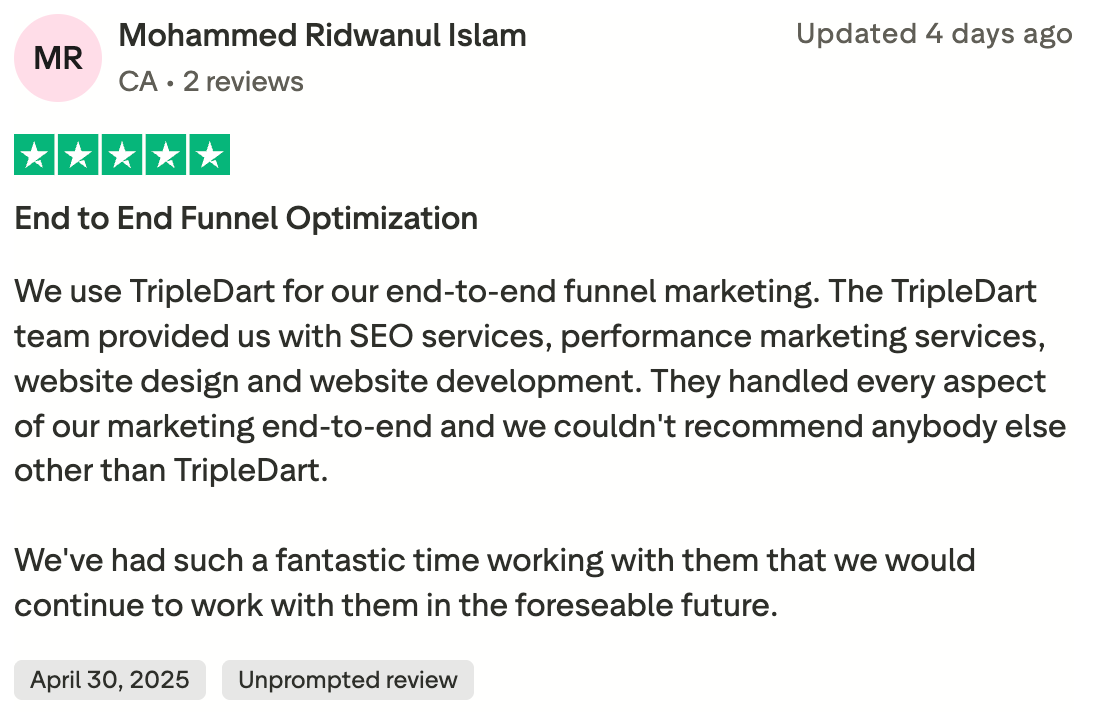
We are rated 4.8/5 on Trustpilot
2. CSTMR
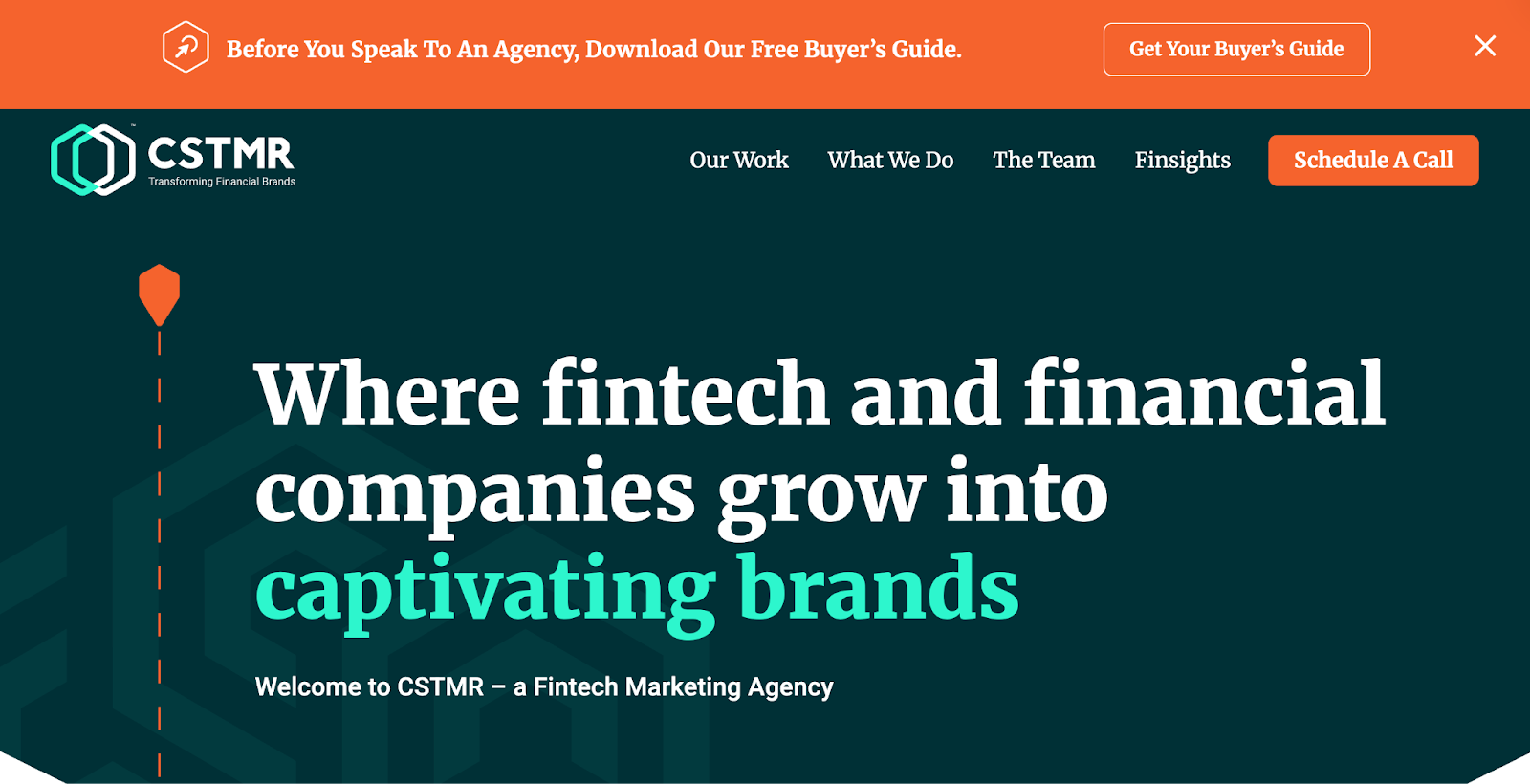
CSTMR’s model is built around three scenarios they've refined over a decade: helping established fintechs scale, helping companies that have stalled reset their marketing foundation, and helping new products or businesses go to market.
What distinguished CSTMR in our opinion was their deliberate pairing of brand marketing with performance marketing.
They operate on the principle that financial products require trust before conversion, so they build long-cycle brand recognition alongside near-term demand capture rather than treating them as separate workstreams.
This approach is particularly relevant for regulated financial products where buyers need multiple touchpoints before committing.
Note that CSTMR also holds SOC 2 Type 1 certification.
Best For
Fintech and financial services companies launching a new product, rebuilding a stalled marketing program, or entering a new market segment.
Strengths
- Deep financial services specialization across banking, lending, payments, insurance, and investing
- Brand-plus-performance integration is structured specifically for long buying cycles common in regulated financial products
- SOC 2 Type 1 certified, which removes a compliance friction point for fintech clients with data security requirements
Notable Clients
ValidMind, UniTeller, LendingTree, Systems and Methods Inc.
Ratings and Reviews
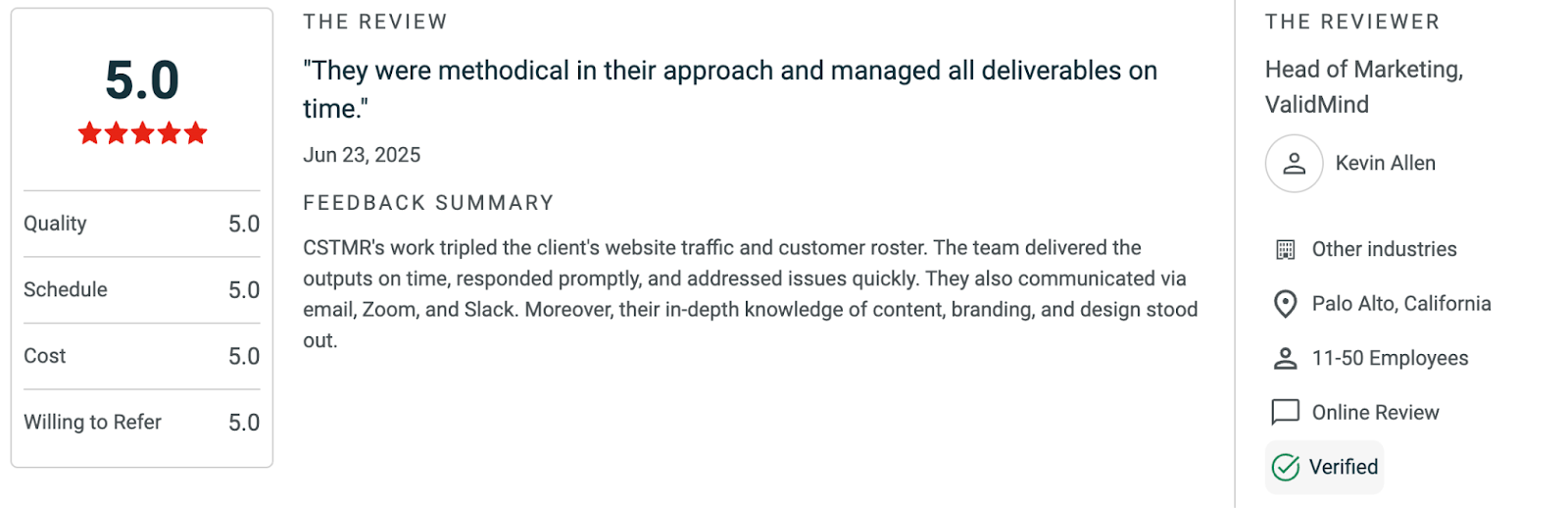
CSTMR is rated 4.9/5 on Clutch
3. Inbound FinTech
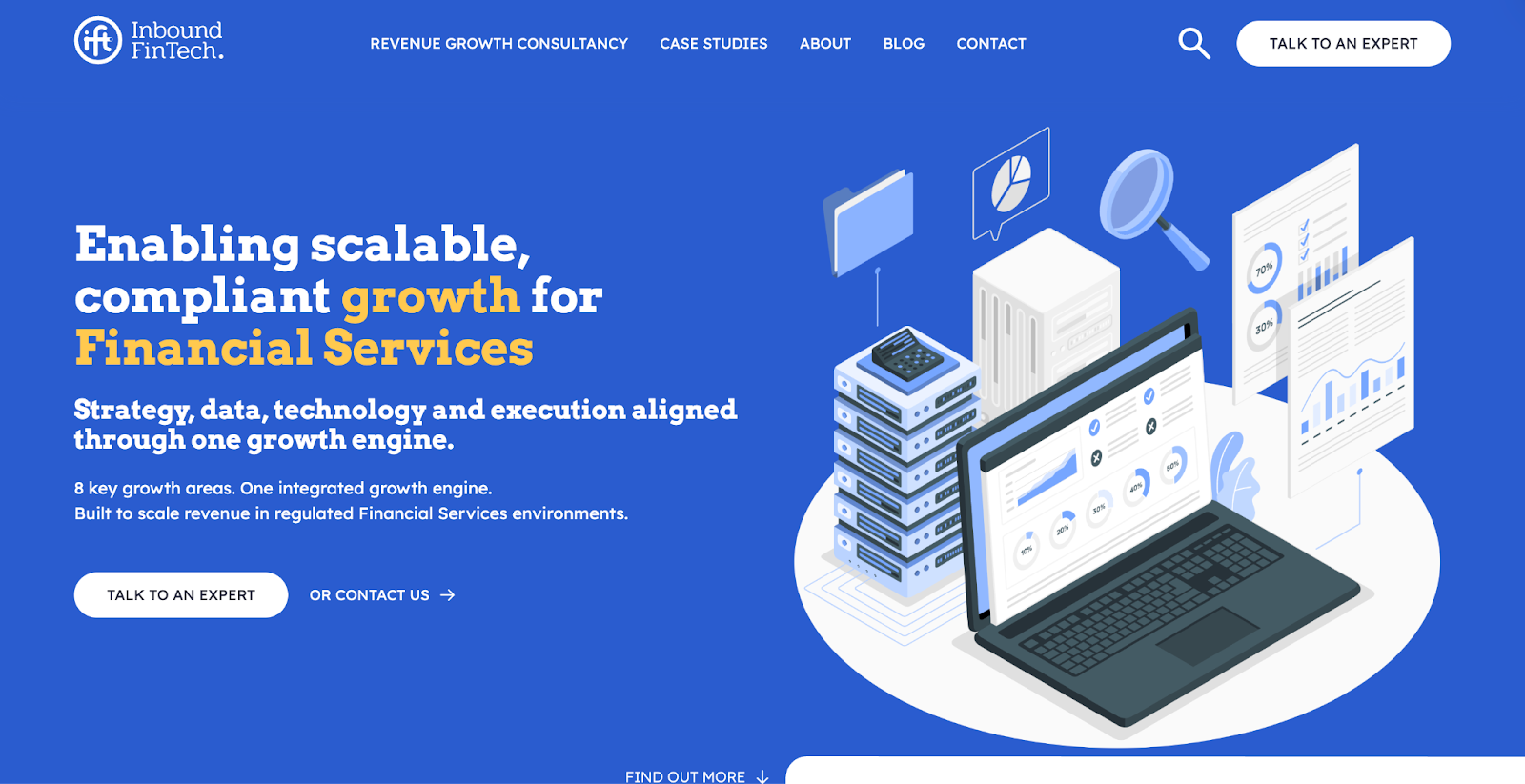
Inbound FinTech sits at an interesting crossroads: part marketing agency, part RevOps consultancy, and part HubSpot integrator, all built exclusively for financial services.
IFT, as they are known, has structured their entire practice around the regulatory complexity, compliance requirements, and long sales cycles that make fintech marketing genuinely different from other B2B categories.
What makes them stand out is how deep the HubSpot specialization goes. About 85% of their clients run on HubSpot, and IFT are architects of fintech-specific workflows.
They also handle Salesforce-to-HubSpot migrations, which have become increasingly common as enterprise fintech firms rethink their tech stacks.
IFT unifies sales, marketing, and customer service into a single revenue engine, with compliance hardwired into every process. For a fintech company where data integrity and auditability matter as much as pipeline, we find that to be a handy offering.
Best For
Fintech and financial services companies at growth or scale stage that want to consolidate their GTM tech stack around HubSpot.
Strengths
- Regulatory compliance is built into marketing and CRM infrastructure
- Deep Salesforce-to-HubSpot migration capability for fintech firms rethinking their enterprise stack
- RevOps framework that unifies sales, marketing, and service under one connected system
Notable Clients
Monument, Temenos, YouLend, CipherTrace
Ratings and Reviews
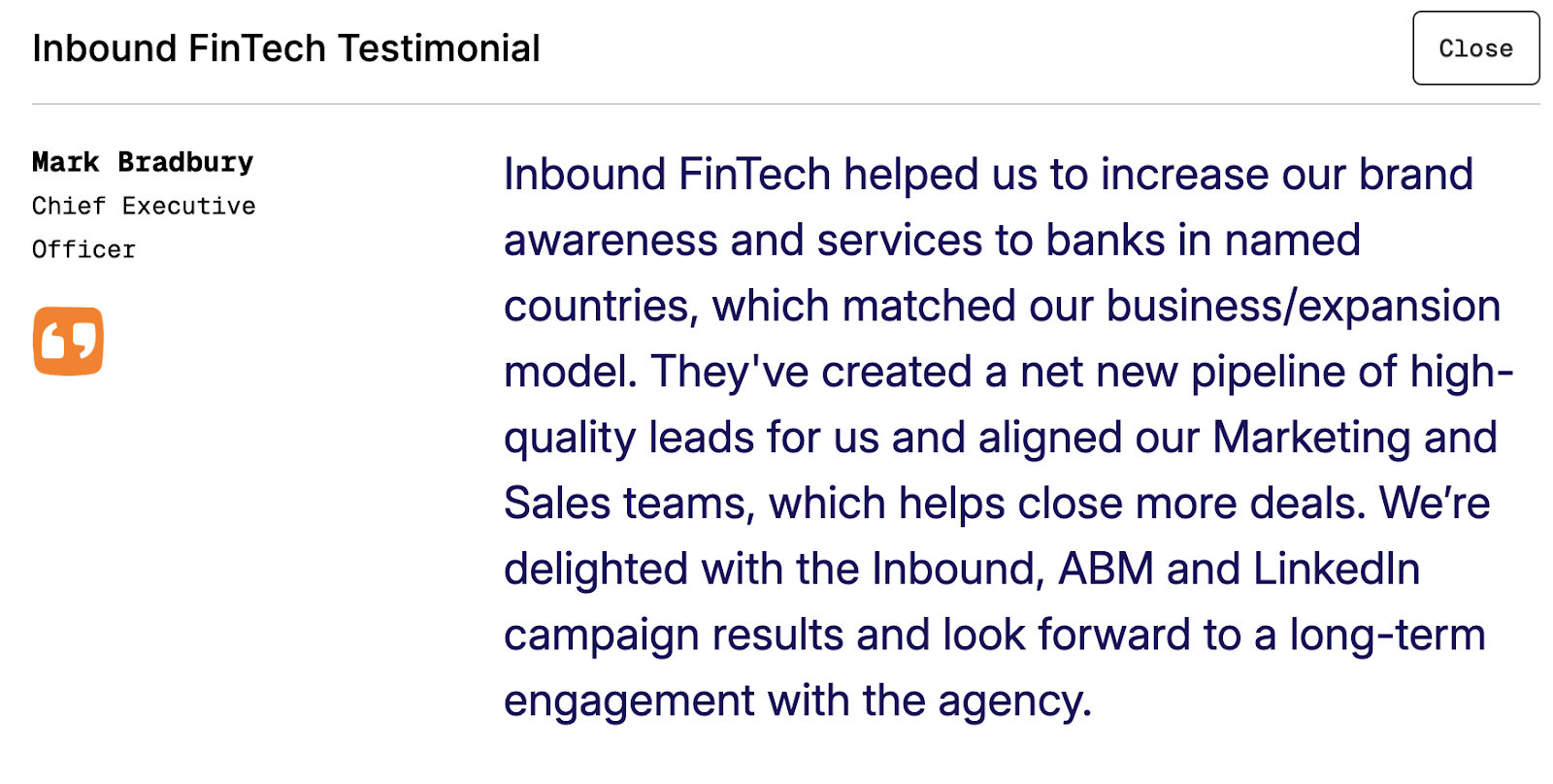
Inbound FinTech is rated 4.4/5 Featured Customers
4. Growth Gorilla
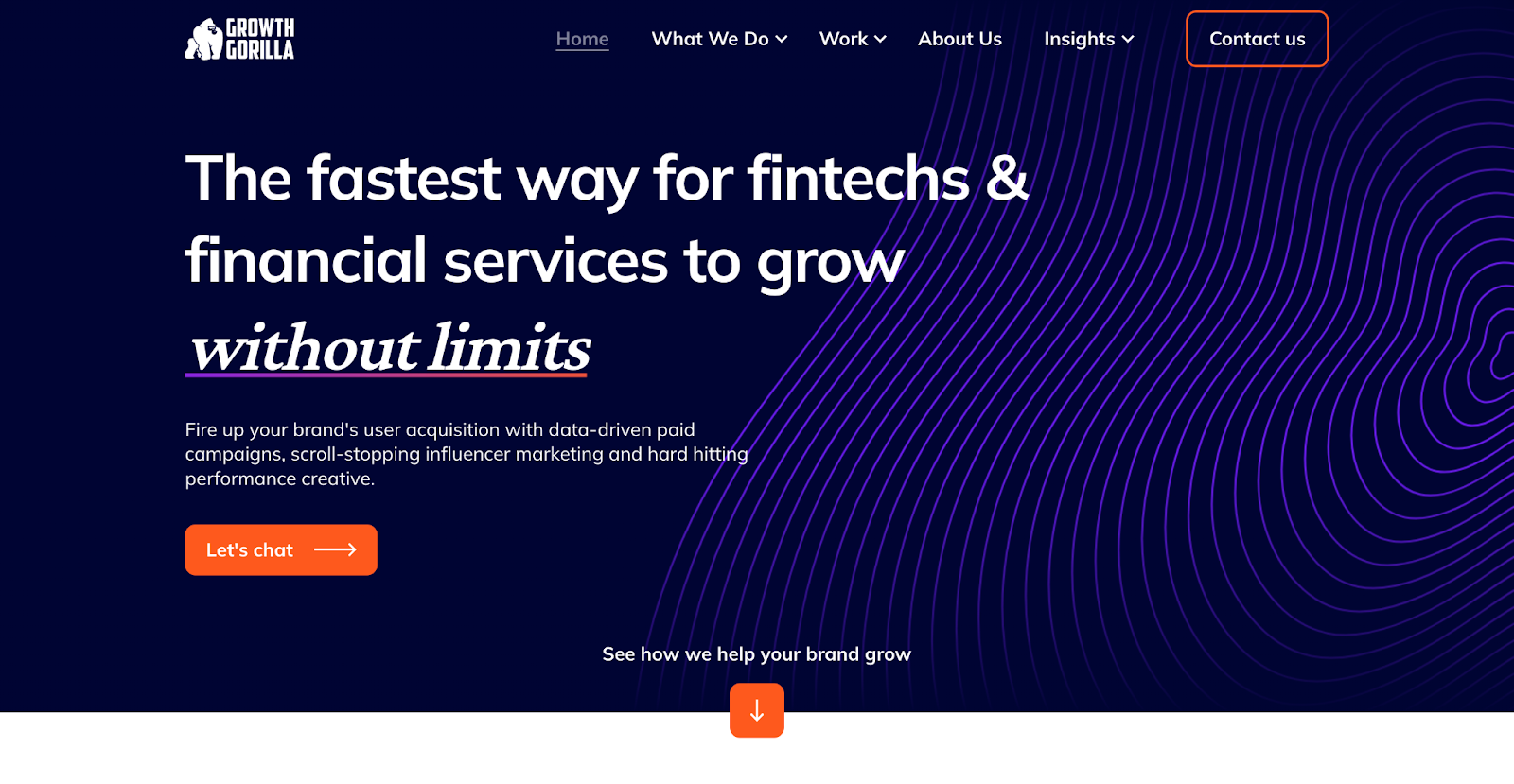
Growth Gorilla is built around an influencer-led performance marketing model.
And this influencer piece is what caught our eye about them. They treat creator-driven content as a primary acquisition channel, selecting fintech-specific influencers whose audiences are already engaged with money, investing, and financial products.
On the paid media side, they run campaigns across Google, Meta, TikTok, YouTube, LinkedIn, Reddit, Spotify, and Microsoft Ads, with performance creatives produced in-house.
Their thought leadership through The FML Podcast and regular fintech marketing roundtables gives them an unusual level of visibility into what's actively working across the sector, which feeds back into how they run campaigns for clients.
Best For
Well-funded fintech startups and scale-ups focused on user acquisition through influencer-led and paid media campaigns.
Strengths
- Influencer marketing as a primary acquisition channel, with creator selection built around financial audience fit
- In-house performance creative production aligned to paid media strategy from the start
- Flexible creative subscription model for brands needing consistent content output without full retainer overhead
Notable Clients
Bloom, Ledn, GoTrade, Wayhome
Ratings and Reviews
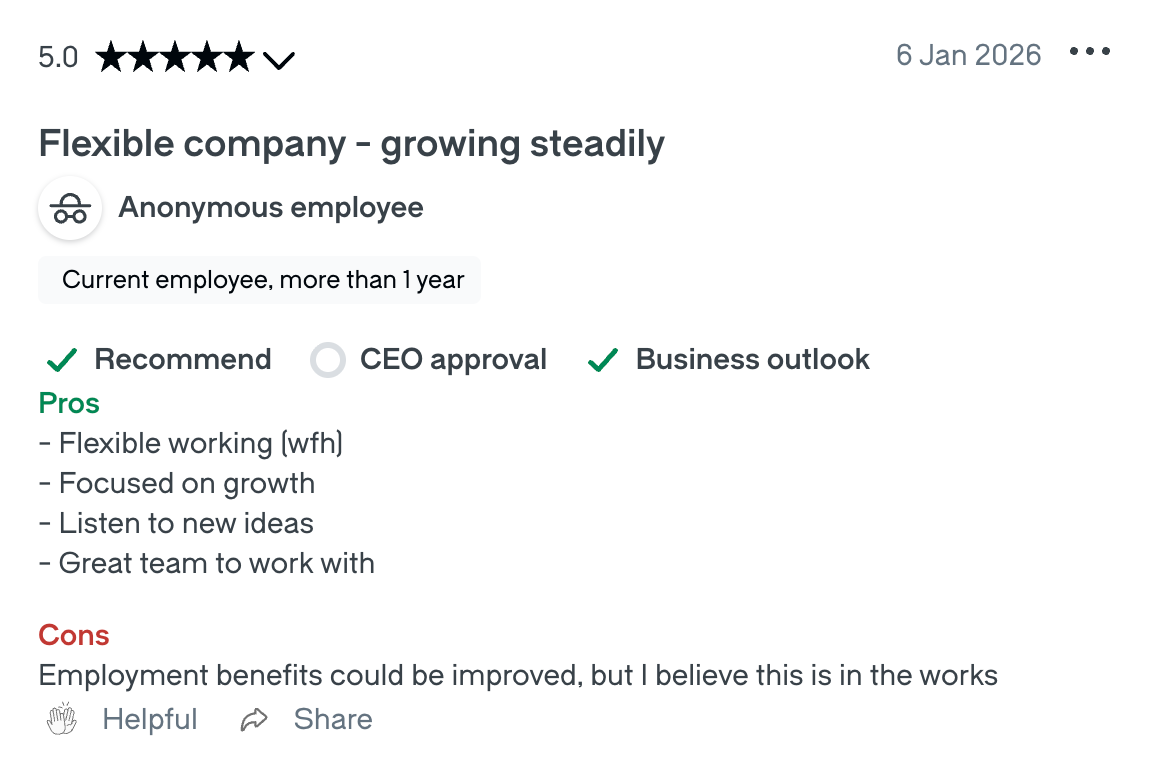
Growth Gorilla is rated 4.3/5 on Glassdoor by employees
5. Ninja Promo
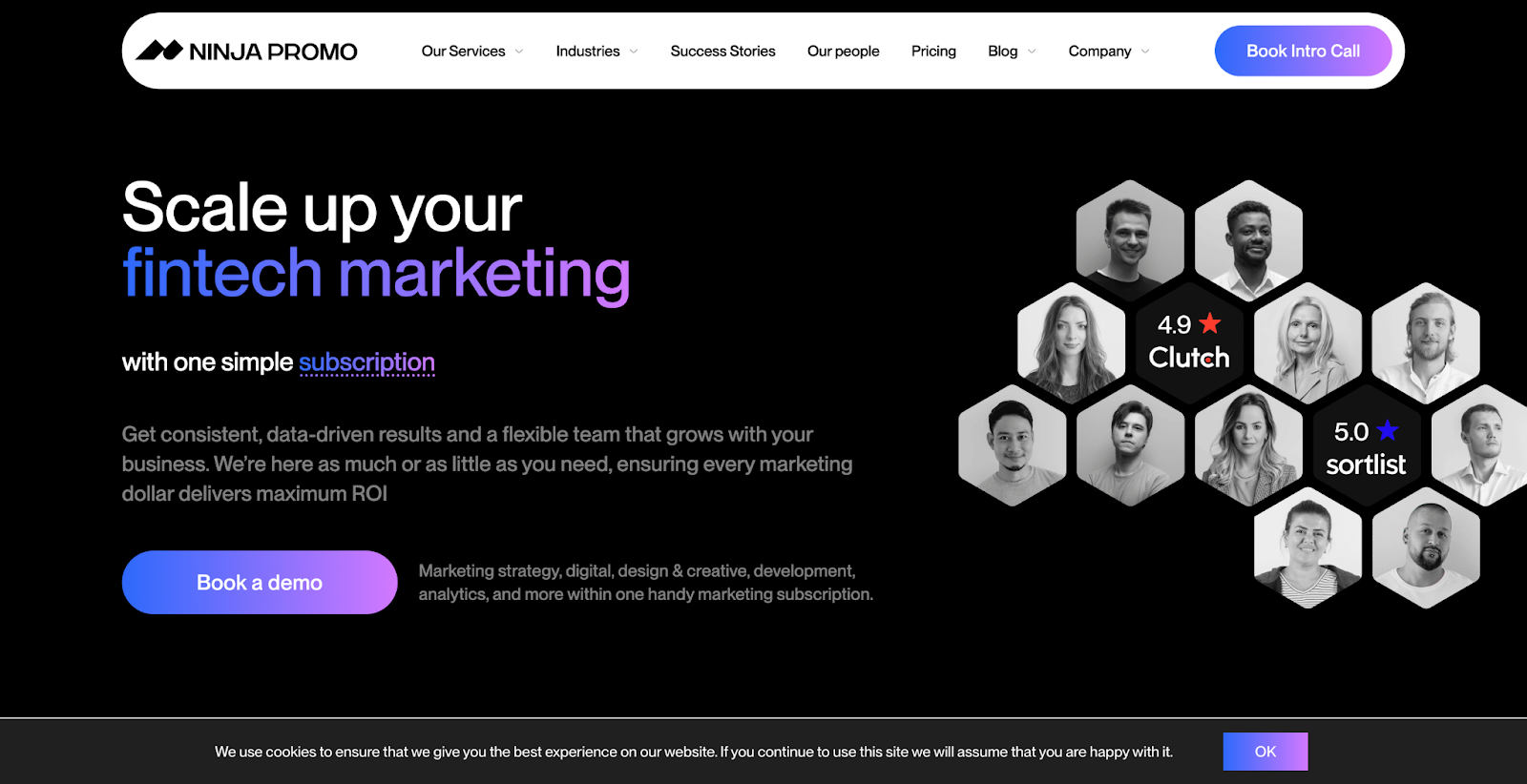
NinjaPromo is one of the few agencies in the fintech space that operates on a subscription-based marketing model, which makes it structurally different from project-based or retainer agencies.
Clients subscribe to a pool of hours each month that can be redirected across services: SEO, paid media, content, social, PR, web development, branding, and more.
What makes them very relevant for fintech is the pace. Fintech companies often need to move fast, and NinjaPromo is known to go from onboarding to campaign launch in under a day.
Their fintech experience spans crypto, DeFi, blockchain, and traditional financial services, and they've built messaging frameworks for compliance-sensitive categories where standard ad copy won't pass platform policies.
Best For
Fintech startups and crypto-native companies that need a full-stack marketing team on demand.
Strengths
- Subscription model allows fintech teams to shift budget across channels (SEO, paid, PR, content, design) within a single engagement
- Crypto and blockchain marketing expertise with experience navigating platform-level ad compliance for financial products
- Real-time execution dashboards give clients visibility into live campaign status without depending on periodic reporting
Notable Clients
Bitcoin.com, KuCoin, Polkadot, IronFX
Ratings and Reviews
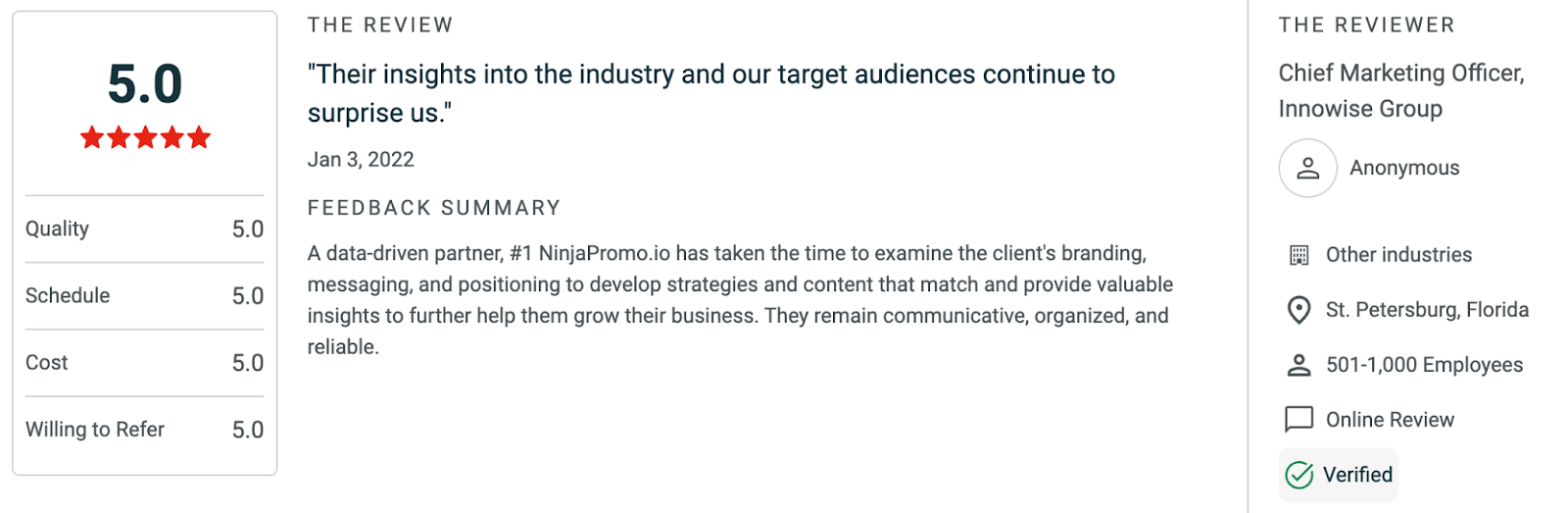
NinjaPromo is rated 4.9/5 on Clutch
6. Disruptive Advertising
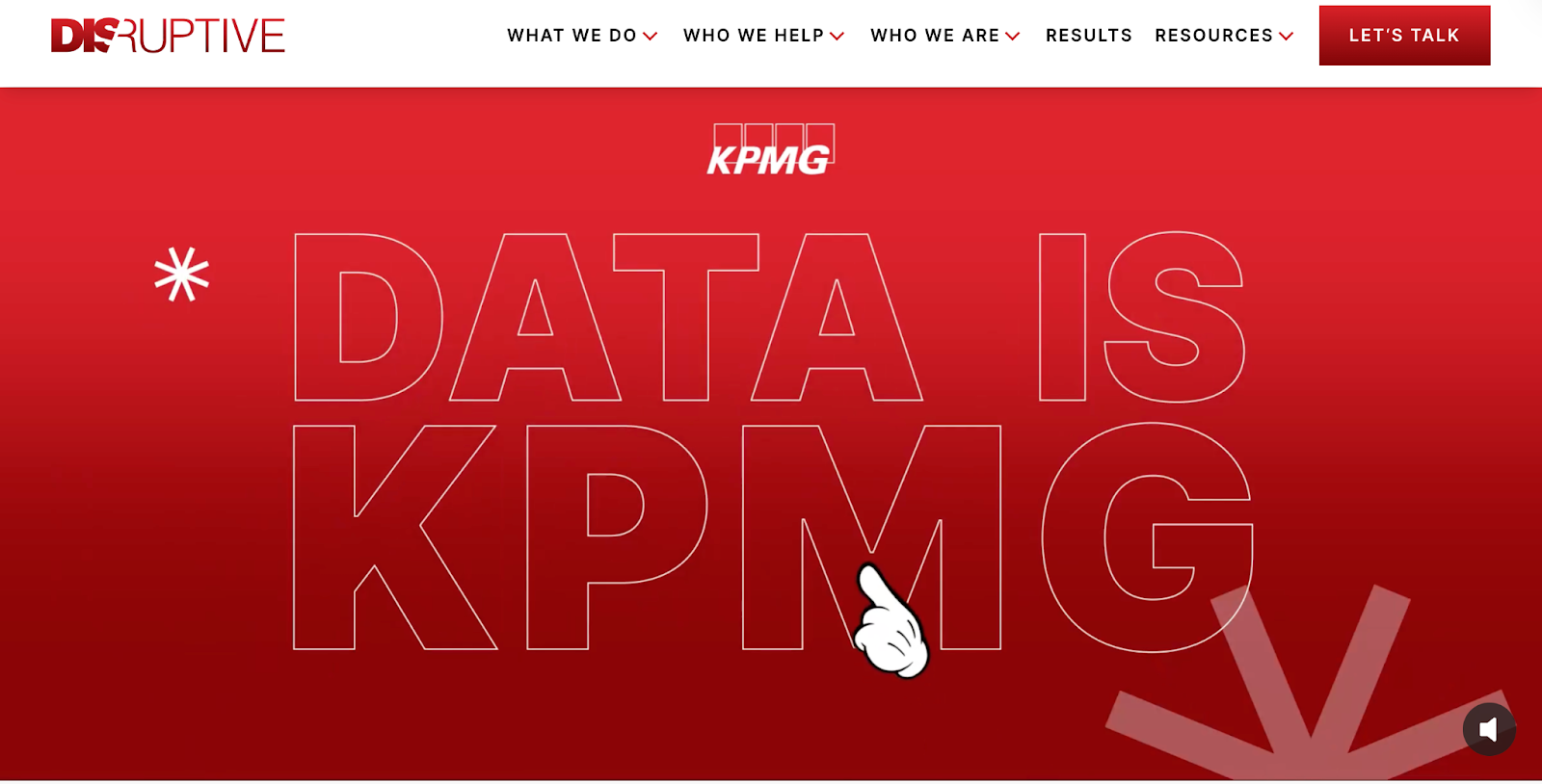
Disruptive Advertising is a performance marketing agency that treats paid media and customer lifecycle as one connected system, not separate line items.
For fintech brands, that integration is important because the cost of acquiring a financial customer is high, and retention is where the margin lives. In this regard, the Disruptive team builds the full journey: from paid search and social to lifecycle sequences.
Their fintech edge shows up in how they think about funnel economics. For example, they pair CRO directly with paid campaigns, so landing pages and ad creative are optimized together rather than managed by two teams pointing fingers.
Best For
Fintech companies with existing paid media programs that are struggling to convert traffic into qualified leads or long-term customers.
Strengths
- Integrated paid + lifecycle model that connects acquisition campaigns directly to retention and upsell sequences
- In-house CRO practice that optimizes landing pages in tandem with ad creative rather than treating them as separate workstreams
- Proven experience running compliant campaigns for regulated financial clients, relevant for fintechs navigating ad policy restrictions on financial products
Notable Clients
KPMG, Adobe, PennyMac, First American Home Warranty
Ratings and Reviews
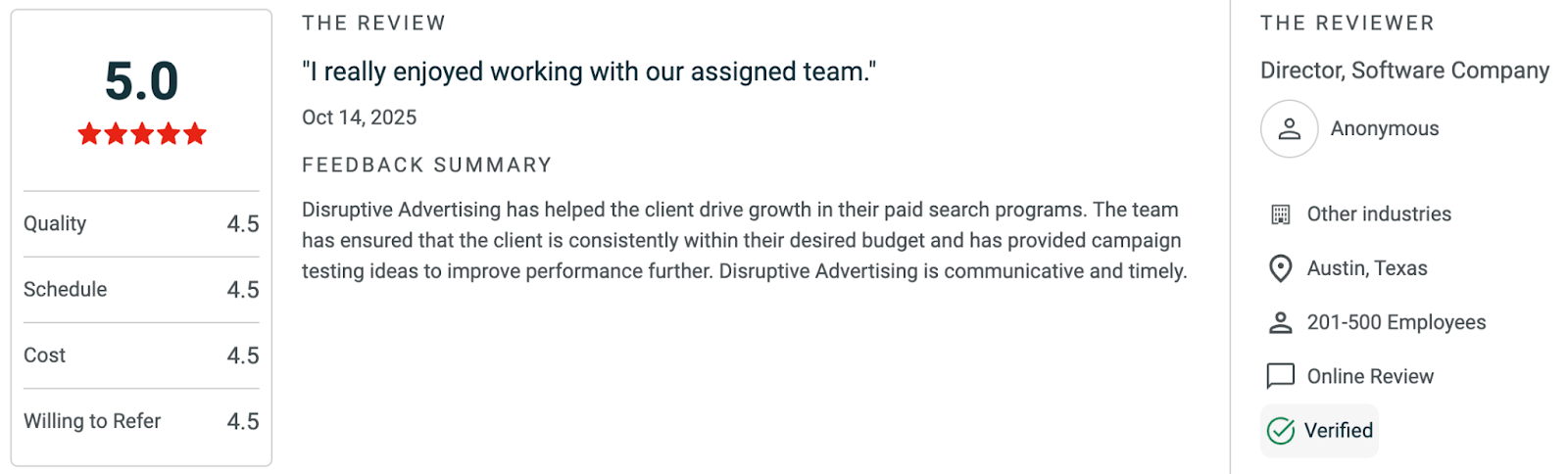
Disruptive Advertising is rated 4.8/5 on Clutch
7. Vayner Media
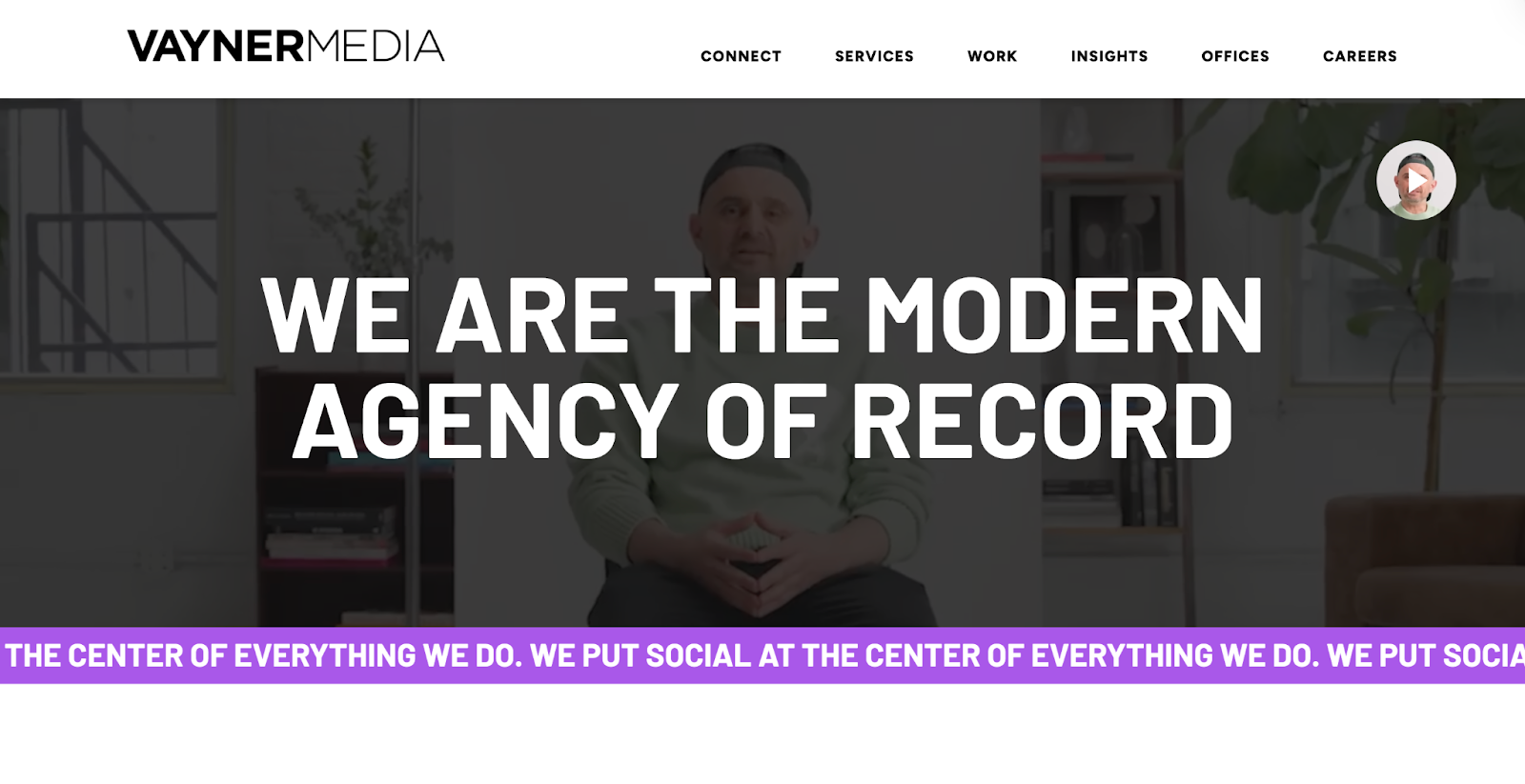
VaynerMedia joins our list for being one of the few agencies that has built its practice around social-first brand marketing at a global scale, with a documented track record in financial services.
VaynerMedia's core methodology, which they call PAC (Platform, Algorithm, Culture), is built around how platform algorithms surface content rather than traditional media-buying logic.
This is an advantage for brands trying to break through in paid social or build organic reach without sounding like a compliance document.
They're not a boutique, and their minimum engagement (reportedly $50k/month) reflects that. But for fintech companies operating at scale, VaynerMedia brings deep financial services experience.
Best For
Enterprise and growth-stage fintech brands with high budgets that need social-first brand marketing and global creative infrastructure.
Strengths
- PAC framework: creative decisions are informed by real-time platform and algorithm signals rather than static content calendars
- Digital banking experience: demonstrated positioning work for fintech-native brands that lack legacy brand trust
Notable Clients
Visa, GXBank, Opendoor, PepsiCo
Ratings and Reviews
VaynerMedia is rated 4/5 on Trustpilot

How to Choose a Fintech Marketing Agency in 2026
Now that you have a fair idea of which are the leading fintech marketing players, let’s proceed to the next step: when you are having that negotiation with a fintech marketing provider, what are the factors to look for?
How do you ensure you choose the right one? Here are some points to keep in mind:
Clarify Your Goals
Be as specific as possible with your goals.
Having clear and quantifiable goals means you know what you want, so it's easy to choose an agency that fits your exact needs, leading to the next step:
Choose an Industry Expert
Look for agencies that focus on fintech and have a deep understanding of financial markets, regulatory rules, and customer behavior. This will ensure they can provide you with a tailored marketing plan.
Some ways you can do this include reviewing their ratings, client testimonials, and the brands they've previously worked with, especially those similar to yours.
Data-driven Approach
Ensure the agency uses data to track, analyze, and optimize marketing efforts. They should offer tools for monitoring customer behavior, campaign performance, and return on investment (ROI).
Creative Branding and Positioning
The agency should excel at creating impactful branding and positioning campaigns that highlight your unique value proposition (e.g., faster payments, lower fees, and better customer experience).
Cultural and Ethical Fit
This is an underrated criterion.
Choosing an agency that aligns with your ethical and cultural values not only fosters a smoother working relationship but also ensures they share your vision and understand your goals.
The Right Fintech Marketing Partner Changes Everything
Choosing the right fintech marketing agency is becoming more of a “growth decision” than a “vendor decision” today.
The agencies on this list each bring something distinct, whether that's compliance fluency, influencer-led acquisition, or full-funnel RevOps architecture built for financial services.
In a category where trust, regulatory nuance, and complex buying cycles define the game, you need more than a generalist with a fintech client logo on their website. You need an agency that combines deep fintech expertise with tailored strategies that map to your specific stage, sales motion, and revenue targets.
That's exactly what TripleDart brings.
From fintech-native paid media and SEO to AI workflows that scale your content engine across LLM search platforms, we operate as a true GTM partner. If you're ready to build a fintech marketing engine that compounds, let's talk.
Connect with a fintech marketing expert!
Frequently Asked Questions
What does a fintech marketing agency do differently from a generalist agency?
A fintech-specialized agency brings regulatory fluency, compliance-aware ad copy, and deep understanding of financial buying cycles — none of which a generalist agency can replicate without significant onboarding time.
How much does it cost to hire a fintech marketing agency?
Retainers typically range from $5,000 to $30,000+ per month, depending on scope, with full-funnel GTM partners at the higher end and channel-specific vendors starting lower.
What marketing channels work best for fintech companies?
LinkedIn, paid search, and content-driven SEO dominate B2B fintech, while social media and influencer marketing drive acquisition for consumer-facing fintech products.
How do fintech agencies handle compliance in ad copy and content?
Experienced agencies build compliance review checkpoints into their creative workflows, ensuring messaging clears platform policies and regulatory guardrails before anything goes live.
When should a fintech company hire an external marketing agency versus building in-house?
An agency makes sense when you need speed, cross-channel expertise, and infrastructure you can't build quickly in-house, typically at Series A and beyond, when pipeline pressure intensifies.
How important is AI search visibility for fintech brands in 2026?
Increasingly critical. Buyers are using ChatGPT, Perplexity, and Gemini to research financial tools, and fintech brands that don't appear in LLM-generated responses are losing consideration before a sales conversation ever starts.
What should fintech companies look for when evaluating agency case studies? Prioritize results tied to pipeline contribution, ROAS from regulated ad categories, and ARR impact, not just traffic or impressions, which don't reflect the revenue metrics that matter in fintech.

.png)



.webp)












.webp)





.webp)


.webp)
.png)





%20(1).png)


.webp)
.webp)
.webp)





%20Ads%20for%20SaaS%202026_%20Types%2C%20Strategies%20%26%20Best%20Practices%20(1).webp)




.webp)














.webp)







![Creating an Enterprise SaaS Marketing Strategy [Based on Industry Insights and Trends in 2026]](https://cdn.prod.website-files.com/632b673b055f4310bdb8637d/6a218bacea463474377dfd32_34%20-%20Creating%20an%20Enterprise%20SaaS%20Marketing%20Strategy.png)







































.webp)









%20Agencies%20for%20B2B%20SaaS%20Compared%20(2026).webp)

.webp)
%20with%20Hubspot.webp)


_%20Expert%20Reviews%20%26%20Comparisons.png)







.webp)





_%20Comparison%2C%20Strengths%2C%20and%20How%20to%20Choose.png)












.webp)




.webp)




.webp)































%20Tools%20in%202026_%20Vetted%20List.webp)



![How to Measure AEO Success: 12 Metrics Beyond Clicks [2026 Framework]](https://cdn.prod.website-files.com/632b673b055f4310bdb8637d/6a0d664b326187e99b3d5960_6%20-%20The%20Ultimate%20Guide%20to%20Measuring%20AEO%20Success%20in%202026.png)
![7-Step Workflow for AEO-Ready Content [2026 Framework]](https://cdn.prod.website-files.com/632b673b055f4310bdb8637d/6a0d55ea88913ede1d3a7123_5%20-%20Workflows%20for%20Optimized%20AEO-Ready%20Content%20Creation.png)
.png)

![How to Structure Content for AEO and GEO [With Templates]](https://cdn.prod.website-files.com/632b673b055f4310bdb8637d/6a0c6a56eb700472e635ff33_1%20-%20How%20to%20Structure%20%20Content%20for%20AEO%20and%20GEO%20%20Summaries%20(2026).png)








.png)
.png)
























.webp)


%20Agencies%20in%202027.webp)
.webp)
![Top 9 AI SEO Content Generators for 2026 [Ranked & Reviewed]](https://cdn.prod.website-files.com/632b673b055f4310bdb8637d/6a2a3e3105bc1a127aae4e8e_34%20-%20Top%209%20AI%20SEO%20Content%20Generators%20for%202026%20%5BRanked%20%26%20Reviewed%5D.webp)