Beyond CPL: Using Claude to Track Meta Ads Lead Quality for B2B SaaS

Key Takeaways
- Retargeting audiences had the lowest cost per registration ($50) but a 0% registration-to-purchase rate. Lookalike audiences at $90 per registration drove a 23.1% purchase rate.
- Optimizing for CPL alone misallocates 30-40% of B2B SaaS Meta Ads budgets toward audiences that generate form fills but zero pipeline.
- Claude's MCP connector pulls registration and purchase events in the same query, replacing the 2-3 hour weekly CSV export workflow.
- Run the lead quality audit weekly, not monthly. Audience quality shifts faster than creative fatigue, especially with Advantage+ audience expansion enabled.
- Interest-plus-job-title targeting hits a quality sweet spot: 10% registration-to-purchase rate at $69 CPR, the best candidate for incremental budget increases.
- Exclude your purchaser list from all prospecting ad sets. Without this exclusion, retargeting inflates registration counts with users who would have converted organically.
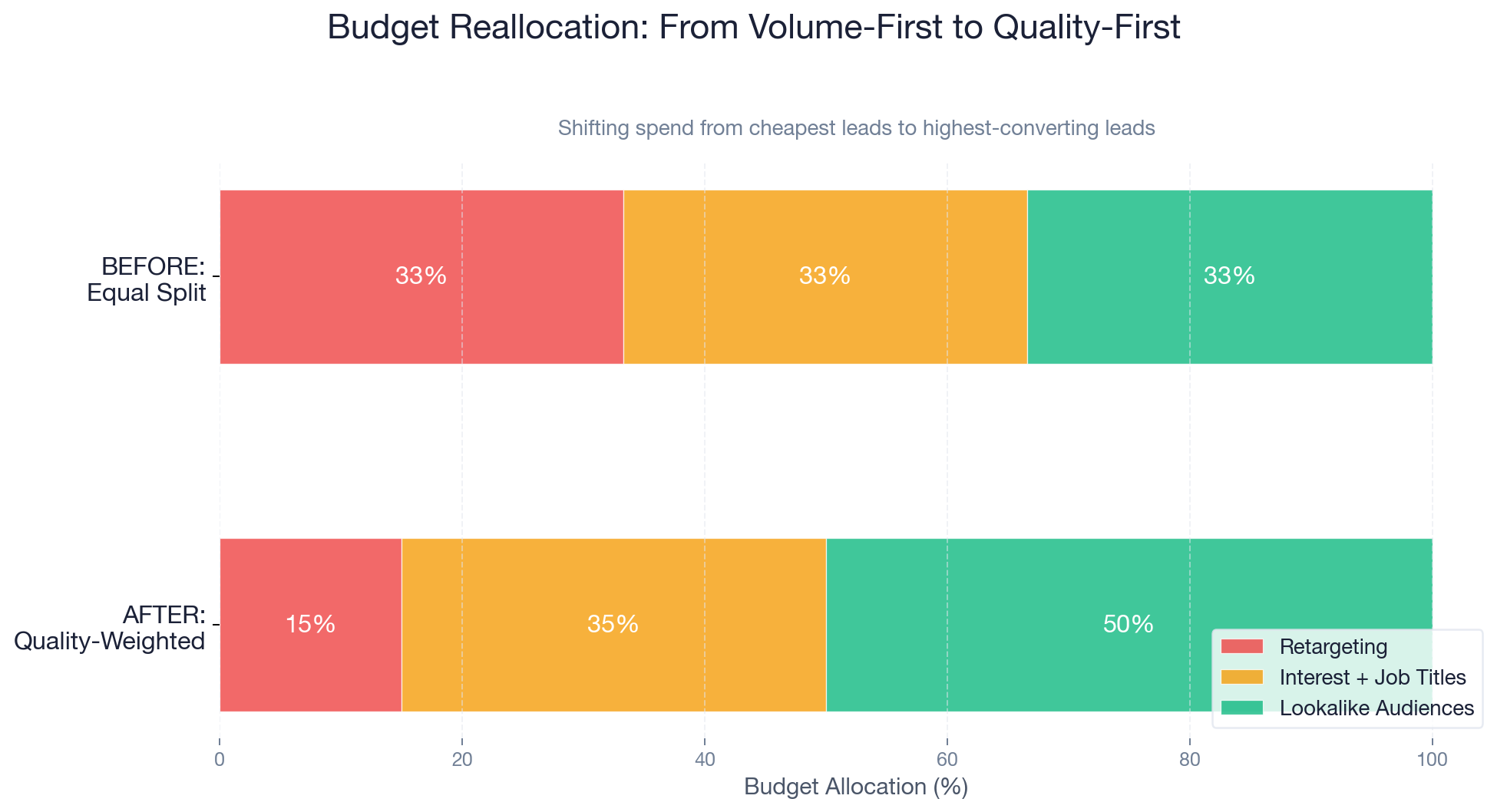
- After rebalancing to quality-first allocation, projected cost per qualified lead drops by 35% within two weeks.
We ran the numbers on a brand new B2B SaaS client last month. The team was celebrating a $65 blended CPL, down 12% from the previous quarter. Their board deck looked great. Their pipeline projections looked better. Then we asked a question nobody had bothered to ask: how many of those cheap leads actually bought anything?
The answer was brutal.
Out of 59 registrations across four ad sets, only five converted to purchases. And the ad set with the lowest CPL, the one getting the most budget, produced exactly zero of those five purchases. The retargeting audience was cranking out $50 registrations that went absolutely nowhere. Meanwhile, a lookalike audience generating $90 registrations was quietly responsible for three of the five purchases.
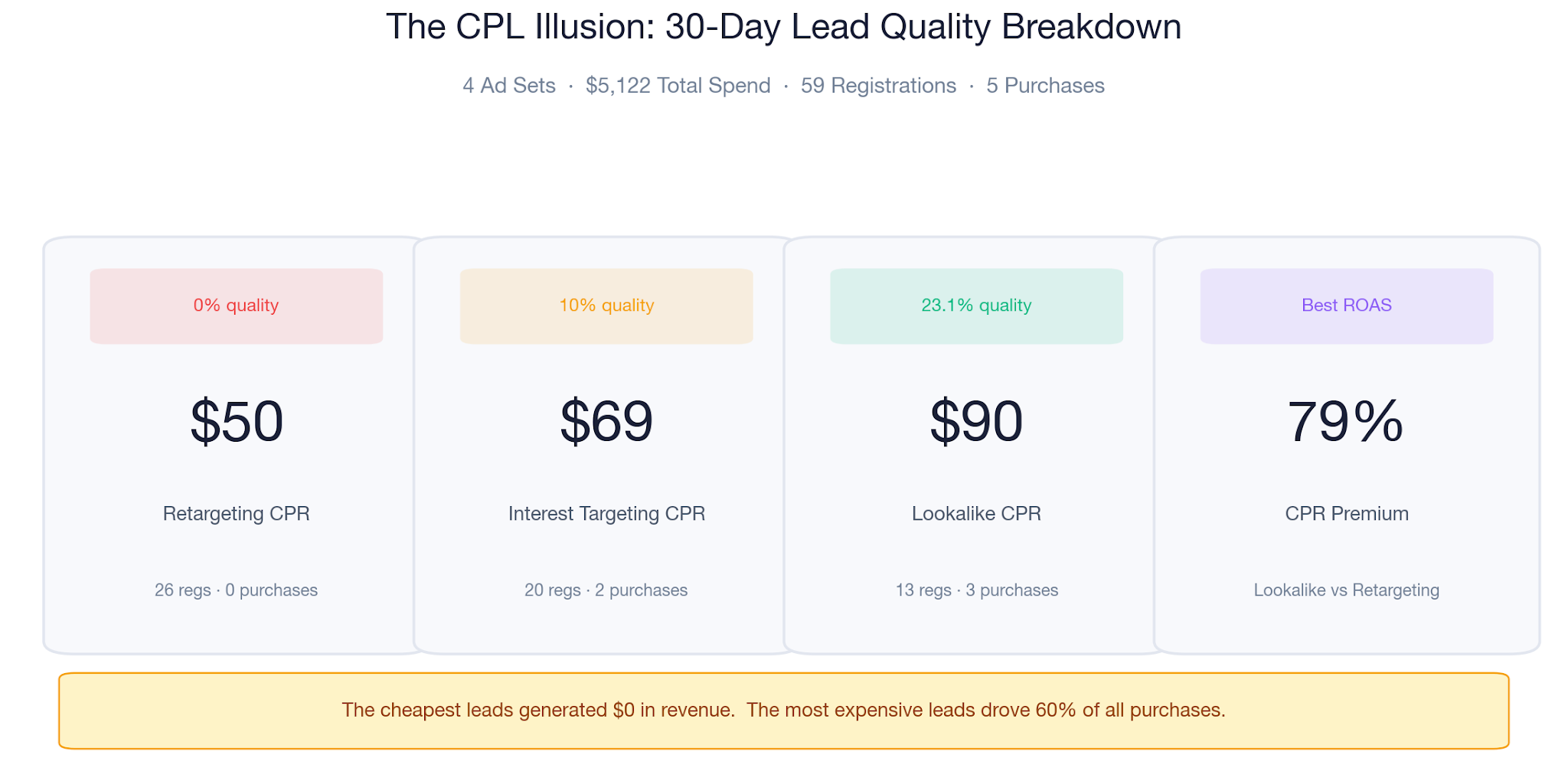
This is the Meta Ads B2B SaaS lead quality problem that most teams do not know they have. Meta optimizes for the conversion event you choose, not for what happens downstream. Your CRM knows the truth, but stitching CRM data back to ad set performance means exporting CSVs, matching UTMs, and burning two to three hours every week on spreadsheet gymnastics. Most teams just skip it and keep optimizing for CPL.
Claude and the Meta Ads MCP connector kill that excuse. In our complete guide to AI-powered paid social management, we covered the full setup. This article focuses on one specific, high-leverage use case: scoring lead quality by ad set and reallocating budget based on revenue impact, not vanity CPL. You will get a repeatable prompt sequence, a quality scoring framework, and the exact budget reallocation logic we use with B2B SaaS paid social clients.
How Chasing CPL Costs You Real Revenue
Let's be honest. Every B2B SaaS paid media team has a CPL target. Finance wants it. The board deck needs it. And Meta's algorithm is more than happy to deliver it. The problem is that CPL measures volume at the top of the funnel and tells you nothing about what happens after the form submit.
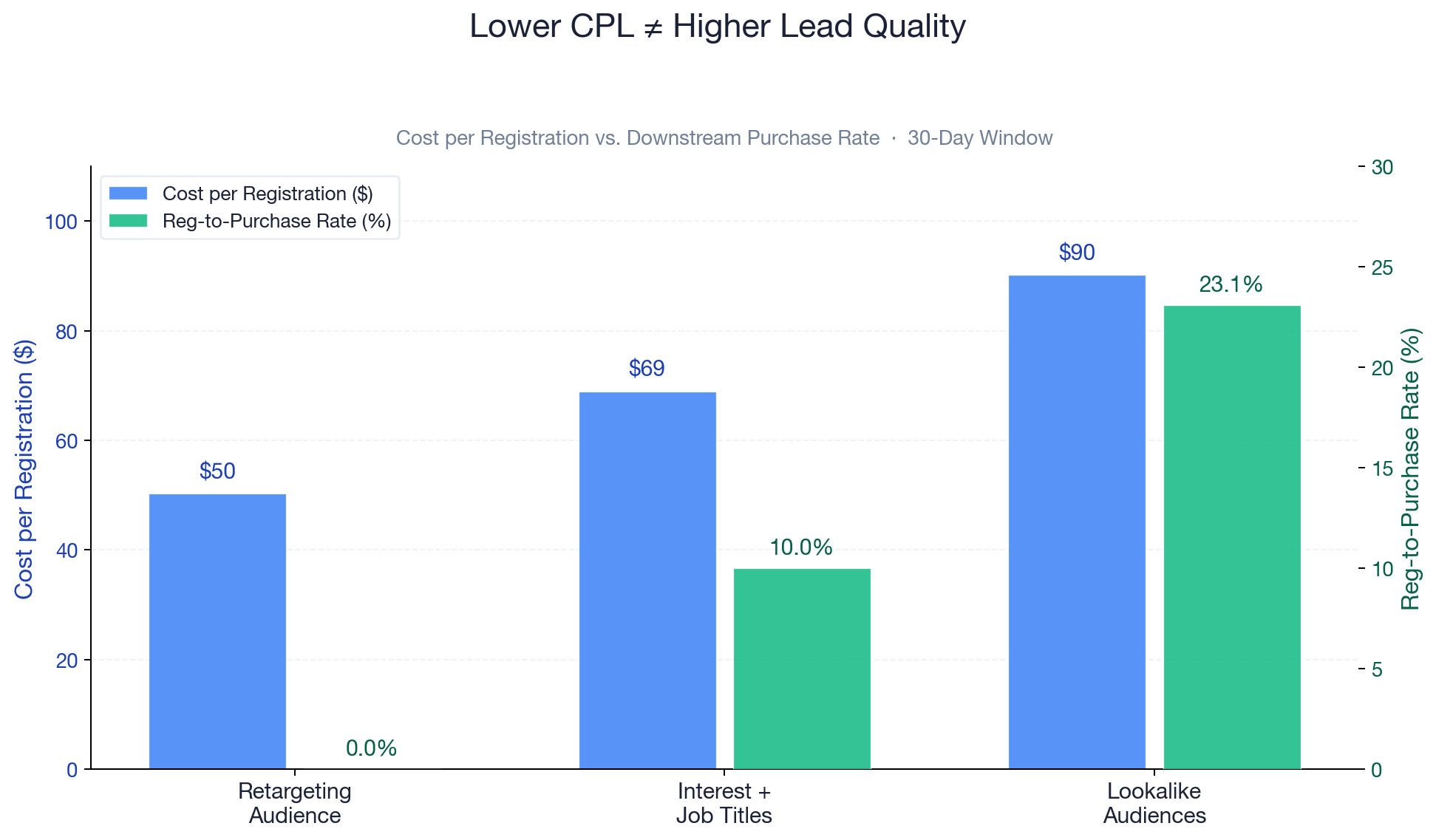
Here is what the data actually looks like when you break it down by ad set type. We pulled 30 days of performance from a B2B SaaS account running three conversion-optimized ad sets and one awareness campaign through the AI PPC agent:
If you are only looking at the Cost per Reg column, retargeting wins by a landslide. But retargeting generated zero purchases. Every single one of those 26 registrations was a dead end from a revenue perspective. The lookalike ad set, the one a CPL-focused team would cut first, was the only source generating meaningful downstream conversions.
This is not an edge case. We see this pattern across Facebook ads for SaaS accounts consistently. Retargeting audiences are warm. They click. They fill out forms. But in B2B, a form fill from someone who already visited your pricing page three times is not the same as a form fill from a net-new decision maker who matches your ICP.
The cost of this blind spot compounds. Teams that optimize for CPL shift budget toward retargeting month after month, starving prospecting audiences that actually build pipeline. Within a quarter, your retargeting pool shrinks (because you are not feeding it with new prospects), CPL creeps up anyway, and revenue stalls. This is the death spiral of CPL optimization in B2B. Understanding paid ads spend management at this level is what separates teams that scale from teams that stall.
How Claude + MCP Tracks Lead Quality Automatically
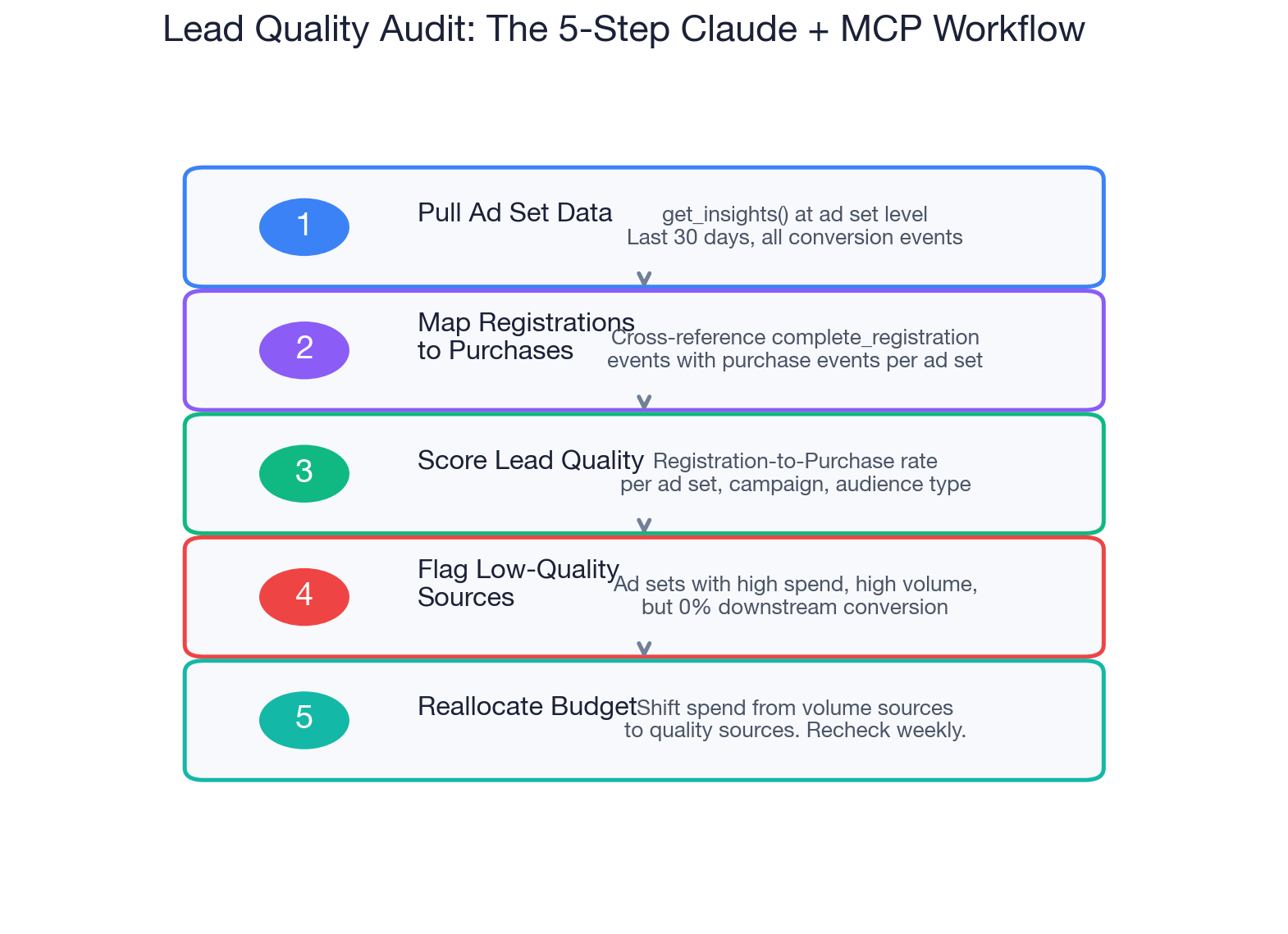
Here is the exact workflow. You do not need to export anything, open Ads Manager, or touch a spreadsheet. Everything happens inside a single Claude conversation using the AI in PPC workflow.
Step 1: Pull Ad Set Performance with Conversion Breakdowns
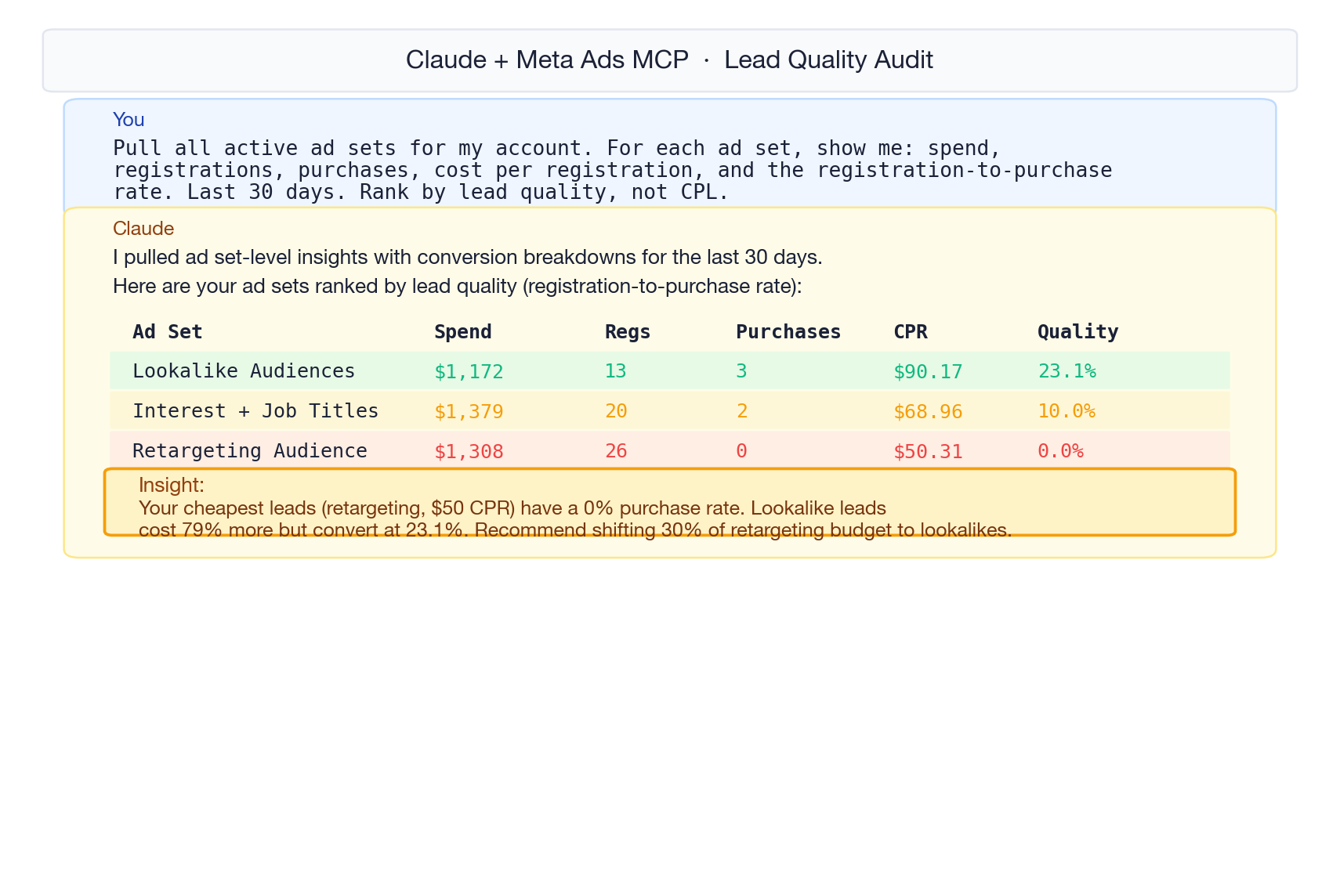
"Pull all active ad sets for my account. For each ad set, show me: spend, registrations (complete_registration events), purchases, cost per registration, and the registration-to-purchase rate. Last 30 days."
Claude calls get_insights() at the ad set level with a 30-day time range and returns a clean table. No tab switching. No CSV exports. The data lands in your conversation in about 15 seconds.
Step 2: Calculate the Quality Score
The quality score is straightforward: registration-to-purchase rate. For each ad set, divide purchases by registrations and multiply by 100.
Ask Claude to run this automatically: "Rank those ad sets by lead quality, not by CPL. Show me which audiences are actually driving revenue."
Step 3: Cross-Reference Targeting Configurations
This is where it gets powerful. Ask Claude to pull the targeting details for the top-performing ad set:
"For the ad set with the highest quality score, show me the full targeting configuration: custom audiences, interests, job titles, exclusions, and geo."
Claude calls get_adset_details() and surfaces the targeting stack. In our analysis, the highest-quality ad set used 1% lookalike audiences seeded from past purchasers and pageview audiences, with a purchaser exclusion. That combination consistently produces the best registration-to-purchase rates in B2B PPC accounts.
Step 4: Generate Budget Reallocation Recommendations
"Based on the quality scores, recommend a budget reallocation across these three ad sets. Optimize for downstream revenue, not CPL. Keep total daily budget the same."
Claude produces a reallocation plan: cut retargeting from 33% to 15% of budget, hold interest targeting at 35%, and increase lookalikes to 50%. You are shifting dollars from the ad set that generates cheap dead-end registrations toward the ad set that generates expensive but revenue-producing leads. The weekly budget recommendation workflow can automate this rebalancing on a recurring schedule.
Real-World MCP Walkthrough: Multi-Campaign Quality Audit
Here is how this plays out in practice. A B2B SaaS company running presentation software had three active campaigns: a remarketing conversion campaign, a prospecting conversion campaign (with two ad sets: interest/job title targeting and lookalike targeting), and a broad awareness campaign optimized for reach.
The team was reporting a blended CPL of $65 and calling it a win. But when we ran the lead quality audit through Claude, the picture changed completely.
The remarketing campaign had the best CPL ($50) and the highest volume (26 registrations). On a dashboard, it looked like the star performer. But cross-referencing with purchase events revealed zero downstream conversions. Every registration from remarketing was a dead end.
Meanwhile, the lookalike ad set had the worst CPL ($90) but the best quality score (23.1% registration-to-purchase rate). The interest-plus-job-title ad set sat in the middle: $69 CPL, 10% quality score, two purchases.
The awareness campaign generated zero registrations by design (optimized for reach), but it was feeding the retargeting pool. So the real question became: is the awareness campaign feeding a retargeting pool that generates zero revenue? That is a question you cannot answer in Ads Manager. It requires the kind of cross-campaign analysis that Claude handles in a single conversation.
We used a similar approach in our guide to managing multiple Meta Ads accounts. If you are running Meta Ads for multiple products, you can run this quality audit across all accounts in one session. The process mirrors what we cover in running a full Meta Ads account audit, but focused on downstream lead quality rather than structural health.
For teams also running Google Ads for SaaS, apply the same quality-over-volume framework using the Google Ads audit with Claude workflow.
Common Mistakes in B2B Lead Quality Tracking
Mistake 1: Using blended CPL as the primary KPI. Blended CPL averages your best and worst audiences together. A $65 blended CPL sounds great until you realize it is the average of $50 (zero revenue) and $90 (actual revenue). Report CPL by ad set, not by account. Always pair it with the registration-to-purchase rate. Teams using AI-powered Meta Ads reporting can automate this breakdown.
Mistake 2: Not excluding purchasers from prospecting. Without a purchaser exclusion list, your retargeting and lookalike audiences overlap with people who already bought. They register again (inflating your CPL metrics) but never purchase again. If you have not set up exclusions, start with our guide to finding and fixing audience overlap.
Mistake 3: Running the quality audit monthly instead of weekly. Audience quality degrades faster than creative performance. A lookalike audience that converts at 23% this week might drop to 8% next week if Meta's algorithm shifts the audience composition. It takes 10 minutes with Claude. Monthly audits let bad allocation compound for three extra weeks.
Mistake 4: Ignoring the awareness-to-retargeting pipeline. If your awareness campaign feeds a retargeting pool that generates zero revenue, you are paying twice for nothing. Use the weekly performance report workflow to track this pipeline holistically.
Best Practices for Meta Ads B2B Lead Quality
- Set up a weekly Claude prompt that pulls registration and purchase events by ad set. Save the prompt as a template so anyone on the team can run it. The whole process takes under 10 minutes.
- Always pair CPL with registration-to-purchase rate in your reporting. Present both numbers side by side. If your CFO only sees CPL, they will optimize for the wrong thing.
- Seed your lookalike audiences from purchaser lists, not website visitors. Purchaser-seeded lookalikes consistently outperform visitor-seeded lookalikes on downstream quality metrics.
- Use Advantage+ audience expansion cautiously. It broadens targeting automatically, which can dilute lead quality. Check the quality score weekly when Advantage+ is enabled.
- Build a quality-weighted budget allocation model. Divide total budget by quality score, not by CPL. The ad set with the highest registration-to-purchase rate gets the largest share.
- Integrate your CRM conversion data with Meta's offline conversions API. This closes the loop and lets Meta optimize for actual revenue events. Until you do this, Claude's cross-referencing is the next best thing.
If you are setting up lookalike audiences for the first time, our tutorial on how to create lookalike audiences in Meta Ads Manager walks through the step-by-step process. And for competitive intelligence on how other B2B companies structure their quality-focused campaigns, check out how to spy on competitors' Facebook ads.
Stop Optimizing for the Cheapest Lead. Start Optimizing for Revenue.
CPL is not a quality metric. It is a volume metric wearing a quality disguise. In B2B SaaS, where a single qualified deal can be worth $50,000 or more in annual contract value, the difference between a $50 registration that goes nowhere and a $90 registration that turns into pipeline is the difference between a successful quarter and a missed target.
Claude and the Meta Ads MCP make lead quality tracking practical. You do not need a data engineer, a BI tool, or three hours of spreadsheet work. You need one prompt, one conversation, and 10 minutes. The workflow we covered, pull registrations, map to purchases, calculate quality scores, reallocate budget, is repeatable and gets faster every time you run it.
For deeper dives into other dimensions of Meta Ads optimization, check out our guides on detecting creative fatigue automatically, Meta Ads budget pacing, and our creative testing and audience research playbook.
Lead quality scoring is the first thing we check when onboarding a new Meta Ads account. We use Claude and the Meta Ads MCP to run this exact audit as part of our B2B SaaS paid social management. If you want us to run this on your account and show you where your budget is going to waste, book a call with our paid media team.
Frequently Asked Questions
What is Meta Ads B2B SaaS lead quality, and how is it different from CPL?
Meta Ads B2B SaaS lead quality measures how many of your registrations actually progress to downstream revenue events like purchases or closed-won deals. CPL only tells you what you paid for the form fill. A $50 CPL means nothing if zero of those leads ever buy. Quality scoring adds a second dimension: the registration-to-purchase rate, which reveals which audiences generate leads that actually convert.
How do I check Meta Ads lead quality using Claude and MCP?
Ask Claude to pull ad set-level insights with both registration and purchase events for the last 30 days. Claude calls the Meta Ads MCP connector, retrieves the data, and calculates the registration-to-purchase rate for each ad set automatically. The entire process takes under 10 minutes and does not require any CSV exports or spreadsheet work.
What is a good registration-to-purchase rate for B2B SaaS Meta Ads?
For B2B SaaS, a 10-25% registration-to-purchase rate is strong. Below 5% indicates your targeting is generating low-intent leads. Above 25% is exceptional and usually comes from tightly seeded lookalike audiences with proper exclusions. The benchmark varies by deal size and sales cycle length.
How often should I audit Meta Ads B2B SaaS lead quality?
Weekly. Audience quality shifts faster than creative performance, especially when Advantage+ audience expansion is enabled. Monthly audits let bad budget allocation compound for three extra weeks. With Claude and MCP, the audit takes 10 minutes, so there is no reason to delay it.
Can Claude track lead quality across multiple Meta Ads accounts?
Yes. Claude can pull data from multiple Meta Ads accounts in the same conversation using the MCP connector. This is useful for agencies managing several B2B SaaS clients or companies running separate accounts for different products. You can compare quality scores across accounts to identify which account structures produce the best downstream conversion rates.
What is the difference between CPL optimization and lead quality optimization in Meta Ads?
CPL optimization tells Meta to find the cheapest registrations possible, which often means retargeting warm visitors who fill out forms but never buy. Lead quality optimization shifts budget toward audiences with the highest registration-to-purchase rate, even if the cost per registration is higher. In B2B SaaS, paying $90 for a lead that converts is far more valuable than paying $50 for one that does not.
How do I fix low lead quality in my Meta Ads B2B campaigns?
Start by running the quality audit: pull registration and purchase events by ad set and calculate the registration-to-purchase rate. Then reallocate budget away from ad sets with high volume but low quality scores toward ad sets with proven downstream conversions. Also ensure you are excluding past purchasers from all prospecting ad sets to prevent inflated registration counts.
Does Advantage+ audience expansion affect Meta Ads B2B SaaS lead quality?
It can. Advantage+ automatically broadens your targeting beyond the audiences you selected, which sometimes dilutes lead quality by reaching users outside your ICP. Monitor your quality score weekly when Advantage+ is enabled. If the registration-to-purchase rate drops, consider disabling Advantage+ or narrowing your seed audiences to maintain quality.

summarize with ai


