.png)

Keyword research is the foundation of every Google Ads strategy, but it's often treated as a one-time task done at account setup and rarely revisited systematically. In practice, the keyword landscape shifts constantly — new terms emerge, existing terms change in intent, and the search queries your actual customers use often differ meaningfully from the terms you thought they'd use.
With Claude connected to your live Google Ads data via MCP, keyword research becomes a continuous, data-grounded process. The prompts in this playbook cover the full keyword research workflow.
Phase 1: Mining Your Own Data First
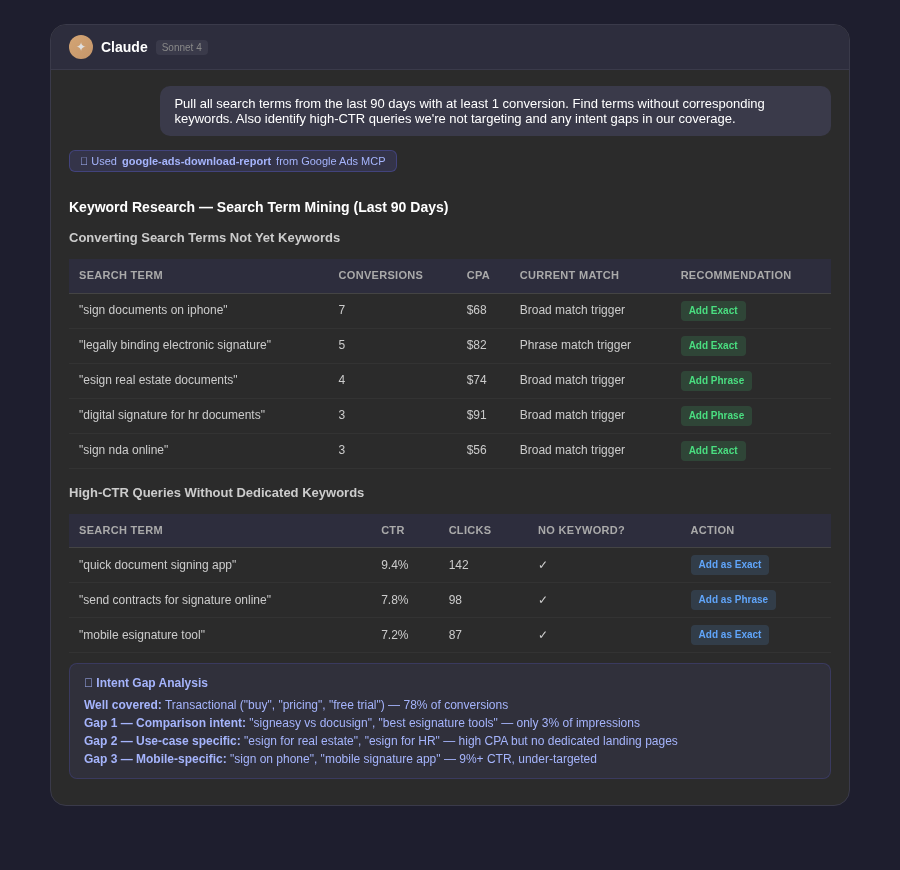
Prompt: Search Term Mining for New Keywords
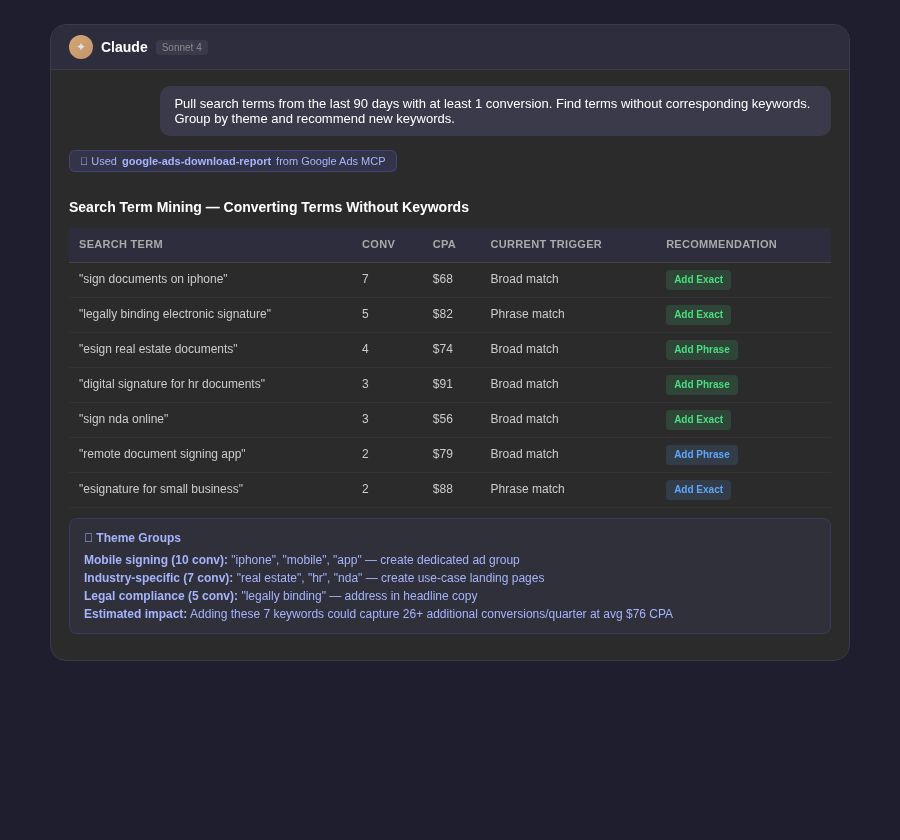
Pull all search terms from the last 90 days that generated at least 1 conversion. Identify terms that don't already exist as keywords in my account, or exist only as broad match keywords. Group them by theme. For the top themes by conversion volume, recommend new exact match or phrase match keywords to add, with suggested starting bids based on the CPA those terms have already demonstrated.
Prompt: High-CTR Queries Without Keywords
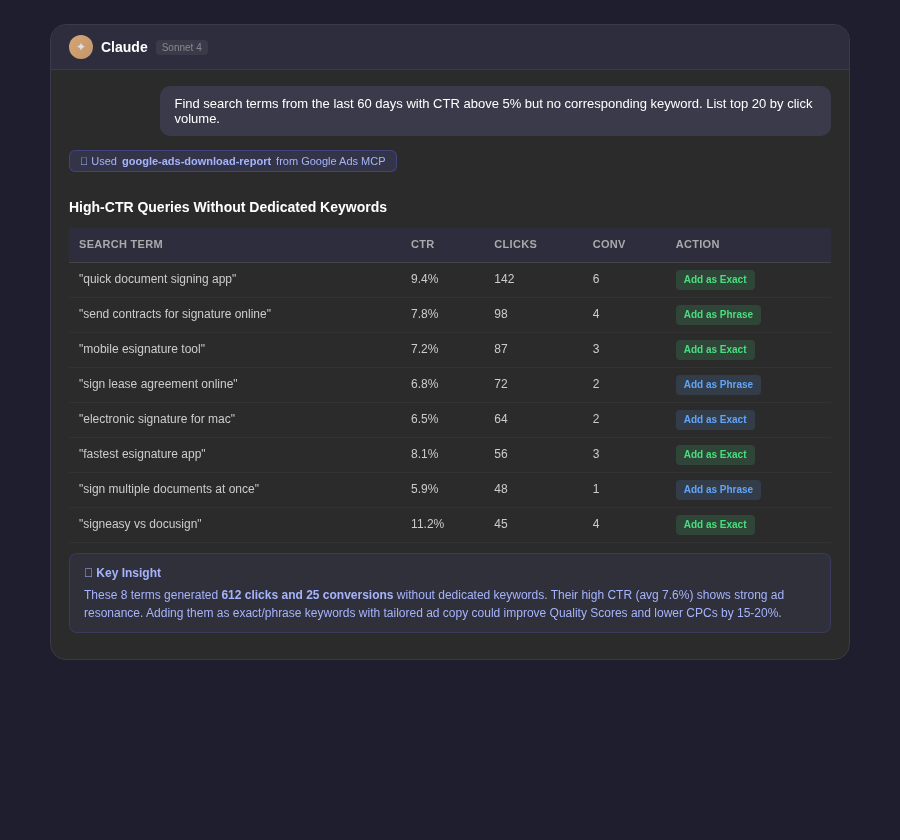
Find search terms from the last 60 days with a CTR above 5% but no corresponding keyword in my account. These are queries where my ads are already resonating but I'm not targeting them directly. List the top 20 by click volume and recommend which to add as keywords.
Prompt: Seasonal and Trend Detection
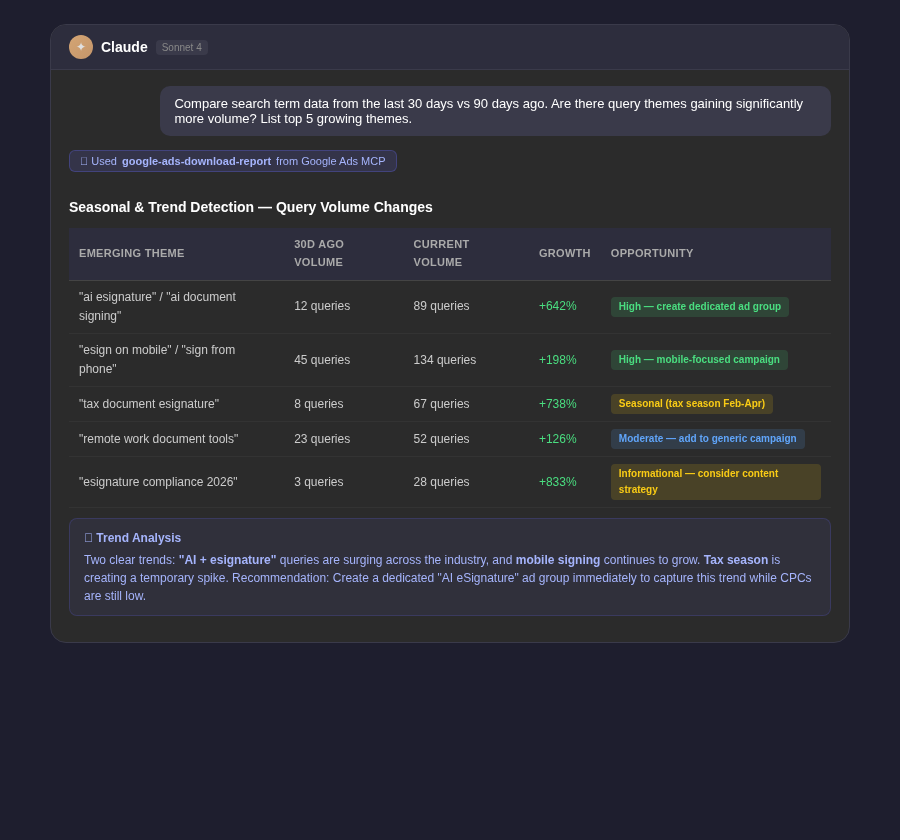
Compare search term data from the last 30 days against the same period last year (or against 90 days ago). Are there any query themes gaining significantly more volume recently? These might represent emerging trends worth targeting proactively. List the top 5 growing query themes.
Phase 2: Expanding Beyond Your Current Data
Prompt: Intent Gap Analysis
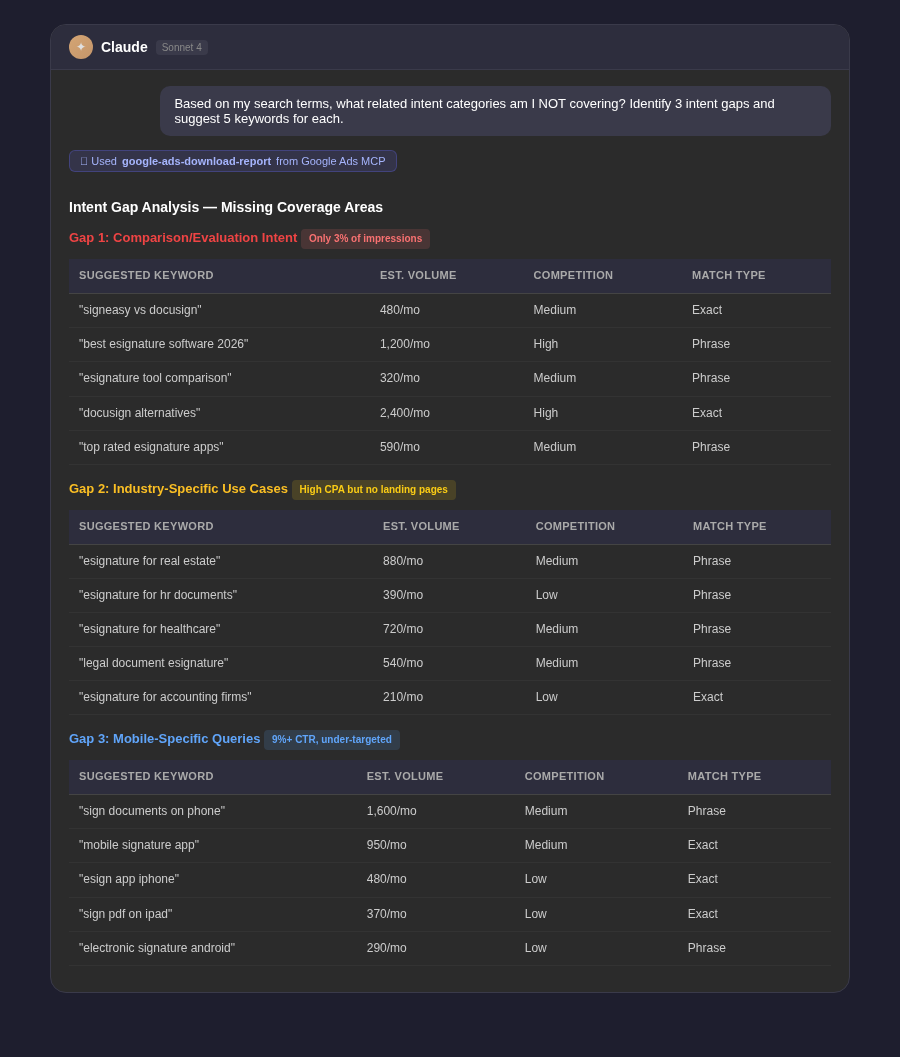
Based on the search terms I'm appearing for, what related intent categories am I NOT covering? For example, if I'm capturing transactional queries well, am I also present for the comparative or research-phase queries that precede a purchase decision? Identify 3 intent gaps and suggest 5 keywords for each.
Prompt: Question-Based Keyword Expansion
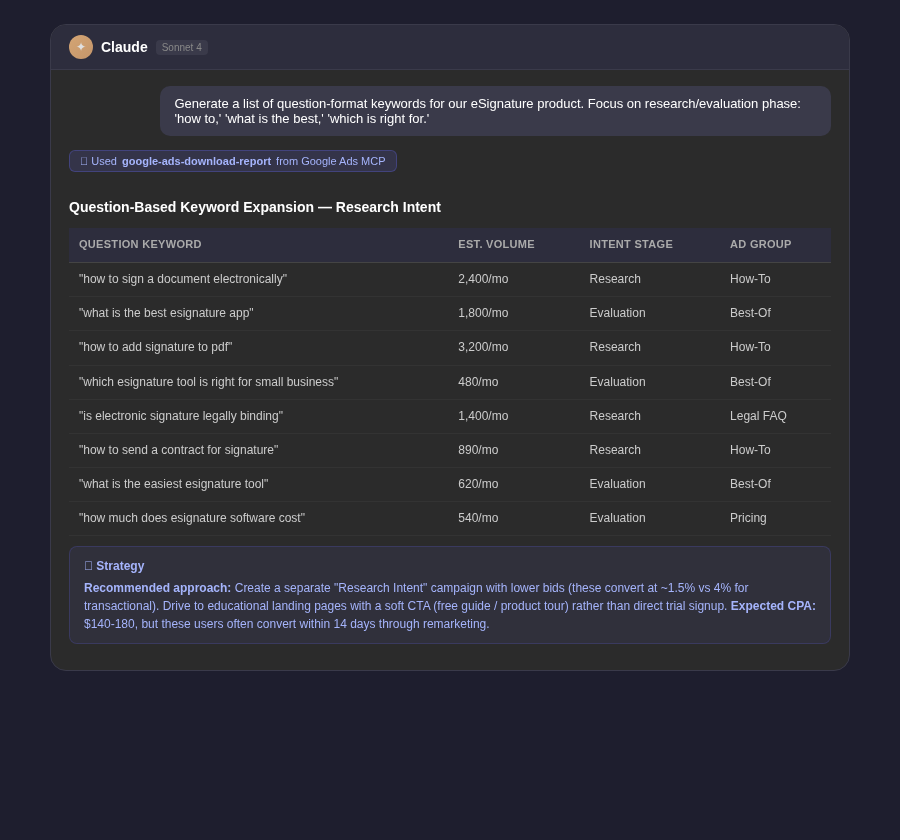
Generate a list of question-format keywords relevant to my product or service ([describe product/service]). Focus on questions that indicate someone is in the research or evaluation phase — 'how to,' 'what is the best,' 'which [product] is right for.' These are useful for targeting informational intent.
Prompt: Keyword Clustering by Intent
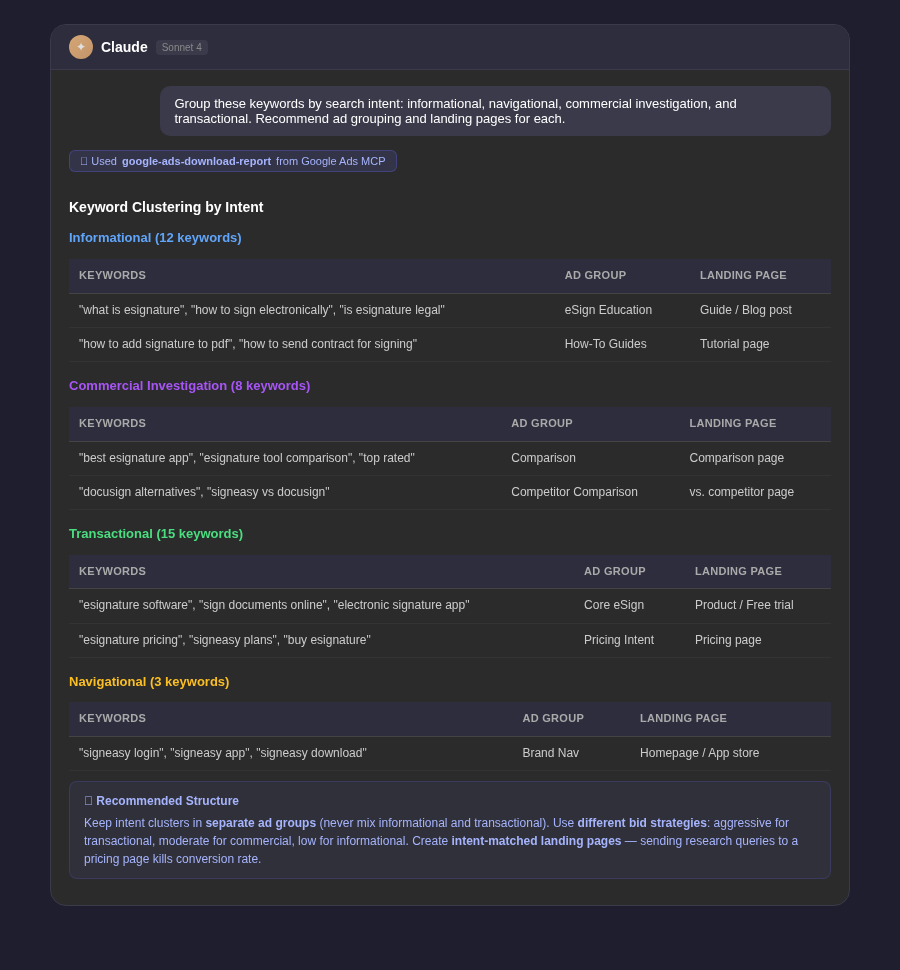
Take the following list of keywords: [paste keyword list]. Group them into clusters based on search intent: informational, navigational, commercial investigation, and transactional. For each cluster, recommend whether they belong in the same ad group or should be separated, and suggest appropriate landing page types for each intent.
Phase 3: Refining and Pruning
Prompt: Keyword Performance Triage
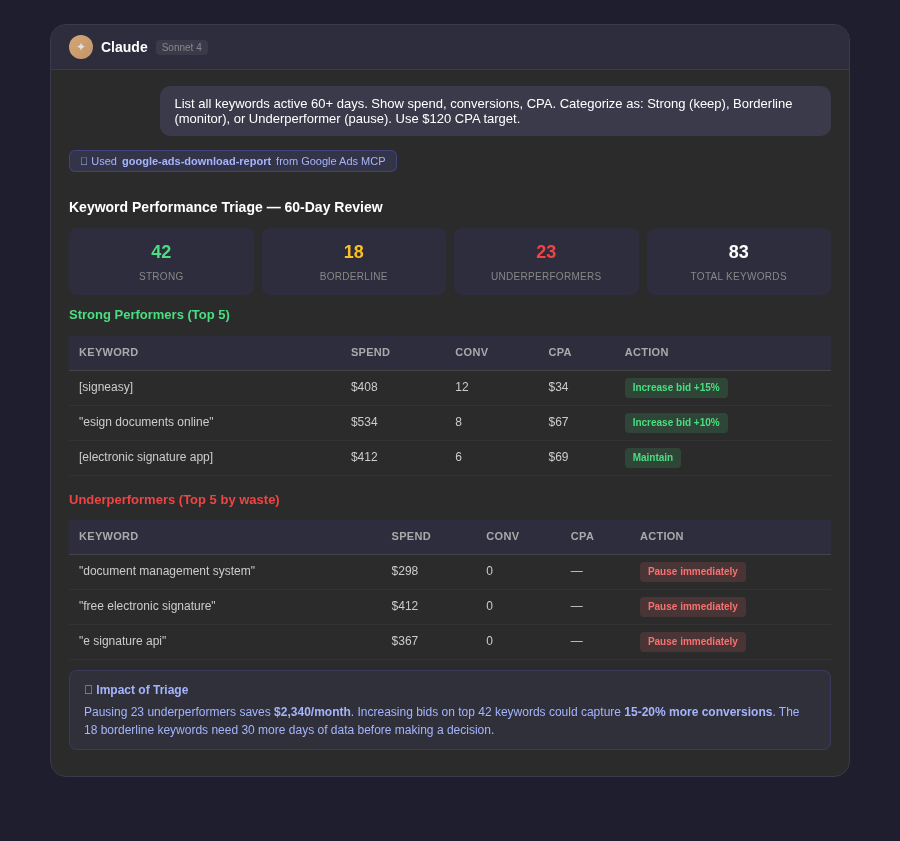
List all keywords in my account that have been active for at least 60 days. For each, show spend, conversions, and CPA. Flag keywords in one of three categories: (1) Strong performers — keep and potentially increase bids, (2) Borderline — needs monitoring or bid reduction, (3) Clear underperformers — recommend pausing. Use our target CPA of [$X] as the benchmark.
Prompt: Match Type Consolidation
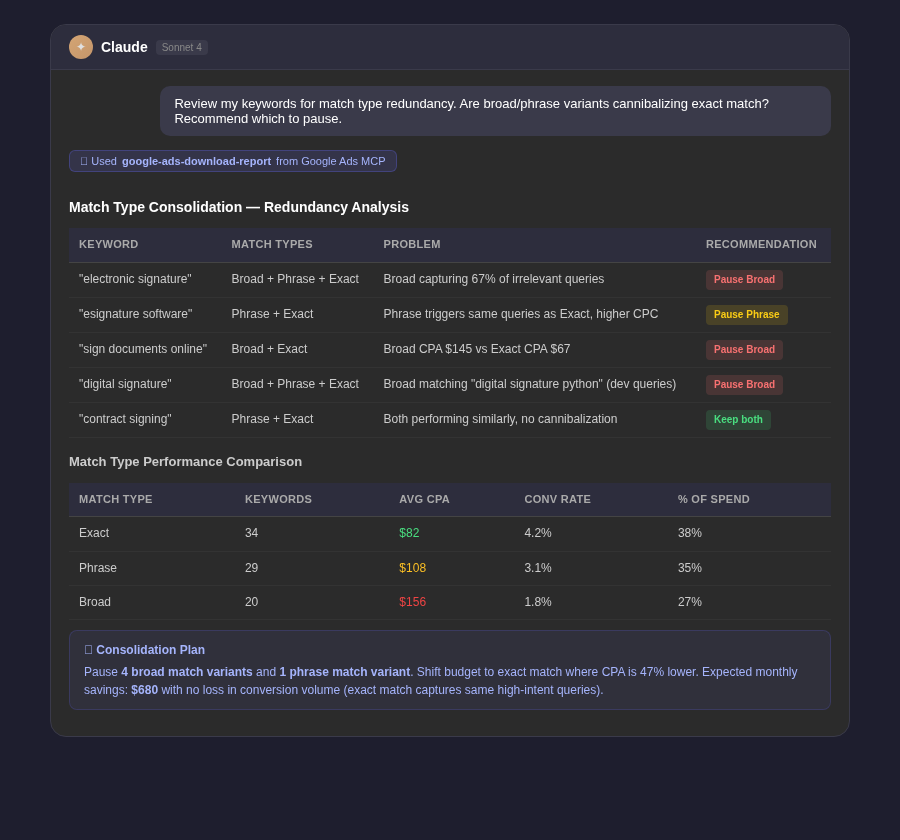
Review my keyword list for unnecessary redundancy in match types. Are there cases where I have the same keyword in broad, phrase, and exact match, but the broad or phrase variants are cannibalizing the exact match by matching irrelevant queries? Recommend which match type variants to pause for each redundant group.
Phase 4: Ongoing Keyword Monitoring
Prompt: Monthly Keyword Health Report
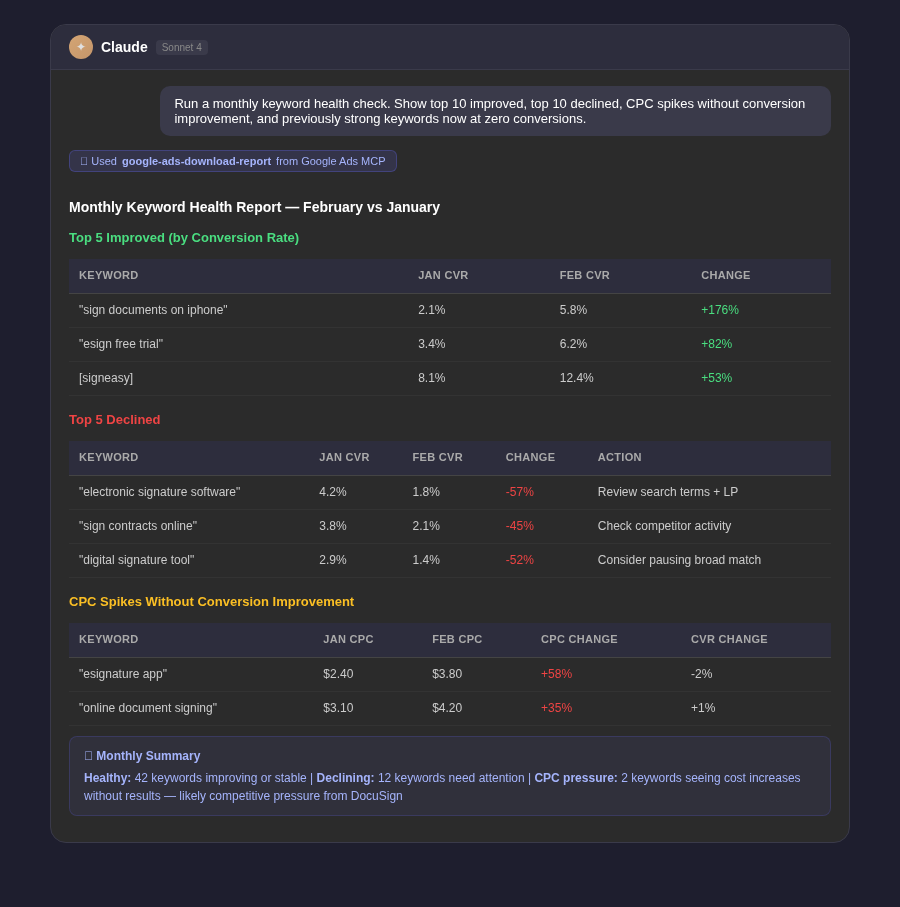
Run a monthly keyword health check. Show me: (1) the 10 keywords that improved the most in conversion rate this month vs last month, (2) the 10 that declined the most, (3) any keywords where CPC increased by more than 20% without a corresponding improvement in conversion rate, and (4) keywords that were previously strong but have had zero conversions in the last 30 days. Recommend actions for each category.
Tip: The most valuable keyword insights come from combining search term mining (what people are actually searching) with keyword performance data (what's converting). Running both analyses together monthly gives you a full picture — what to add, what to prune, and what to promote.

Get the best SaaS tips in your inbox!
No top-level BS. Actionable SaaS marketing and growth content only.



.webp)
.webp)

.png)


.png)





.webp)





.webp)


.webp)





%20(1).png)


.webp)
.webp)
.webp)





%20Ads%20for%20SaaS%202026_%20Types%2C%20Strategies%20%26%20Best%20Practices%20(1).webp)





.webp)










.webp)




![Creating an Enterprise SaaS Marketing Strategy [Based on Industry Insights and Trends in 2026]](https://cdn.prod.website-files.com/632b673b055f4310bdb8637d/6a218bacea463474377dfd32_34%20-%20Creating%20an%20Enterprise%20SaaS%20Marketing%20Strategy.png)



























.webp)






%20Agencies%20for%20B2B%20SaaS%20Compared%20(2026).webp)

.webp)
%20with%20Hubspot.webp)


_%20Expert%20Reviews%20%26%20Comparisons.png)







.webp)






_%20Comparison%2C%20Strengths%2C%20and%20How%20to%20Choose.png)











.webp)




.webp)




.webp)























%20Tools%20in%202026_%20Vetted%20List.webp)



![How to Measure AEO Success: 12 Metrics Beyond Clicks [2026 Framework]](https://cdn.prod.website-files.com/632b673b055f4310bdb8637d/6a0d664b326187e99b3d5960_6%20-%20The%20Ultimate%20Guide%20to%20Measuring%20AEO%20Success%20in%202026.png)
![7-Step Workflow for AEO-Ready Content [2026 Framework]](https://cdn.prod.website-files.com/632b673b055f4310bdb8637d/6a0d55ea88913ede1d3a7123_5%20-%20Workflows%20for%20Optimized%20AEO-Ready%20Content%20Creation.png)
.png)
![How to Structure Content for AEO and GEO [With Templates]](https://cdn.prod.website-files.com/632b673b055f4310bdb8637d/6a0c6a56eb700472e635ff33_1%20-%20How%20to%20Structure%20%20Content%20for%20AEO%20and%20GEO%20%20Summaries%20(2026).png)








.png)
.png)










.png)

.png)

.png)






%2520Agencies%2520(2025).png)

![Top 9 AI SEO Content Generators for 2026 [Ranked & Reviewed]](https://cdn.prod.website-files.com/632b673b055f4310bdb8637d/6858e2c2d1f91a0c0a48811a_ai%20seo%20content%20generator.webp)




.webp)
.webp)
.png)


.png)













.webp)