Claude Skills for SEO Agencies: Scale Client Delivery Without Scaling Headcount

Key Takeaways
- The bottleneck in SEO agency delivery is the synthesis layer that converts raw data into client-ready deliverables, not the data retrieval step.
- Six core Claude Skills handle 80% of repeatable agency work: content briefs, SEO audits, content gap analysis, internal linking, fact-checking, and GEO audits.
- Shared Skill frameworks with client-specific Direction prompt variants let you onboard new verticals in under an hour instead of rebuilding from scratch.
- Adding a fintech client to an existing Skill framework takes 45 minutes of Direction prompt configuration.
- Quarterly Direction prompt audits prevent output drift as client positioning and competitor sets evolve.
- The capacity math: one strategist with Skills produces what previously required 2.5 strategists on manual workflows.
Your senior strategist spent four hours yesterday building a content brief. Not thinking strategically.
Not analyzing data. Assembling a document.
Pulling keyword data from Ahrefs, opening the top four ranking pages in separate tabs, scanning H2 structures, cross-referencing internal links, drafting FAQ questions, formatting everything into a Google Doc.
That playbook repeats for every brief, every client, every week.
Meanwhile, three accounts need quarterly audits by Friday. The backlog on internal linking retroactive runs is two months deep. And the hiring pipeline for another analyst is six weeks out.
This is the synthesis bottleneck. And it is the structural problem that determines whether your agency scales profitably or hits the same capacity ceiling every growing agency hits.
The Synthesis Bottleneck: Where Agency Time Really Goes
Every SEO agency runs the same two-step process for every deliverable. Step one: retrieve data. Step two: synthesize that data into a client-ready output.
Step one is fast. Pulling keyword reports, running crawls, exporting backlink profiles. Ten minutes, maybe fifteen.
Step two is where the hours go. Interpreting the data, structuring the deliverable, applying client-specific formatting, checking competitor H2s, cross-referencing internal links, drafting recommendations. And here is the thing that makes this a solvable problem: the synthesis process follows the same structural pattern every single time. Different inputs, same framework.
That is the definition of a Skill candidate.
Claude Skills operate on this synthesis layer. They take structured inputs (keyword data, URLs, client context), run them through a configured Claude prompt with tool integrations, and return the finished output in the format your team uses. The SEO thinking stays human. The assembly of the deliverable becomes automated.
Teams running AI-powered workflows through platforms like Slate publish 5 to 6 times more content than teams relying on manual processes. The AI handles the assembly work that used to consume 70% of a strategist's day. When you free up that 70%, your strategist focuses on the analysis and strategy they were hired for.
The Six Core Skills Every SEO Agency Should Deploy
These are the six Skill types we run across our client portfolio. Each one maps to a high-frequency, high-structure deliverable that follows the same synthesis pattern regardless of client.
1. Content Brief Generator (Keyword to Content Brief)
The highest-frequency deliverable in any agency. Our Keyword to Content Brief workflow in Slate runs through 25 nodes to produce a writer-ready brief in under 10 minutes.
Here is what the finished brief contains:
- Target keyword with live Ahrefs metrics (volume, KD, CPC, traffic potential)
- Full H2/H3 outline reverse-engineered from the top five ranking pages
- Five FAQ questions sourced from People Also Ask and competitor FAQ sections
- Internal link suggestions pulled from the client's sitemap with priority scoring
- Competitive angle analysis identifying the content gap the piece should fill
- Word count recommendation based on SERP competitor analysis
The full content brief Skill build guide walks through the pipeline structure, Direction prompt template, and Ahrefs integration. This single Skill typically saves 45 to 50 minutes per brief compared to manual production.
2. SEO Audit Skill (Refresh Content for SERP)
Quarterly audits for every account, structured consistently. The Refresh Content for SERP workflow (currently at v16 in Slate) pulls data for the client domain and up to three competitors, then synthesizes it into a prioritized report:
- Executive summary with three headline findings
- Page-level findings ranked by severity (critical, high, medium, low)
- Competitive benchmarks showing where the client leads and trails
- 90-day action roadmap with estimated impact per recommendation
What took a full analyst day per account now takes 30 minutes of senior review. The analyst day gets reallocated to implementing the recommendations instead of producing the report.
3. Content Gap Audit
Run at onboarding and quarterly thereafter. The Research on Content/Brief workflow scrapes competitor blog archives, extracts topic clusters, scores gaps against Ahrefs traffic data, and returns a prioritized CSV of 15 to 20 content opportunities with estimated traffic potential per piece.
Your analyst reviews the ranked list and populates the content calendar. The gap analysis that used to take a senior strategist half a day now takes 20 minutes of review and prioritization.
4. Internal Linking Engine
Every new piece gets processed before publication. The Internal Linking Engine (v2 in Slate) scrapes the client sitemap, categorizes URLs by priority hierarchy (product pages first, then pillar content, then supporting posts), inserts 5 to 8 contextually appropriate links, and returns a link insertion report showing what was added and why.
The retroactive batch capability is where the real value compounds. Running the engine across an existing 200-post archive surfaces hundreds of missed internal linking opportunities. One batch run on a logistics SaaS client's blog added 340 internal links across 180 posts in a single afternoon.
The internal linking Skill guide covers the retroactive archive processing workflow and priority hierarchy configuration.
5. Fact-Checker
Non-negotiable for every content piece containing statistics before publication. The fact-checker Skill extracts every factual claim, searches for the primary source, and classifies each as Verified, Uncertain, or Incorrect. It provides the original source link, publication date, and a confidence assessment.
For fintech and cybersecurity clients, this is a production requirement. One outdated market-size figure in a fintech blog post undermines months of credibility building with financially sophisticated readers.
6. GEO Audit Skill
Quarterly for any client with AI search visibility goals. The GEO audit Skill runs five parallel subagent analyses (AI Citability, Platform Presence, Technical Infrastructure, Content Quality, Schema Markup) and produces a composite score out of 100 with a prioritized action plan.
The AEO Enhancer (v13) and AEO Score Card (v7) workflows in Slate handle the ongoing optimization work that the audit surfaces. The Schema Generator (v1) produces the JSON-LD for schema gaps identified in the audit.
Pair this with the keyword research Skill for clustering, intent classification, and the Ahrefs integration that feeds live data into every other workflow in the stack.
Multi-Client Architecture: How It Actually Works
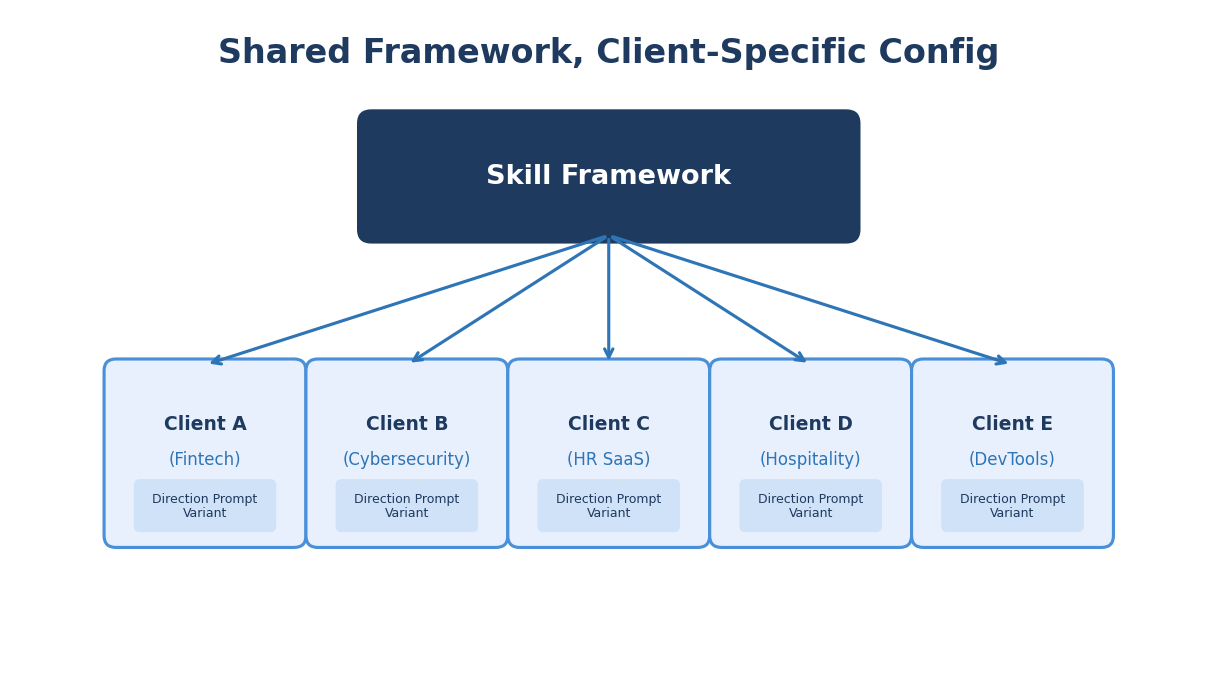
The most important architectural decision you will make: build shared Skill frameworks with client-specific Direction prompt variants. You are building one Skill per task type and configuring it differently per client.
The Direction prompt is the configuration layer. It contains:
- Brand context: Company name, product positioning, target audience, tone of voice
- Competitive context: Primary competitors, differentiation points, topics to avoid
- Technical context: CMS platform, sitemap URL, preferred URL structure
- Quality standards: Word count ranges, heading depth, link density, citation requirements
Everything else is infrastructure that does not change between clients. The Ahrefs integration, the sitemap scraper, the SERP analyzer, the output formatting... all shared.
Adding a Fintech Client: The 45-Minute Walkthrough
Here is exactly what you configure when onboarding a new fintech client to the existing Skill framework:
Minutes 0 to 10: Brand context block. Company name, one-paragraph positioning statement, three primary competitors, target ICP description. Pull this from the client onboarding doc.
Minutes 10 to 20: Source priority hierarchy. Fintech clients get a custom source priority: SEC filings and Federal Reserve data first, then KPMG/Deloitte benchmark studies, then peer-reviewed financial research, then industry publications like American Banker. This hierarchy configures the fact-checker and feeds into the content brief's citation instructions.
Minutes 20 to 30: Compliance layer. Add the compliance flags: qualified language requirements ("as of Q1 2026..."), regulated product category identifiers (lending, insurance, investment products), and the human-review trigger for any content touching those categories. This layer does not exist in the standard B2B SaaS configuration.
Minutes 30 to 40: Tool connections and test runs. Connect the client's sitemap URL, verify the Ahrefs integration pulls data for the correct domain, run a test keyword research query and a test content brief. Validate outputs against the quality standard.
Minutes 40 to 45: Deploy and document. Push the Direction prompt variant live, tag it with the client name, and log the configuration decisions for the quarterly audit.
That is 45 minutes of configuration to give a new fintech client access to the entire six-Skill stack. No custom development. No workflow rebuilds. Just Direction prompt configuration.
Compare that to the alternative: two weeks of custom setup per client, with each strategist maintaining their own brief templates, audit formats, and linking processes.
How This Scales Across Verticals
The same framework extends to every vertical. A cybersecurity client gets a different source priority hierarchy (NIST, MITRE, vendor threat intelligence reports). An HR SaaS client gets a different compliance layer (EEOC guidelines, labor law citation requirements). A DevTools client gets a different competitive context (open-source alternatives, GitHub star counts as social proof metrics).
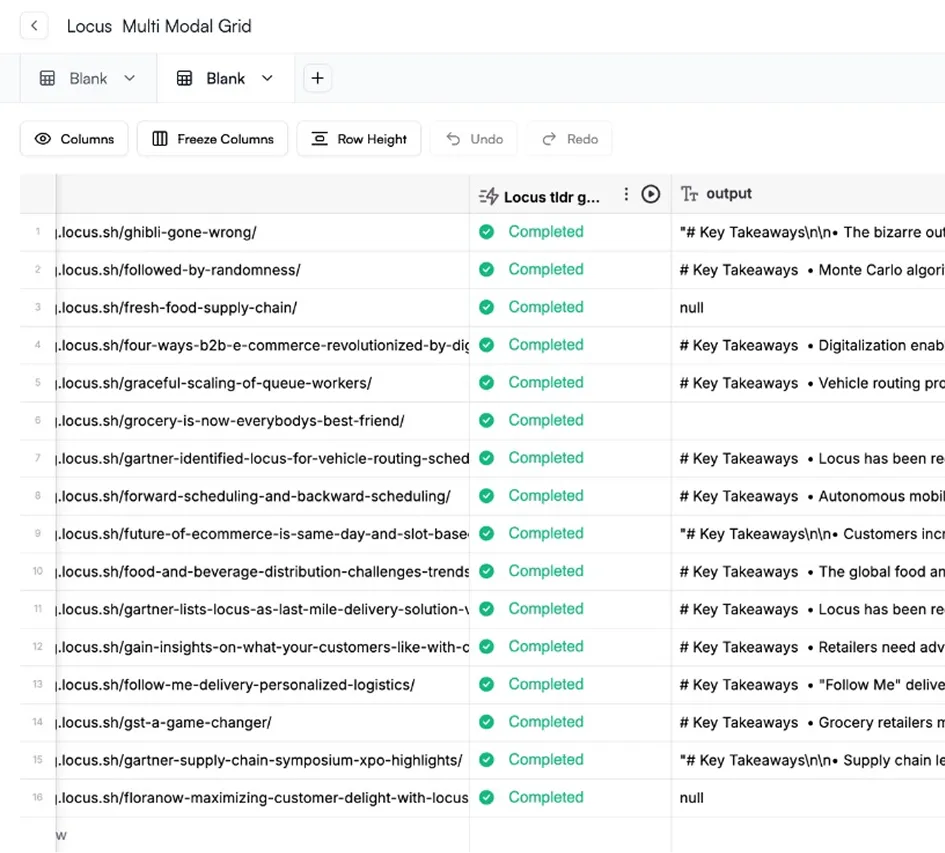
The Slate workspace above shows this in practice: multiple client workflows running through the same Skill framework with client-specific configurations producing tailored outputs at scale.
Preventing Direction Prompt Drift
Skills do not degrade on their own. They drift when Direction prompts are not maintained as client requirements evolve.
Here is what drift looks like in practice.
Before drift (Month 1): The content brief Skill for a payments SaaS client produces briefs targeting mid-market CFOs evaluating AP automation platforms. The competitive analysis references Tipalti, Bill.com, and Stampli. The tone is authoritative and data-forward. Output quality: consistently strong.
After drift (Month 6, no audit): The client's ICP expanded to include enterprise treasury teams. Their main competitor launched a new product line that changed the comparison landscape. Their brand voice guidelines updated to emphasize "platform" over "tool." The Skill is still producing Month 1 outputs. They are good outputs. They are also wrong for the current reality.
After quarterly audit (Month 6, with audit): The strategist pulls five recent brief outputs, compares them against the current client positioning doc, identifies three drift points (ICP expansion, competitor set change, terminology update), and updates the Direction prompt. Thirty minutes of work. The Skill is current again.
Our practice: quarterly Direction prompt audits for every production Skill. Pull a sample of five recent outputs per Skill per client, compare against the quality standard set at launch, update where output has drifted. The audit takes half a day per quarter for a 10-client portfolio.
For verticals with fast-changing data, like fintech, monthly fact-checker source list reviews are standard. Financial data changes faster than most Direction prompt elements, so the source hierarchy needs more frequent validation.
The Capacity Math: What Changes When You Deploy This Framework
Here are the numbers from our own deployment.
Before Skills (manual workflow):
- Content briefs: 60 minutes each
- Quarterly SEO audits: 6 to 8 hours each
- Internal linking (new posts): 30 minutes per post
- Internal linking (retroactive): not feasible at scale
- Content gap analysis: 4 hours per client
- Fact-checking: 45 minutes per piece
After Skills:
- Content briefs: 10 minutes (review only)
- Quarterly SEO audits: 30 minutes (review only)
- Internal linking (new posts): 5 minutes (review only)
- Internal linking (retroactive): automated batch runs
- Content gap analysis: 20 minutes (review only)
- Fact-checking: 10 minutes (review only)
What this means for a 15-client portfolio producing 12 pieces per month per client:
Manual: 180 briefs per month at 60 minutes = 180 hours of brief production alone. That is 4.5 full-time strategists doing nothing but building briefs.
With Skills: 180 briefs per month at 10 minutes of review = 30 hours. Less than one full-time strategist on brief review. The other 3.5 FTE-equivalents of capacity get reallocated to strategy, client communication, and analysis.
Multiply that recovery across all six Skill types and the total recovered capacity is 60 to 80 hours per month per strategist. That is the difference between an agency that grows headcount proportionally to client count and one that scales profitably.
The SEO automation playbook covers broader automation strategy. Skills are the execution layer that makes the strategy operational.
Deploying the Stack: Sequence and Rationale
The content brief Skill goes first. Always.
It is the highest-frequency deliverable, the most structurally predictable task, and the one where a subpar automated output carries the least risk. A brief that needs tweaking is a 5-minute fix. A bad audit recommendation that reaches a client is a relationship problem.
Weeks 1 to 2: Content brief Skill. Configure for your three highest-volume clients. Run 10 test briefs per client. Validate against your best manually-produced briefs. Deploy.
Weeks 3 to 4: Internal linking engine and fact-checker. These are QA Skills that improve every piece passing through your pipeline. Deploy across all clients simultaneously since the client-specific configuration is minimal.
Weeks 5 to 6: SEO audit and content gap analysis. These are lower frequency (quarterly) but higher complexity. Configure and test with two to three clients before full portfolio rollout.
Weeks 7 to 8: GEO audit. The most architecturally complex Skill. Deploy after the team has confidence in the simpler Skills and the Direction prompt audit cadence is established.
Build the content brief workflow first. The momentum from early wins makes the case for deploying the rest of the stack.
What the Slate Workflow Library Provides
The Slate workflow library includes pre-built versions of every Skill referenced in this article:
- Keyword to Content Brief (25 nodes)
- Internal Linking Engine (v2)
- External Linking Engine (v2)
- Refresh Content for SERP (v16)
- AEO Enhancer (v13)
- Backlink Analysis (v17)
- Schema Generator (v1)
- AEO Score Card (v7)
- Generate Meta Title and Description (v1)
- Content Brand Enhancer (v11)
- Generate FAQs (v10)
- Publish to Webflow (v2)
Each workflow comes with a default Direction prompt that you configure for your clients. The framework is operational. You configure the client-specific layer, run test outputs, and deploy.
TripleDart runs this exact Skill stack across 250+ B2B SaaS client accounts. We have Direction prompt templates for SaaS verticals ready to configure. Book a call to map the Skill framework against your client portfolio and see which Skills would recover the most strategist capacity.
Try Slate here: slatehq.com
Frequently Asked Questions
How do Skills handle client confidentiality across a shared framework?
Each client's Direction prompt variant is isolated. Data, prompts, and outputs live in dedicated configurations within the Slate workspace. Zero cross-client data flows. The shared infrastructure is the Skill framework itself (the nodes, integrations, and output structure). The client-specific layer (brand context, competitive context, source priorities) stays siloed.
Can the brief Skill handle different content formats?
Yes. Maintain separate Direction prompt variants per format: listicle, long-form guide, comparison page, product-led content. Conditional logic in the workflow selects the right Direction based on the content type input. Some agencies maintain 3 to 4 format variants per client.
What is the minimum client size where Skills make sense?
Any client producing 8 or more pieces per month or requiring quarterly audits. Below that threshold, the Direction prompt configuration time does not recover enough manual hours to justify the setup. For smaller clients, batch them into a shared "general B2B SaaS" Direction prompt.
Do Skills reduce content quality?
Our experience: brief quality improved after Skill deployment. The Skill always checks competitor H2s, always pulls fresh Ahrefs data, always applies the agreed format. Human strategists sometimes skip steps when rushing. The Skill never does.
How long to onboard a new client to the existing framework?
45 to 60 minutes per Skill: update the Direction prompt, verify tool connections, run five test inputs, validate output quality, deploy. A full six-Skill onboarding takes half a day.
What happens when a Skill produces a poor output?
It is always a Direction prompt issue. Check the output against the quality standard, identify which instruction is underperforming, and refine that specific section. Poor outputs are diagnostic. They tell you exactly where the Direction prompt needs adjustment.
Can junior team members use Skills effectively?
That is the entire point. Skills encode the methodology of your senior strategists. Junior team members generate output that meets senior-level quality standards because the expertise is embedded in the Direction prompt and workflow structure, not dependent on the person running it.
How do Skills integrate with existing project management tools?
MCP connectors exist for ClickUp, Asana, Monday, and Linear. Completed Skill runs can trigger task creation with output documents automatically linked. The workflow stays in Slate; the task management stays in your existing tool.
How often should Direction prompts be audited?
Quarterly is the minimum cadence for all Skills. For verticals with fast-changing data (fintech, cybersecurity), monthly audits on the fact-checker source list are standard. If a client undergoes a major positioning change mid-quarter, audit the affected Direction prompts immediately.
What is the ROI timeline for a 15-client agency?
Week 1: first brief Skill deployed, immediate time savings visible. Month 1: three to four Skills operational, 40 to 60 hours recovered monthly. Month 3: full stack deployed across the portfolio, 150+ hours recovered monthly. That is roughly 1 FTE of recovered senior capacity per quarter of deployment.
.png)
summarize with ai


