.png)


Key Takeaways
- AEO is becoming essential for search visibility. AI platforms like ChatGPT, Google AI Overviews, and Perplexity are changing how users discover content, making AI citations just as important as traditional rankings.
- Traditional SEO alone is no longer enough. Brands now need structured, answer-focused content optimized for extraction, citation, and conversational AI queries.
- Content structure has a direct impact on AI visibility. Clear headings, concise definitions, bullet points, tables, and FAQ-style formatting increase the chances of being cited by AI engines.
- Bing indexation and schema markup are critical for AEO success. Since ChatGPT relies on Bing’s index, optimizing for both Google and Bing while implementing structured data is essential.
- Authority and freshness drive AI trust. AI engines prioritize expert-led, data-rich, frequently updated content backed by strong E-E-A-T signals and multi-platform brand presence.
- TripleDart helps B2B SaaS brands build AI-visible content programs through technical AEO optimization, AI-focused content structuring, schema implementation, and AI citation tracking strategies designed to improve visibility across ChatGPT, Google AI Overviews, and Perplexity.
AI-powered search isn't a trend to watch anymore. It's the channel your buyers are already using. Over 50% of Google searches now trigger an AI Overview, and ChatGPT crossed 100 million daily active users faster than any product in history. If your content isn't optimized to be cited by these systems, it's invisible to a growing share of your audience.
Answer Engine Optimization (AEO) is the practice of structuring, formatting, and distributing content so that AI-powered platforms like ChatGPT, Google AI Overviews, Perplexity, and Claude select it as a cited source when answering user queries. Unlike traditional SEO, which competes for ranked positions in a list of links, AEO competes for citation in a synthesized answer. The goal shifts from "rank on page one" to "be the source the AI quotes."
Based on our work optimizing content for AI visibility across 50+ B2B and SaaS brands, we've distilled the most impactful tactics into this 42-step AEO checklist. We've seen what actually moves the needle and what wastes time, and this guide reflects both.
The checklist is organized into seven categories: technical foundation, content structure, authority signals, platform-specific optimization, voice search, multi-platform presence, and measurement. Work through them sequentially or jump to the category where your gaps are largest. Let's get started.
How Does AEO Differ from SEO in 2026?
AEO doesn't replace SEO. It extends it. Traditional SEO optimizes for ranking algorithms that sort a list of links by relevance and authority. AEO optimizes for AI retrieval systems that synthesize a single answer from multiple sources and decide which to cite. In SEO, you compete for a position. In AEO, you compete for citations.
Every AEO tactic in this checklist builds on a strong SEO foundation. If your technical SEO is broken, no amount of answer optimization will get you cited.
How Do AI Answer Engines Select Sources?
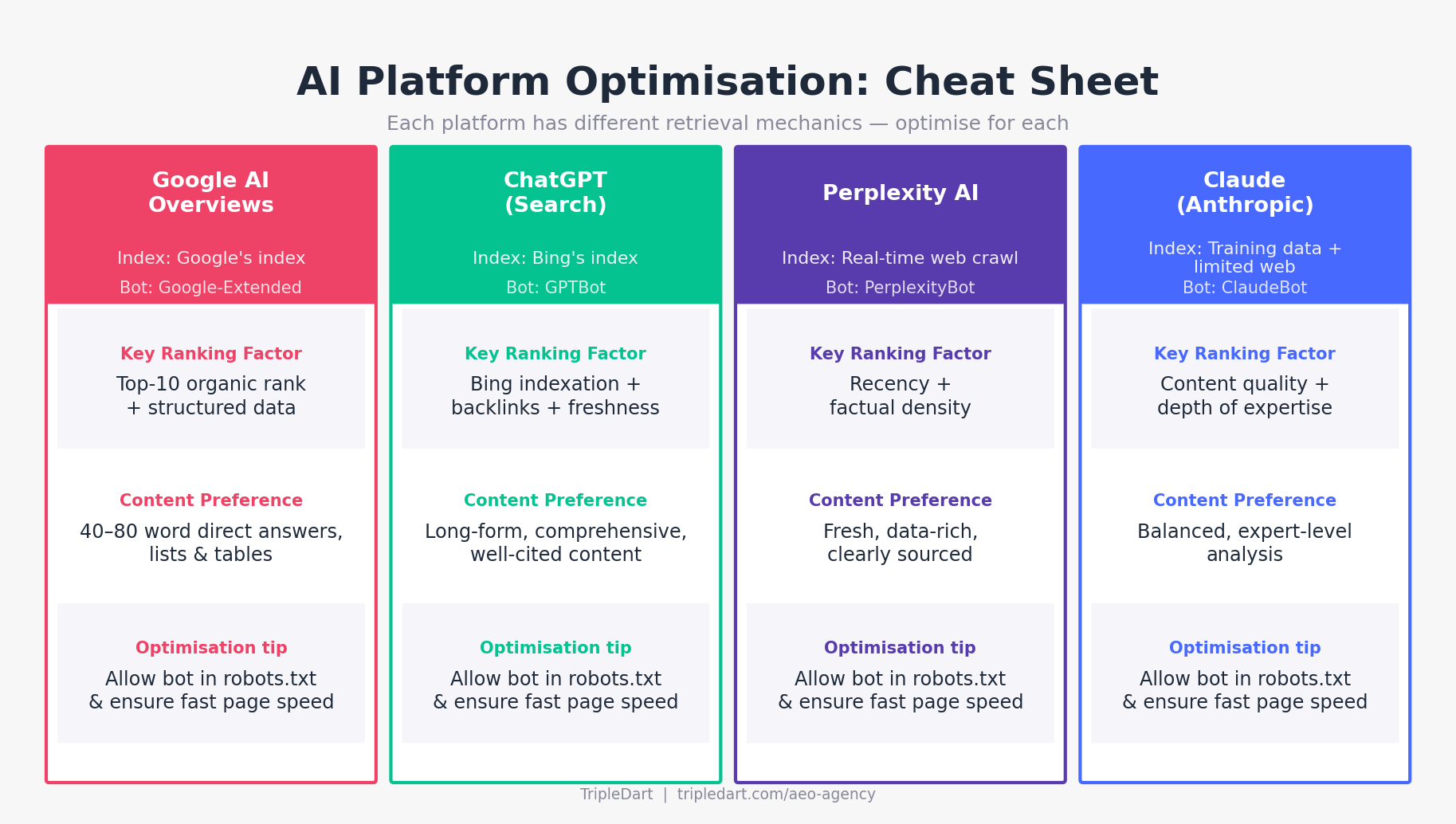
Understanding the retrieval mechanics behind each platform is what separates strategic AEO from guesswork.
- Google AI Overviews pull from Google's own search index, favoring pages that already rank in the top 10 and provide concise, structured answers.
- ChatGPT with search uses Bing's index via retrieval-augmented generation (RAG, a process where the model retrieves live web content before generating a response), meaning Bing indexation and Bing-favored signals like backlinks and freshness matter significantly.
- Perplexity crawls the web in real-time with its own bot, prioritizing recency and factual density above almost everything else.
- Claude has more limited web access but draws from training data where high-authority, widely-distributed content has a compounding advantage.
Why Is Traditional SEO Necessary but Not Sufficient?
You still need crawlability, indexation, and technical health. AI engines can't cite what they can't find. You still need domain authority and backlinks, which remain trust signals for both Bing and Google.
What SEO alone doesn't cover: content structure optimized for extraction, entity clarity across platforms, factual density with cited sources, and multi-platform presence. The 42 steps below address both the SEO foundations and the AEO-specific layers you need to build on top of them.
What Is the Technical Foundation for AI Visibility?
Without these technical prerequisites in place, no amount of content optimization will get you cited by AI engines.
1. Ensure Full Crawlability by AI Bots
Many sites inadvertently block AI crawlers through default CMS settings or security plugins. Audit your robots.txt file and server-level configurations for these specific user-agent strings: GPTBot (OpenAI/ChatGPT), Google-Extended (Google AI Overviews), PerplexityBot (Perplexity), and ClaudeBot (Anthropic).
This is the single highest-impact, lowest-effort action on this entire list. If AI bots can't crawl your site, nothing else matters.
User-agent: GPTBot
Allow: /
User-agent: Google-Extended
Allow: /
User-agent: PerplexityBot
Allow: /
User-agent: ClaudeBot
Allow: /
A thread in r/seogrowth from early 2026 confirmed this is the most commonly missed step in basic AEO audits, with many WordPress sites blocking AI bots through Wordfence or Cloudflare bot management by default.
2. Verify Indexation Across Search Engines
Here's the most commonly overlooked point in AI search optimization: ChatGPT relies on Bing's index, not Google's. Most SEOs only check Google Search Console.
Verify indexation in both Google Search Console and Bing Webmaster Tools. Run site:yourdomain.com in both Google and Bing and compare the page counts. If Bing shows significantly fewer indexed pages, submit your sitemap to Bing immediately. We've seen sites with 100% Google indexation but only 40% Bing indexation, making them effectively invisible to ChatGPT.
3. Submit and Optimize XML Sitemaps
Ensure XML sitemaps are submitted to both Google and Bing. Accurate lastmod dates matter because AI engines use them as freshness signals. Keep sitemaps under 50,000 URLs and prioritize high-value content pages over thin or duplicate pages.
4. Implement Comprehensive Schema Markup
AI engines use structured data to understand content context, entity relationships, and content type. The most important schema types for AEO are Article, FAQPage, HowTo, Organization, Person, Product, and Review. Match schema type to content type: FAQPage schema on pages with FAQ sections, HowTo schema on tutorial content.
Schema doesn't guarantee citation, but it significantly improves the odds by making your content machine-readable.
Research from BlogSEO.io found that the Definition + Micro-FAQ content pattern delivers a 38% citation rate uplift in Google AI Overviews and Copilot. Structured data is what makes those patterns machine-readable.
{
"@context": "https://schema.org",
"@type": "FAQPage",
"mainEntity": [{
"@type": "Question",
"name": "What is AEO?",
"acceptedAnswer": {
"@type": "Answer",
"text": "AEO (Answer Engine Optimization) is the practice of optimizing content to be cited by AI-powered answer engines like ChatGPT, Google AI Overviews, and Perplexity."
}
}]
}
Validate your implementation with Google's Rich Results Test before publishing.
5. Optimize Core Web Vitals and Page Speed
Fast-loading pages get crawled more deeply and more frequently by AI bots. Target LCP under 2.5 seconds, INP under 200ms, and CLS under 0.1. Perplexity's bot crawls frequently and may deprioritize slow-responding servers. Use PageSpeed Insights to audit and prioritize fixes.
6. Implement HTTPS and Security Best Practices
HTTPS is a baseline trust signal. Ensure all pages serve over HTTPS with no mixed content warnings. If this isn't already in place, fix it before anything else.
7. Create and Maintain a Clean URL Architecture
Use descriptive, keyword-rich URLs that communicate page topic. Avoid parameter-heavy or dynamically generated URLs. Implement proper canonical tags to prevent duplicate content confusion. AI crawlers that encounter duplicate content may cite neither version.
How Can You Optimize Content Structure?
This is the highest-impact category for most sites. How you structure content determines whether AI engines can extract and cite it.
8. Use Clear, Hierarchical Heading Structure
AI engines parse heading hierarchy to understand content organization and identify the most relevant section for a given query. Every page needs exactly one H1, logical H2 sections, and H3 subsections.
Headings should be descriptive and, where appropriate, phrased as questions that match how users prompt AI engines. Avoid vague headings like "Overview." Use specific ones like "How Schema Markup Improves AI Citation Rates."
9. Lead Every Section with a Direct Answer
This is the single most important content structure principle for AEO. Use the inverted pyramid: put the answer in the first one to two sentences of each section, then elaborate with context, examples, and nuance.
AI engines extract the most concise, direct answer available. If your answer is buried in paragraph three after a lengthy preamble, a competitor's content that leads with the answer will get cited instead.
Before (poorly structured): "When it comes to understanding what AEO actually means for your business, there are a lot of factors to consider. Many marketers have been asking about this topic. AEO, which stands for Answer Engine Optimization, is essentially about..."
After (AEO-optimized): "AEO (Answer Engine Optimization) is the practice of structuring content so AI engines select it as a cited source. It differs from SEO in that you're competing for citation in a synthesized answer, not a ranked position in a list of links."
Action Checklist content patterns achieve a 42% citation rate uplift in ChatGPT and Perplexity specifically because they lead with direct, extractable answers.
10. Write Concise Definition Paragraphs for Key Terms
When introducing any concept, provide a clean 40-60 word definition paragraph using the format: "[Term] is [definition]." These standalone definition paragraphs are prime extraction targets for AI engines because they provide self-contained, quotable answers.
Be direct and authoritative. Avoid starting definitions with "It's basically..." or "Think of it as..."
11. Use Bullet Points and Numbered Lists Strategically
AI engines prefer structured, parseable content. Use numbered lists for sequential steps, bullet points for non-sequential features or benefits. Keep list items parallel in grammatical structure. Aim for five to eight items per list. Each item should be a complete thought, not a single word.
12. Create Comparison Tables for Multi-Entity Content
HTML tables are among the most extractable content formats for AI engines. Use tables for any comparison, feature matrix, pricing breakdown, or specification data. Always use proper HTML table markup, not images of tables. AI engines frequently pull table data directly into their responses.
13. Optimize for Question-Based Queries
Structure content around the exact questions users ask AI engines. Use "What is," "How to," "Why does," and "When should" as H2/H3 headers. Answer the question directly in the first sentence below the heading.
Reverse-engineer common prompts in your niche by searching your topic on ChatGPT and Perplexity and noting what questions users ask.
14. Maintain Optimal Content Length and Depth
AI engines favor comprehensive content that thoroughly covers a topic. For pillar content, aim for 2,000+ words. But depth beats length. Every paragraph must add unique value. The goal is to be the single most comprehensive resource on your topic so AI engines don't need to synthesize from multiple sources.
15. Include Data, Statistics, and Specific Numbers
AI engines prioritize factual, data-rich content because it's more useful and verifiable. Include specific statistics, percentages, dates, and numerical data points. Always cite your sources.
Vague statements like "many companies struggle with AEO" lose to specific ones like "73% of SaaS marketers report declining organic traffic from AI-generated answers." Original data is especially valuable.
16. Add Contextual Internal Links Within Content
Internal links help AI engines understand your site's topical authority and the relationships between your content. Link to related resources and definitions using descriptive anchor text. Build topic clusters where a pillar page links to supporting content and vice versa.
This signals to AI engines that your site has comprehensive coverage of a subject, increasing AI visibility for every page in the cluster.
What Are Authority and E-E-A-T Signals for AI Search?
AI engines don't just evaluate your content. They evaluate you as a source, making E-E-A-T (Experience, Expertise, Authoritativeness, Trustworthiness) even more critical for AEO than traditional SEO.
17. Create Detailed Author Bios with Credentials
Every piece of content should have a visible author with a bio demonstrating relevant expertise. Include credentials, years of experience, notable publications or clients, and links to LinkedIn and other professional profiles.
A byline that says "Written by Marketing Team" carries far less weight than "Written by [Name], SEO Director with 12 years of experience and former contributor to Search Engine Journal."
18. Build and Maintain a Robust "About" Page
Your About page is a key trust signal for AI engines building your entity profile. Include founding date, mission, team credentials, notable clients, awards, media mentions, and industry affiliations. Keep it updated. Stale About pages with outdated team members undermine trust signals.
19. Earn and Display Third-Party Trust Signals
Reviews on G2, Capterra, Trustpilot, and Clutch; industry certifications and awards; media mentions and press coverage. These are all signals AI engines cross-reference when evaluating source credibility. Display them prominently and link to your third-party review profiles so AI engines can verify the connection.
20. Get Cited on Wikipedia and Knowledge Bases
Wikipedia citations are among the most powerful authority signals for AI engines, which heavily reference Wikipedia in their training data and retrieval processes. Contribute accurate, well-sourced information to relevant Wikipedia articles following Wikipedia's editorial guidelines. Ensure your brand has accurate entries on Wikidata and Crunchbase.
This is a high-effort, high-reward tactic. Plan for it as a quarterly initiative.
21. Publish Original Research and Data
Original studies, surveys, benchmarks, and proprietary data reports are the highest-value citation targets for AI engines because they provide unique information unavailable elsewhere. Even a survey of 100 industry professionals or an analysis of your own platform data counts.
The key is publishing data that others will reference, creating a citation flywheel. Our SaaS marketing benchmark reports consistently earn AI citations because they provide data points no one else publishes.
22. Maintain Consistent NAP and Entity Information
Name, Address, Phone (NAP) consistency across all web properties helps AI engines build an accurate entity profile for your brand. Ensure your brand name, description, and contact information are identical across your website, Google Business Profile, LinkedIn, Crunchbase, social profiles, and directory listings. Inconsistencies confuse AI entity resolution and dilute your authority signals.
23. Implement Organization and Person Schema
Use Organization schema on your homepage and Person schema on author pages. Include sameAs links pointing to your social profiles, Wikipedia entries, and Crunchbase page. This helps AI engines connect your content to your verified entity profile, strengthening the trust signal for every page on your site.
If you'd like to partner with an agency that has built AI-visible content programs for 50+ B2B and SaaS brands, we'd be glad to talk. Our GEO and AI search services are built on the exact playbooks in this checklist, tested across clients like Signeasy (800 monthly LLM sessions with 60-68% consistent growth) and FlowForma (7x AI search visibility growth in six months).
How Do You Optimize for Specific AI Platforms?
This is where most AEO guides fall short. They treat "AI engines" as a single monolith. In reality, each major platform has different retrieval mechanisms, index sources, and content preferences.
24. Optimize for Google AI Overviews
Google AI Overviews pull from Google's own index, which means organic ranking is a prerequisite. Pages outside the top 10 rarely get cited. Focus on ranking in the top 10 for your target queries, providing a concise 40-80 word answer in the first paragraph of each section, using structured data (especially FAQPage and HowTo), and targeting informational queries where AI Overviews appear most frequently.
Use tools like SEMrush or Ahrefs to identify which of your target keywords trigger AI Overviews, then prioritize those pages for optimization. Our guide on how to rank in AI Overviews covers this in more depth.
25. Optimize for ChatGPT (with Search)
ChatGPT's search feature uses Bing's index, making this the most commonly overlooked optimization opportunity. Specific tactics: ensure your site is fully indexed in Bing (see item 2), don't block GPTBot in robots.txt, focus on comprehensive long-form content, build a strong backlink profile since Bing weighs backlinks heavily, and ensure content has clear citations and source attribution.
Check your Bing Webmaster Tools for crawl errors and indexation gaps. Our detailed guide on how to rank on ChatGPT walks through the full process.
26. Optimize for Perplexity AI
Perplexity crawls the web in real-time and cites sources inline with numbered references, which means recency is paramount. Publish and update content frequently. Include factual density with specific numbers, dates, and data points. Attribute your own sources clearly. Ensure fast server response times since PerplexityBot crawls frequently and may skip slow sites.
Search for your brand's key topics on Perplexity to see which competitors are getting cited, then analyze what their content does that yours doesn't.
27. Optimize for Claude (Anthropic)
Claude's web access is more limited than ChatGPT or Perplexity, but it draws from training data where high-quality, widely-distributed content has an advantage. Focus on publishing nuanced, expert-level content that demonstrates deep understanding, presenting balanced perspectives that acknowledge complexity, and ensuring your content appears on high-authority, widely-crawled platforms. Don't block ClaudeBot in robots.txt.
28. Create Content That Matches AI Query Patterns
Reverse-engineer how users actually prompt AI engines. Common patterns include: "What is the best [X] for [Y]?", "Compare [A] vs [B]", "How do I [action]?", "Give me a checklist for [topic]", and "What are the pros and cons of [X]?"
Structure your content to directly answer these prompt patterns. If users ask ChatGPT "What is the best AEO strategy for SaaS companies?", your content should have a section that directly answers that exact question. This is prompt-aware content strategy, and it's one of the most underused approaches in AEO right now.
29. Optimize for Multi-Turn AI Conversations
AI users don't ask a single question. They have conversations with follow-up queries. Create content that anticipates follow-ups within the same page. Use FAQ sections and comprehensive coverage that addresses the full topic journey.
If your page answers the initial question and the likely follow-ups, AI engines are more likely to keep citing you throughout the conversation rather than switching to a different source.
30. Ensure Your Content Appears in AI Training Data
Beyond real-time retrieval, AI engines learn from their training data. Publish content on high-authority, widely-crawled platforms to increase the likelihood of inclusion. Syndicate key insights (with proper canonical tags) to Medium, LinkedIn articles, and industry publications. Contribute guest posts to authoritative sites. The more places your expertise appears with proper attribution, the more likely it shapes AI engines' understanding of your domain.
How Do You Optimize for Voice Search and Conversational Queries?
As voice assistants increasingly rely on AI engines for answers, conversational optimization becomes a critical subset of your AEO strategy.
31. Optimize for Natural Language Queries
Voice searches are longer and more conversational than typed queries. Target long-tail, question-based keywords that mirror natural speech. Write in a conversational tone. Use complete sentences in your answers since voice assistants read answers aloud, and fragmented bullet points don't translate well to spoken responses.
Typed query: "AEO checklist 2026"
Voice equivalent: "What are the most important steps for answer engine optimization this year?"
32. Target Featured Snippet Positions
Featured snippets remain the primary source for voice search answers and are also frequently extracted by AI Overviews. Structure content to win three snippet types: paragraph snippets (40-60 word direct answers), list snippets (five to eight item numbered or bulleted lists), and table snippets (comparison data in HTML tables).
Use the snippet bait technique: question as heading, concise answer immediately below, then elaboration.
33. Create Speakable Content Sections
Implement Speakable schema markup on sections designed for voice readout. Write these sections at a conversational reading level (8th-9th grade Flesch-Kincaid). Avoid jargon, complex sentence structures, and parenthetical asides in speakable sections.
34. Optimize for Local and Voice Queries (If Applicable)
For businesses with a local presence, optimize for "near me" and location-based voice queries. Ensure Google Business Profile is complete and accurate. Include location-specific content and LocalBusiness schema. This is less relevant for pure SaaS companies but critical for agencies, consultancies, and businesses with physical locations.
What Is Multi-Platform Presence and Brand Visibility?
AI engines don't just look at your website. They build your entity profile from mentions, listings, and content across the entire web.
35. Claim and Optimize All Relevant Directory Listings
Ensure your brand is listed and fully optimized on G2, Capterra, Clutch, Crunchbase, Product Hunt, TrustRadius, LinkedIn Company Page, and Google Business Profile. Complete every field: descriptions, features, pricing, screenshots, and reviews.
AI engines cross-reference these listings to validate entity information and assess authority. Incomplete profiles signal low credibility.
36. Build a Strong Social Media Entity Presence
Maintain active, consistent profiles on LinkedIn, Twitter/X, and YouTube. Use consistent branding, descriptions, and links across all profiles. AI engines use social profiles to validate entity information and assess ongoing activity. A dormant social presence can signal an inactive or less credible entity.
37. Pursue Strategic Digital PR and Mentions
Earn mentions in industry publications, news sites, and authoritative blogs. These third-party mentions strengthen your entity profile in AI engines' knowledge graphs. Focus on both linked mentions (backlinks) and unlinked brand mentions. AI engines recognize both.
Pitch data-driven stories, expert commentary, and original research to journalists and editors in your industry. Our digital PR services are built specifically around earning the kinds of mentions that improve AI citation rates.
38. Contribute to Community Platforms (Reddit, Quora, Stack Overflow)
AI engines, especially Perplexity and ChatGPT, frequently cite Reddit and Quora threads in their responses. Provide genuinely helpful, expert answers on these platforms. Include your expertise context without being promotional.
A discussion in r/b2bmarketing highlighted community platform contributions as one of the most underrated AEO tactics, with several marketers reporting direct citation increases after consistent Reddit engagement. Our own research on why Reddit and Wikipedia matter for B2B SEO covers the mechanics in detail.
39. Create and Distribute Video Content
YouTube is a significant source for AI engines, especially for how-to and explainer queries. Create video content covering your key topics. Use detailed descriptions, timestamps, and full transcripts. AI engines extract information from video metadata and transcripts. A video without a transcript is invisible to most AI retrieval systems.
How Do You Measure and Improve AEO Performance?

AEO isn't a one-time project. It's an ongoing discipline that requires systematic tracking and iteration.
40. Set Up AI Visibility Monitoring
Track AI citations through three approaches: manual prompt testing (systematically query ChatGPT, Perplexity, and Google AI Overviews for your target topics weekly and document which sources get cited), referral traffic analysis (check Google Analytics 4 for traffic from chatgpt.com, perplexity.ai, and other AI platform referrers), and third-party monitoring tools like Otterly.ai and Profound that automate AI citation tracking.
Our guide on how to track AI and LLM chatbot traffic in GA4 walks through the exact setup process.
41. Implement a Content Freshness and Update Schedule
AI engines heavily favor recent content, especially Perplexity and Google AI Overviews. Establish a quarterly content audit and update cycle for your highest-value pages. Update statistics with current data, add new information and developments, refresh publication dates using "Last updated: [date]" prominently, and re-optimize for emerging query patterns.
Content updated within the last 90 days is significantly more likely to be cited than content that hasn't been touched in a year.
When we helped Glean rebuild their content program with a systematic update cadence, they achieved a 275% increase in monthly organic clicks, growing from approximately 18,000 to over 67,000, with monthly impressions surging 365%.
"TripleDart is a super helpful team, tremendously aiding in SEO enhancements from blog topics to technical recommendations." -- Daniel Henderson, Glean
42. Track, Test, and Iterate on AEO Performance
Establish clear KPIs for your AEO program: AI citation frequency, AI referral traffic (visits from AI platforms), brand mention volume, and featured snippet ownership rate. A/B test content structures, heading formats, and answer lengths to see what drives more citations. Document what works and build an internal AEO playbook that your team can follow and improve over time.
What Are the Common AEO Mistakes to Avoid in 2026?
Knowing what to do is half the battle. Knowing what not to do prevents you from undermining your own efforts.
1. Blocking AI crawlers without realizing it.
Many CMS platforms, especially WordPress with security plugins like Wordfence or Sucuri, and CDN configurations like Cloudflare bot management, block AI bots by default. Audit your robots.txt, server configurations, and CDN settings regularly. Whitelist GPTBot, PerplexityBot, ClaudeBot, and Google-Extended.
2. Over-optimizing for keywords instead of answers.
Keyword stuffing hurts AEO even more than it hurts SEO. AI engines evaluate semantic relevance and answer quality, not keyword density. Write for the question behind the keyword. Focus on providing the best answer, not the most keyword mentions.
3. Ignoring Bing indexation.
Most SEOs focus exclusively on Google. Since ChatGPT relies on Bing's index, neglecting Bing means missing the largest AI citation opportunity. Submit your sitemap to Bing Webmaster Tools and monitor Bing indexation alongside Google.
4. Publishing thin, AI-generated content without expert review.
AI engines are increasingly sophisticated at identifying low-quality, mass-produced content. Ironically, using AI to generate content without adding genuine expertise makes you less likely to be cited by AI. Use AI as a drafting assistant, but ensure every piece includes original insights, expert review, and unique data or perspectives.
5. Neglecting content updates and freshness.
Publishing a great article and never updating it is an AEO liability. AI engines check publication and modification dates. A 2024 article with outdated statistics will lose to a 2026 article with current data, even if the older article is more comprehensive. Establish a quarterly update cycle.
6. Treating AEO as separate from SEO.
Some marketers are abandoning SEO fundamentals in pursuit of AEO-specific tactics. AEO builds on SEO. Crawlability, indexation, authority, and quality content are prerequisites. Without a strong technical SEO foundation, AEO tactics have nothing to build on.
How Do You Prioritize with the AEO Checklist Matrix?
42 steps can feel overwhelming. Here's how to prioritize based on impact and effort, because not every action is equally important, and most teams can't do everything at once.
1. High Impact, Low Effort - Start Here
If you implement nothing else from this checklist, do these eight things first: unblock AI crawlers and verify the specific user-agent strings in your robots.txt (#1), verify Bing indexation and submit your sitemap to Bing Webmaster Tools (#2), submit XML sitemaps to both Google and Bing (#3), lead every content section with a direct answer in the first one to two sentences (#9), write 40-60 word definition paragraphs for every key term (#10), use bullet points and numbered lists with five to eight items each (#11), structure content around question-based queries (#13), and target featured snippet positions with the snippet bait technique (#32). These actions require minimal resources and can show results within two to four weeks.
2. High Impact, High Effort - Plan for These
These items require significant resources but deliver major long-term results: getting cited on Wikipedia and Wikidata (#20), publishing original research and proprietary data (#21), creating prompt-aware content that mirrors how users query AI engines (#28), pursuing strategic digital PR and third-party mentions (#37), and setting up systematic AI citation monitoring (#40). Treat these as quarterly or annual initiatives, not quick fixes.
3. Quick Wins for Immediate Visibility
These can be implemented in under an hour each: implementing HTTPS if not already in place (#6), ensuring NAP consistency across all web properties (#22), adding Speakable schema to key sections (#33), and optimizing social media profiles for entity consistency (#36). Small actions that compound over time.
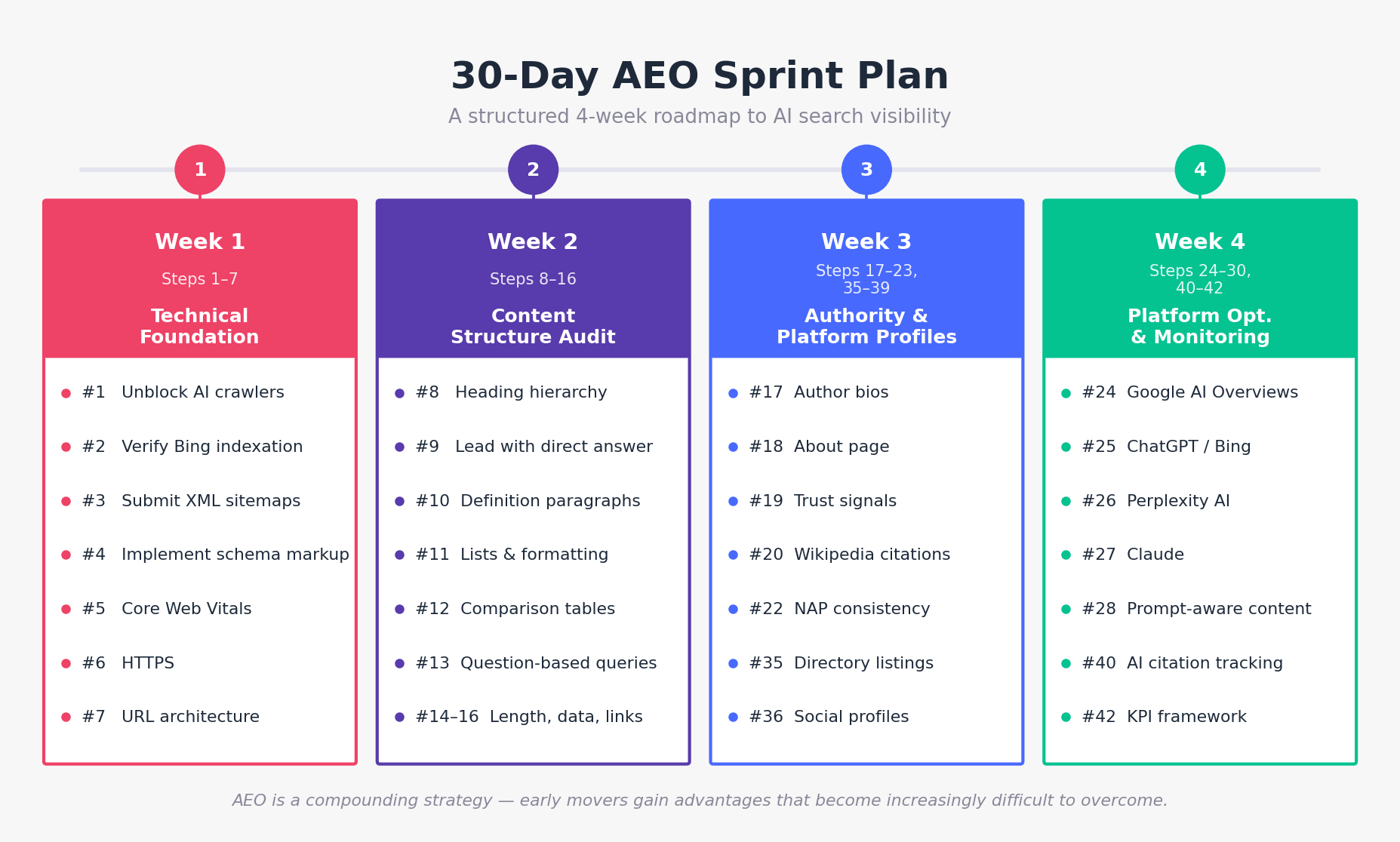
Our recommended 30-day AEO sprint: Week 1 covers the technical foundation (items 1-7). Week 2 covers a content structure audit and optimization (items 8-16). Week 3 covers authority signals and platform profiles (items 17-23, 35-39). Week 4 covers platform-specific optimization and monitoring setup (items 24-30, 40-42).
Get Help With Your AEO Strategy
TripleDart is an AI-native SEO agency for B2B SaaS, and we've built and run AI search optimization programs for 50+ companies using our proprietary Slate AI system, which automates content refresh across 50-100+ pages monthly, implements bulk schema markup, and runs weekly prompt testing across 50+ buying scenarios. We know which of these 42 steps move the needle fastest for different business types, and we've built the workflows to execute them at scale.
Our AEO agency services cover everything from technical audits and schema implementation to platform-specific content optimization and AI citation monitoring. We've helped clients like Signeasy reach 800 monthly LLM sessions with 60-68% consistent month-over-month growth, and FlowForma achieve 7x AI search visibility growth in six months.
If you're ready to build a content program that gets cited by ChatGPT, Perplexity, and Google AI Overviews, we'd like to show you exactly how we'd approach it for your business. Schedule a Demo
Frequently Asked Questions
1. What is an AEO checklist?
An AEO checklist is a structured, step-by-step framework of actionable items that ensure your content is discoverable, extractable, and citable by AI-powered answer engines. Answer Engine Optimization (AEO) is the practice of optimizing content to be cited by platforms like ChatGPT, Google AI Overviews, Perplexity, and Claude. An answer engine optimization checklist covers technical, content, authority, and platform-specific optimizations, giving teams a practical implementation tool rather than theoretical guidance.
2. What is the difference between AEO and SEO?
SEO focuses on ranking in traditional search engine results pages (blue links), while AEO focuses on getting content cited and referenced in AI-generated answers. SEO optimizes for ranking algorithms; AEO optimizes for AI retrieval and citation systems. They're complementary, not competing. AEO builds on SEO foundations but adds requirements around content structure for extraction, entity clarity, factual density, and multi-platform presence. Brands should invest in both simultaneously rather than treating AEO vs SEO as an either/or decision.
3. How do I know if my content is being cited by AI engines?
Track AI citations through three methods: manual testing (regularly query ChatGPT, Perplexity, and Google for your target topics and check if your content appears as a cited source), referral traffic analysis (check Google Analytics 4 for traffic from chatgpt.com, perplexity.ai, and other AI platform domains), and third-party tools like Otterly.ai and Profound that automate AI citation tracking. Tooling for AI visibility monitoring is still maturing compared to traditional SEO tracking, so a combination of manual and automated approaches works best.
4. Does AEO replace traditional SEO?
No. AEO complements and builds upon SEO. Strong SEO fundamentals, including crawlability, indexation, domain authority, and quality content, are prerequisites for AEO success. Without them, AEO-specific tactics have no foundation to build on. Brands should invest in both simultaneously. Frame AEO as an additional optimization layer on top of existing SEO best practices, not a replacement strategy. AI search optimization and traditional SEO reinforce each other.
5. How long does it take to see results from AEO optimization?
Results vary by tactic. Technical fixes like unblocking AI crawlers and adding schema can show results within two to four weeks. Content restructuring and optimization may take one to three months to impact AI citations. Authority-building efforts like digital PR, original research, and Wikipedia citations are three to six month investments. AEO is a compounding strategy. Early movers gain advantages that become increasingly difficult for competitors to overcome, so starting now matters more than starting perfectly.
6. Which AI search engines should I prioritize for AEO?
Prioritize based on your audience and market share. Google AI Overviews has the largest search market share and appears on billions of queries. ChatGPT is the fastest-growing AI search platform, especially for research and professional queries. Perplexity is popular among researchers, professionals, and early adopters. Core AEO principles, including quality content, clear structure, and strong authority, benefit all platforms simultaneously. Check your GA4 referral data to see which AI platforms already send you traffic and prioritize those first.
7. Can small businesses or startups benefit from AEO?
Yes. AEO can level the playing field because AI engines prioritize content quality, relevance, and expertise over raw domain authority. A well-structured, deeply expert piece from a smaller site can get cited over a superficial piece from a Fortune 500 brand. Startups should focus on niche expertise, original data from their own operations, and comprehensive coverage of their specific domain where they have genuine authority. The barrier to entry for AI citation is lower than the barrier to ranking on page one of Google.
8. How do we help with AEO at TripleDart?
As an AI-native SEO agency for B2B SaaS, we build and run AI search optimization programs across the full stack: technical audits to unblock AI crawlers and implement schema, content restructuring to optimize for extraction and citation, platform-specific optimization for Google AI Overviews, ChatGPT, and Perplexity, and systematic AI citation monitoring through our Slate AI workflow system. Our GEO and AI search services have helped clients like FlowForma achieve 7x AI search visibility growth and Signeasy reach 800 monthly LLM sessions with consistent 60-68% month-over-month growth. If you want to see what this looks like for your specific business, book an intro call with our team.

.png)



.webp)









.webp)



.webp)

.webp)
.png)





%20(1).png)


.webp)
.webp)
.webp)




%20Ads%20for%20SaaS%202026_%20Types%2C%20Strategies%20%26%20Best%20Practices%20(1).webp)




.webp)







.webp)



![Creating an Enterprise SaaS Marketing Strategy [Based on Industry Insights and Trends in 2026]](https://cdn.prod.website-files.com/632b673b055f4310bdb8637d/6a218bacea463474377dfd32_34%20-%20Creating%20an%20Enterprise%20SaaS%20Marketing%20Strategy.png)






























.webp)



%20Agencies%20for%20B2B%20SaaS%20Compared%20(2026).webp)

.webp)
%20with%20Hubspot.webp)


_%20Expert%20Reviews%20%26%20Comparisons.png)






.webp)





_%20Comparison%2C%20Strengths%2C%20and%20How%20to%20Choose.png)









.webp)




.webp)



.webp)



















%20Tools%20in%202026_%20Vetted%20List.webp)


![How to Measure AEO Success: 12 Metrics Beyond Clicks [2026 Framework]](https://cdn.prod.website-files.com/632b673b055f4310bdb8637d/6a0d664b326187e99b3d5960_6%20-%20The%20Ultimate%20Guide%20to%20Measuring%20AEO%20Success%20in%202026.png)
![7-Step Workflow for AEO-Ready Content [2026 Framework]](https://cdn.prod.website-files.com/632b673b055f4310bdb8637d/6a0d55ea88913ede1d3a7123_5%20-%20Workflows%20for%20Optimized%20AEO-Ready%20Content%20Creation.png)
.png)
![How to Structure Content for AEO and GEO [With Templates]](https://cdn.prod.website-files.com/632b673b055f4310bdb8637d/6a0c6a56eb700472e635ff33_1%20-%20How%20to%20Structure%20%20Content%20for%20AEO%20and%20GEO%20%20Summaries%20(2026).png)






.png)
.png)












.webp)


%20Agencies%20in%202027.webp)
.webp)
![Top 9 AI SEO Content Generators for 2026 [Ranked & Reviewed]](https://cdn.prod.website-files.com/632b673b055f4310bdb8637d/6a2a3e3105bc1a127aae4e8e_34%20-%20Top%209%20AI%20SEO%20Content%20Generators%20for%202026%20%5BRanked%20%26%20Reviewed%5D.webp)