

.png)


Key Takeaways
- Instagram earns a line in the B2B SaaS paid budget because decision-makers use it daily, provided pipeline is the KPI and impressions are a byproduct.
- Standard Meta Pixel alone misses most B2B SaaS funnel events, so a server-side Conversions API feeding closed-won ARR is table stakes in 2026.
- Decision-maker targeting works through CRM custom audiences and revenue-weighted lookalikes, never broad job-title filters on their own.
- Reels outperform every other format for B2B SaaS, and five archetypes (vox-pop, creator, meme, product vignette, behind-scenes) keep the creative pipeline fed.
- Landing pages, UTM hygiene, and CRM mapping decide whether an Instagram lead becomes a closed-won deal or vanishes into the MQL pile.
- A weekly review, reallocation, and refresh cadence keeps CAC inside the target band and lifts pipeline contribution month over month.
Why Most B2B SaaS Brands Run Instagram Ads Wrong
Most B2B SaaS PPC teams run Instagram ads the way consumer brands do.
Broad interest targeting. Static corporate creative. A homepage link, one engagement metric, and a CPL number on a Monday morning report that has nothing to do with closed-won ARR.
That model produces impressions; it rarely produces pipeline.
The B2B playbook is different.
It treats Instagram as a channel built for how a CFO, a VP Sales, or a Head of Marketing buys software in 2026.
- Reels over static
- CRM audiences over interests
- Pipeline over CPL
The system below is the exact setup we run for B2B SaaS accounts whose Instagram budget must defend itself against a revenue target. It covers six layers:
- Meta Pixel and Conversions API infrastructure.
- CRM-seeded audience build.
- Five reel formats that keep working.
- Landing page and UTM chain.
- CRM attribution map.
- Weekly cadence that holds CAC in range.
Every layer is illustrated with a screenshot from a brand already shipping it.
Step 1: Instagram Earns B2B SaaS Paid Budget (If Pipeline Is the KPI)
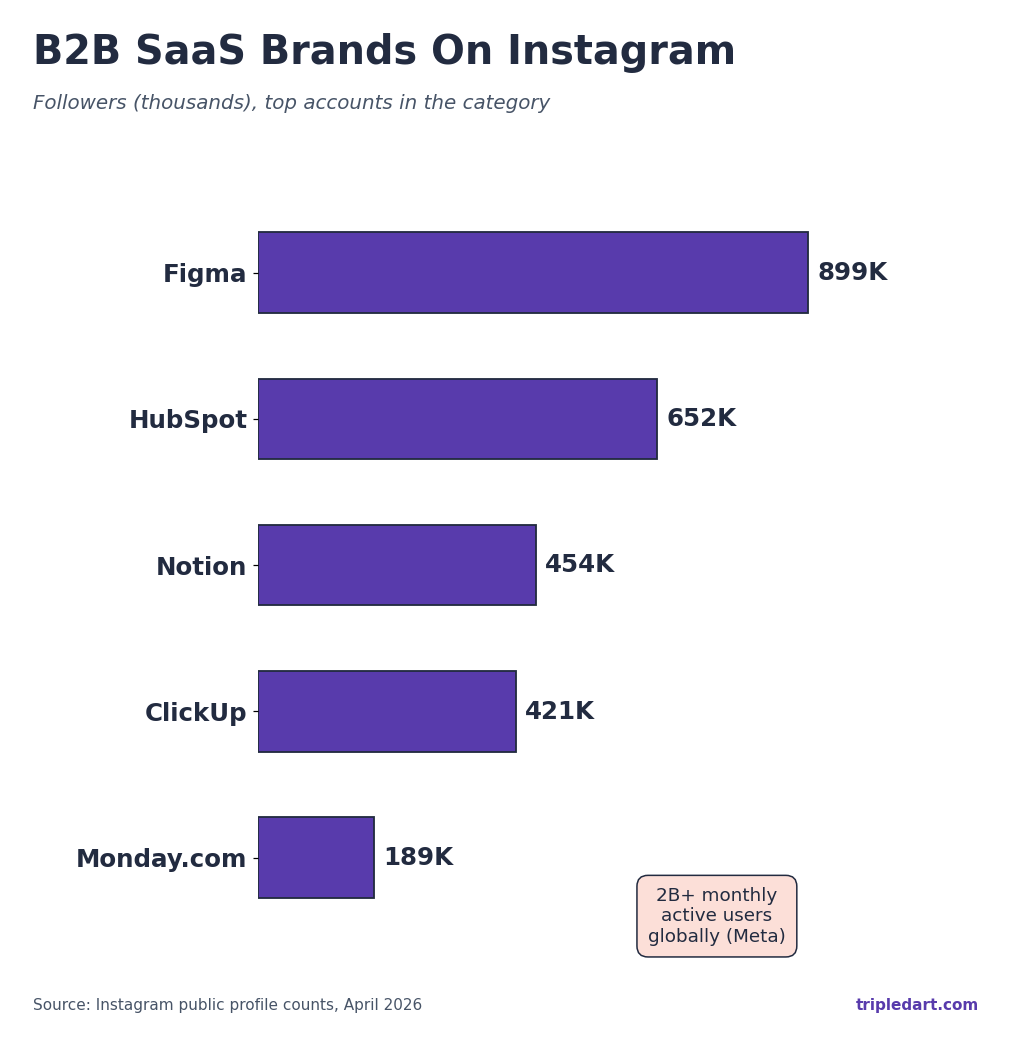
B2B decision-makers spend nearly as much time on Instagram as on LinkedIn, and the auction is less crowded. Instagram has roughly two billion monthly active users per Meta's platform data.
Look at the accounts themselves. HubSpot has 650K+ followers and posts daily. The feed mixes memes, AI-angle carousels, customer stories, and presenter-led reels. ClickUp sits at 420K+ with an equally dense feed. Notion has 450K+ and leans into creator partnerships.
Gong runs a podcast-clip reel feed at a smaller 6,909-follower account and still gets branded-response clips in front of tens of thousands of revenue leaders. None of them treat Instagram as a brand billboard.
All of them push software into the consideration set of buyers who also watch their kid's soccer game on the same app.
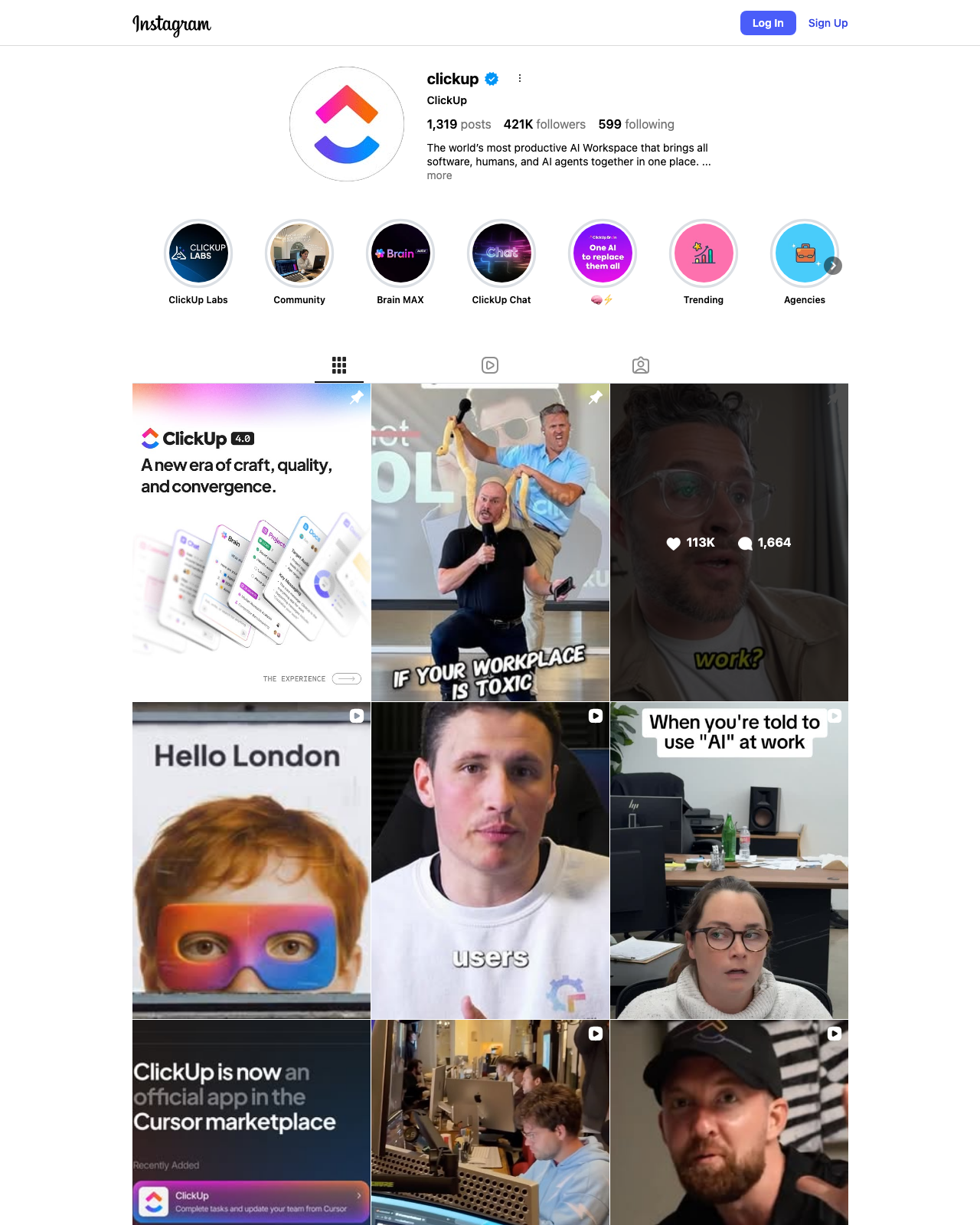
Every third post is a meme. Every feature launch gets a carousel, and every story highlight is organized around a buyer persona or a product pillar.
What the Active Meta Ads Library Shows
Search "hubspot" in the Meta Ads Library and you will see roughly 1,100 active B2B SaaS ads at any moment, running across Facebook and Instagram, most with an Instagram Feed or Reels placement enabled. This is the single best research asset for creative inspiration and for tracking what your competitors are spending on.
Your buyers are on Instagram. The harder question is whether your CPL, CAC payback, and pipeline report tie back to a concrete ARR number. If the measurement chain ends at impressions, the Instagram line item will fail every budget review.
This guide treats pipeline as the KPI.
If brand lift alone is acceptable, the rules below still apply, but the measurement chain in Step 5 becomes optional, not mandatory.
Step 2: Set Up the Meta Pixel and Conversions API
The single biggest reason B2B SaaS Instagram campaigns underperform is that the tracking setup was copied from a D2C playbook. Install the Pixel, fire a Lead event on form submit, call it done. That works for a $49 subscription.
It breaks for a $25K ACV SaaS whose actual revenue event happens six weeks later in a CRM the Pixel never sees.
The setup that works for B2B SaaS stacks three layers.
Layer 1: Meta Pixel for Client-Side Events
The Pixel still has a job. Install it in the site header and fire standard events:
- PageView on every page load.
- ViewContent on pricing, features, and case-study pages.
- Lead on form submit.
- Custom event for any demo or sandbox start.
The Meta for Developers Pixel reference covers the event schema if your engineering team is new to it.
Layer 2: Conversions API for Server-Side Events
The Pixel will lose 20% to 40% of events to iOS 14.5 tracking limits, ad blockers, and cookie expiry. Conversions API (CAPI) fixes it by sending events server-to-server, so Meta gets the MQL, SQL, Opportunity, and Closed-Won events straight from your CRM, not your browser.
Every event must carry the same event_id through both the Pixel and CAPI so Meta dedupes cleanly.
Layer 3: Offline Conversion Events for Deep-Funnel Revenue
Meta sunsetted the old Offline Conversions API in May 2025. Every deep-funnel revenue event now flows through standard CAPI as a server event with a custom_event_type like Opportunity, ClosedWon, or QualifiedMQL.
Here is the minimum event map we ship for a B2B SaaS account:
Client-side (Pixel)
PageView
ViewContent → /pricing, /features/*, /case-studies/*
Lead → demo form submit
CompleteRegistration → free trial signup
Server-side (CAPI)
QualifiedLead → MQL in CRM (routed by scoring model)
SalesQualifiedLead → SQL stage in HubSpot/Salesforce
Opportunity → Opp stage with deal amount
Purchase / ClosedWon → contract signed, amount in ARR
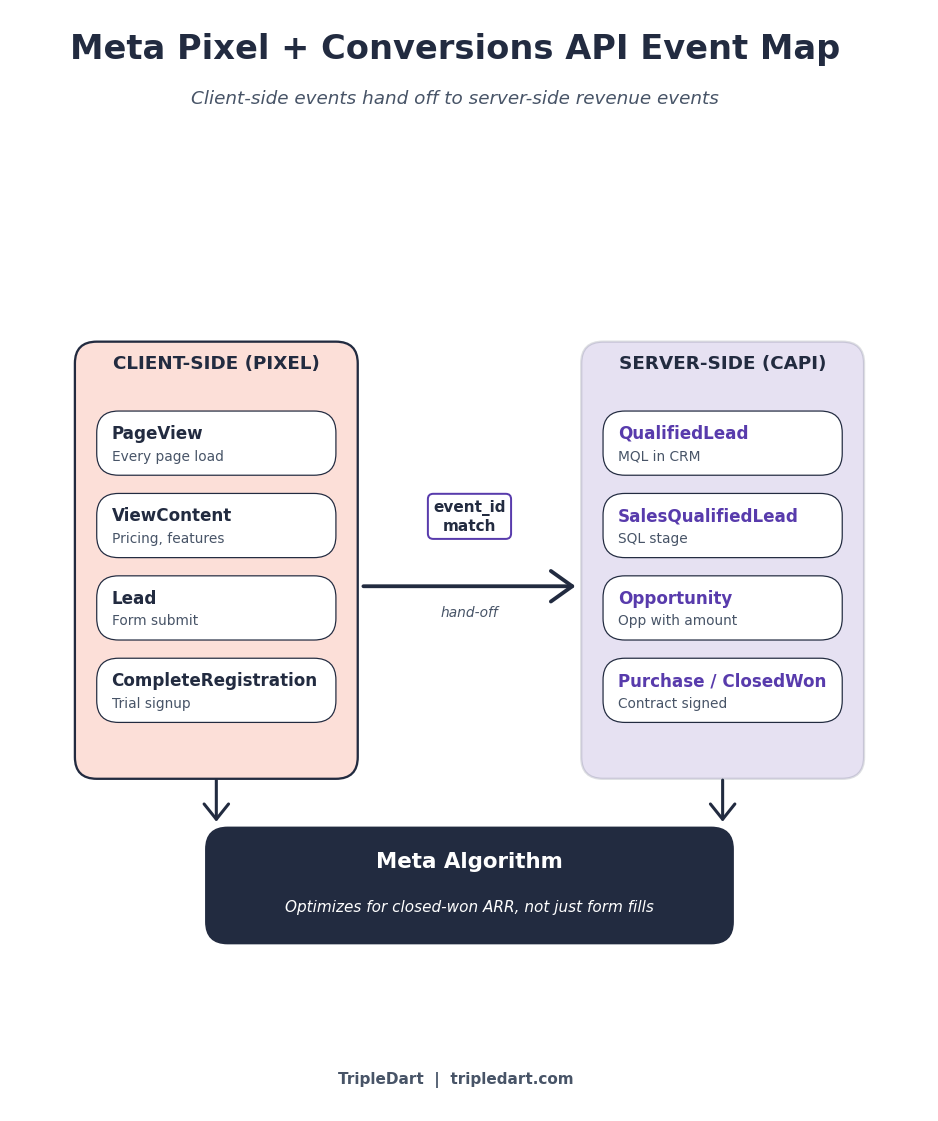
Meta's algorithm optimizes against whatever event it sees. If it only sees Lead (form fills), it optimizes for form fillers. Most of those never become Opportunities.
Feed Meta ClosedWon events with an ARR value attached, and it starts optimizing for audiences that resemble closed-won buyers. MQL quality improves inside the first 4 to 6 weeks.
Inside Our B2B SaaS Paid Accounts
CAPI accounts fed with SQL and Closed-Won events push MQL-to-SQL conversion rates 1.5x to 2x higher than accounts that only fire client-side Lead events. The lift is almost entirely signal quality, not targeting magic.
Before any targeting or creative goes live, the Events Manager dashboard should show green health checks on Pixel, CAPI, and event match quality (aim for 7.0 or higher). If it does not, pause and fix it.
Every dollar spent on an account with broken tracking is a dollar you cannot explain to your CFO.
Step 3: Build the Decision-Maker Audience (Not the Consumer Audience)
Instagram is a Meta placement, which means the targeting tools are Meta's, and Meta's detailed-targeting options for B2B job titles got heavily pruned over the last three years.
Targeting "VP of Marketing, technology" as an interest still exists, but it no longer holds the kind of precision a serious B2B SaaS campaign needs.
The setup that works leans on first-party data, not Meta interests.
Customer File Custom Audiences, Tiered by Stage
Upload four customer files to Meta, hashed per Meta's customer list hashing guide:
Revenue-Weighted Lookalikes, Not MQL-Volume Lookalikes
Most B2B SaaS accounts build lookalikes off their full MQL list, which includes every free-email tire-kicker who downloaded an ebook. Those lookalikes return more tire-kickers.
The fix is to weight the seed list by ARR or deal size. Closed-Won customers only, weighted by contract value, with the top 25% of deals getting a 4x weight inside the customer file.
Meta's algorithm then builds the lookalike around the highest-ARR customers, not the highest-volume leads. Ahrefs covers the same logic for SaaS lookalike seeding in its broader SaaS marketing guide.
Retargeting Layers That Convert
Retargeting carries the highest conversion rate and the lowest CPL in every B2B SaaS account we run. The segmentation drives the outcome:
- Pricing page viewers in the last 30 days.
- Feature-page viewers who hit two or more pages.
- Video viewers who watched 75% or more of a reel.
- Demo-form abandoners (event fired but no submit).
- Trial activations with no second-session login.
Each of these needs its own ad-set with its own creative angle, not one generic "website visitor" bucket with one generic ad.
Interest Layers for Cold Reach, Carefully
Interest targeting works as a widener on top of lookalikes, not as a standalone audience. Four interest buckets survive in 2026 for a B2B SaaS campaign:
- Category events (SaaStr, Dreamforce, HubSpot Inbound).
- Publishers (Harvard Business Review, TechCrunch).
- Analyst firms (Gartner, Forrester).
- Competitor-adjacent interests (legacy enterprise software the buyer is migrating off of).
Layer one or two, never more than three, or the audience collapses into a consumer pool.
Step 4: Creative Formats That Work for B2B SaaS on Instagram
Creative is the single largest lever in a B2B SaaS Instagram campaign. Meta's own creative best practices research puts creative quality at 70%+ of campaign performance.
The gap between a scroll-stopping reel and a static stock image is the difference between a $40 CPL and a $180 CPL in the same auction.
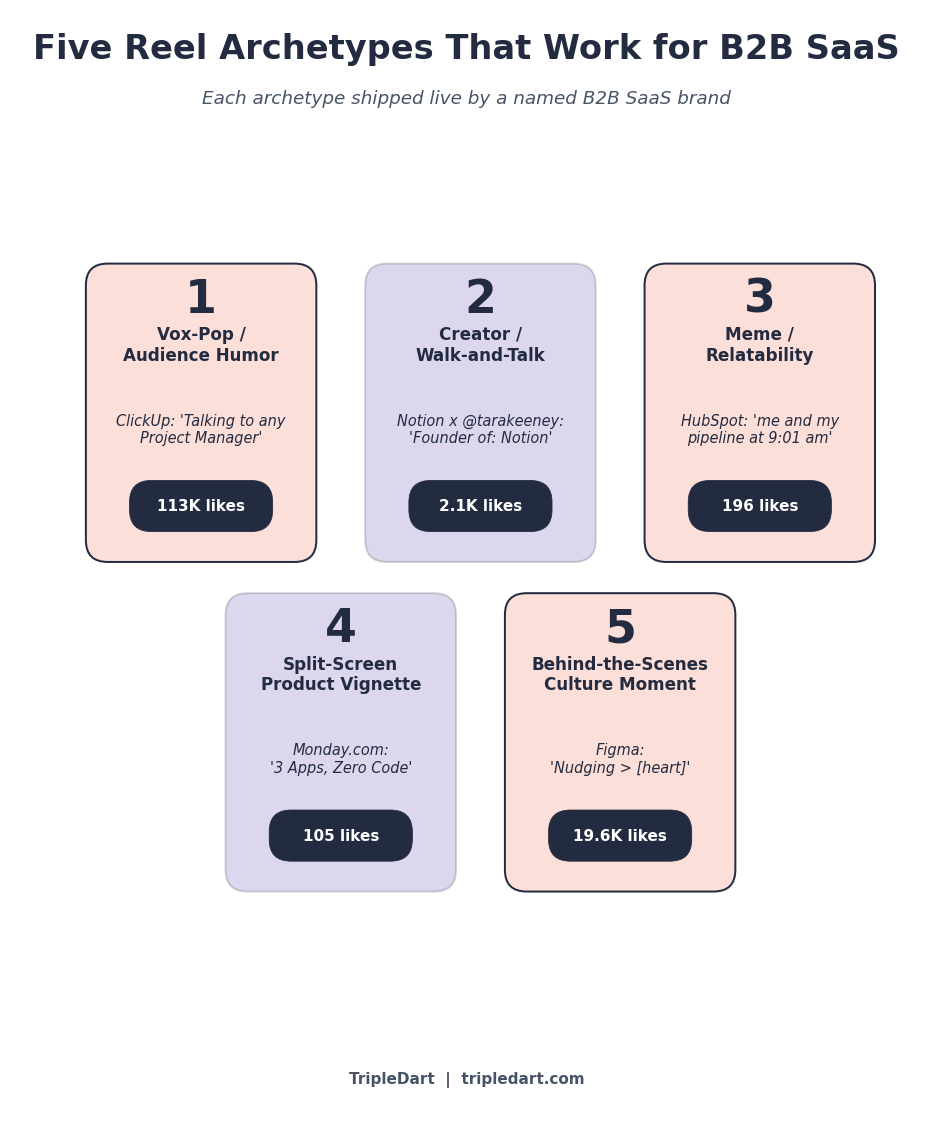
The formats below are the five reel archetypes we see keep working, each with a live example already running on Instagram.
Archetype 1: The Vox-Pop / Audience-Humor Reel
A direct-to-camera clip that names the viewer's job and makes a joke only an insider would laugh at. ClickUp's "Talking to any Project Manager" reel (113K likes) is the canonical example.
A single creator, a warmly lit home setup, a caption that names the audience, a punchline hashtag stack (#projectmanager #management #leadership) that does double duty as targeting signal.
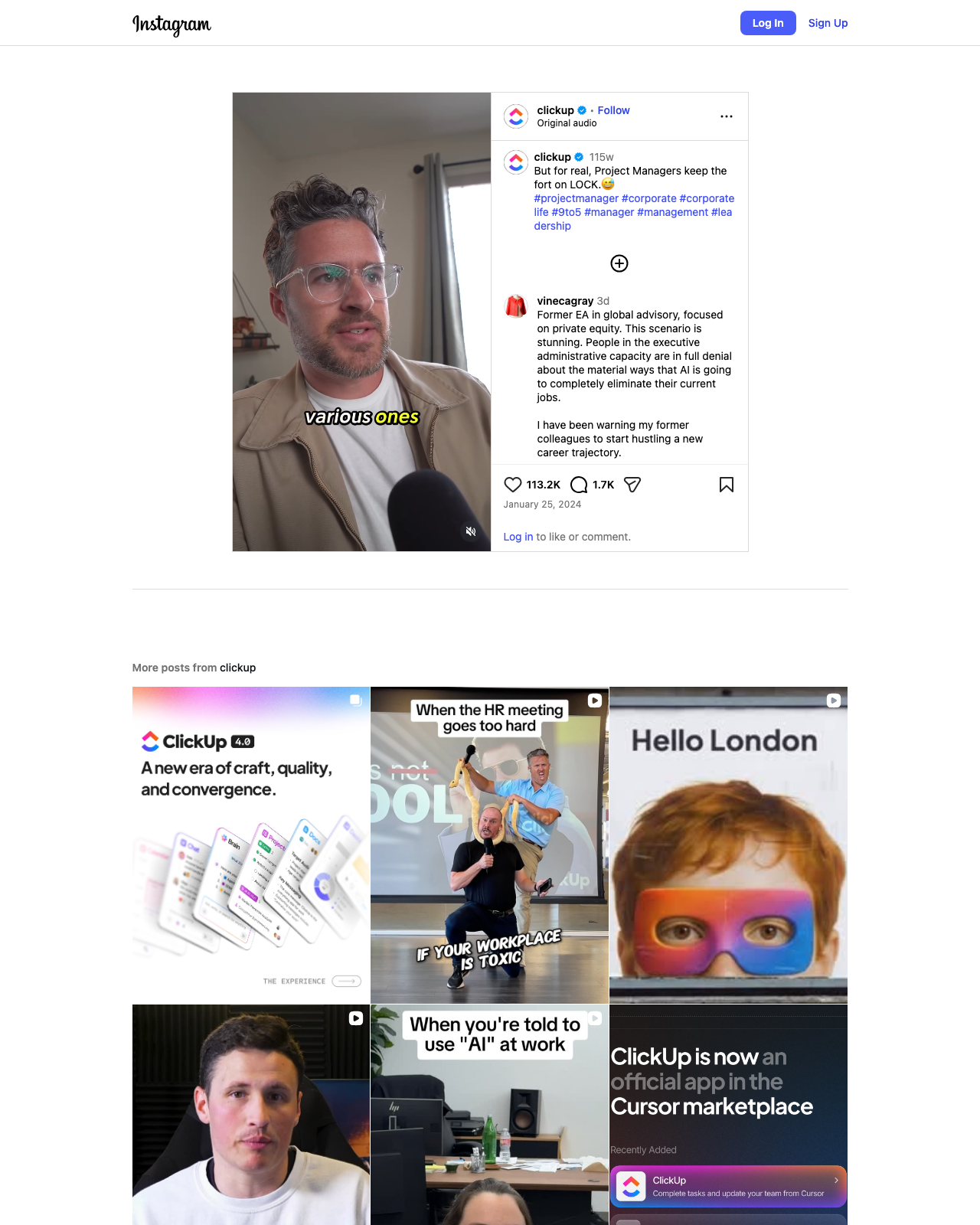
The format works because it signals "we know you" inside the first 1.5 seconds. B2B SaaS buyers scroll past 95% of reels. The 5% they stop on are the ones that name them.
Archetype 2: The Creator / Founder Walk-and-Talk
A partnership reel with a creator whose audience already overlaps your ICP. Notion partnered with @tarakeeney on a "Founder of:" walk-and-talk.
The hook: "He built an 11 billion dollar company @notionhq." The caption then drops a stat: used by 94% of the Fortune AI50 companies, including OpenAI, Ramp, and Figma. 2,087 likes, and a 30-second association between Notion and enterprise-grade social proof.
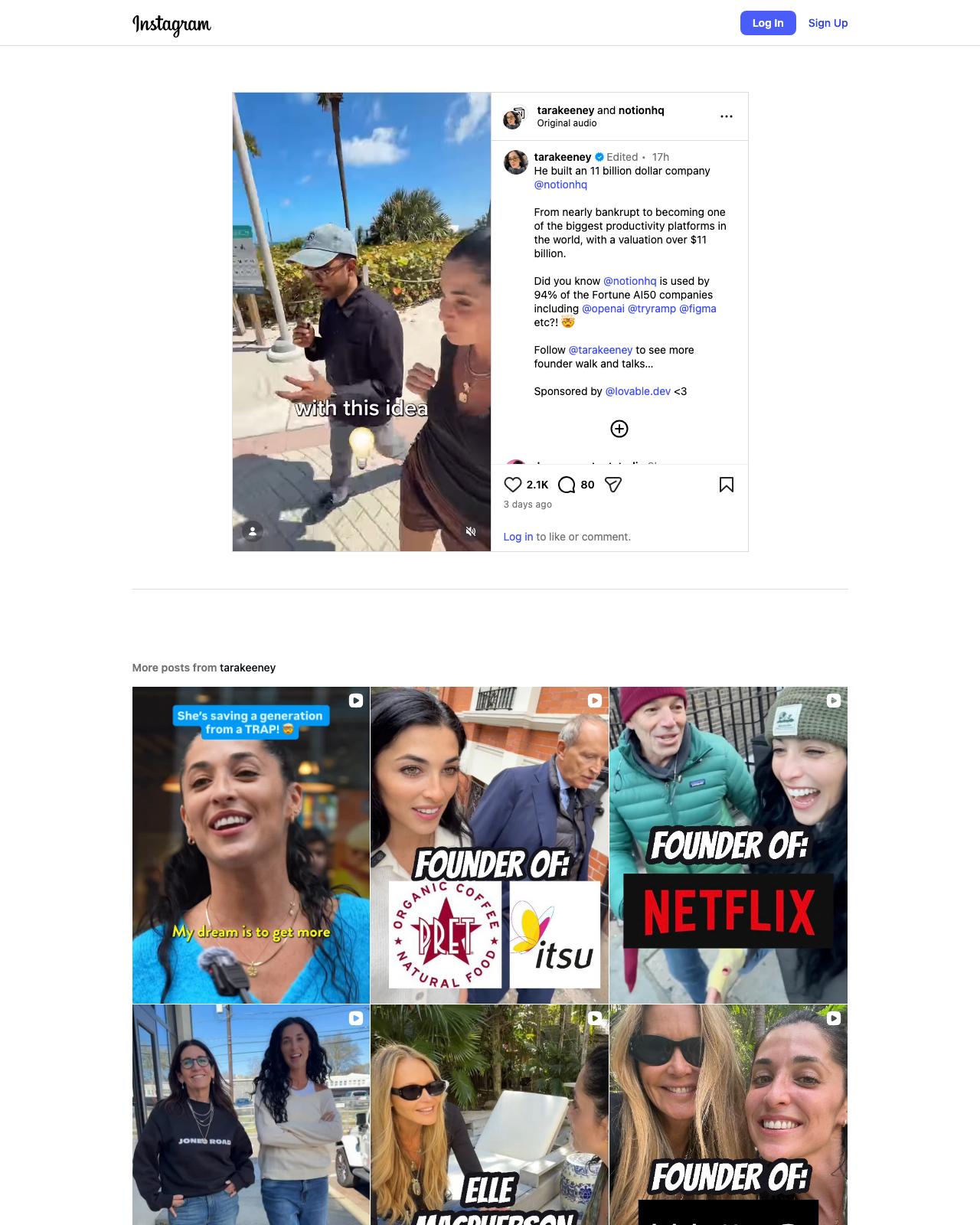
This archetype is the single most underused format in B2B SaaS. A mid-tier creator with 20K to 200K followers in your ICP will accept paid partnerships at a fraction of the cost of a full-funnel creative agency.
Pick operations, revops, marketing, design, or engineering depending on your category. The ROI on one well-picked creator often beats a quarter of paid-social spend.
Archetype 3: The Meme / Relatable Post
A caption-driven meme tied to the daily life of the buyer. HubSpot's "me and my pipeline at 9:01 am" post riffs on a Drake tweet format with a tired-founder GIF.
196 likes and a comment thread of reps responding "empty pipe hahahah" and "too real for a Monday." Static product screenshots never earn that kind of engagement.
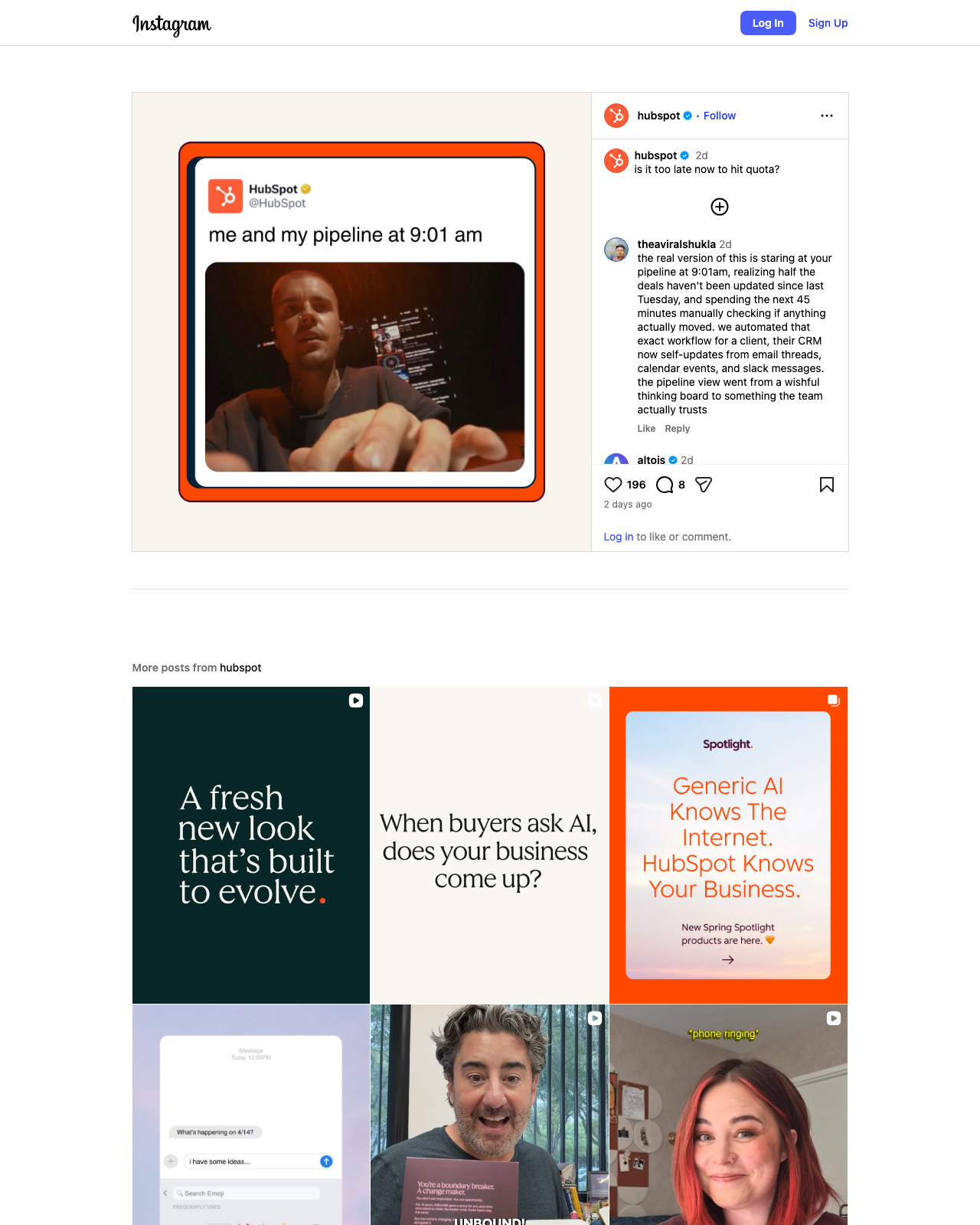
Memes are top- and mid-funnel, not closing content. They keep your brand in the feed of buyers who are months away from a demo request, and they make the eventual demo form feel familiar, not cold.
Archetype 4: The Split-Screen Product Vignette
A vertical reel with presenter above and product screen below, usually 15 to 30 seconds. It shows one feature in action against a specific use case. Monday.com's "3 Apps, Zero Code" reel is a clean example.
The caption names the common objection about what can be built. The reel answers with three concrete apps (delivery tracking, room booking, asset inventory) and shows the build happening on screen.
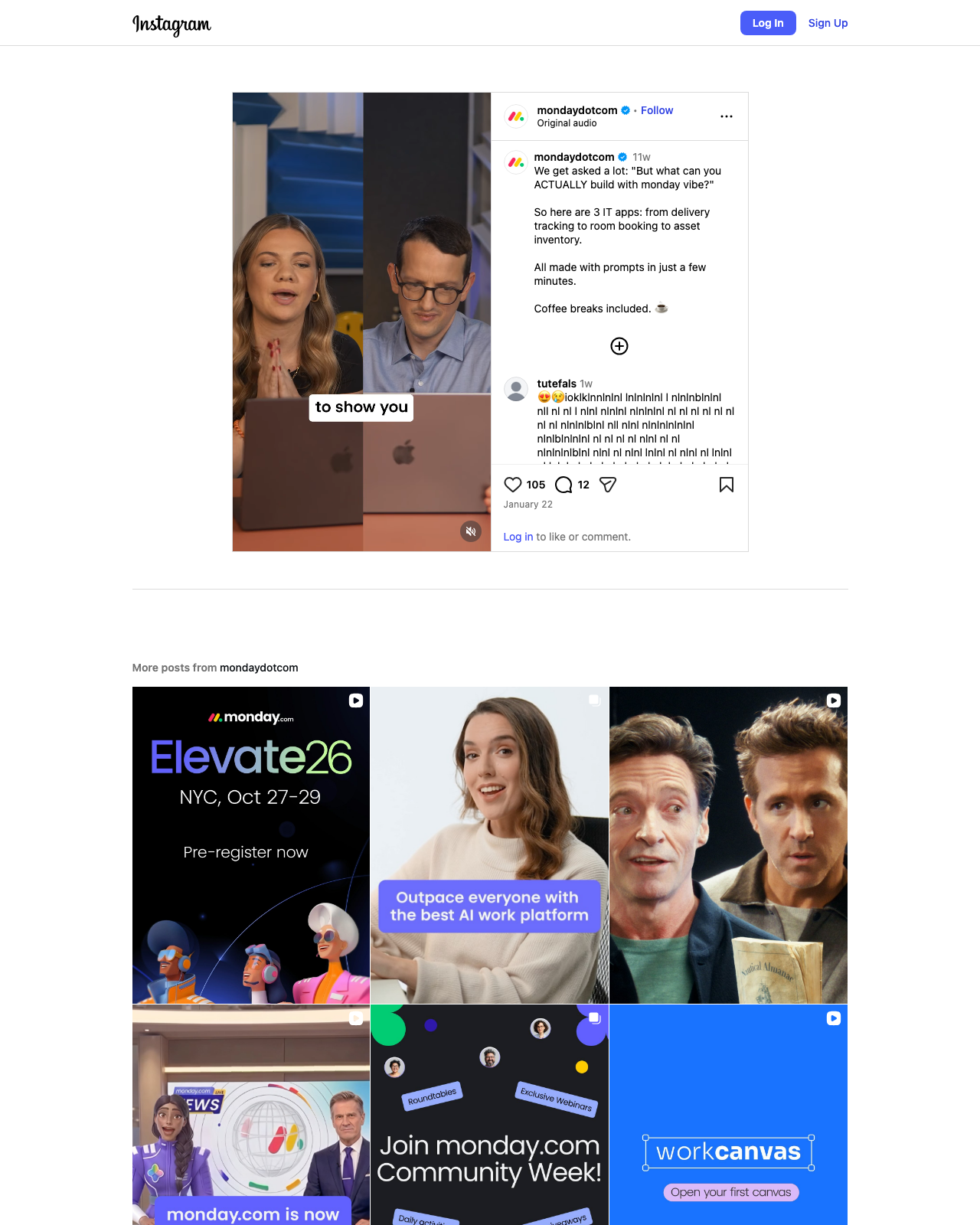
This format carries the highest view-through rate in the B2B SaaS accounts we measure. It answers the implicit "show me it works" question that every buyer has by the time they see a paid reel in their feed.
Archetype 5: The Relatable Behind-the-Scenes Moment
A slice-of-team-life reel that is not about the product at all. Figma posted a reel of a designer nudging a canvas with "Nudging > ❤️" as the only caption. 19.6K likes.
The top comment, "Design systems keep me from crashing out," tells you exactly how deeply the format landed with the target audience.
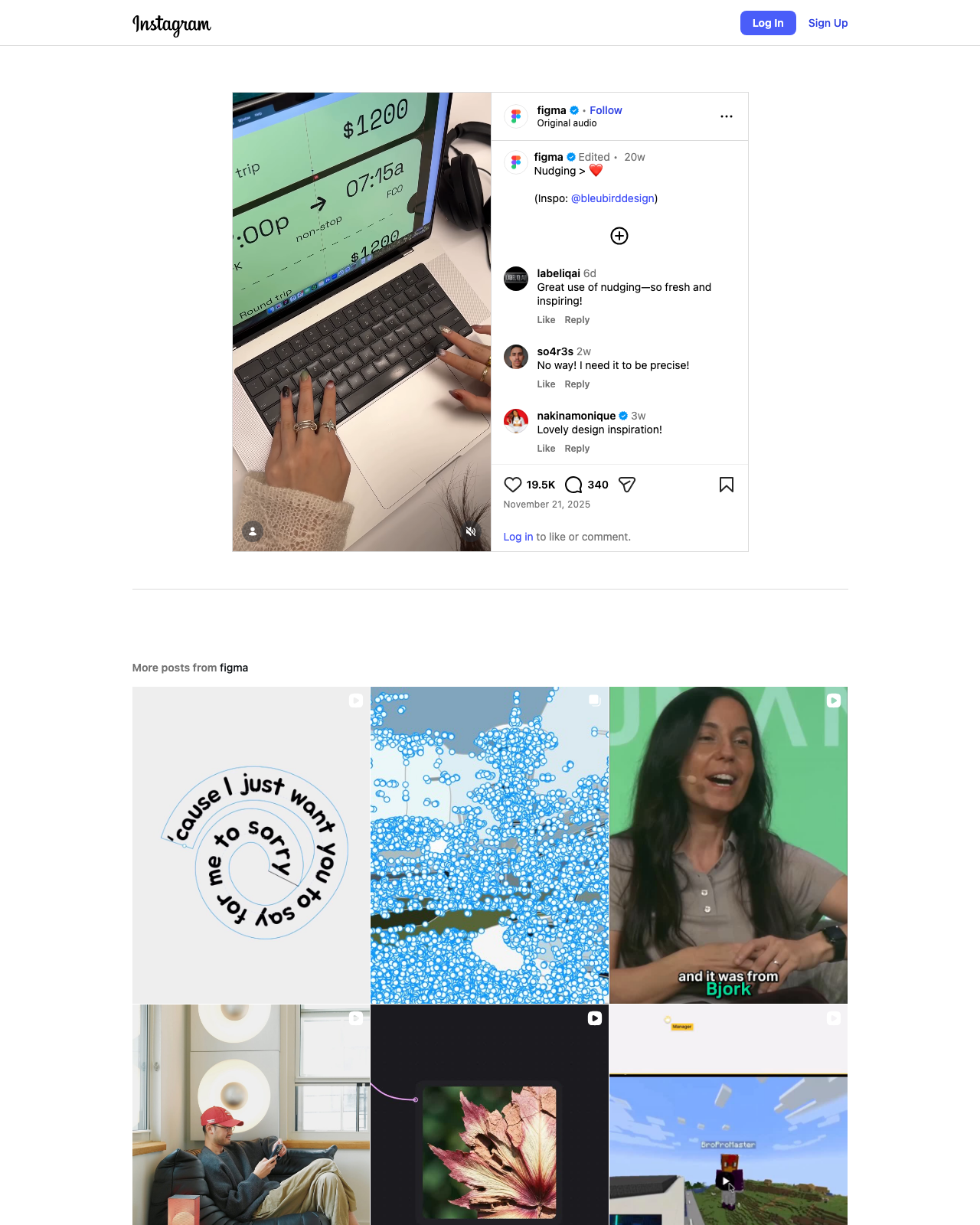
Behind-the-scenes content gets written off as brand-only. In practice it builds the familiarity that makes a later retargeting demo-form ad feel like a continuation, not an interruption.
Archetype 6 (Honorable Mention): The Thought-Leader Podcast Clip
A 30-second clip of your CEO, a product lead, or a partner making one punchy point, with named-speaker chyrons and captions. Gong's #RevealPodcast clip with Brendan Dell and Corrina Owens is the template.
Split-screen, named roles, a specific claim ("8 elements they use in their sales pitch"), and a link-in-bio CTA.
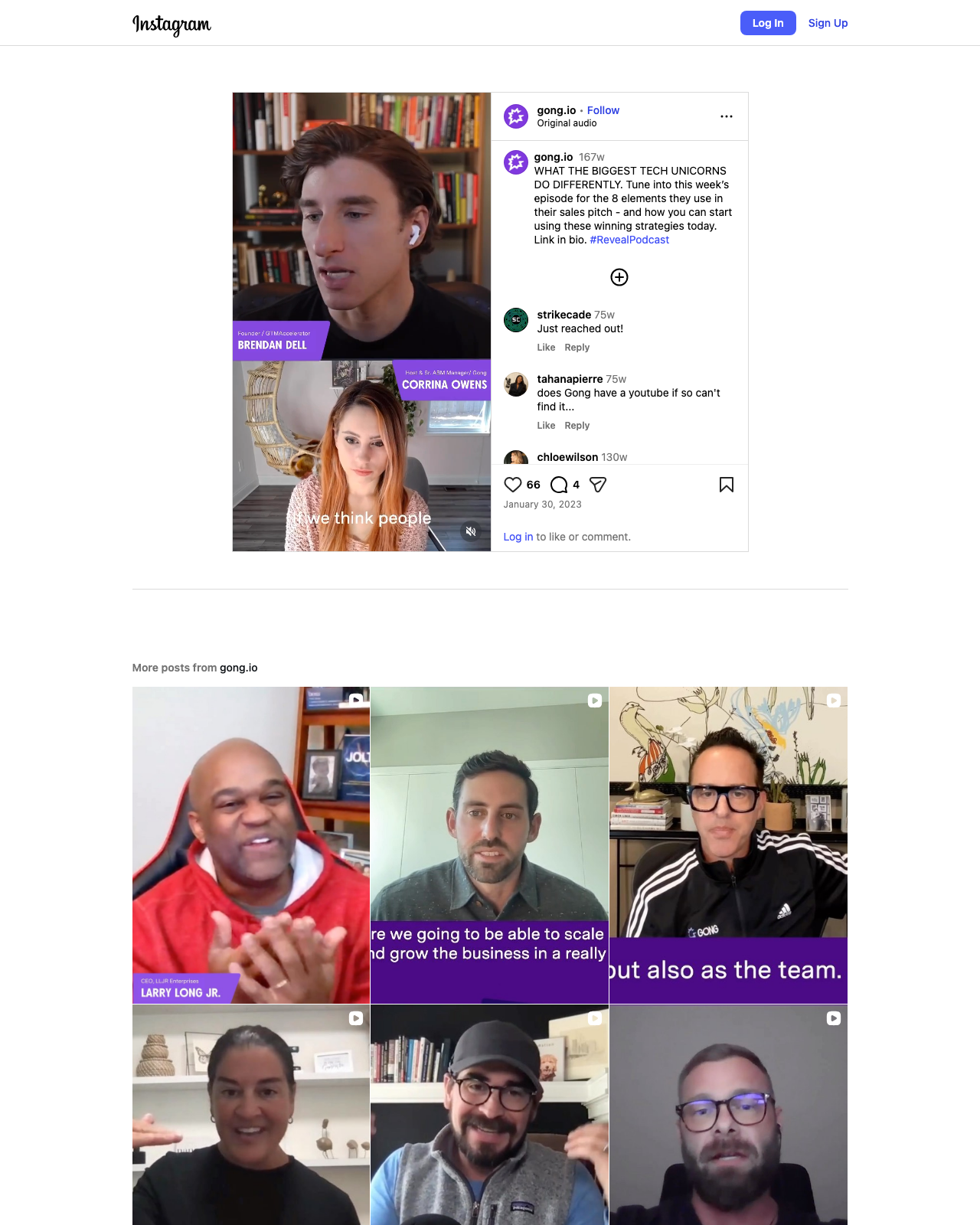
The clip archetype has the lowest production cost of any format on this list. Record the podcast once, cut four to eight clips, schedule across Reels and TikTok, repurpose the audio into an Instagram audio asset.
One podcast episode can fuel a month of paid creative.
What Our Creative Testing Data Shows
Across the B2B SaaS accounts we run paid social for, the top-performing reel in a given month typically carries a 3x to 5x CTR advantage over the median, and that winner rotates every 2 to 3 weeks. No single creative stays on top. A library of at least 8 to 12 live reels per account keeps creative fatigue inside acceptable bands.
Each archetype needs at least two variants live at any time, with the copy variant tested separately from the visual variant. Never kill a reel with less than 15,000 impressions on its data. Never scale a reel past $5K spend without rotating a new variant in behind it.
Step 5: Landing Pages, Lead Gen Forms, and the CRM Attribution Chain
A perfect reel pointing at a broken landing page is the most common B2B SaaS ad failure we see. The creative wins the click, the landing page loses the lead, and the CPL number on the Monday report blames the ad.
Two routes exist for capturing the lead, and they behave differently.
Route A: Meta Lead Gen Forms (On-Platform)
Meta's native Lead Ads form stays inside Instagram, pre-fills fields from the user's Meta profile, and submits without ever leaving the app. CTR to lead rates run 2x to 3x higher than landing page flows, because the friction is near zero.
The tradeoff is lead quality. Pre-filled forms collect the lead's personal Instagram email, not their work email. You will get more leads. You will also qualify 40% of them out during MQL review.
Use Lead Gen for top-funnel audiences and retargeting, not for bottom-funnel demo requests.
The HubSpot guide to Facebook Lead Ads walks through the work-email filter setups that help.
Route B: Dedicated Landing Page (Off-Platform)
A mobile-native landing page with one CTA, no nav, no footer links, and a form that asks for the work email, company, and role. This is the default for bottom-funnel traffic and for anything tied to a demo or trial.
The non-negotiables:
- Page loads in under 2 seconds on 4G.
- One hero, one value proposition, one proof asset, one form. Nothing else above the fold.
- Form fields under six. Company-name lookup from email domain if possible.
- Hidden UTM fields captured and pushed to the CRM on submit.
- Thank-you page fires the Pixel Lead event AND the CAPI QualifiedLead event with the same event_id.
UTM Hygiene, Because No CRM Fixes Bad Tags
Every ad needs a consistent UTM parameter set passed through to the landing page and into the CRM. The schema we run:
utm_source=instagram
utm_medium=paid_social
utm_campaign=<campaign_name_slug>
utm_content=<ad_id>
utm_term=<ad_set_name>
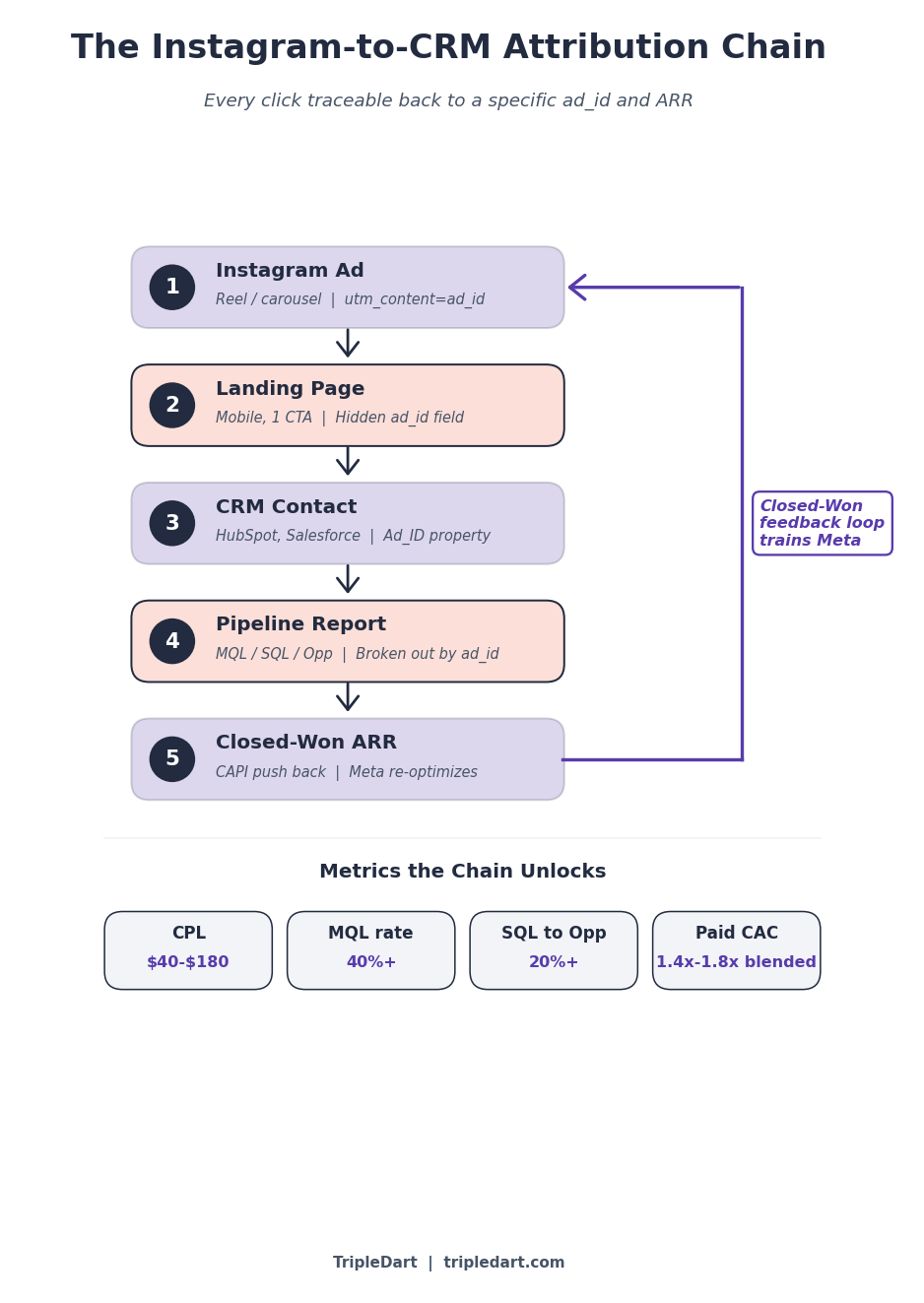
The utm_content=<ad_id> field is the one most teams drop. Without it, you cannot tell which specific reel drove which MQL.
With it, you can build a HubSpot attribution report that ties closed-won revenue back to a specific creative.
CRM Mapping Back to the Ad
Inside the CRM, create a hidden "Ad ID" field on the Contact and Deal objects, populated on form submit from the utm_content param. Every pipeline report then breaks out MQLs, SQLs, Opportunities, and Closed-Won by ad, not just by campaign.
The Sales leader can finally answer "which specific reel is driving pipeline" without a spreadsheet export.
This is the attribution chain that lets an Instagram ad defend itself against a closed-won ARR target. Without it, the Monday morning CPL report is a vanity number.
Step 6: Measure, Optimize, Scale: The Weekly Instagram Cadence
The final layer is operational. Instagram ads for B2B SaaS are a weekly system, not a launch-and-leave channel. The auction moves every week, creative fatigues every 2 to 3 weeks, and audience performance drifts as seasonal buying patterns change.
A weekly cadence keeps the whole system building pipeline instead of decaying into a vanity line item.
The standing agenda we run:
Monday: Pipeline and CPL Review
Pull the last 7 days of Instagram ad performance alongside the CRM data. Metrics that go on the report:
Tuesday: Creative Rotation
Identify the reel that dropped below median CTR over the last 7 days and queue a replacement from the creative backlog. Pause the loser. Move its budget to the top-performing variant, in 20% increments, never more than 20% per week to avoid algorithm reset.
Wednesday: Audience Reallocation
If one ad-set (e.g., retargeting 75%-video-viewers) is driving MQLs at half the CPL of another, move 20% of the lagging ad-set's budget to the winner. Do not reallocate more than 20% per week. Meta's algorithm needs the stability.
Thursday: New Creative Brief
Brief the design team on the next reel variant. Use the Ahrefs ad creative framework or a similar structured brief.
Every brief names the archetype (one of the five in Step 4), the hook, the product beat, and the CTA.
Friday: CRM Closed-Won Push
Push the last 7 days of Closed-Won events from HubSpot or Salesforce to Meta via CAPI. This is the feedback loop that keeps Meta's algorithm optimizing for revenue, not form fills. Skipping this step for even two weeks starves the system of its most valuable signal.
The Scaling Trigger We Use
Only scale an ad-set when its paid-attributable CAC runs at least 30% below the target CAC for two consecutive weeks. Scaling a "good" week without the second confirmation is the fastest way to burn budget on what was random variance. The brands we work with that respect the two-week rule typically grow spend at 30% quarter-over-quarter without CAC drift.
The cadence builds on itself. Creative library grows, CAPI event match quality improves, lookalikes refresh on better seeds, and the weekly reallocation keeps budget concentrated on the highest-ROAS combinations.
Most B2B SaaS accounts we onboard hit their first pipeline milestone inside 90 days when this cadence is in place from week one.
How We Run Instagram for B2B SaaS Pipeline
A pipeline-grade Instagram program for B2B SaaS is five layers stacked together:
- Meta Pixel plus Conversions API setup.
- CRM-seeded audience build.
- Five reel archetypes shipped every month.
- Landing page and UTM chain.
- Weekly cadence.
Skip any one of those layers and the channel turns into a brand vanity line item instead of a pipeline source.
We run this system across 250+ B2B tech engagements for brands like Airbase, SpotDraft, Apty, Factors.AI, and SignEasy, as part of our broader paid social program.
The Instagram layer typically contributes 14% to 22% of paid-social MQLs within the first 90 days. Paid-attributable CAC tends to land inside 1.6x blended when every layer is instrumented correctly.
Ship a pipeline-grade Instagram program with us starting today - book a call.
Frequently Asked Questions
Does Instagram work for B2B SaaS, or is it a consumer-only channel?
Instagram works for B2B SaaS when pipeline is the KPI and the tracking is instrumented for deep-funnel events. Meta reports roughly 2 billion monthly active users, and those include the same decision-makers who use LinkedIn. The Instagram auction is less crowded, so a well-targeted reel often carries a lower CPM than the equivalent LinkedIn sponsored post.
What is a realistic CPL for B2B SaaS Instagram ads in 2026?
B2B SaaS CPLs on Instagram typically land between $40 and $180 depending on ACV. Bottom-funnel retargeting ads come in at the low end, top-funnel prospecting at the high end. The HubSpot 2025 paid social benchmark puts the median B2B social CPL near $90, and Instagram runs inside that range for most growth-stage accounts we operate.
Is Meta Lead Gen or a landing page better for B2B SaaS?
Lead Gen forms deliver 2x to 3x more raw leads at lower CPL. The tradeoff is that 40% or more get disqualified at MQL review because the pre-filled email is a personal address. Use Lead Gen for top-funnel and retargeting. Use a dedicated landing page with a work-email filter for bottom-funnel demo or trial flows.
How much should a B2B SaaS spend on Instagram to see pipeline impact?
A minimum viable test budget for a growth-stage B2B SaaS is $8K to $15K per month for the first 90 days, split across prospecting, retargeting, and creator partnerships. Spend below that starves Meta's algorithm of the conversion volume it needs to optimize, and the data never stabilizes enough to make a confident scaling decision.
Which Instagram format converts best for B2B SaaS demo requests?
Vertical reels under 30 seconds that name the buyer's role in the first 1.5 seconds outperform every other format in the B2B SaaS accounts we measure. Split-screen product vignettes (like the Monday.com "3 Apps, Zero Code" reel) carry the highest view-through rate, while vox-pop creator reels carry the highest CTR to demo.
How often should we refresh Instagram ad creative?
Rotate the lowest-performing reel out every 2 to 3 weeks, and queue a replacement variant before frequency hits 3.5 per audience. Creative fatigue is the single largest reason a campaign that hit target in month one drifts off target in month three. The fix is a creative backlog of at least 8 to 12 live reels per account.
Do we need the Conversions API if the Meta Pixel is working?
Yes. The Pixel alone loses 20% to 40% of events to iOS 14.5, ad blockers, and cookie expiry. It also cannot see deep-funnel events (SQL, Opportunity, Closed-Won) that only live in the CRM. CAPI is how Meta's algorithm learns to optimize for revenue, not form fills. Meta's CAPI docs confirm the setup is mandatory for any account that cares about back-end conversion quality.
How do we tie an Instagram ad to a specific closed-won deal in HubSpot?
Pass utm_content=<ad_id> on every ad URL and capture it in a hidden form field. Push it to a custom "Ad ID" property on the HubSpot Contact and Deal objects, and build an attribution report that breaks pipeline by Ad ID. The HubSpot single-object reports documentation covers the build. Without this chain, pipeline attribution stops at the campaign level and the Instagram spend cannot be defended on a board report.
.webp)



.webp)
.webp)
.png)


.png)


.webp)



.webp)

.webp)




%20(1).png)


.webp)
.webp)
.webp)



%20Ads%20for%20SaaS%202026_%20Types%2C%20Strategies%20%26%20Best%20Practices%20(1).webp)



.webp)






.webp)



![Creating an Enterprise SaaS Marketing Strategy [Based on Industry Insights and Trends in 2026]](https://cdn.prod.website-files.com/632b673b055f4310bdb8637d/6a218bacea463474377dfd32_34%20-%20Creating%20an%20Enterprise%20SaaS%20Marketing%20Strategy.png)
























.webp)


%20Agencies%20for%20B2B%20SaaS%20Compared%20(2026).webp)

.webp)
%20with%20Hubspot.webp)


_%20Expert%20Reviews%20%26%20Comparisons.png)






.webp)




_%20Comparison%2C%20Strengths%2C%20and%20How%20to%20Choose.png)








.webp)



.webp)


.webp)



















%20Tools%20in%202026_%20Vetted%20List.webp)


![How to Measure AEO Success: 12 Metrics Beyond Clicks [2026 Framework]](https://cdn.prod.website-files.com/632b673b055f4310bdb8637d/6a0d664b326187e99b3d5960_6%20-%20The%20Ultimate%20Guide%20to%20Measuring%20AEO%20Success%20in%202026.png)
![7-Step Workflow for AEO-Ready Content [2026 Framework]](https://cdn.prod.website-files.com/632b673b055f4310bdb8637d/6a0d55ea88913ede1d3a7123_5%20-%20Workflows%20for%20Optimized%20AEO-Ready%20Content%20Creation.png)
.png)
![How to Structure Content for AEO and GEO [With Templates]](https://cdn.prod.website-files.com/632b673b055f4310bdb8637d/6a0c6a56eb700472e635ff33_1%20-%20How%20to%20Structure%20%20Content%20for%20AEO%20and%20GEO%20%20Summaries%20(2026).png)





.png)
.png)








.png)

.png)
.png)





%2520Agencies%2520(2025).png)

![Top 9 AI SEO Content Generators for 2026 [Ranked & Reviewed]](https://cdn.prod.website-files.com/632b673b055f4310bdb8637d/6858e2c2d1f91a0c0a48811a_ai%20seo%20content%20generator.webp)


.webp)
.webp)
.png)


.png)






.webp)














.avif)