.png)

Key Takeaways
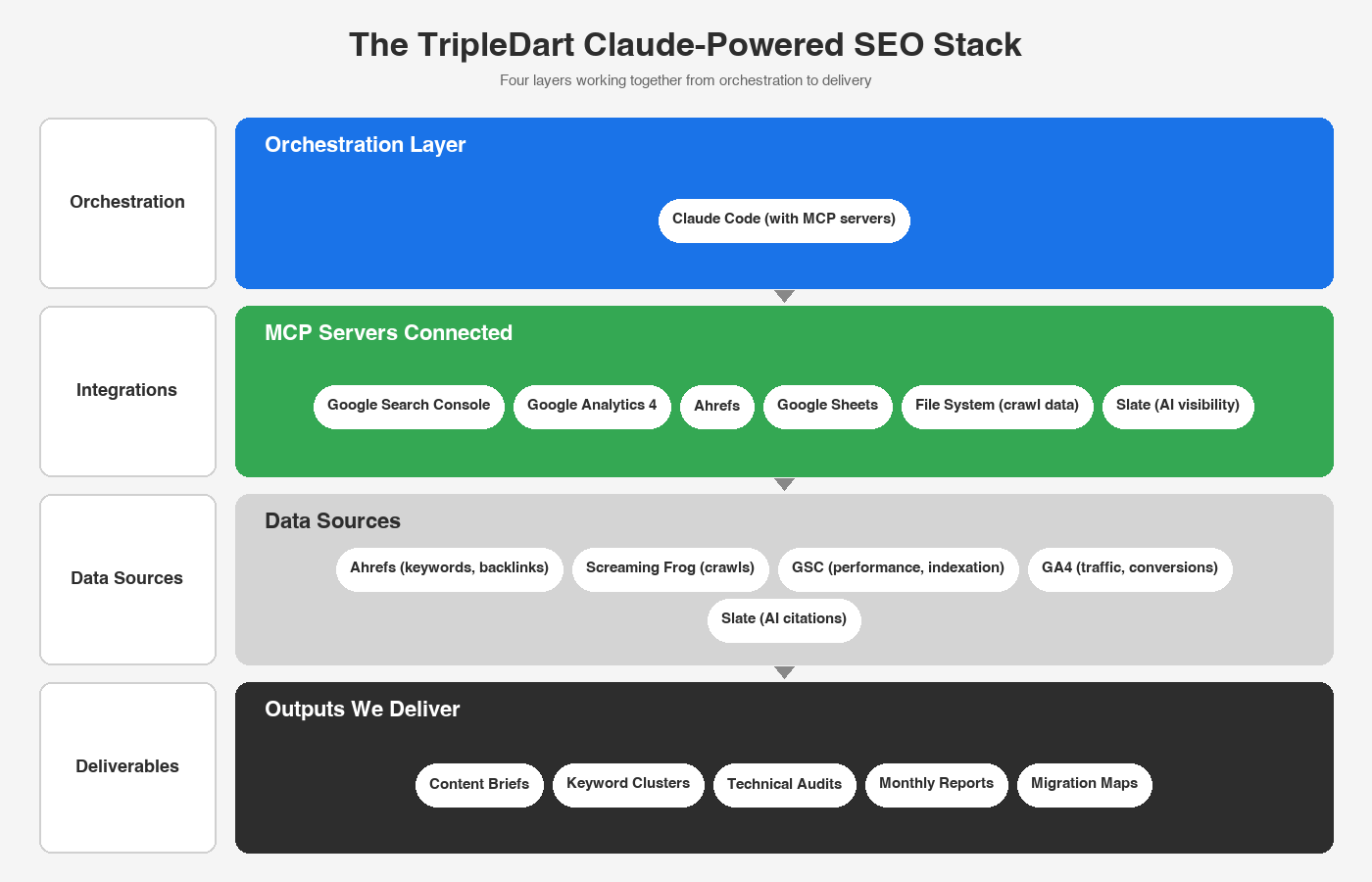
- We run Claude Code as the orchestration layer, connected via MCP servers to Google Search Console, GA4, Ahrefs, Google Sheets, our file system, and Slate (for AI citation monitoring).
- We maintain three layers of CLAUDE.md files: an agency-wide one for standards, one per client for brand voice and positioning, and one per project for task-specific framing.
- Content brief generation dropped from 60-90 minutes per article to 10-15 minutes. Monthly client reports dropped from a full day of analyst time to under two hours of review.
- We refuse to let Claude make strategic trade-off calls, final technical validations, or client-facing decisions. The tool drafts and synthesizes. Humans decide.
- Claude excels at instruction adherence, long-context processing, and nuanced B2B writing. It falls short on live web access, hallucinations on technical specifics, context-window ceilings, and training data lag.
- For most teams, Claude.ai Pro covers 80% of workflows. Claude Code unlocks the rest when you bring MCP integrations and file-based workflows into the mix.
- Claude is a reasoning layer on top of your SEO stack. It does not replace Ahrefs, Semrush, or Screaming Frog. It makes sense of their outputs.
There is no shortage of articles about what Claude could do for an SEO team. Hypotheticals, demo workflows, clever prompts shared on LinkedIn. Most of them read like aspiration, not day-to-day reality.
This one is different.
We run SEO programs for B2B SaaS companies. That work happens every weekday, across dozens of accounts, in a stack we have tuned over the last year to integrate Claude deeply.
So rather than add another "here is what Claude can do" piece to the pile, we wrote down what Claude does inside our agency today. The stack we run, the workflow stages, the CLAUDE.md files, the tasks we keep human-only, and what a strategist's week looks like.
If you run an in-house SEO team, you will get a reference model you can copy. If you work with a B2B SEO agency like ours, you will get a clearer picture of how the sausage is made.
One housekeeping note before we dive in. We will also cover what Claude is genuinely good at, where it falls short, and how we decided which setup path makes sense for which kind of team.
That way, if you are earlier in your Claude adoption, you get the honest assessment alongside the first-party playbook.
Let's get started.
Our Stack: The Tools We Run
The first thing to understand is that Claude does not sit on top of a clean, empty stack. It sits on top of the same tools SEO teams have been running for years. Ahrefs for keyword data. Screaming Frog for crawls. Google Search Console for performance. GA4 for traffic. Slate for AI citation tracking.
Claude is the orchestration and reasoning layer. Everything else is data.
Claude Code as the orchestration layer
Most of our strategist work happens inside Claude Code rather than Claude.ai. The reason is simple: Claude Code runs in the terminal, reads and writes files, executes scripts, and connects to MCP servers without friction.
A strategist working in Claude Code can read a Screaming Frog export sitting locally, query GSC for the last 90 days of impressions, pull Ahrefs data, and write the output straight to a Google Sheet. All in one session, with no copy-pasting between tabs.
Claude.ai Pro still has its place for quick one-off analysis and projects with shared context across the team. But the bulk of our SEO automation work runs through Claude Code.
Choosing a setup path: Claude.ai vs Claude Code vs API
Before we go deeper, here is our honest take on which setup path fits which kind of team. We have run all three across different engagements.
If you are starting fresh, we recommend Claude.ai Pro first. It covers 80% of individual workflows. Move to Claude Code when manual data handoffs become the bottleneck. Graduate to the API when the work is repetitive enough to productise.
The MCP servers we connect
MCP (Model Context Protocol) is what turns Claude from a text interface into a connected workflow engine. Here are the servers we run day-to-day:
Not every client gets every server turned on. A strategist running technical audits leans on Filesystem and GSC. A content strategist on the same team might use Ahrefs, GSC, and Google Sheets.
For teams getting started, we usually recommend GSC first, Ahrefs second, Sheets third. That order covers 80% of recurring workflows. Our separate write-up on the Claude + Google Ads MCP setup covers the PPC flavour of the same pattern.
The data sources we still rely on
Claude does not replace any of these. It makes sense of their outputs.
- Ahrefs for keyword data, SERP analysis, backlinks, and content gaps
- Screaming Frog for crawls, technical audits, and redirect mapping
- Google Search Console for performance, impressions, and index coverage
- GA4 for behavioural data and conversion paths
- Slate for AI search visibility, citation domains, and share of voice across AI engines
If you are evaluating the broader category of AI SEO tools, we break down the full landscape in our tools guide.
Claude's Capabilities and Limitations: What We Have Learned
Before we get into the workflow, here is the honest capability picture we operate under. These are the patterns we see every week, not theoretical limits.
Where Claude earns its keep
Where Claude falls short, and these matter
No live web access. Claude cannot check current rankings, crawl live pages, or verify SERP features natively. It works with data you provide.
Hallucination risk on technical specifics. Claude will confidently generate schema markup or hreflang configurations that contain subtle errors. We validate every output against Google's Rich Results Test or the relevant docs.
Context window is large but not unlimited. Feeding a full Screaming Frog crawl of a 50K-page site still requires chunking and strategic prompting. We decide what data Claude needs for the task at hand before loading it.
No native tool integrations without MCP. Out of the box, Claude.ai is a text interface. The power unlocks when you connect it to your data sources through MCP or structured exports.
Training data lag. Claude's knowledge has a cutoff. It will not know about the latest Google update or new Search Console feature unless you tell it.
The mental model that changed our work
The single biggest change in our thinking happened when we stopped asking "how can AI do SEO for us" and started asking "how can AI amplify the SEO our team already does."
Claude is the reasoning layer that sits on top of our stack. It does not replace our crawl data. It makes sense of it. It does not replace rank tracking. It reads the rank tracking exports and surfaces the patterns that would otherwise take a strategist hours of spreadsheet filtering to find.
Framing Claude as a workflow engine rather than an SEO tool is the single most important mindset change a team can make. Every piece of the stack below follows from that framing.

How We Structure Our CLAUDE.md Files
A CLAUDE.md file is, in effect, a system prompt for Claude Code. When a strategist opens a project, Claude automatically reads any CLAUDE.md in the directory and applies its instructions for the entire session.
We run three layers of these files. The discipline around writing them is what separates an average Claude setup from one that produces client-ready output.
Layer 1: Agency-wide CLAUDE.md
This sits in our shared root directory and defines standards that apply to every engagement:
# TripleDart SEO - Agency Standards

## Voice
- American English, Oxford commas throughout
- Authoritative but conversational, written like a knowledgeable
  friend leading a seminar
- Never use em dashes. Use commas, short dashes, or parentheses
- Paragraph max: 3 lines
- Vary sentence lengths within every section

## Output formats
- Tables for structured comparisons
- Bulleted lists for unrelated items
- Numbered lists only when order matters
- Always include a short intro sentence before any list

## Hard rules
- No fabricated statistics. Every number must come from a linked source
- No claims without supporting data or direct observation
- Flag all assumptions with an "Assumption:" prefix
- Never overpromise. If a workflow has limits, name them
Layer 2: Client-specific CLAUDE.md
Each client folder has its own CLAUDE.md that layers on top of the agency one. This captures what is unique to that client:
- Brand voice specifics (tone, approved phrases, phrases to avoid)
- Target personas and their pain points
- Primary and secondary competitors
- Product positioning and feature vocabulary
- Content guidelines the client has approved
- Historic performance notes and what has worked before
Example structure:
# Client: [Company]

## Positioning
One-line product description (verified with client)
Primary ICP: [role], [company size], [industry]
Top pain points addressed: ...

## Competitors
Direct: [list with Ahrefs DR and ranking URLs]
Indirect: [list]

## Voice rules
Use: [approved phrases]
Avoid: [phrases the client rejects]

## What has worked
[Link to top performing pages and the reasons they work]
Layer 3: Task-specific CLAUDE.md
For recurring tasks (content brief generation, technical audits, monthly reporting), we keep task-level CLAUDE.md files that define what good output looks like for that task.
Example: our content brief CLAUDE.md defines the 12-section brief structure, word count targets per section, how to format entity lists, and how to present SERP analysis findings.
The combination of these layers means a strategist can drop into any project, run a single command, and get output that matches agency standards, client voice, and task requirements without rewriting the prompt every time.
The 7 Stages of Our SEO Workflow (and Where Claude Plugs In)
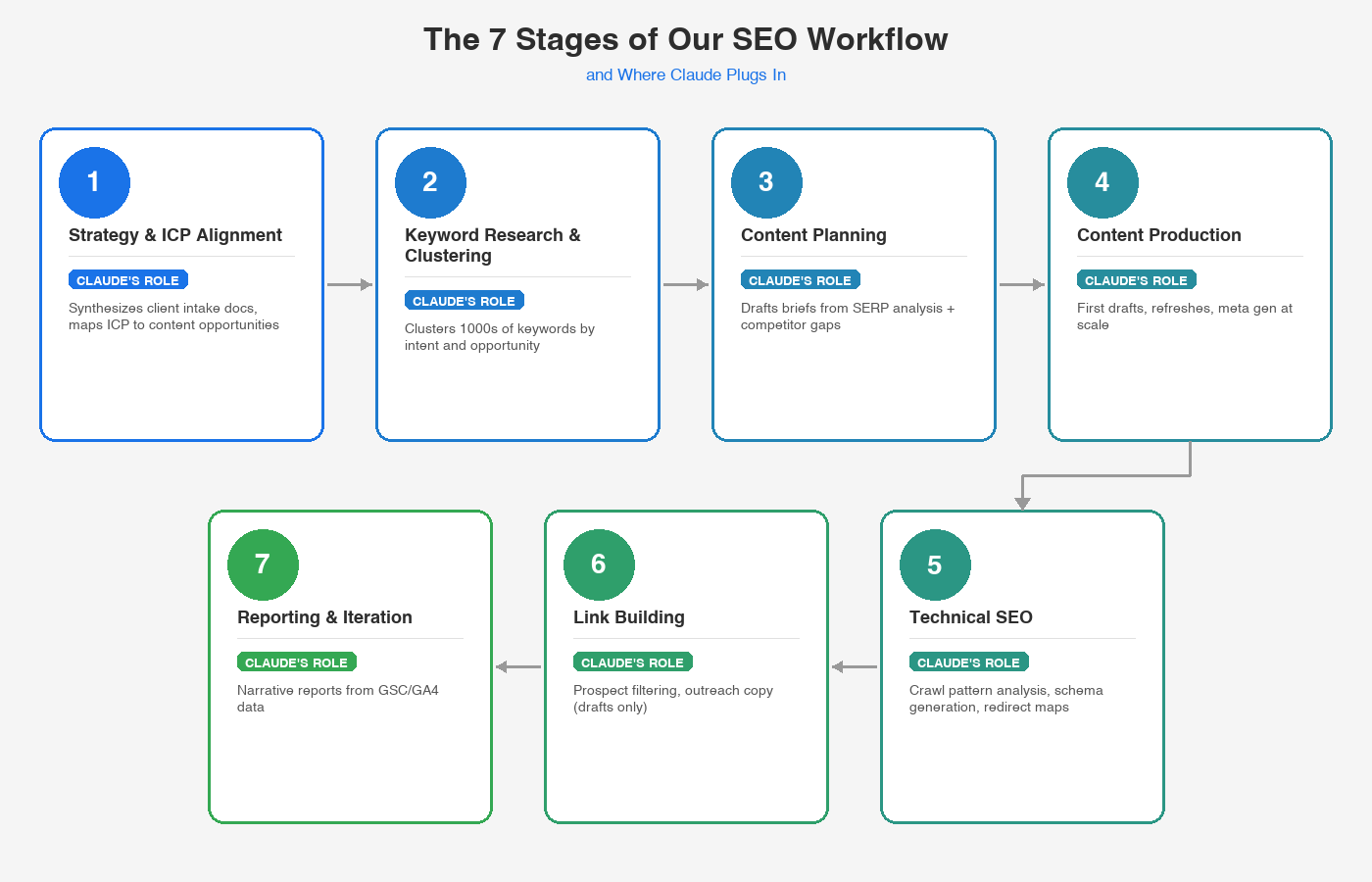
Our workflow has seven stages. Every client engagement touches all of them. Claude is involved in each one, but the intensity changes from stage to stage.
Here is the breakdown.
Stage 1: Strategy and ICP Alignment
This is where every engagement starts. Before any keyword research happens, we align on who the ideal customer is, what their buying journey looks like, and how SEO fits into their discovery process.
A senior strategist runs this. Client intake calls and stakeholder interviews kick it off. Internal document review fills in the gaps. Claude does not lead the stage. The strategist does.
Where Claude plugs in: synthesizing intake materials. We drop client intake docs, sales call transcripts, existing website content, and competitor positioning into Claude Code. Claude extracts ICP signals, pain point vocabulary, and messaging gaps. A strategist reviews the output, adds expert context, and turns it into a written strategy doc.
Clients who want to go deep on strategy typically work with our SaaS SEO strategy team on this phase.
Stage 2: Keyword Research and Clustering
The bottleneck in SaaS keyword research was never finding keywords. Ahrefs and Semrush handle that. The bottleneck is making sense of the thousands we already have.
Here is how we run it.
- Export keyword data from Ahrefs or Semrush with full metrics: volume, difficulty, SERP features, current rankings, ranking URL
- Feed the export into Claude Code along with Stage 1 strategy context
- Claude classifies each keyword by intent (informational, navigational, commercial investigation, transactional) with a confidence rating
- Claude clusters by topic and buying stage, flags ambiguous keywords, and suggests the page type for each cluster (guide, comparison, alternative, tool, hub)
- A strategist reviews, overrides edge cases, and finalises the cluster plan
Claude's intent classification accuracy is stronger than GPT-4o for nuanced B2B. It distinguishes between product comparison and solution evaluation, for example, where other models collapse these into one category.
Two days of strategist spreadsheet work now takes four hours once the prompt is set up and the output reviewed.
Competitive gap analysis
We also feed Claude a content gap report (from Ahrefs or Semrush) along with our existing content inventory. Claude identifies the missing keywords, the missing topics, and the missing angles.
The qualitative layer is where the value compounds. Claude reasons about why competitors rank for terms we do not. Is it a content gap, an authority gap, or a technical gap? A spreadsheet tells you what is missing. Claude tells you why and what to do about it.
Stage 3: Content Planning and Briefs
This is where Claude delivers the largest time savings in our workflow. Content brief generation used to take a senior strategist 60-90 minutes per article. We have built a content brief workflow that now closes out a brief in 10-15 minutes.
The strategist provides the target keyword, the intent, the top 10 ranking URLs, and the client's CLAUDE.md context. Claude outputs a full brief covering heading structure, section-by-section guidance, entities to reference, competitor gaps, word count targets, and internal linking suggestions.
Where Claude plugs in: everything except the final angle decision and QA. Briefs get a human review pass focused on whether the angle is differentiated from what is already ranking.
If you write B2B content briefs regularly, this is the single highest-leverage workflow we have adopted.
Stage 4: Content Production
Our writers work with Claude as a drafting partner. Claude produces structured first drafts from our briefs. Writers then do what writers do: add the expert layer, correct factual drift, inject original examples, and layer in the brand-specific voice that Claude cannot manufacture.
The 70/10 rule holds. About 70% of the information in a Claude draft survives to our final published version. Only 10% of the sentences survive word-for-word. The voice layer, the examples, the specific angles come from writers.
The content workflows we run
First-draft generation from detailed briefs. Claude produces drafts that need human expertise layered in, never published as-is. The brief quality determines the draft quality.
Content refresh and expansion. We feed existing underperforming content to Claude with current SERP data and ask for specific improvements. Claude identifies what is missing relative to what is now ranking.
Meta title and description generation at scale. For large sites needing hundreds of optimised metas, we provide Claude with page content and target keywords, and get structured output we can implement in bulk.
Internal linking suggestions. We provide Claude with our sitemap or content inventory, and it recommends contextual internal links for new or existing content.
Content consolidation. We identify and merge thin or overlapping pages by providing Claude with content from multiple URLs covering similar topics. Claude drafts the consolidated version and flags what to redirect.
Localisation and adaptation. We adapt content angles for different market segments or regions. Claude adjusts framing, examples, and positioning while keeping the core argument intact.
The content quality trap we watch for
Claude produces fluent, well-structured content that passes surface-level quality checks. That fluency is the danger.
Content that ranks and builds authority in 2026 requires genuine expertise, original data, practitioner insight, and specific examples Claude cannot fabricate. The correct workflow: Claude as accelerator, human as expert.
Teams that use Claude to publish faster without adding expertise see short-term traffic gains and long-term authority erosion. We have watched this play out across enough client accounts to state it with confidence. The brands winning in 2026 are the ones combining AI speed with AI-aware content craft that survives human review.
Writing for AI citations alongside rankings
Content produced in 2026 needs to perform in two systems: traditional search and AI answer engines. Claude helps structure content for AI citability by producing:
- Clear factual statements that AI models can extract and attribute
- Well-organised answer-ready paragraphs
- Comprehensive entity coverage
- Structured data that reinforces topical signals
The visibility picture backs this up. In the GEO/AEO space, dominant brands hold 19.1% visibility in AI-generated answers for category-relevant prompts, while most B2B brands sit below 1%. If you cannot see where your brand is cited, you are optimising blind.
Stage 5: Technical SEO and Site Health
Technical audits are the most data-heavy stage we run. A crawl of a 50K-page enterprise site produces thousands of rows of signals. Filtering that manually takes a full day.
Our technical SEOs feed Screaming Frog exports directly into Claude Code via the filesystem MCP server. Claude identifies pattern-level issues (all pages under /integrations/ have duplicate H1s, pages with more than 3 redirect hops are losing impressions, blog posts before a certain date are under-word-counted). The human reads the patterns, verifies a sample, and prioritises fixes.
Examples of the kinds of findings that would take hours to uncover manually:
- "All product pages under /integrations/ have duplicate H1 patterns"
- "Pages with more than 3 redirect hops correlate with those showing declining impressions in your GSC data"
- "Blog posts published before Q3 2024 have an average word count 40% below current ranking competitors"
Schema markup and structured data
Our workflow for schema generation:
- Provide Claude with a page's content and the target schema type (FAQ, HowTo, Product, Article, and so on)
- Claude generates the JSON-LD markup
- Validate the output against Google's Rich Results Test. This step is non-negotiable. Claude occasionally produces syntactically correct but semantically incorrect schema.
- For scale implementations, use Claude to generate schema templates that the dev team can programmatically apply across page types
Claude is stronger at generating complex nested schema (like Product with AggregateRating and Offer) than most other AI tools because of its instruction-following precision. But better does not mean error-free. We validate everything.
Log file analysis
This is a Claude Code power use case. Claude Code writes and executes Python scripts that:
- Parse server log files
- Identify Googlebot crawl patterns
- Flag crawl budget waste (repeated crawls of low-value URLs, ignored high-priority pages)
- Generate visualisations of crawl frequency by site section
For SEO teams without dedicated data engineering support, Claude Code effectively serves as a technical SEO analyst that can process data at scale. One rule we never break: always review the scripts Claude generates before running them on production data. Read the code, understand what it does, then execute.
Redirect mapping and migration support
Site migrations and URL restructuring are high-value use cases. Claude ingests an old URL list and the new site architecture, then generates redirect maps with reasoning for each mapping.
For large migrations (10K+ URLs), this workflow alone saves dozens of hours. According to Ahrefs' research on site migrations, even well-executed migrations typically see a 10-30% traffic dip. Redirect map quality is the biggest variable in recovery speed.
The human check we never skip: Claude maps URLs based on surface-level content similarity rather than search intent alignment. We validate every redirect map against ranking and traffic data. A URL that looks content-similar might serve a different search intent, and mapping it incorrectly destroys ranking equity.
Our SaaS SEO checklist captures the full set of technical checks we run per engagement.
Stage 6: Link Building and Authority
Link building is the stage where Claude helps least. The human craft of SaaS link building is relationship-driven, not data-driven.
Where Claude plugs in: prospect filtering (we feed it a list of 500 potential prospects and have it score relevance and authority signals), first-draft outreach emails, and link anchor text suggestions for new content. Everything else (the outreach, the follow-ups, the earned relationships) stays with our link team.
For enterprise clients, our enterprise link building team treats Claude as a research assistant, never a campaign runner.
Stage 7: Reporting and Iteration
Monthly client reporting used to eat a full analyst day. Now it takes under two hours. Claude pulls SEO tracking data from GSC and GA4, identifies trends and anomalies, and drafts the narrative sections of the report. The analyst reviews, adds strategic interpretation, and refines the recommendations.
Claude produces specific narrative patterns we used to write manually:
- "Impressions for your /product/ subdirectory increased 34% MoM while clicks remained flat, suggesting a CTR optimisation opportunity"
- "Queries containing 'alternative to [competitor]' are growing fastest but landing on your homepage rather than a dedicated comparison page"
- "Your /blog/ pages show a 22% decline in average position for queries with commercial intent, while informational queries remain stable"
The analyst reviews the narrative, pressure-tests the logic, and refines the recommendations before the report ships.
The AI visibility layer we also report on
A complete 2026 reporting stack also tracks how often the brand gets cited in AI-generated answers for target queries. Claude handles traditional metrics. Slate handles the AI citation layer. We feed both into Claude for joint analysis.
The pattern we see across B2B SEO prompts is striking. Across ChatGPT, Google AI Mode, and Google AI Overview in the last 90 days of monitored data, 80.7% of all AI citations went to domains that were not being tracked by their owners. Share of voice for leading brands like HubSpot and Directive sat in the 5-10% range for B2B SEO topics. Most SaaS brands were below 1%.
That gap is what Claude helps us close. We use Slate data to identify citation opportunities, then run our content engine through Claude to target them.
For a fuller breakdown of how we measure performance, see our enterprise SEO metrics framework.
What We Keep Human-Only
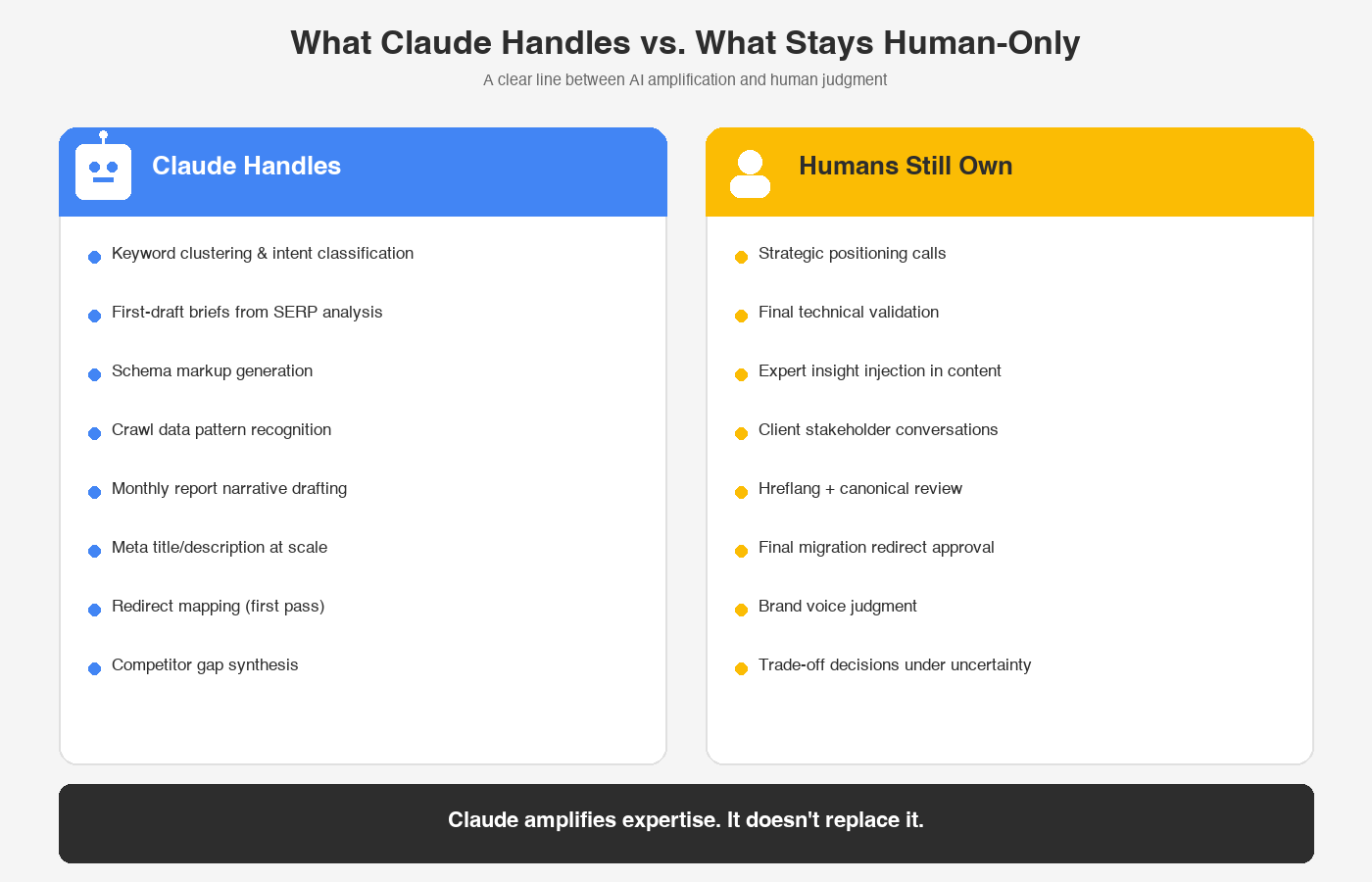
Every time we have tested letting Claude close the loop on a stage end-to-end, we found the cost of a single bad output exceeds the time saved across the good ones. So we maintain a firm list of human-only tasks.
Strategic positioning calls. Claude synthesises inputs. Humans make the call.
Final technical validation. Redirects, canonicals, hreflang, schema on high-value pages. Claude drafts. A human signs off.
Client stakeholder conversations. No AI on client calls.
Expert insight injection in content. Original examples, proprietary data, insider takes, and specific client results. Claude cannot fabricate these, and we do not let it try.
Trade-off decisions under uncertainty. When two approaches both have merit and data is sparse, a human chooses.
We have tried to compress these boundaries. Every compression attempt produced a lower-quality deliverable than the version we would have shipped with the human in the loop.
A Week in the Life: Our SEO Strategist + Claude
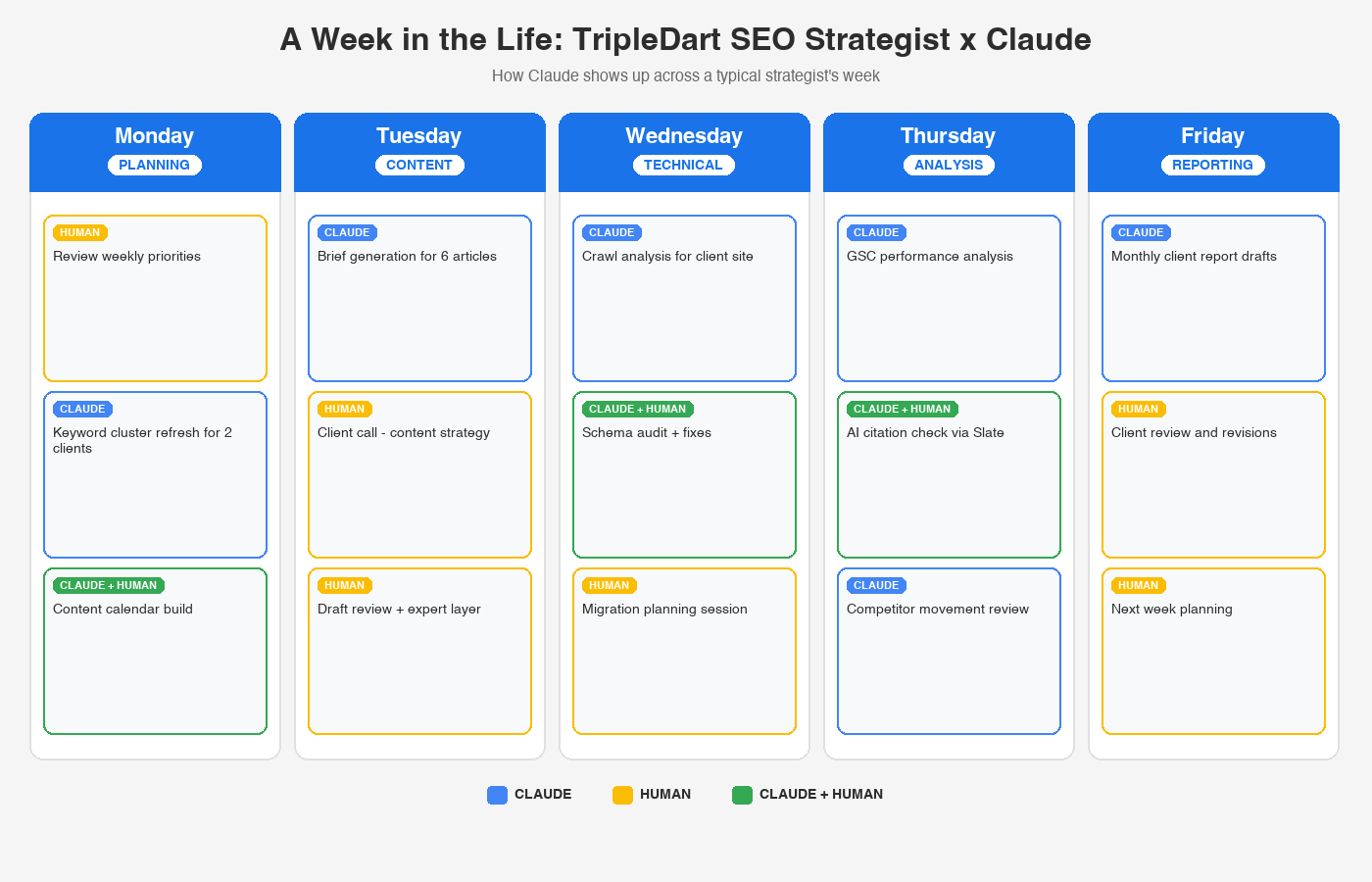
Here is what a typical week looks like for one of our senior SEO strategists running three active B2B SaaS accounts. Specifics are generic; the rhythm comes from a live week.
Monday: Planning
- 9:30 AM. Review weekly priorities and blockers across accounts (human)
- 10:15 AM. Run keyword cluster refresh for two clients via Claude Code, cross-check against Ahrefs competitor movements (Claude-led, human review)
- 12:00 PM. Build a draft content calendar for next month from the refreshed clusters (Claude)
- 2:00 PM. Team standup (human)
- 3:00 PM. Final review and approval of content calendar, sent to client (human)
Tuesday: Content strategy
- 9:00 AM. Generate six content briefs using our brief CLAUDE.md workflow (Claude)
- 11:00 AM. Client call: walk through next month's content strategy (human only)
- 1:30 PM. Review two draft articles from writers, add expert layer and original examples (human)
- 3:30 PM. Deep-research into an emerging topic. Claude synthesises 10 source articles, strategist forms the angle (Claude + human)
Wednesday: Technical SEO
- 9:30 AM. Crawl analysis for a client site using Screaming Frog output in Claude Code (Claude)
- 11:30 AM. Schema audit across product pages. Claude generates new JSON-LD, strategist validates in Rich Results Test (Claude + human validation)
- 2:00 PM. Migration planning session with client's dev team (human)
- 4:00 PM. Draft redirect map for migration. Claude produces first pass, technical SEO reviews line-by-line (Claude + human)
Thursday: Analysis and AI visibility
- 9:00 AM. Pull GSC data for all three accounts and run performance analysis via Claude Code (Claude)
- 11:00 AM. AI citation visibility check through Slate, cross-referenced with Claude for pattern analysis (Claude + human interpretation)
- 1:30 PM. Competitor movement review: who is gaining and losing across the topic clusters we care about (Claude, human review)
- 3:30 PM. Internal debrief on findings, priorities for next week (human)
Friday: Reporting and reset
- 9:00 AM. Monthly client report drafts for two accounts (Claude drafts, analyst reviews)
- 11:30 AM. Client review calls, walking through findings (human)
- 2:00 PM. Refresh the client CLAUDE.md files with the week's learnings (human)
- 3:30 PM. Next-week prep and Monday setup (human)
Across this week, Claude is involved in roughly 60-65% of the calendar. The remaining 35-40% (client conversations, strategic judgment, final validation, editorial review) is entirely human. That ratio has held stable for the last several months. It is deliberate, not accidental.
The Two-System Reality We Operate In
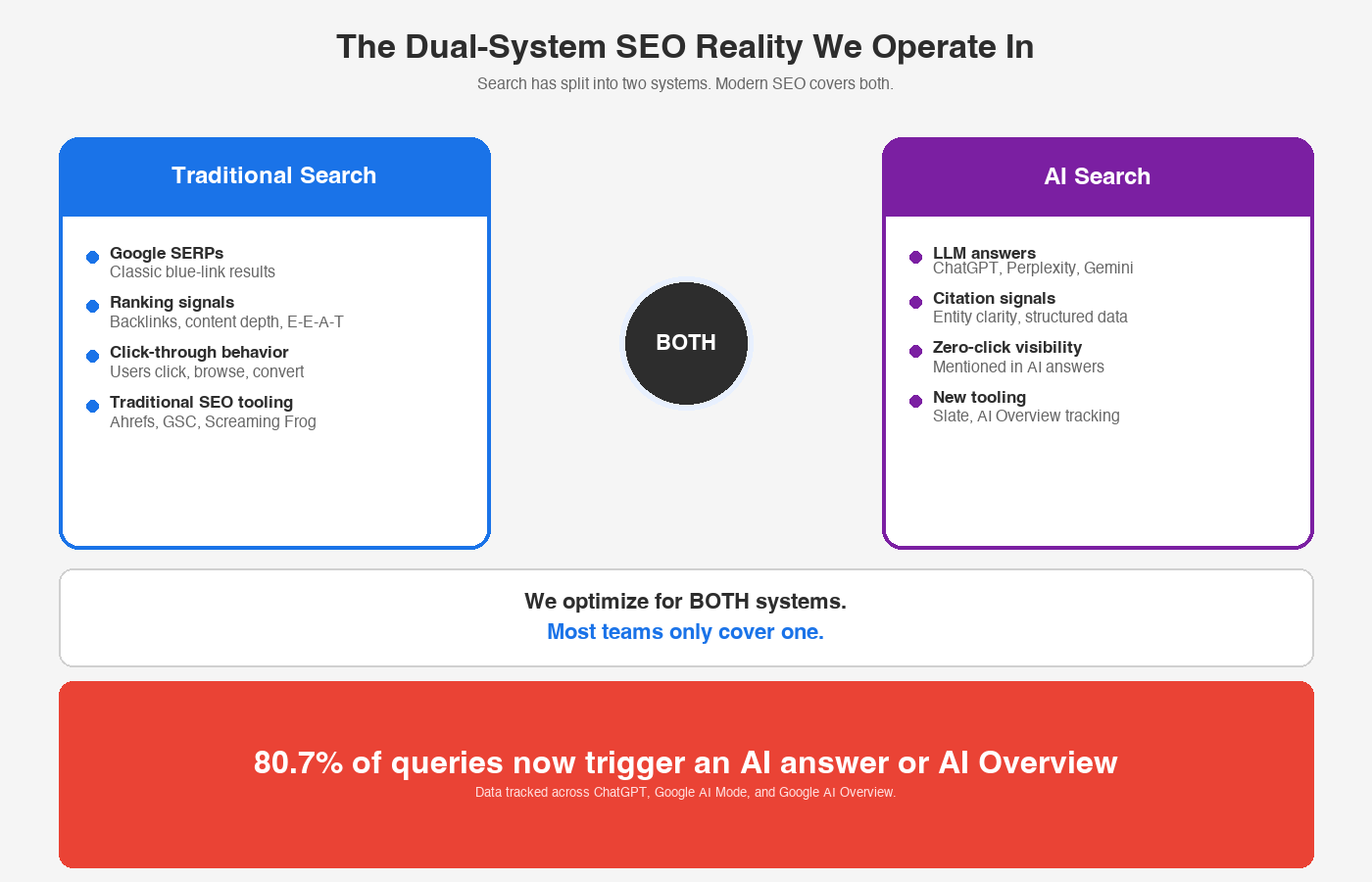
SEO in 2026 is two games, not one. Traditional search engines and AI-powered answer engines. Both matter. Both need different optimisation approaches. Both require tracking, which is the part most teams skip. We cover the full picture in our AEO versus SEO breakdown, but here is the operational shortcut.
For traditional search, we track rankings, impressions, clicks, and conversions through GSC and Ahrefs. For AI search, we track citations, share of voice, and visibility across ChatGPT, Google AI Mode, Google AI Overview, and Perplexity through Slate.
Claude is what connects the two. We feed both datasets into Claude and ask it to identify where visibility diverges. Where are we ranking well in Google but invisible in AI answers? Where are we cited in AI answers but not ranking on the SERP?
That analysis feeds our content and optimisation decisions. If a topic is trending in AI answers but we do not have a dedicated page, we move that keyword up the priority list. It is one reason our generative engine optimisation work sits alongside our traditional SEO engagements rather than separately.
Teams building an answer engine optimisation practice from scratch will hit the same integration problem. Our take: do not treat AEO as a separate discipline. Treat it as one more channel inside the same workflow.
Why Claude Over GPT-4o or Gemini for Our Work
We use all three. Not equally. Here is how we split them day-to-day.
Claude vs Gemini for SEO
Gemini's advantage is native Google ecosystem integration. Direct access to Google Search data, YouTube analysis, Google Docs/Sheets integration. For teams deep in the Google stack who need quick analysis without export-import friction, Gemini has a genuine workflow edge.
Claude's advantage is output quality and instruction precision. When the deliverable needs to be client-ready or publication-ready, Claude consistently produces more polished results.
Where each wins:
Gemini wins: quick SERP checks during strategy sessions, YouTube SEO analysis, collaborative analysis in Google Sheets, teams embedded in Google Workspace.
Claude wins: detailed content briefs, long-form content production, complex data analysis requiring multi-step reasoning, any deliverable that requires precise formatting or brand voice adherence.
The multi-tool reality
We do not use Claude exclusively. Transparency here builds more credibility than advocacy.
Our working split looks like this: Claude as the primary reasoning engine (roughly 80% of AI-assisted SEO work), supplemented by GPT-4o for web research and quick queries, and Gemini for Google-native data analysis.
The sign of a mature AI-augmented SEO practice is not loyalty to one tool. It is knowing which tool to reach for at each moment.
When no AI tool is the right answer
There are scenarios where Claude (and all AI tools) should not be the decision-maker:
Final technical validation of critical implementations (redirects, canonical tags, hreflang on high-value pages). Claude drafts. A human must verify.
Strategic decisions about market positioning and competitive differentiation. Claude synthesises inputs. Strategic judgment stays human.
Any analysis where the cost of an AI error exceeds the time savings. A bad redirect map on a 50K-page migration can cost months of recovery. The time saved on generation is not worth the risk of unvalidated output.
Experienced SEOs use Claude to accelerate their work, never to replace their judgment. The tool is powerful precisely because it is wielded by someone who knows what good output looks like.
What We Tell Teams Rolling This Out Themselves
We get asked often how a smaller team could adopt a version of this stack. The honest answer: start small. The stack above was not built in a week.
Phase 1 (Weeks 1-4): Individual productivity
- Set up Claude.ai Pro with a dedicated SEO Project
- Start with content brief generation. It is the fastest time-to-value workflow
- Add keyword clustering as your second workflow. Export from your keyword tool, analyse in Claude
- Build a prompt library. Save your best-performing prompts as reusable templates
- Track time savings honestly. Measure hours saved per week to build the case for team-wide adoption
This phase is about proving value and building muscle memory. Do not try to automate everything at once.
Phase 2 (Months 2-3): Team integration
- Move to Claude Code for the heavier workflows (technical audits, multi-source analysis)
- Write your first CLAUDE.md at the agency or team level
- Connect your first MCP server. Usually GSC
- Standardise how briefs and reports look across team members
- Establish quality review processes. Define which Claude outputs require human review before delivery (most of them, initially)
- Document workflows so they are not locked in one person's head
Phase 3 (Months 3-6): Workflow depth and automation
- Add client-level and task-level CLAUDE.md files
- Connect Ahrefs, GA4, and Slate MCP servers
- Move high-volume repetitive tasks to API-driven automation (meta descriptions, schema generation, weekly reports)
- Build custom Claude workflows that connect multiple data sources for comprehensive analysis
- Integrate AI visibility monitoring. Track how your content performs in both traditional search and AI citations
- Establish feedback loops. Use performance data to refine your Claude prompts and workflows continuously
Plenty of teams stall at Phase 1 because they do not invest in CLAUDE.md discipline. The difference between an average prompt and a great one is mostly context. CLAUDE.md is where context lives. If you want a shortcut, our SEO automation write-up covers the prompts we use.
What a mature workflow looks like
A reference model, not a pitch.
The human layer does not diminish. It moves from execution to judgment and quality. The team produces more, at higher quality, because Claude handles the time-consuming synthesis work while practitioners focus on the decisions that require expertise.
The Unlock We Keep Coming Back To
The biggest change in our thinking happened when we stopped asking "how can AI do SEO for us" and started asking "how can AI amplify the SEO our team already does."
Claude is not replacing any role on our team. It is making every role 40-60% faster on the stages where it plugs in, with human judgment unchanged on the stages where it does not.
That is the practical truth, not the hype version. It also means the teams that get the most out of Claude are the ones with the deepest existing SEO knowledge. The tool multiplies expertise. It does not create it.
Where to start: Pick one workflow. Content brief generation is the highest-ROI. Set up Claude Pro. Create a Project with your brand context. Generate briefs for two weeks and measure the hours saved. Expand from there.
At TripleDart, we run this stack across dozens of B2B SaaS engagements. If you want to see how it operates on an account like yours, talk to our team. If you want to dig deeper into the workflows, the links below go to every related piece in this cluster.
FAQs
Can Claude replace SEO tools like Ahrefs or Semrush?
No. Claude is a reasoning and synthesis layer on top of data from these tools. It analyses the data, interprets it, and structures it for output. It does not collect it. You still need dedicated SEO platforms for keyword data, backlink analysis, rank tracking, and crawling.
What's the best Claude plan for SEO work?
Claude Pro ($20/mo) is enough for most individual practitioners. Claude Team is better for agencies and in-house teams that need shared Projects and higher usage limits. API access is for teams building automated workflows at volume.
How does Claude compare to ChatGPT for SEO tasks?
Claude excels at instruction-following, long-document analysis, and content quality. ChatGPT (GPT-4o) has advantages in web browsing, multimodal analysis, and quick research queries. Most mature teams use both, with Claude as the primary reasoning engine and GPT-4o supplementing for web research.
What is MCP and why does it matter for SEO?
Model Context Protocol (MCP) is Anthropic's open standard that lets Claude connect directly to tools like Google Search Console, GA4, and Ahrefs. It eliminates manual data export/import and enables real-time analysis within Claude. It transforms Claude from a text interface into a connected workflow engine.
What MCP servers should a small SEO team start with?
Google Search Console first, Ahrefs second, Google Sheets third. These three cover the bulk of recurring workflows (keyword research, content briefs, reporting) without requiring custom engineering.
How do you prevent Claude from fabricating data in reports?
A few safeguards. Our CLAUDE.md files explicitly prohibit unsourced claims. Every number in a client-facing report gets traced back to the source data before it ships. And a human reviews every deliverable. Claude still drifts occasionally; the process catches it.
Does this setup require a technical SEO background?
For Claude Code and MCP setup, yes. For Claude.ai Pro with Projects, no. Most marketing managers can run the Pro setup without engineering help. The Claude Code path requires terminal comfort and willingness to debug the occasional MCP server hiccup.
How much of your content gets written by Claude end-to-end?
Zero percent. Every piece gets human expert layering before publish. Claude produces first drafts; writers rewrite about 90% of the sentences and add the original examples, insider takes, and client-specific expertise. Drafts ship faster, the craft layer is entirely human.
Can Claude help with AI search optimisation (AEO)?
Claude helps structure content for AI citability and analyses AI citation patterns when given the data. Monitoring the AI search visibility layer itself requires a dedicated tool that tracks how AI models cite your brand. Once you have that data, Claude becomes the analysis layer on top of it.
How do I track whether my brand is being cited by AI engines?
You need a monitoring tool that regularly queries AI platforms (ChatGPT, Perplexity, Google AI Mode, Google AI Overview) for your target prompts and tracks whether your brand appears. We use Slate for this. The alternative is manual testing, which does not scale past a handful of prompts.



.webp)
.webp)
.png)


.png)


.webp)



.webp)

.webp)




%20(1).png)


.webp)
.webp)
.webp)



%20Ads%20for%20SaaS%202026_%20Types%2C%20Strategies%20%26%20Best%20Practices%20(1).webp)






.png)


.png)





.webp)


![Creating an Enterprise SaaS Marketing Strategy [Based on Industry Insights and Trends in 2026]](https://cdn.prod.website-files.com/632b673b055f4310bdb8637d/6965f37b67d3956f981e65fe_66a22273de11b68303bdd3c7_Creating%2520an%2520Enterprise%2520SaaS%2520Marketing%2520Strategy%2520%255BBased%2520on%2520Industry%2520Insights%2520and%2520Trends%2520in%25202023%255D.png)




.png)














.webp)



%20Agencies%20for%20B2B%20SaaS%20Compared%20(2026).webp)

.webp)
%20with%20Hubspot.webp)






.png)


.png)

.png)
.png)
.png)
.png)















.webp)
.webp)
.png)
.png)



.webp)


.png)


















.webp)
![How to Measure AEO Success: 12 Metrics Beyond Clicks [2026 Framework]](https://cdn.prod.website-files.com/632b673b055f4310bdb8637d/6a0d664b326187e99b3d5960_6%20-%20The%20Ultimate%20Guide%20to%20Measuring%20AEO%20Success%20in%202026.png)
![7-Step Workflow for AEO-Ready Content [2026 Framework]](https://cdn.prod.website-files.com/632b673b055f4310bdb8637d/6a0d55ea88913ede1d3a7123_5%20-%20Workflows%20for%20Optimized%20AEO-Ready%20Content%20Creation.png)
.png)
![How to Structure Content for AEO and GEO [With Templates]](https://cdn.prod.website-files.com/632b673b055f4310bdb8637d/6a0c6a56eb700472e635ff33_1%20-%20How%20to%20Structure%20%20Content%20for%20AEO%20and%20GEO%20%20Summaries%20(2026).png)




.png)
.png)









.png)

.png)



%2520Agencies%2520(2025).png)

![Top 9 AI SEO Content Generators for 2026 [Ranked & Reviewed]](https://cdn.prod.website-files.com/632b673b055f4310bdb8637d/6858e2c2d1f91a0c0a48811a_ai%20seo%20content%20generator.webp)


.webp)
.webp)












.webp)