.png)

Key Takeaways
- Per-post link insertion solves the wrong problem on large sites. Most archive authority loss sits in orphan pages, anchor fatigue, and topic cluster breaks, not missing links on new posts.
- We run a site-level audit first. Claude Code reads the full sitemap and crawl, maps topic clusters, identifies orphan pages, scores anchor diversity, and surfaces authority leaks.
- The pipeline outputs a rebuild plan, not a link insertion queue. A typical 2,000-page B2B SaaS archive surfaces 300 to 500 internal linking opportunities a per-post tool would never find.
- Topic cluster mapping is the step that moves rankings most. We group every page into hub-and-spoke clusters, verify the hub-to-spoke link graph, and fix breaks.
- Anchor diversity and scale are managed at site level, not page level. Repetitive anchors on a 500-page archive signal over-optimization; Claude finds the patterns and recommends dilution.
- The rebuild ships as one engineering deployment per cluster, not as 500 individual link edits. That difference is what makes the architecture change stick.
The 340 Orphan Pages That Started This Workflow
The first sitemap scan we ran with this pipeline surfaced 340 orphan pages on a 2,000-page B2B SaaS archive. 180 of those orphans were still earning impressions in GSC. 62 of them were earning over 500 monthly impressions each.
The client had been using a per-post internal linking tool for eight months. The tool was inserting five to eight links into every new post published. None of those links were pointing at the orphans.
That gap is the one this workflow exists to close. Per-post linking tools ship forward.
Site-level architecture is about the archive you already have, the pages earning impressions nobody links to anymore, and the topic clusters that quietly broke when the content team grew from two writers to six without an architecture review.
This article walks the exact pipeline we run on 1,000-plus-page B2B SaaS sites.
The audit that surfaces the true opportunities, the topic cluster mapping that reorganizes the link graph, the anchor diversity work that protects against over-optimization, and one full archive rebuild walked through outcome first.
The broader workflow this sits inside is covered in our Claude SEO guide. This piece is the site-architecture layer.
Why Per-Post Linking Cannot Solve Archive-Level Problems
Per-post linking tools insert contextual links into new content as it is published. That is useful. It is also a different problem from the one most B2B SaaS archives are truly suffering from.
The archive-level problems are four. Orphan pages earning traffic with no incoming links. Anchor over-optimization across the 500 pages that already exist.
Topic cluster breaks where hub-to-spoke link graphs are incomplete. Authority flowing to the wrong pages because the internal linking was never planned at site level.
A per-post tool, by design, only touches the post being published. It cannot fix the archive. It cannot reroute authority from a shallow page to a deep one. It cannot detect when the anchor "SaaS SEO agency" has been used 47 times across the site and needs dilution.
The framing of how content and linking connect at scale sits in our SaaS content marketing agencies roundup, where we break down how top agencies structure content around topic clusters and internal linking maps.
Where Per-Post Linking Earns Its Keep
We still run per-post linking. The pipelines are complementary, not competitive.
New posts going live get five to eight contextual links through a per-post flow. The site-level pipeline below runs quarterly to rebuild the architecture around the archive that has been accumulating since the last pass.
Both matter. Only one of them is under-served by current tooling, and that is the site-level layer.
The Site-Level Audit That Runs First
Before any linking decisions get made, we run a four-part site-level audit. The audit is the input to every downstream decision. Skipping it produces a linking plan that papers over symptoms.

Part One. Sitemap Reconciliation
Claude Code reads the XML sitemap and cross-references it against the crawl export. Every URL in the sitemap that has zero inbound links from indexable pages is an orphan.
On sites over 1,000 pages, we surface 80 to 400 orphans per audit. Most of them are deliberate (tag pages, paginated archives). The 20 to 80 that earn impressions are the ones we fix.
Part Two. Link Graph Construction
Claude reads internal_all.csv from Screaming Frog, builds the full link graph, and surfaces three metrics per page: inbound link count, outbound link count, and shortest-path distance from the homepage.
Pages over four clicks deep that still earn GSC impressions are authority-starved. Pages under three clicks deep that earn zero impressions are authority-wasted. Both show up in the rebuild plan.
Part Three. Anchor Distribution Analysis
This is the part per-post tools cannot handle. Claude reads every anchor text across every internal link in the site and maps distribution per destination URL.
The patterns surface immediately. A destination page with 47 inbound links where 41 of them use the same anchor is a page with anchor fatigue. A destination page with 12 inbound links where 11 of them use generic anchors like "learn more" is a page with wasted anchor signal.
Part Four. Topic Cluster Integrity Check
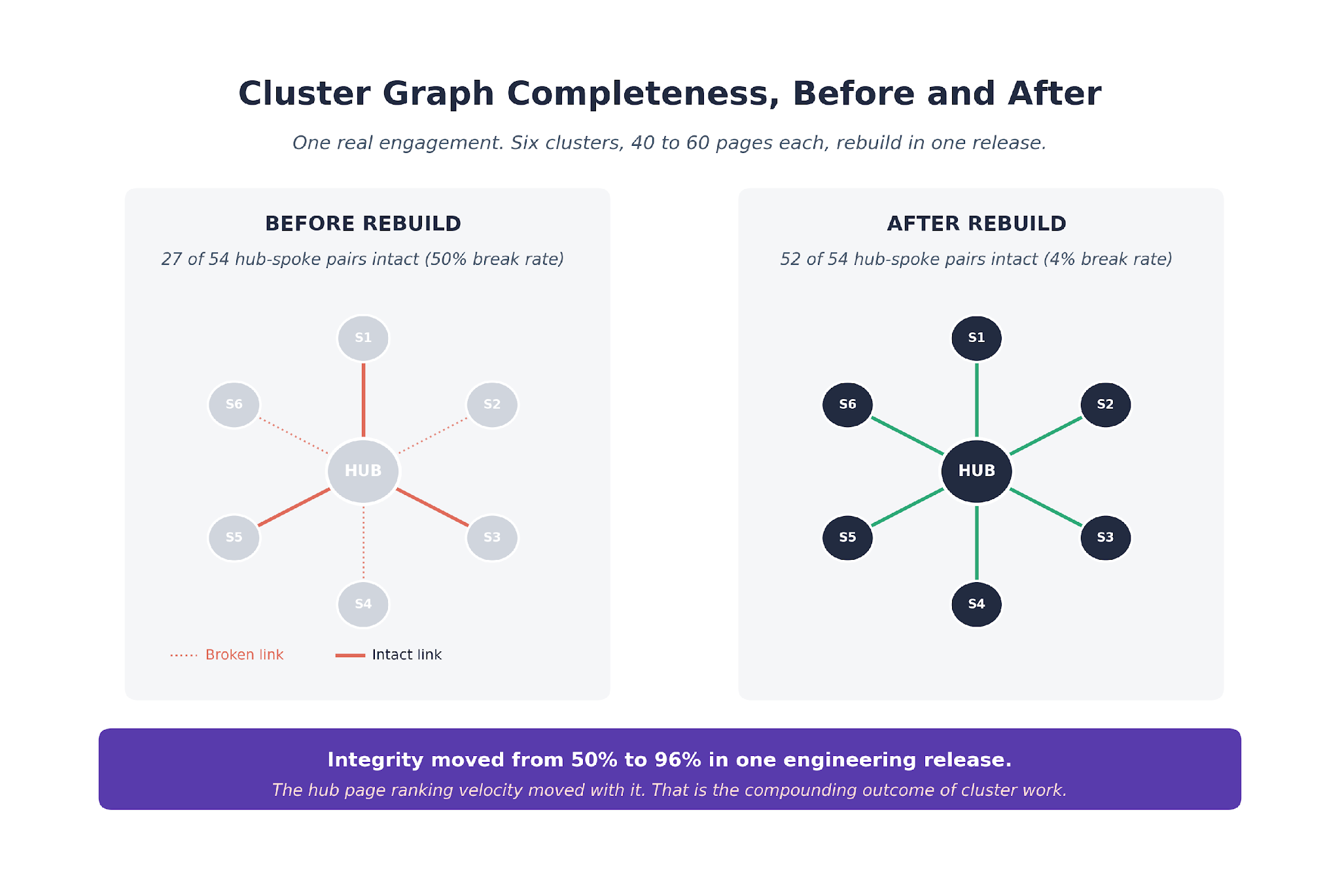
The fourth pass maps every URL to a topic cluster and checks whether the hub-to-spoke link graph is complete. A hub page that does not link to one of its spokes is a break. A spoke that does not link back to its hub is a break.
Typical break rate on unaudited archives: 15 to 30% of hub-spoke pairs are incomplete.
Fixing this alone moves rankings on the hub pages more than adding new content. The SaaS SEO agency engagements where we run this pattern consistently see the largest hub-page lifts here.
What Our Site-Level Audits Keep Surfacing
Across the B2B SaaS archives we rebuild, 40 to 50% of the high-impact linking opportunities are orphan fixes. Another 25 to 30% are topic cluster integrity fixes. The remaining 20 to 30% are anchor diversity corrections. New-post link insertion accounts for under 5% of the lift we measure post-rebuild. The archive is the work.
The Topic Cluster Mapping Pipeline
Topic cluster mapping is where the audit becomes a rebuild plan. Claude reads the full content inventory and clusters pages into hub-and-spoke groups based on topical proximity and buyer-stage alignment.
The Search Engine Land's guide frames the concept at the content-planning level. The link graph version is where the architecture work happens.
How the Clustering Runs
Read the content inventory at /pages.csv.
For each URL: classify by topic (the primary noun phrase that describes it),
buyer stage (TOFU, MOFU, BOFU), and page type (hub, spoke, landing, blog, tool).
Group pages into clusters where:
- one page serves as the hub (usually the /topic/ or /[topic]-guide/ URL)
- supporting spokes cover sub-topics, FAQs, comparisons, alternatives
- each spoke links to the hub and is linked from the hub
Flag incomplete clusters. Flag orphans that belong in a cluster.
Output: a cluster map with URL assignments.
On a 2,000-page archive, a run produces 30 to 60 clusters. Most of them have gaps. The gaps are the rebuild plan.
How Breaks Get Fixed
A broken hub-to-spoke link gets added through a site-wide template update when possible, not through a manual edit. The Webflow and WordPress templates that most clients run make this a one-release change once the break is identified.
Fixes that cannot be templated get queued for a content-side insertion pass. About 70% of the breaks are templatable. The remaining 30% need contextual placement inside body prose.
The Authority Flow Outcome
Once the cluster graph is complete, authority flows from the hub to the spokes and back. Pages that sat at crawl depth five suddenly get linked from the hub and move to depth three.
That one change is what we see move ranking velocity most.
A spoke at depth three, linked from a hub with authority, gains ranking in weeks. The same spoke at depth five, orphaned, does not rank regardless of content quality.
The Semrush internal linking guide covers the same dynamic from a different angle.
Why Template-Level Fixes Beat Per-Page Edits
A 1,000-page archive cannot be fixed one page at a time. The math does not work. Manual edits across 1,000 pages produces a rebuild that ships over two quarters and introduces as many inconsistencies as it fixes.
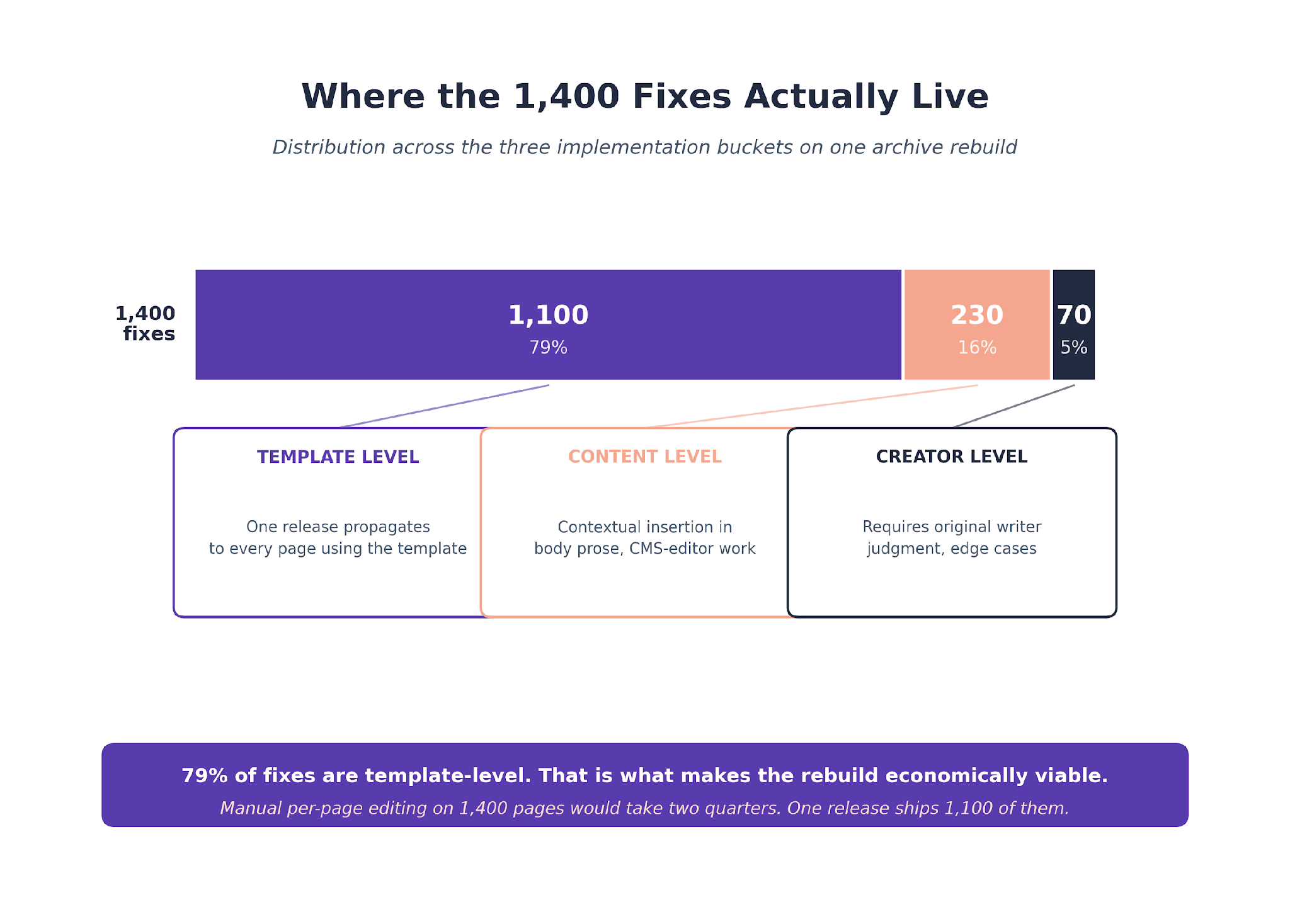
The template-level approach solves this. Claude groups proposed fixes by the CMS template that owns them. The fix ships as a one-release change to the template, and 300 pages inherit it.
We typically group fixes into three buckets: template-level, content-level, and creator-level.
About 70% of fixes sit in the first bucket (one release fixes many pages). That is what makes the rebuild economically viable.
The Moz internal linking guide frames the same architecture principle from a different angle. Site-wide patterns carry more signal than per-page edits.
Anchor Diversity at Scale
Anchor text carries ranking signal. It also carries over-optimization risk when the same anchor gets used 47 times on a 2,000-page site.
The pipeline measures anchor distribution per destination URL and flags pages where any single anchor exceeds 25% of total inbound anchor text. That is the threshold we watch.
The Dilution Rewrite
When a page has anchor fatigue, Claude reads the source paragraphs of the over-represented links and suggests rewrites that carry the same topical signal with more varied phrasing. The writer or the SEO ops lead reviews and accepts the rewrite.
A typical fatigue fix across a 500-page site rewrites 15 to 30 source anchors. The destination page's anchor diversity score moves from 0.38 to 0.72 after the rewrite. Ranking lift follows within two to four weeks of re-crawl.
The Generic Anchor Fix
The opposite pattern is also common. A page with 12 inbound links where "learn more" or "click here" dominates is a page wasting anchor signal.
Claude reads each source paragraph and suggests a topical anchor that fits the surrounding context. The writer accepts or overrides. The fix is the same kind of one-paragraph edit as the dilution rewrite, with the opposite intent.
What Our Anchor Audits Keep Surfacing
Across the B2B SaaS archives we rebuild, anchor fatigue shows up on 10 to 15% of high-traffic destination pages. Generic anchor waste shows up on 25 to 35% of them. Fixing both inside the same pass tends to add 10 to 20 percentage points of ranking position across the affected pages within the quarter.
One Archive Rebuild, Walked Through Outcome First
Here is what the pipeline looked like on one engagement. A DevOps observability client, 2,400 indexable URLs, eight months into a content investment, and ranking plateau across the blog despite steady publishing.
Ranking position gained: average position on the blog moved from 18.4 to 12.1 across 340 tracked queries inside 90 days of the rebuild.
Orphan pages recovered: 62 of the 180 earning-traffic orphans moved back into cluster graphs and added 190,000 monthly impressions.
Anchor diversity improved: fatigue flags dropped from 14 destination pages to two, and generic anchor waste dropped from 89 pages to 11. The keyword research pipeline the archive was planned against also refreshed at the same time.
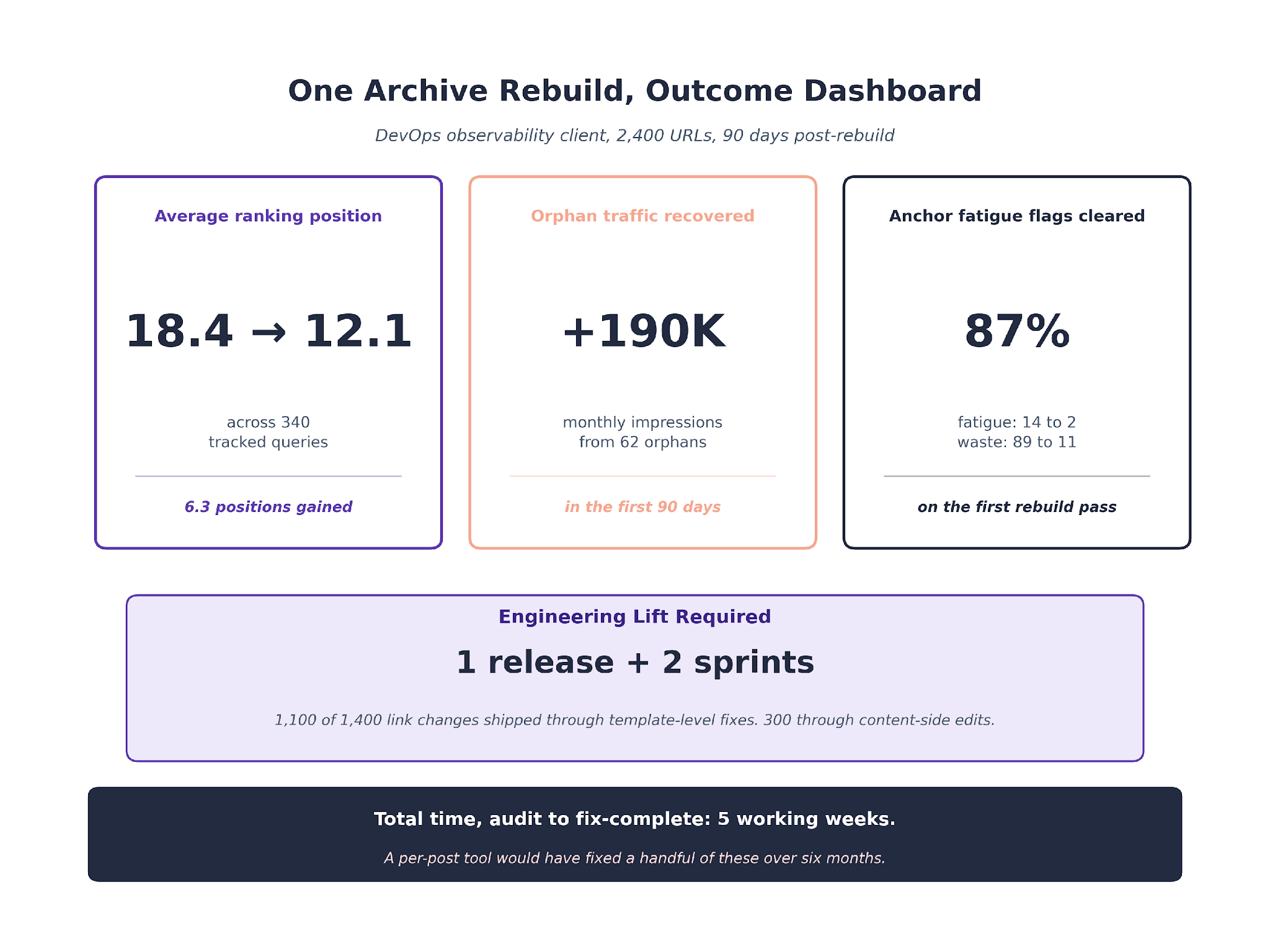
Total engineering effort: one release for the template-level fixes covering 1,100 of the 1,400 identified link changes, plus two sprints of content-side insertion work for the remaining 300. Total time from audit start to fix complete: five working weeks.
The template-level approach is the detail that moves the rebuild from cosmetic to structural.
A per-post linking tool would have fixed a handful of the orphans over the next six months as new content was published. The site-level rebuild fixed 1,100 of them in one release. The math is not close.
The client's archive has since been through two additional refresh passes (six months apart). Each refresh surfaces fewer issues than the last, which is how it should work.
The first pass is the heavy lift. The subsequent passes maintain the architecture.
The archive rebuild is also a trust-building moment with clients. Ranking lift from content alone arrives unevenly across an archive.
Ranking lift from architecture work arrives across the full set of affected clusters at once, often inside the same re-crawl window. That concentration of outcome is what makes the work legible to a CMO watching quarterly reports.
The second thing an archive rebuild produces is a cleaner baseline for everything downstream.
Fresh content published after the rebuild inherits the clean cluster graph and ranks faster. Writers onboarded after the rebuild pick up cluster ownership rather than trying to retrofit linking into an archive no one had mapped.
The Refresh Cadence Pattern
Across the archives we rebuild, subsequent refreshes surface roughly a quarter of the issues the initial rebuild did. Orphan counts drop fastest because the template-level fixes catch the biggest cluster. Anchor fatigue takes two to three passes to stabilize because the content team keeps publishing, and patterns creep back in. The pipeline is a maintenance discipline, not a one-time audit.
How the Pipeline Handles CMS Realities
Webflow and WordPress handle template-level changes differently. The pipeline accommodates both without forcing the client to change CMS.
On Webflow, template-level fixes ship through component updates that propagate to every page using the component. The turnaround is typically one engineering sprint. Contextual insertions ship through the CMS collection editor.
On WordPress, template-level fixes ship through theme updates or block patterns depending on the client's publishing setup. Contextual insertions go through Gutenberg, ACF, or the WYSIWYG editor, depending on what the site uses.
The pipeline outputs the same rebuild plan regardless of CMS. The implementation layer is what varies, and that layer is owned by the dev team the client already works with.
Putting the Architecture Workflow Into Practice
Site-level internal linking is the stage most teams skip because it looks like per-post linking dressed up. The distinction is not cosmetic.
The technical SEO for SaaS guide covers the crawler-setup side of the audit. The service layer this work sits inside is our technical SEO agency.
The right entry point is a single audit pass against your current archive. Run the four audit parts once. Compare the surfaced orphan count, cluster break rate, and anchor fatigue to what you were catching with per-post tools. The delta is the evaluation.
We run this architecture pipeline across 250+ B2B SaaS engagements at TripleDart. The pattern carries across WeWork, Atlas, Payoneer, and SignEasy, and across archives that share nothing beyond the common pattern of a content team that outgrew its original linking strategy.
The site-level audit feeds directly into the technical audit work covered in our technical audit guide.
The cluster map feeds the content calendar from the keyword research pipeline linked earlier. The rebuild outcomes feed the reporting layer.
To see how we would rebuild yours, talk to our team.
Frequently Asked Questions
Does this replace a per-post linking tool? No. The pipelines are complementary. Per-post tools handle the new content going live. The site-level pipeline handles the archive, the orphan pages, and the topic cluster integrity. Most archives need both.
Does the rebuild cause any ranking volatility in the short term? Minor, usually. Google's crawlers need a few cycles to recalibrate anchor distributions and cluster relationships. We see a week or two of minor position fluctuation after a rebuild, followed by the ranking lift. The fluctuation is never deep; deep drops indicate something went wrong in the implementation, and those are worth investigating.
How do you prioritize orphan pages when there are too many to fix at once? Impressions first, then conversion proximity, then recency. An orphan earning 2,000 monthly impressions on a BOFU query gets fixed before an orphan earning 400 impressions on a TOFU one. An orphan published last quarter gets fixed before an orphan from three years ago, unless the older one is still earning meaningful traffic.
How often should we run the site-level audit? Quarterly for actively publishing sites. Semi-annually for sites publishing under one piece per week. The pipeline catches drift before it snowballs, so the cadence depends on how fast the archive is growing.
Can Claude handle enterprise-scale archives? Yes, with chunking. For sites over 20,000 pages, we split the sitemap by URL pattern (blog, product, integrations, etc.) and run the audit per segment. The merged output works for the cluster mapping step.
Which crawler do you use as input? Screaming Frog primarily. Sitebulb and DeepCrawl also produce exports Claude can read. The input format is the CSV, so any crawler producing the standard columns works.
What is the highest-ROI finding the audit surfaces? Orphan pages that earn impressions. A page earning 500 monthly impressions with no inbound internal links has nowhere to route authority from. Fixing a cluster of 20 of those is the single highest-ROI action we recommend from most rebuilds.
How do you handle anchor text rewrites without breaking the content? Claude proposes the rewrite in context. The writer or SEO ops lead approves or edits. No anchor gets rewritten without human review. The Ahrefs AI content study covers the same human-in-loop principle applied to drafting.
Does this work on Webflow and WordPress equally well? Yes. The pipeline outputs a list of template-level changes plus a list of per-page insertions. The implementation runs through whatever CMS the client uses. Webflow and WordPress both handle the template-level fixes through a single release; the per-page insertions take CMS-native tools.
How do rankings respond after a rebuild? Within four to twelve weeks of re-crawl. The fastest responses come from orphan-page fixes where the page was already earning impressions. The slower responses come from anchor dilution where Google needs multiple crawl cycles to recalibrate. Our SEO reporting workflow tracks both.
What happens to the existing per-post tool after the rebuild? It keeps running. Per-post insertion is still valuable on every new piece that gets published. What changes is that the per-post tool is now operating on top of a cleanly architected archive, so the signals it inserts route authority cleanly. Before the rebuild, those same per-post insertions are linking into a broken graph that does not distribute authority well. The order is important: rebuild first, run per-post continuously afterward.
What is the audit pipeline cost at enterprise scale? A 20,000-plus page audit runs Claude against the full sitemap and crawl in a few hours. The analyst review layer is where the hours sit, typically 15 to 25 hours across the audit, rebuild plan, and verification. That compares against three to six weeks of analyst-led work on the same audit before this pipeline existed.



.webp)
.webp)

.png)


.png)





.webp)





.webp)


.webp)





%20(1).png)


.webp)
.webp)
.webp)





%20Ads%20for%20SaaS%202026_%20Types%2C%20Strategies%20%26%20Best%20Practices%20(1).webp)









.png)


.png)





.webp)


![Creating an Enterprise SaaS Marketing Strategy [Based on Industry Insights and Trends in 2026]](https://cdn.prod.website-files.com/632b673b055f4310bdb8637d/6965f37b67d3956f981e65fe_66a22273de11b68303bdd3c7_Creating%2520an%2520Enterprise%2520SaaS%2520Marketing%2520Strategy%2520%255BBased%2520on%2520Industry%2520Insights%2520and%2520Trends%2520in%25202023%255D.png)




.png)
















.webp)













%20Agencies%20for%20B2B%20SaaS%20Compared%20(2026).webp)

.webp)
%20with%20Hubspot.webp)








.png)


.png)

.png)
.png)
.png)
.png)


















.webp)

.webp)
.png)
.png)



.webp)


.png)




















.webp)


![How to Measure AEO Success: 12 Metrics Beyond Clicks [2026 Framework]](https://cdn.prod.website-files.com/632b673b055f4310bdb8637d/6a0d664b326187e99b3d5960_6%20-%20The%20Ultimate%20Guide%20to%20Measuring%20AEO%20Success%20in%202026.png)
![7-Step Workflow for AEO-Ready Content [2026 Framework]](https://cdn.prod.website-files.com/632b673b055f4310bdb8637d/6a0d55ea88913ede1d3a7123_5%20-%20Workflows%20for%20Optimized%20AEO-Ready%20Content%20Creation.png)
.png)

![How to Structure Content for AEO and GEO [With Templates]](https://cdn.prod.website-files.com/632b673b055f4310bdb8637d/6a0c6a56eb700472e635ff33_1%20-%20How%20to%20Structure%20%20Content%20for%20AEO%20and%20GEO%20%20Summaries%20(2026).png)






.png)
.png)









.png)


.png)





%2520Agencies%2520(2025).png)

![Top 9 AI SEO Content Generators for 2026 [Ranked & Reviewed]](https://cdn.prod.website-files.com/632b673b055f4310bdb8637d/6858e2c2d1f91a0c0a48811a_ai%20seo%20content%20generator.webp)




.webp)
.webp)













.webp)