.avif)
25% of all Google searches now trigger an AI Overview - and the content that appears in those summaries follows a specific structural pattern. It's not the most authoritative domain or the longest article. It's the content that AI engines can parse, extract, and attribute with confidence.
If you've been searching for an example of content for AEO and GEO, you've probably noticed that most guides tell you what to do without ever showing you what it looks like. They say "use clear headings" and "write concise answers" and "add schema markup." Useful advice, in theory. Useless without a finished model to study. As AI in SEO reshapes how content gets discovered, AEO and GEO have become the most consequential content disciplines of 2026 - and the gap between knowing the theory and producing the content is where most teams stall.
This article closes that gap. Each of the seven examples below covers a different content type, shows the finished product with annotations explaining every structural choice, and includes a reusable template you can adapt immediately. The examples span blog introductions, FAQ sections, comparison tables, how-to guides, authority paragraphs, listicle items, and long-form guide sections.
By the end, you'll have concrete models for each format so your content gets cited in AI-generated answers, not buried beneath them.
What are AEO and GEO?
AEO (Answer Engine Optimization) is the practice of structuring content to be selected as the direct answer by AI-powered search engines, voice assistants, and featured snippets. It targets People Also Ask boxes, AI Overviews, and zero-click results by providing clear, concise, authoritative responses to specific questions.
GEO (Generative Engine Optimization) is the practice of structuring content to be cited, referenced, or synthesized by generative AI systems like ChatGPT, Perplexity, and Google AI Overviews. The goal isn't just to rank in traditional SERPs but to appear inside AI-generated responses as a named source.
How AEO and GEO differ from traditional SEO
Traditional SEO gets you to page one so a user clicks through to your site. AEO makes your content the direct answer, so the user sees your information without necessarily clicking. GEO gets your brand cited inside AI-generated responses, so users encounter your content even when they never search Google at all.
All three work together. Think of them as layers, not replacements.
The rise of AI in SEO means these three disciplines now work in concert. Neglecting AEO and GEO while focusing only on traditional SEO leaves a growing share of search visibility on the table.
Why do examples matter more than theory for AEO and GEO?
Most AEO and GEO guides give abstract advice. The problem isn't the advice itself - it's that abstract advice creates an execution gap. A content manager can read five guides and still not know what to change on their next blog post, because they've never seen the finished product.
The "show, don't tell" principle applies to content strategy education just as it does to content itself. Seeing a fully written, annotated example collapses the gap between understanding a principle and applying it. It also reveals details that prose descriptions miss: where exactly the direct answer sits, how many sentences constitute a "concise" response, what entity-rich language actually looks like in context.
There's a second reason examples matter specifically for AEO and GEO. AI engines learn from patterns in content. Content creators should study those same patterns, not just the principles behind them. The seven examples below are organized by content type. Read them sequentially or jump to the format most relevant to your current work.
- The "Definition + Context" blog introduction
- The Question-and-Answer section (PAA optimization)
- The comparison table for AI synthesis
- The step-by-step how-to with structured markup
- The statistic-rich authority paragraph (GEO citation bait)
- The listicle item with entity optimization
- The long-form guide section with content chunking
What are some examples of content optimized for AEO and GEO?
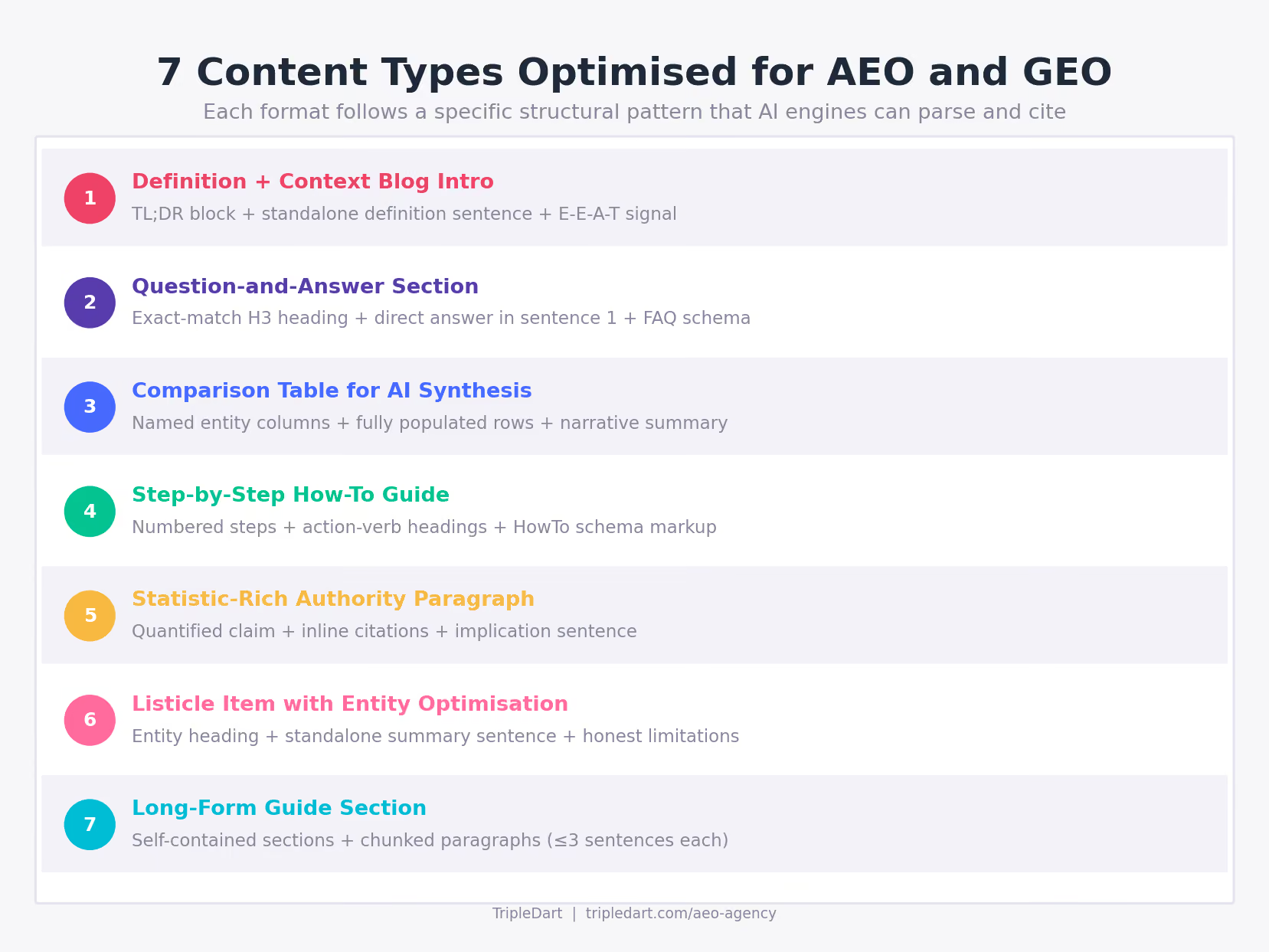
Each example below shows a different content type, annotates the structural choices, and provides a fill-in-the-blank template. The examples use SaaS and B2B marketing topics throughout.
Example 1: The "Definition + Context" Blog Introduction
The example (topic: Product-Led Growth)
TL;DR:
- Product-led growth (PLG) is a go-to-market strategy where the product itself drives user acquisition, expansion, and retention. Companies like Slack and Figma scaled primarily through product virality rather than outbound sales.
- Product-led growth is a business methodology in which the product is the primary vehicle for acquiring, activating, and retaining customers. Unlike sales-led models, PLG relies on users experiencing value before they ever speak to a salesperson.
- Based on analysis of 200+ SaaS companies, PLG works best when the product delivers immediate, tangible value during a free trial or freemium tier. The faster a user reaches their "aha moment," the higher the conversion rate from free to paid.
- This guide covers the core PLG frameworks, the metrics that matter, and how to build a PLG motion without dismantling your existing sales team.
This guide covers the core PLG frameworks, the metrics that matter, and how to build a PLG motion without dismantling your existing sales team.
Annotations:
- TL;DR block - placed above the fold, this two-sentence summary is the primary extraction target for AI Overviews. Following AEO article summary placement best practices, the concise answer appears before all other content. AI systems scan the first 150 words of a section for extractable answer blocks.
- "[Topic] is..." sentence - the first sentence of the first paragraph is a standalone, extractable definition. It starts with the subject and delivers a complete answer without requiring surrounding context.
- E-E-A-T signal - "Based on analysis of 200+ SaaS companies" establishes authority and experience. AI engines weight content with verifiable expertise signals more heavily than generic claims.
- Natural keyword integration - the target phrase appears once in the first 100 words without repetition or awkward phrasing.
Template:
TL;DR:
- [One-sentence answer to the topic question].
- [One sentence of supporting context or example].
- [Topic] is [clear, concise definition in one sentence].
- [Second sentence expanding the definition with one specific detail or example].
- [E-E-A-T signal sentence - reference experience, data, or authority].
- [Transition sentence connecting to the rest of the article].
Example 2: The Question-and-Answer Section (PAA Optimization)
The example (topic: Customer Acquisition Cost)
1. What is customer acquisition cost (CAC)?
Customer acquisition cost is the total amount a company spends to acquire one new customer, calculated by dividing total sales and marketing spend by the number of new customers acquired in a given period. For SaaS companies, CAC typically includes ad spend, sales salaries, and marketing tool costs. A healthy CAC ratio depends heavily on your average contract value and payback period.
2. What is a good CAC payback period for SaaS?
A CAC payback period under 12 months is generally considered healthy for B2B SaaS companies. Enterprise-focused businesses with longer sales cycles often see payback periods of 18 to 24 months, which is acceptable given higher ACV. The key benchmark is whether your payback period is shorter than your average customer lifetime.
Annotations:
- Question as H3 heading - phrased as an exact-match to a common search query. AI engines use heading text to classify what a section answers. "What is customer acquisition cost" matches the query pattern directly.
- Direct answer in the first sentence - following AEO article summary placement best practices, each answer leads with the complete response before elaborating. The first sentence can be extracted standalone and still make sense.
- Elaboration after the direct answer - two to three additional sentences provide depth, examples, and caveats. This signals to AI engines that the content is authoritative, not just a surface-level definition.
- Schema markup - implement FAQ schema on every Q&A pair using JSON-LD. Add this to your page's <head> section or use a CMS plugin like Yoast or RankMath to generate it automatically.
{
"@context": "https://schema.org",
"@type": "FAQPage",
"mainEntity": [
{
"@type": "Question",
"name": "What is customer acquisition cost (CAC)?",
"acceptedAnswer": {
"@type": "Answer",
"text": "Customer acquisition cost is the total amount a company spends to acquire one new customer, calculated by dividing total sales and marketing spend by the number of new customers acquired in a given period."
}
}
]
}
Template:
[Question phrased as exact-match search query]
- [Direct answer in one to two sentences - complete and extractable standalone].
- [Elaboration with one specific detail, example, or caveat].
- [Optional: benchmark, data point, or recommendation].
Example 3: The Comparison Table for AI Synthesis
The example (topic: Project management tools)
Summary: ClickUp is the best choice for teams that want a single tool for project management, documentation, and goal tracking. Monday.com stands out for visual thinkers who need highly customizable dashboards. Asana is the strongest option for larger cross-functional teams that need workload management and timeline views.
Annotations:
- Specific entity names in column headers - "Asana," "Monday.com," and "ClickUp" are named entities. AI engines build knowledge graphs around entities, not generic labels. Named entities increase the probability of being cited in comparison queries.
- Consistent data across all rows - every cell is populated. Incomplete tables get deprioritized because AI engines can't synthesize partial comparisons reliably.
- Summary paragraph below the table - AI engines frequently extract the narrative synthesis rather than the raw table when responding to comparison queries. Bold the first sentence. Start with a clear recommendation.
Template:
| Feature/Attribute | [Tool 1] | [Tool 2] | [Tool 3] |
| Best For | [Use case] | [Use case] | [Use case] |
| Pricing | [$/mo] | [$/mo] | [$/mo] |
| Key Differentiator | [Feature] | [Feature] | [Feature] |
| Free Tier | [Yes/No] | [Yes/No] | [Yes/No] |
| Rating | [X/5] | [X/5] | [X/5] |
Summary: [Tool X] is the best choice for [use case] because [reason]. [Tool Y] stands out for [different use case]. [Tool Z] offers the best value for [budget-conscious teams or specific scenario].
Example 4: The Step-by-Step How-To with Structured Markup
The example (topic: Setting up UTM tracking)
Step 1: Define your UTM parameter taxonomy
Decide on consistent naming conventions for your source, medium, and campaign parameters before building any URLs. Inconsistent naming (e.g., "linkedin" vs. "LinkedIn" vs. "linked-in") creates fragmented data in Google Analytics 4 that's nearly impossible to reconcile later.
Step 2: Build UTM URLs using a parameter builder
Use Google's Campaign URL Builder or a spreadsheet-based UTM builder to generate tagged URLs. Paste the destination URL, then fill in source, medium, campaign, and optional term and content fields. Never manually type UTM strings - typos break attribution.
Step 3: Test each URL before publishing
Click the tagged URL yourself and verify the parameters appear correctly in your GA4 real-time report under Traffic Acquisition. A five-second check prevents weeks of bad data.
Step 4: Store all UTM URLs in a shared tracking sheet
Maintain a central UTM log with columns for destination URL, tagged URL, campaign name, channel, and launch date. This prevents duplicate parameters and gives your team a single source of truth.
Annotations:
Step numbering and action-verb headings are the two signals AI engines use to identify procedural content. Without "Step 1," "Step 2," and action verbs like "Define," "Build," and "Test," your how-to content gets treated as a generic paragraph, not an extractable procedure. Implement HowTo schema to reinforce this classification.
{
"@context": "https://schema.org",
"@type": "HowTo",
"name": "How to Set Up UTM Tracking",
"step": [
{
"@type": "HowToStep",
"name": "Define your UTM parameter taxonomy",
"text": "Decide on consistent naming conventions for source, medium, and campaign parameters before building any URLs."
},
{
"@type": "HowToStep",
"name": "Build UTM URLs using a parameter builder",
"text": "Use Google's Campaign URL Builder to generate tagged URLs with source, medium, and campaign fields."
}
]
}
Template:
Step 1: [Action verb + specific task]
- [Concise instruction in one to two sentences].
- [Explanatory detail or common mistake to avoid].
Step 2: [Action verb + specific task]
- [Concise instruction in one to two sentences].
- [Tip or context].
Example 5: The Statistic-Rich Authority Paragraph (GEO Citation Bait)
The example (topic: AI search adoption)
Across 10 key industries, AI referral traffic accounts for 1.08% of all website traffic, with IT (2.8%) and Consumer Staples (1.9%) seeing the highest share. Meanwhile, Gartner projects that 25% of organic search traffic will shift to AI chatbots and virtual agents by 2026, a figure that represents a structural change in how B2B buyers research software. For SaaS companies, this means a growing share of your target audience is forming vendor shortlists inside ChatGPT and Perplexity before they ever visit a website. Brands that aren't cited in those AI responses are invisible at the most critical stage of the buying journey.
Annotations:
- Leading with a specific quantified claim - the first sentence contains a number and a source. AI engines preferentially cite content with verifiable data points because they need attributable claims to include in generated responses.
- Inline source citations - parenthetical attributions within the text signal trust to AI engines. Footnotes and end-of-article references are harder for LLMs to parse and attribute correctly.
- Contextual framing - the third sentence explains what the statistics mean for the reader's specific role and industry. Raw numbers without context get cited less frequently than numbers with clear implications.
- Implication sentence - the final sentence draws a conclusion. This is what AI engines extract when users ask "why does this matter" questions.
Original research and proprietary data are the strongest GEO signals. AI engines preferentially cite primary sources over content that aggregates others' data. If your company has internal benchmarks or survey data, publish them.
Template:
- [Specific quantified claim + inline source citation].
- [Second data point that reinforces or contrasts the first + inline source citation].
- [Contextual sentence explaining what these numbers mean for the reader's industry or role].
- [Implication sentence: recommendation or prediction based on the data].
Example 6: The Listicle Item with Entity Optimization
The example (topic: Customer success platforms)
Gainsight - Best for Enterprise Customer Success Management
Gainsight is a customer success platform that helps enterprise SaaS companies reduce churn, drive expansion revenue, and scale customer onboarding through health scoring, playbooks, and automated workflows.
- Pricing: From $2,500/month (enterprise contracts; no public self-serve pricing)
- Best For: Enterprise SaaS teams with dedicated customer success managers
- Key Feature: AI-powered health scoring that predicts churn risk 90 days in advance
- Limitations: Significant implementation time; not suited for SMB or early-stage teams
Gainsight's strength is its depth. The platform integrates with Salesforce, HubSpot, and most major CRMs, and its Journey Orchestrator feature automates multi-step customer engagement sequences without manual intervention. Teams managing 500+ accounts will find the ROI clear; teams under 100 accounts will likely find it over-engineered.
Annotations:
- Entity-rich heading - "Gainsight" is the named entity; "Best for Enterprise Customer Success Management" is the category descriptor. This structure tells AI engines both what the entity is and where it belongs in a taxonomy.
- Standalone summary sentence - the sentence immediately after the heading can be extracted without any surrounding context. It answers "what is Gainsight" completely in one sentence.
- Structured attributes - the bullet list provides consistent, scannable data points. AI engines extract structured attributes when users ask comparison or feature questions.
- Honest limitation - including a limitation signals credibility. AI engines weight balanced assessments more heavily than promotional copy.
Template:
[Brand Name] - Best for [Primary Use Case]
[One-sentence summary: what the tool is and what it does, written as a standalone extractable statement.]
- Pricing: [Starting price / Free tier details]
- Best For: [Target user or use case]
- Key Feature: [Single most important differentiator]
- Limitations: [One honest limitation]
[2-3 sentence evaluation paragraph with specific details, not generic praise.]
Example 7: The Long-Form Guide Section with Content Chunking
This example demonstrates GEO content structure and formatting principles - specifically, how to chunk long-form content so AI engines can extract individual sections without losing meaning.
The example (topic: Email deliverability, from a comprehensive email marketing guide)
How Email Deliverability Affects Campaign ROI
One of the most overlooked aspects of email marketing strategy is deliverability - the percentage of sent emails that actually reach the inbox rather than the spam folder or promotions tab. Deliverability isn't a binary pass/fail metric; it exists on a spectrum that directly determines how many of your subscribers ever see your campaigns.
According to Conductor's AEO/GEO Benchmarks Report, which analyzed over 100 million AI citations, content that is self-contained and contextually anchored performs significantly better in AI retrieval scenarios than content that assumes prior reading. The same principle applies to email: a subscriber who opens your email without remembering your last three sends needs enough context in the first two sentences to stay engaged.
For SaaS companies, a deliverability rate below 90% typically signals domain reputation issues, list hygiene problems, or authentication failures (SPF, DKIM, DMARC). Audit your sending domain quarterly using tools like MXToolbox or Google Postmaster Tools, and remove unengaged subscribers after 90 days of inactivity.
Annotations:
- Self-contained section - the section makes complete sense without the reader having seen any other part of the guide. A reader dropped into this section mid-article loses nothing.
- Contextual anchoring sentence - the first sentence references the broader guide topic ("email marketing strategy") without requiring the reader to have read the preceding sections. This prevents meaning loss during AI extraction.
- Chunked paragraphs - each paragraph covers one sub-point. No paragraph exceeds three sentences. AI retrieval systems (RAG pipelines) chunk documents into segments before embedding them; paragraphs that cover multiple points get split mid-thought and lose coherence.
- Semantic heading hierarchy - the H3 heading signals the relationship to the parent topic. "How Email Deliverability Affects Campaign ROI" tells AI engines this section is a subtopic of email marketing strategy, not a standalone article.
Template:
[Specific Subtopic] and Its Impact on [Broader Topic]
[Contextual anchoring sentence referencing the broader guide topic]. [Core claim or definition of the subtopic - extractable standalone].
[Supporting detail paragraph - 2-3 sentences with one specific data point or example].
[Practical implication paragraph - what the reader should do, in 2-3 sentences].
How can standard content be transformed into AEO/GEO-ready content?
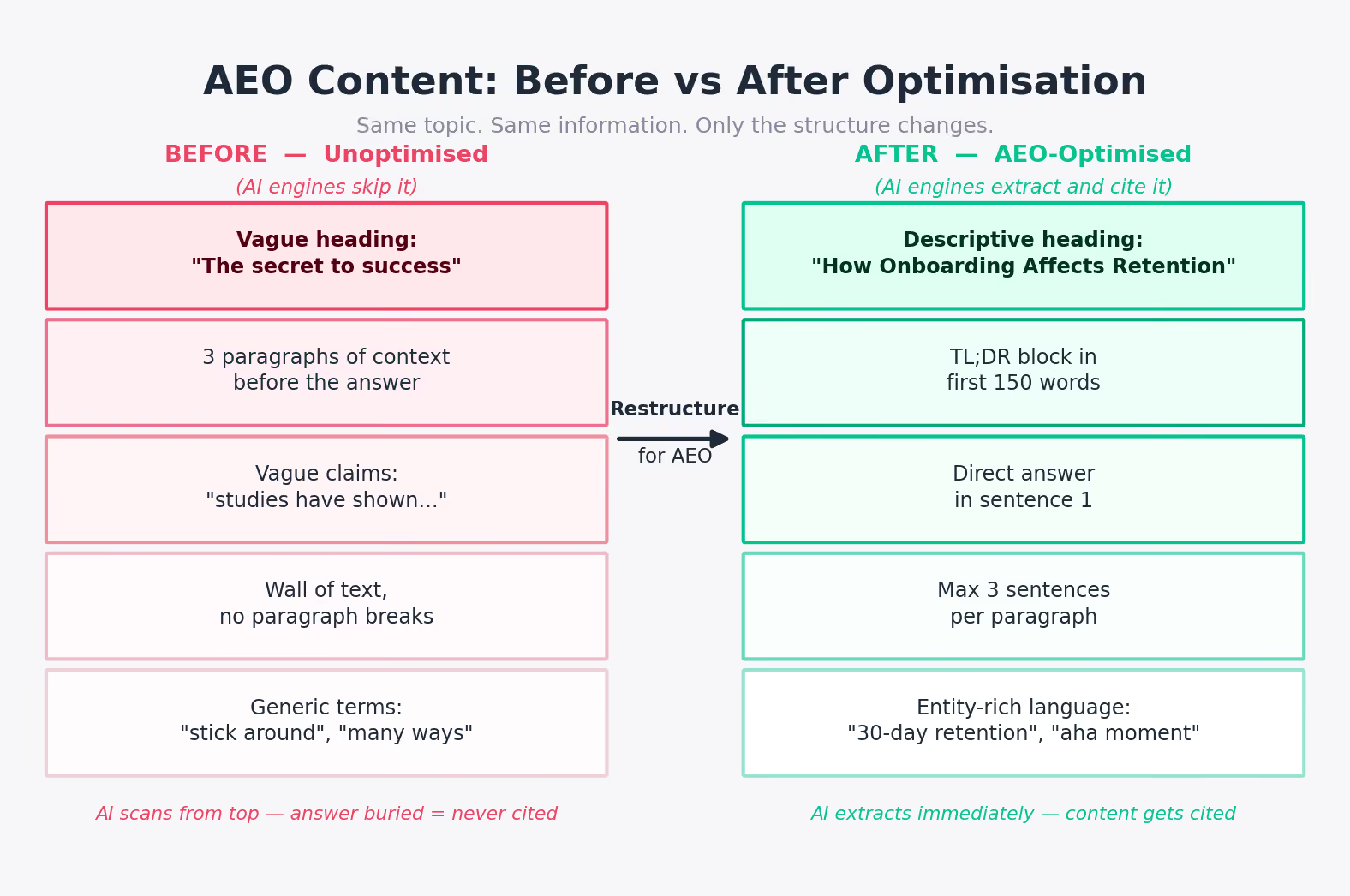
The fastest way to understand AEO and GEO optimization is to see the same content before and after restructuring. The topic and information below are identical in both versions. Only the structure changes.
The original content (before)
The following is a realistic example of unoptimized blog content on customer onboarding:
There are a lot of things that go into making sure your customers are successful after they sign up for your product. Customer onboarding is one of those things that companies often overlook, but it can really make a big difference in whether customers stick around or churn. The secret to success is really about making sure customers understand the value of your product as quickly as possible. Studies have shown that customers who complete onboarding are more likely to stay. You want to make sure you have a good onboarding flow that walks people through the key features and helps them get to that first moment of value. There are many different ways to do this and it depends on your product.
The optimized content (after)
How Customer Onboarding Affects SaaS Retention
TL;DR:
- Customers who complete a structured onboarding sequence are significantly more likely to reach their first value milestone and convert from trial to paid. Onboarding is the single highest-leverage retention lever for early-stage SaaS companies.
- Customer onboarding is the process of guiding new users from signup to their first meaningful outcome with your product. Done well, it compresses time-to-value and directly reduces early churn.
- SaaS companies with structured onboarding sequences see measurably higher 30-day retention than those relying on self-serve discovery. The critical variable isn't the number of onboarding steps but how quickly users reach their first "aha moment" - the point where the product's value becomes undeniable.
- Prioritize three elements: a welcome sequence that sets clear expectations, an in-app checklist that guides users to the core feature, and a triggered email at day three for users who haven't completed setup.
What changed and why
- Vague heading replaced with a descriptive, query-matched H3 - AI engines use heading text to classify section content. "The secret to success" tells AI engines nothing; "How Customer Onboarding Affects SaaS Retention" is an extractable topic signal.
- TL;DR block added above the fold - following AEO article summary placement best practices, the two-sentence summary is now the first thing AI engines encounter. This is the primary extraction target for AI Overviews.
- Direct answer moved to the first sentence - the definition of customer onboarding now appears in sentence one, not buried in paragraph three.
- Wall of text broken into three focused paragraphs - each paragraph covers one point. No paragraph exceeds three sentences.
- Vague claims replaced with specific language - "studies have shown" became a specific causal claim. "Many different ways" became three concrete action items.
- Entity-rich language added - "30-day retention," "time-to-value," and "aha moment" are recognized entities in the SaaS domain. Generic terms like "stick around" carry no entity signal.
- Bold key phrase added - bolding the first sentence of the TL;DR block signals its importance to both readers and AI parsers.
- Keyword stuffing removed - the original repeated "onboarding" seven times in six sentences. The optimized version uses it three times with clear semantic variation.
Quick self-audit checklist:
- Does the section have a descriptive, query-matched heading?
- Is there a TL;DR or summary block in the first 150 words?
- Does the first sentence directly answer the implied question?
- Are paragraphs three sentences or fewer?
- Does the section include at least one statistic with an inline citation?
- Are key terms bolded for scannability?
- Is the section self-contained without surrounding context?
- Have you implemented relevant schema markup?
- Are headings descriptive rather than clever or vague?
- Does the content use entity-rich language instead of generic terms?
What are common mistakes that prevent AI engines from citing your content?
These aren't "areas for improvement." They're mistakes that make your content invisible to AI engines, and they appear in the majority of B2B SaaS blog posts published without AEO or GEO optimization.
1. Burying the answer below irrelevant preamble
AI engines extract from the first 100 to 150 words of a section. If your actual answer sits in paragraph four after three paragraphs of context-setting, it won't get cited. A section that opens with "In today's rapidly evolving digital landscape, businesses face unprecedented challenges..." signals nothing extractable. A section that opens with "Customer churn rate is the percentage of customers who cancel within a given period" gives AI engines exactly what they need in the first sentence.
2. Using vague or clever headings instead of descriptive ones
"The Secret Sauce" fails for AI extraction. "How to Structure Content for AEO" succeeds. AI engines need semantic clarity in headings to understand what a section covers. Clever headings that work for human engagement often carry zero topic signal for AI classification. Use descriptive headings every time.
3. Ignoring structured data markup
Content without schema markup is harder for AI engines to classify and trust. FAQ, HowTo, and Article schema are the minimum for AEO and GEO-optimized content. Implement schema using JSON-LD - it takes ten minutes and measurably increases AI visibility.
4. Writing for keywords instead of entities
AI engines think in entities and relationships, not keyword density. Writing "best project management tool" fifteen times produces no entity signal. Writing about Asana, Monday.com, and ClickUp with specific feature comparisons creates a rich entity graph that AI engines can reference. The entity-rich version gets cited; the keyword-stuffed version gets ignored.
5. Failing to update content with current data
AI engines prioritize freshness. Content with 2023 statistics gets deprioritized in 2026. Audit your top-performing content quarterly and update all statistics, tool references, and trend claims to reflect the current year. This single habit has an outsized impact on AI citation frequency.
How can you track whether AI engines are citing your content?
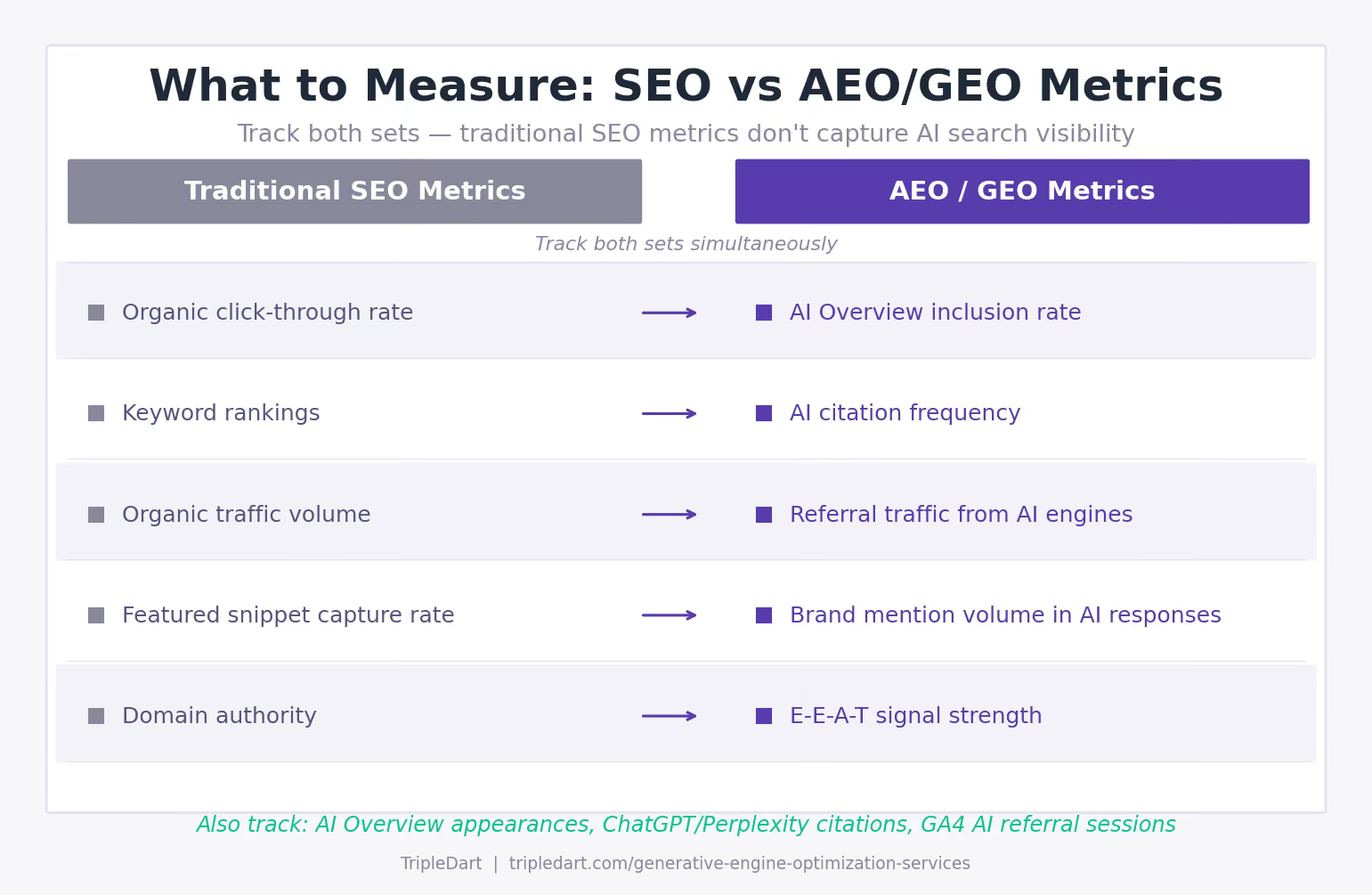
Most AEO and GEO guides stop at optimization. Measurement is where the real feedback loop begins.
1. Monitoring AI Overview appearances
Manual spot-checking is the simplest starting point: search your target queries in Google and check whether your content appears in the AI Overview panel. For systematic tracking, Semrush's AI Overview tracking feature and Ahrefs' AI Overview monitoring both provide query-level data on which pages are being included. These tools are evolving rapidly in 2026, and new capabilities are being added quarterly.
2. Tracking citations in ChatGPT, Perplexity, and other AI engines
Search for your brand name and core topic queries directly in ChatGPT, Perplexity, and Claude to see whether your content is being cited. For automated monitoring, Otterly.ai tracks AI search visibility across multiple engines, and Profound specializes in AI citation tracking and brand mention monitoring. The tooling landscape here is nascent but maturing quickly - check for new entrants every quarter.
3. Metrics that matter for AEO and GEO
Track referral traffic from AI engines directly in GA4 by filtering for sessions from ai.google.com, chat.openai.com, perplexity.ai, and similar sources. For businesses targeting local queries, local search trends show increasing AI Overview penetration for location-specific searches in 2026 - track whether your content appears in AI Overviews for geo-modified queries relevant to your market.
Recommended tools: Semrush (AI Overview tracking), Ahrefs (AI Overview monitoring and content gap analysis), Otterly.ai (AI search monitoring across multiple engines), Profound (AI citation tracking), and Google Search Console (impressions from AI Overview-triggered queries).
How can you bring it all together for an AEO and GEO content strategy?
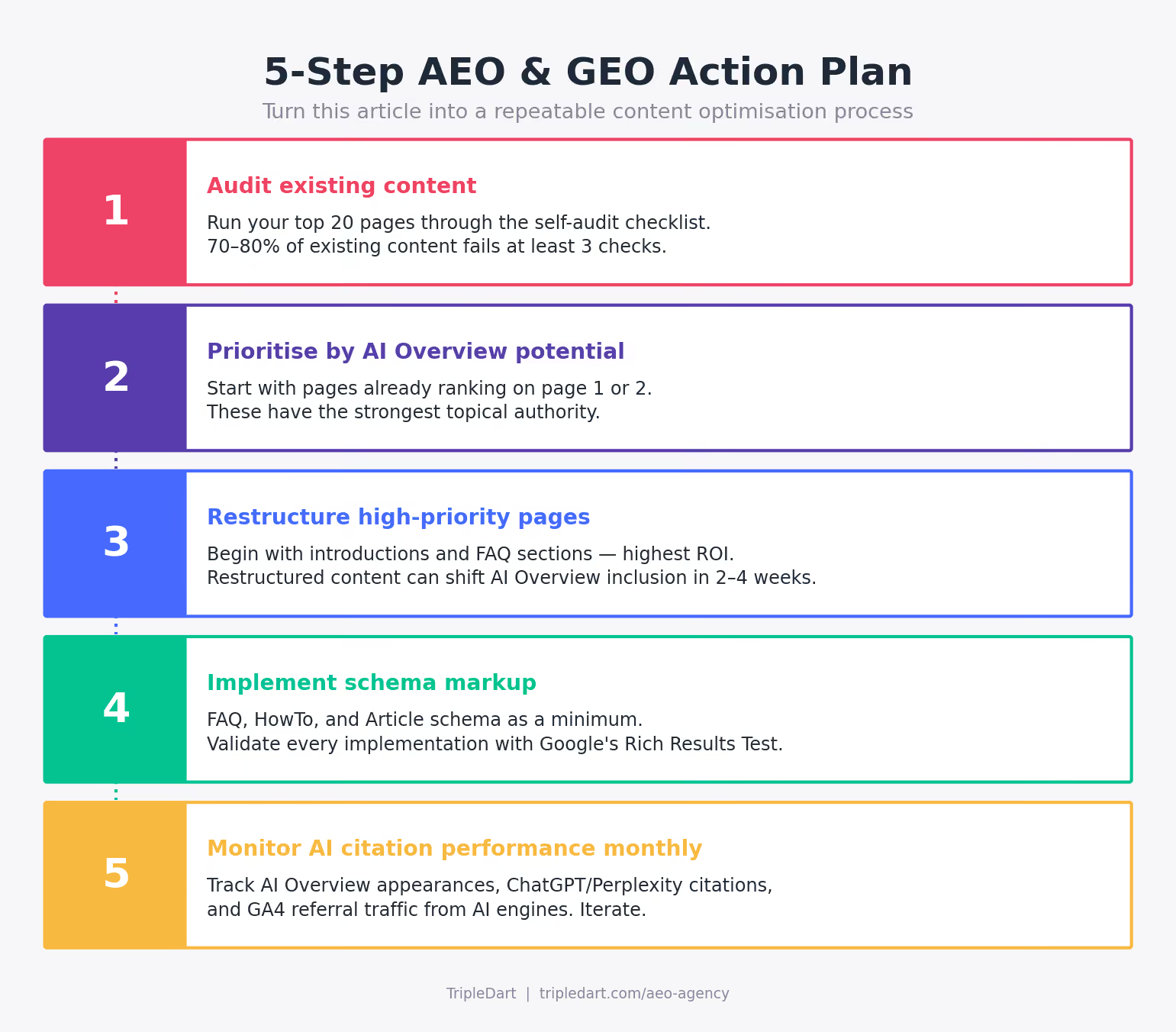
The examples, templates, and anti-patterns above are most useful when applied systematically rather than page by page. Here is a five-step action plan for turning this article into a repeatable process.
- Audit existing content against the transformation checklist from the before-and-after section. Run your top 20 pages through each item. Most teams find that 70 to 80% of their existing content fails at least three checklist items.
- Prioritize pages by AI Overview potential. Start with pages already ranking on page one or two for relevant queries. These pages have the strongest topical authority and the shortest path to AI Overview inclusion.
- Apply the templates to restructure high-priority pages. Start with introductions and FAQ sections - these have the highest ROI for AEO optimization. A restructured introduction and a properly marked-up FAQ section can shift AI Overview inclusion within two to four weeks.
- Implement schema markup across all restructured content. FAQ, HowTo, and Article schema are the minimum. Use JSON-LD and validate every implementation with Google's Rich Results Test before publishing.
- Monitor AI citation performance monthly using the tools from the tracking section. Track which pages appear in AI Overviews, which queries trigger citations in ChatGPT and Perplexity, and how referral traffic from AI engines trends over time. Iterate based on what gets cited.
AEO and GEO aren't emerging trends anymore - they're the current standard for content visibility in 2026. The SaaS content strategy teams that build these habits now will compound their AI search visibility while competitors are still reading guides about it.
If you're a SaaS company looking to accelerate your AEO and GEO strategy, our content marketing services are built specifically for B2B brands that need AI-visible content at scale. Explore our SEO services to see how we approach this work.
Optimize Your AEO and GEO Content Strategy
As an AI-native SEO agency for B2B SaaS, we've helped companies like Glean achieve a 275% increase in monthly organic clicks - growing from approximately 18,000 to over 67,000 monthly visits - by building content systems structured for both traditional search and AI extraction. That kind of growth doesn't come from publishing more content. It comes from publishing content that AI engines can parse, attribute, and cite.
"TripleDart is a super helpful team, tremendously aiding in SEO enhancements from blog topics to technical recommendations." - Daniel Henderson, Glean
Our GEO and AI search services are built around the same principles this article demonstrates: self-contained sections, entity-rich language, structured data markup, and content that earns citations rather than just rankings. We run this process across 50 to 100 pages per month for our clients using our Slate AI workflow system, which makes the scale of optimization that would take a team months to do manually achievable in weeks.
If you want to build a content library that appears in AI-generated answers for your category's most important queries, schedule a demo and we'll walk you through exactly how we'd approach it for your specific situation.
Frequently Asked Questions
1. What is the difference between GEO and AEO?
AEO focuses on making your content the direct answer to specific queries, while GEO focuses on getting your content cited by generative AI systems. AEO targets featured snippets, People Also Ask boxes, and AI Overviews - places where your content becomes the answer a user sees. GEO targets citations inside ChatGPT, Perplexity, Claude, and AI-generated summaries - places where your brand is referenced as a source. Both require structured, authoritative content, but they target different AI behaviors. AEO is about being the answer; GEO is about being the source.
2. What does AEO-optimized content look like?
AEO-optimized content has a clear question-as-heading format, a direct answer in the first one to two sentences, and supporting detail in subsequent sentences. It uses structured data markup (FAQ or HowTo schema), keeps paragraphs to two or three sentences, and includes a TL;DR or summary block in the first 150 words of each section. Following AEO article summary placement best practices, the concise answer always appears before elaboration, not after it. Examples 1 and 2 in this article demonstrate these structural patterns in full.
3. How do I structure content so AI engines cite it?
Structure content around five elements: self-contained sections, entity-rich language, inline data citations, E-E-A-T signals, and schema markup. Self-contained sections make sense when extracted in isolation - this is critical for RAG-based AI systems that chunk documents before retrieval. Entity-rich language means using specific names, tools, and data points rather than generic terms. Inline citations (not footnotes) signal that your claims are attributable. GEO content structure and formatting also requires that each section has a semantic heading that signals its relationship to the broader topic. Example 5 (the authority paragraph) and Example 7 (the long-form guide section) demonstrate these principles in detail.
4. Does AEO and GEO replace traditional SEO?
No - AEO and GEO are layers on top of traditional SEO, not replacements. You still need keyword research, technical SEO, quality backlinks, and strong content fundamentals. AEO and GEO add structural and formatting optimizations that make your already-strong SEO content visible to AI engines. Think of it as an evolution: traditional SEO gets you to page one, AEO makes you the direct answer on that page, and GEO gets you cited in AI responses that bypass the page entirely. All three disciplines reinforce each other.
5. What schema markup should I use for AEO and GEO?
Match schema type to content type: FAQ schema for Q&A content, HowTo schema for step-by-step guides, Article schema for blog posts, and Product schema for product or comparison pages. Schema helps AI engines classify and trust your content by providing machine-readable signals about what a page contains. The JSON-LD code snippets in Examples 2 and 4 of this article provide syntactically correct implementations you can adapt directly. At minimum, implement FAQ, HowTo, and Article schema across your highest-traffic content.
6. How long does it take to see results from AEO and GEO optimization?
AI Overview appearances can shift within two to four weeks of restructuring content, but consistent GEO citation building takes two to six months. The faster results come from pages that already rank on page one or two - restructuring their introductions and FAQ sections gives AI engines cleaner extraction targets immediately. Broader GEO citation frequency, where your brand is regularly referenced in ChatGPT and Perplexity responses, builds over time as your content accumulates authority signals. Track monthly and iterate based on what gets cited.
7. Can I optimize existing content for AEO and GEO, or do I need to create new content?
Both approaches work, and the right answer depends on your current content inventory. Existing high-performing content should be restructured using the before-and-after framework from this article - these pages already have topical authority and the shortest path to AI Overview inclusion. New content should be built with AEO and GEO principles from the start using the templates provided here. Prioritize pages that already rank on page one or two for relevant queries. They have the strongest foundation and the best chance of being selected for AI Overviews after restructuring.
8. How do we help with AEO and GEO content optimization?
As an AI-native SEO agency for B2B SaaS, we build and run AI-visible content systems that combine structured content production with technical optimization and ongoing citation monitoring. Our team applies the same principles demonstrated in this article - self-contained sections, entity-rich language, schema markup, and data-backed authority paragraphs - across 50 to 100 pages per month using our Slate AI workflow system, which handles the research, structuring, and optimization steps that would otherwise take a content team weeks to complete manually. We've helped clients like Signeasy reach 800 monthly LLM sessions with 60 to 68% consistent month-over-month growth, and FlowForma achieve 7x AI search visibility growth in six months. Our AEO agency services and GEO optimization services are designed for SaaS teams that want to build compounding AI search visibility without rebuilding their entire content operation from scratch.