.png)
The Story
Last Thursday, Google dropped a document.
A developer guide called "Optimizing your website for generative AI features on Google Search." Their first official word on a topic the SEO industry has been arguing about for nearly two years.
Better late than never?
The message from Google was clean and simple: GEO is just SEO. Do the basics well, and AI search will sort itself out. Don't bother with the special hacks.

We agree with parts of it. We've run GEO programmes for over 100 B2B SaaS companies through those same 18 months. And there are parts we disagree with as well.
What Google Wants You to Stop Doing
The guide has a “myth-busting” section.
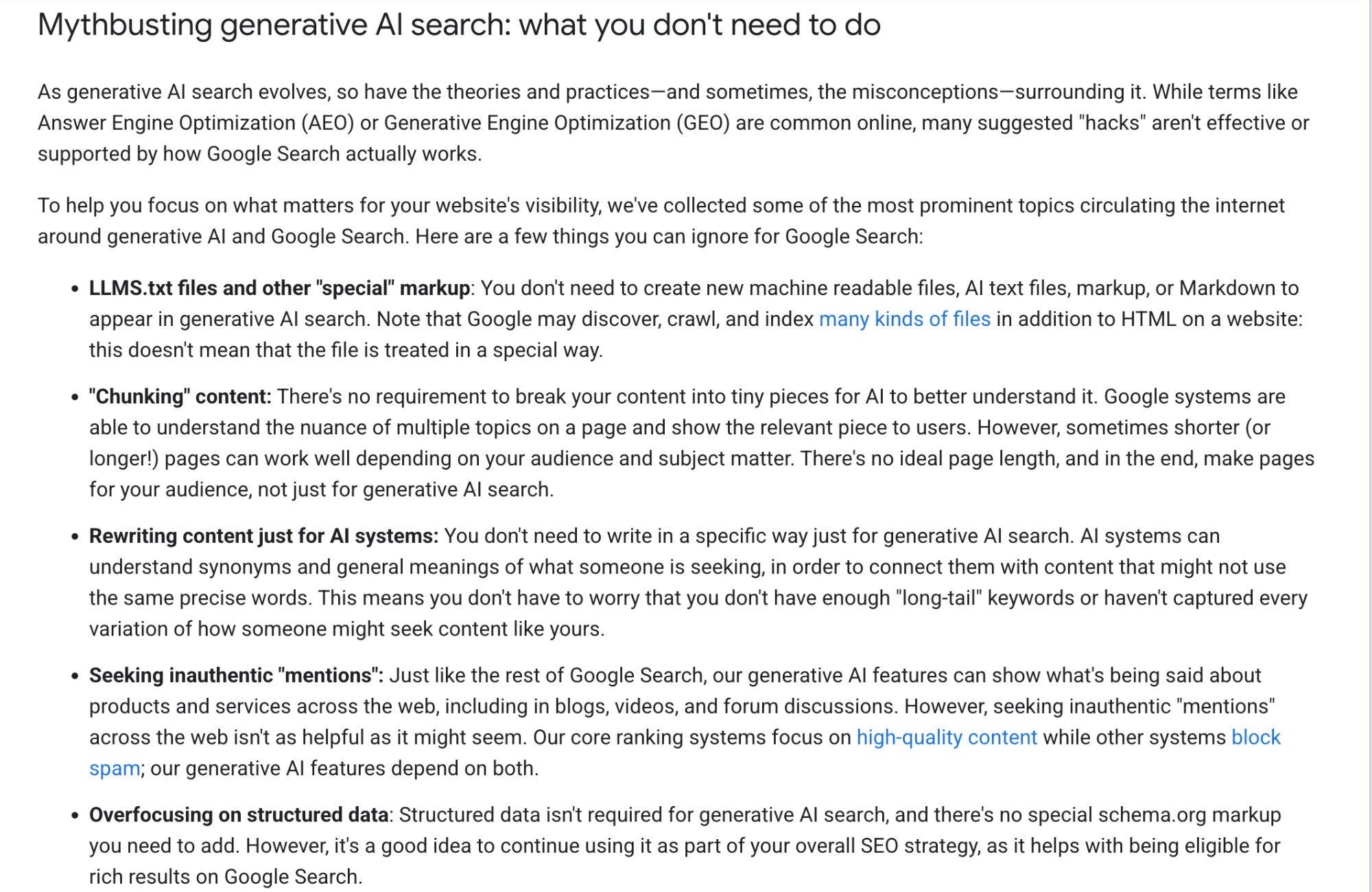
Five tactics the GEO industry has been selling since 2023 are declared unnecessary:
- Separate llms.txt files do nothing for ranking.
- Chunking content specifically for AI parsing is busy-work.
- And the "mentions" seeding tactic from 2023 was never useful in the first place.
On those three, we agree completely.
But Google also dismisses question-format H2 headings and FAQ schema markup. And that's where we part ways.
On the 250+ B2B SaaS accounts we track, pages with FAQ and Organisation schema earn 25% more impression share on AI-driven queries than pages without them. The same gap shows up on Perplexity, ChatGPT, and Claude.
"Not required" is technically accurate, but only inside Google's walls. The moment you step outside, the picture changes.
What the Rest of the Industry Thinks
Lily Ray got there two days before Google did.
On May 13, she pointed out that scaled comparison pages and self-promotional listicles already fell inside Google's existing spam policies.
Brainlabs found back in July 2025 that 96% of AI Overview links come from the top 10 organic results. Cyrus Shepard's analysis put organic rank as the second-strongest predictor of AI citation, behind only URL accessibility.
These findings point in Google's direction. Good SEO lifts AI visibility. The logic holds.
On the other side, Chris Long flagged something Google buried in a companion piece published the same week: a page called "Build agent-friendly websites."
Long believes agent rendering will matter far more than the main guide admits. Accessibility trees and screenshot-based parsing. The kind of structural work most B2B sites haven't started yet.
That's a new category of work.
Why We Will Still Call It “GEO”
Four reasons.
Google speaks only for Google.
The guide covers AI Overviews and AI Mode. Both pull from Google's index. But Perplexity ranks sources differently. ChatGPT cites domains by a different signal mix. Claude has its own pattern. Gemini outside of Search behaves differently from Gemini inside it.
When we optimize a page, we optimize it for all of those surfaces. Google does not.
Structure carries a separate lift on non-Google surfaces.
Google calls question-format H2s and answer-first paragraphs "general SEO advice." Fine, they are. But the lift on Perplexity and ChatGPT runs bigger than on Google's own surfaces. Big enough that we treat content structure as a GEO requirement.
A page ranking #1 on Google that never surfaces in a Perplexity answer has a content-structure problem.
Measurement looks completely different.
SEO measures rankings and clicks. GEO measures citation share, AI answer presence, and brand entity weight inside language models. We run separate dashboards for both. They tell different stories week to week. The pages that win in one don't always win in the other.
Agent rendering is new work entirely.
Half the pricing and feature pages we audit on B2B SaaS sites render in client-side JavaScript. AI agents trip on that. Moving key content to server-rendered HTML is a new operational category, and we're already seeing a citation lift on agent-led queries once the rebuild goes live.
Any single point on that list could be filed under “SEO.” All five, sequenced across a 12-week engagement and measured against AI citation share rather than rankings, looks nothing like "SEO."
What Stays in the Playbook
Regardless of how Google chose to frame its documentation, four moves stay in our quarterly plans.
- Schema on every page competing for a category query: FAQ markup where the page answers a discrete question. Organisation markup site-wide. This is non-negotiable.
- Answer-first paragraphs under every H2 mapped to a buyer question: Thirty to sixty words, plain prose. Lifts the page across every AI surface we track.
- Agent-rendering rebuilds: Most B2B SaaS sites still render half their key content in client-side JavaScript. We're moving that to server-rendered HTML on accounts where AI-agent traffic has started showing up.
- Cross-surface measurement: Citation share on Perplexity, ChatGPT, Claude, and AI Overviews, tracked weekly against rankings. The pages that win on both are easy to spot. The ones that win on rankings but lose on AI citation is where the next quarter's work lives.
Google's guide is accurate within its own walls. It's just that AI search has moved well beyond those walls.
If GEO is on your quarterly plan, grab a call. We're happy to compare notes.
Until next time.
.webp)


.webp)
.webp)

.png)


.png)





.webp)





.webp)


.webp)





%20(1).png)


.webp)
.webp)
.webp)





%20Ads%20for%20SaaS%202026_%20Types%2C%20Strategies%20%26%20Best%20Practices%20(1).webp)








.png)


.png)





.webp)


![Creating an Enterprise SaaS Marketing Strategy [Based on Industry Insights and Trends in 2026]](https://cdn.prod.website-files.com/632b673b055f4310bdb8637d/6965f37b67d3956f981e65fe_66a22273de11b68303bdd3c7_Creating%2520an%2520Enterprise%2520SaaS%2520Marketing%2520Strategy%2520%255BBased%2520on%2520Industry%2520Insights%2520and%2520Trends%2520in%25202023%255D.png)




.png)
















.webp)





%20Agencies%20for%20B2B%20SaaS%20Compared%20(2026).webp)

.webp)
%20with%20Hubspot.webp)








.png)


.png)

.png)
.png)
.png)
.png)

















.webp)

.webp)
.png)
.png)



.webp)


.png)


















.webp)

.png)
.png)









.png)


.png)





%2520Agencies%2520(2025).png)

![Top 9 AI SEO Content Generators for 2026 [Ranked & Reviewed]](https://cdn.prod.website-files.com/632b673b055f4310bdb8637d/6858e2c2d1f91a0c0a48811a_ai%20seo%20content%20generator.webp)




.webp)
.webp)














.webp)