
Unlike paid advertising, where results vanish the moment you stop spending, organic search builds compounding returns that continue delivering qualified leads for years.
B2B SaaS businesses can experience an average ROI of as much as 7x from SEO strategy alone, with organic search sometimes converting at roughly twice the rate of paid channels.
However, realizing these returns requires strategic budget allocation.
Spending too little leaves you invisible against well-funded competitors, while overspending without direction wastes resources on activities that never move the needle.
This guide walks you through everything you need to know about SaaS SEO budgets: how much to invest based on your company size and growth model, where to allocate funds for maximum impact, how to justify spend to stakeholders, and which metrics matter.
Whether you're a startup testing SEO viability or an enterprise scaling your organic program, you'll find actionable frameworks to align your investment with real business outcomes.
Let’s get started.
Why SEO is Crucial for SaaS Companies
The SaaS industry operates differently from traditional businesses: subscription revenue models, extended sales cycles that often span months, and multiple decision-makers within buying committees all demand marketing approaches that build trust over time.
SaaS SEO delivers precisely this capability by creating educational content that nurtures prospects throughout their research journey.
Here are some common SEO wins:
Outranking Competitors and Capturing Market Demand
Roughly 70% of B2B buyers use search engines to research suppliers before making purchasing decisions.
When competitors dominate search results for keywords your prospects are actively searching, you're essentially ceding revenue to them. This makes organic visibility a competitive necessity.
What makes organic search particularly powerful for SaaS (especially BOFU content) is the nature of the traffic it attracts. People searching for solutions are already problem-aware and actively hunting for answers. The higher conversion rates SEO has translates directly into lower customer acquisition costs over time, as organic rankings continue generating leads without requiring continuous ad spend.
Perhaps most importantly, smaller companies can compete effectively against larger players by focusing on specific keywords and underserved niches. You don't need enterprise-level resources to outrank established competitors in specialized areas where you can demonstrate genuine expertise.
Building Brand Awareness and Trust
Earning prominent positions in organic search results carries an implicit endorsement that paid placements cannot replicate. When prospects repeatedly encounter your educational content while researching their challenges, they develop familiarity and trust with your brand before ever speaking to sales.
SaaS SEO enables multi-touch engagement where prospects discover your blog posts, return for whitepapers, and consume case studies across their evaluation timeline.
By the time they request a demo, they've already positioned you as an authority in their consideration set. This educational approach makes it possible for SEO to achieve a cost per lead at 10-30% the cost of paid media campaigns.
Recommended SEO Budgets for SaaS Companies
Budgeting by Company Size
Industry benchmarks provide useful starting points for planning, even though there's no universal SEO budget that fits every SaaS business.
What you invest depends on your growth objectives, SEO challenges, market competitiveness, and internal capabilities.
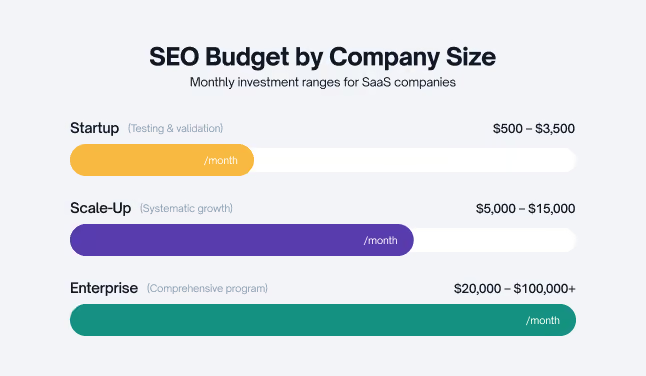
Small businesses typically invest $500-$3,500 monthly, mid-market companies spend $3,500-$15,000 monthly, and enterprise organizations allocate $15,000-$100,000+ monthly on SEO activities.
Startups
Early-stage SaaS companies should approach SEO as a validation exercise before making big commitments.
Startups typically allocate $500-$3,500 monthly during initial testing phases, focusing primarily on proving whether organic search can generate a meaningful pipeline for their specific market.
Once you've hit the $1M mark in annual revenue, consider scaling to 5-10% of revenue dedicated to SEO. This allows you to expand from foundational keyword targeting into more comprehensive content strategies.
The critical principle at this stage is validation before full commitment.
Utilize free tools like Google Search Console and entry-level subscriptions to SEO platforms. Only upgrade to enterprise-tier tools when your budget genuinely requires the advanced capabilities they provide.
Scale-Ups
Companies that have established product-market fit should target organic search contributing 15-25% of new customer acquisition. At this stage, SEO shifts from an experimental channel to a systematic growth engine.
For a company generating ~$10M in annual revenue, it's usually suggested to dedicate 15-30% of your total marketing budget specifically to SEO.
Within that allocation, expect people costs to consume the largest portion at roughly 30-50% for strategy and execution, especially if it's through in-house team members.
Scale-up investments should also be distributed systematically across all SEO components: content production, technical optimization, link building, and analytics infrastructure. The goal is building a sustainable organic acquisition engine rather than pursuing quick wins that don't compound.
Enterprises
Enterprise-level SaaS companies operating in competitive markets face well-funded competitors and sophisticated buyer expectations.
They typically invest $20,000-$100,000+ monthly on comprehensive SEO programs.
At this scale, SEO programs become complex operations requiring content strategies spanning multiple buyer personas, robust technical infrastructure supporting large-scale websites, systematic link-building programs to maintain domain authority, and international or multilingual SEO capabilities for global markets.
TripleDart's enterprise SEO pricing research indicates monthly investments ranging from $5,500 to $21,500 for comprehensive enterprise programs—but this cost can really vary from one growth partner to another!
Budgeting by Growth Strategy
Your go-to-market approach significantly influences how much to invest in SEO and where to focus that investment.
There are three primary growth models, each with distinct SEO budget implications.
Product-Led Growth
PLG companies where the product drives acquisition through freemium models and viral adoption should allocate at least 5% of revenue to SEO. The focus shifts toward volume-driven strategies targeting high-intent keywords around core use cases to drive free trial signups.
Content for PLG emphasizes feature-specific pages, comparison content against alternatives, and use case demonstrations that help users understand product value without requiring sales conversations. The self-service nature of PLG means SEO content must independently convince visitors to start trials.
Sales-Led Growth
SLG companies with complex sales cycles and higher average contract values should invest 5-10% of revenue in SEO. However, content priorities differ substantially from PLG approaches.
Sales-led SEO emphasizes comparison content, detailed case studies, and educational resources that support multi-stakeholder buying committees. These prospects often involve IT directors concerned with security, CFOs focused on ROI, and end users worried about adoption complexity.
Your SEO content must address each stakeholder's distinct concerns while providing materials that support sales conversations throughout lengthy evaluation periods.
Marketing-Led Growth
MLG companies require the most substantial SEO investment, around 10-15% of revenue for comprehensive market coverage. This approach demands extensive content libraries that attract problem-aware prospects and guide them through complete buyer journeys.
Marketing-led SEO creates educational ecosystems spanning top-of-funnel awareness content, middle-funnel consideration resources, and bottom-funnel decision support materials. Content production becomes your largest discretionary expenditure, as the volume and depth of assets directly determines organic visibility and lead generation capacity.
What Constitutes a SaaS SEO Budget?
Key Components of SEO Budgeting
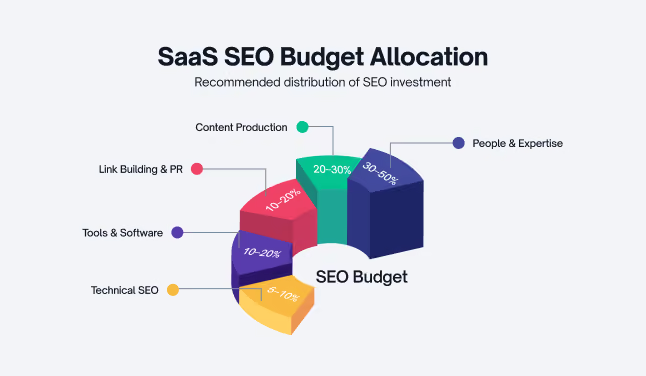
A comprehensive SEO budget encompasses far more than content creation. There are five essential categories that effective programs must fund.
People and Expertise
Human expertise represents the foundation of successful SEO, consuming approximately 30-50% of the total SEO budget.
This includes:
- SEO strategists who set priorities and guide execution
- Content creators who produce and optimize materials
- Technical specialists who resolve infrastructure issues
- Project managers who coordinate activities across teams
The choice between in-house teams and agency partnerships depends on your organizational maturity and resource availability. In-house SEO teams cost $150,000-$500,000+ annually depending on seniority and team size, while agency retainers typically range from $2,500-$15,000+ monthly.
If you’d like to partner with an agency that has solved the toughest SEO issues for hundreds of companies, at a fraction of the cost of an in-house team, do reach out to us!
TripleDart’s SEO services range from $3,000 to $6,000 a month, and we come with tried and tested playbooks that have worked for hundreds of companies. Expect deep expertise and knowledge of what exactly works for your domain - all at an affordable price! If you want to know more about our SEO Services, click here.
Tools and Software
Professional SEO requires specialized tools for keyword research, rank tracking, technical audits, competitive analysis, and content optimization. Allocate 10-20% of your SEO budget to software, which typically translates to $100-$1,200+ monthly depending on company size and requirements.
Essential tool categories include keyword research platforms like Ahrefs or Semrush ($100-$500 monthly), content optimization software such as Surfer or Clearscope ($50-$300 monthly), rank tracking systems ($20-$150 monthly), and technical SEO auditing tools ($50-$200 monthly). The key is selecting tools that provide actionable insights rather than vanity metrics, and ensuring they integrate effectively with your existing marketing technology stack.
You might also want to check out our GEO Automation tool, Slate. Slate identifies winning topics, ships fresh assets, and refreshes your archive so your brand becomes the source AI trusts.
Content Production and Optimization
Content creation typically consumes 20-30% of total SEO budget, directly determining your ranking potential and lead generation capacity. This involves original article creation, existing content optimization, visual asset development, and multimedia production.
New comprehensive content pieces cost $150-$600 for standard blog posts, with pillar pages or in-depth guides ranging from $300-$1,000+. Content optimization projects typically run $100-$400 per page. The appropriate mix depends on your existing content library and competitive gaps.
Quality consistently outperforms quantity in SEO. One authoritative, comprehensive guide addressing specific customer pain points will typically generate more organic traffic and conversions than multiple surface-level blog posts. Under-investing in content production will constrain organic performance regardless of spending in other areas.
Link Building and Digital PR
Backlinks remain one of the strongest ranking signals for search engines. The general budget range for link building is dedicating 10-20% of SEO budget to systematic link acquisition through digital PR, relationship building, and content promotion.
Link building costs vary significantly based on approach and quality expectations. Manual outreach through freelancers or agencies costs $100-$500 per quality link, while comprehensive link-building agency retainers run $2,000-$10,000+ monthly. Digital PR campaigns designed to earn editorial coverage typically cost $3,000-$15,000+ per campaign.
Modern link building emphasizes earning editorial links through valuable content contributions, original research, and expert insights that naturally attract citations from authoritative publications.
Avoid bulk link packages promising hundreds of placements at low cost, as these typically come from low-quality sources that can harm rather than help your rankings.
Technical SEO Improvements
Technical SEO ensures your website infrastructure supports rather than hinders organic visibility.
Allocate 5-10% of the budget to technical improvements, including site speed optimization, mobile responsiveness, schema markup implementation, crawlability fixes, and Core Web Vitals optimization.
Technical SEO costs depend heavily on your platform complexity and available internal resources. Companies on modern CMS platforms may require minimal ongoing technical investment, while custom-built systems often demand substantial optimization work.
Technical SEO freelancing consultants charge $100-$200 hourly, with one-time audits ranging from $1,000-$5,000.
Even if ongoing technical work isn't needed, schedule technical audits at least annually to identify emerging issues before they impact organic performance.
How to Justify SEO Budget for SaaS Startups
Revenue and Customer Acquisition Targets
Effective SEO budget justification starts with clear revenue impact projections tied to business objectives. B2B SaaS companies experience SEO ROI of as much as 700%, with break-even typically occurring around month 7-9 of a sustained campaign.
To build a compelling budget case, calculate potential customer acquisition from organic search using your existing conversion data. Start with target monthly signups from organic traffic, then work backward through your demo closure rate and visitor-to-demo conversion rate to determine required organic traffic. Compare this traffic cost against paid alternatives to demonstrate SEO's efficiency advantage.
It’s also important to align SEO investment with your specific go-to-market reality rather than following generic industry benchmarks. Your competitive landscape, target market sophistication, and available resources all influence appropriate budget levels.
Expected ROI and Performance Metrics
SEO delivers superior long-term ROI because it builds assets that compound over time.
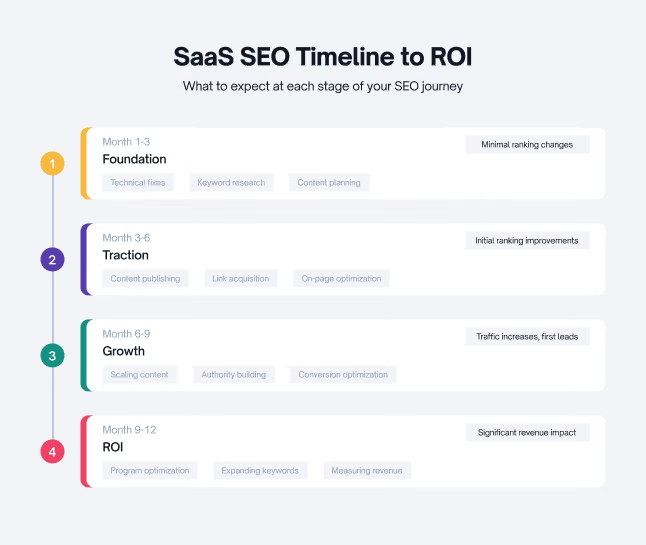
Set realistic timeline expectations when presenting SEO budgets. Initial improvements typically appear within 3-6 months, with big revenue impact materializing in 6-12 months. Include both direct revenue attribution and indirect benefits like brand authority development and reduced paid acquisition dependency in your ROI calculations.
Creating a Cost-Effective SEO Plan
Prioritizing High-Impact Activities
Resource-constrained companies must focus on activities delivering maximum impact per dollar invested. Prioritize keyword research to identify low-competition, high-intent opportunities where smaller budgets can realistically compete against established players.
Target long-tail keywords representing specific use cases rather than broad category terms dominated by enterprise competitors. These specialized queries often convert at higher rates because they indicate buyers are further along in their evaluation process.
For content strategy, pursue depth over breadth. Create resources addressing specific customer pain points rather than surface-level blog posts. Concentrate content investment on bottom-funnel searches where conversion probability justifies the resource commitment.
Using Free and Affordable Tools
Early-stage companies can make substantial SEO progress using free and low-cost tools before investing in premium platforms. Google Search Console provides essential performance data including keyword impressions, click-through rates, and indexing status at no cost. Combined with Google Analytics, you have foundational visibility into organic performance.
Free versions of tools like Ubersuggest or Answer The Public enable basic keyword research, while Screaming Frog's free tier (up to 500 URLs) supports initial technical audits. Most small to mid-sized SEO programs can cover 70-80% of their needs with one well-chosen platform supplemented by free alternatives.
Google has become highly sophisticated at understanding natural language, reducing the necessity of expensive optimization software for early-stage content programs. Focus your limited budget on content creation rather than optimization tools until you reach the scale where marginal improvements justify tool investments.
Measuring the Success of Your SaaS SEO Investment
Effective SEO measurement requires tracking both leading and lagging indicators.
Leading indicators signal that your program is gaining momentum before revenue impact becomes visible: keyword rankings growth, organic traffic increases, backlink acquisition velocity, and improvements in technical health scores.
Lagging indicators focus on business impact: organic conversion rates, customer acquisition costs from organic channels, organic revenue contribution, and customer lifetime value from organic acquisitions compared to other channels.
Growth-stage companies should target organic channels contributing 15-25% of new customer acquisition.
Track what percentage of your total pipeline originates from organic search and compare the LTV of organic customers against other acquisition sources. Many SaaS companies find that SEO-acquired customers demonstrate higher lifetime values because they've educated themselves about product benefits before signing up.
Analyzing ROI and Adjusting Strategy
ROI analysis for SEO must account for compound growth patterns. Month-over-month improvements may appear modest, but year-over-year comparisons typically reveal high growth trajectories.
Calculate cumulative ROI, including both direct conversions attributed to organic search and assisted conversions where organic content influenced deals that ultimately closed through other channels.
Adjust your strategy based on performance data while maintaining a long-term perspective. If certain content types consistently outperform others, reallocate budget toward similar initiatives. When technical improvements show diminishing returns, shift investment toward content production or link building.
Optimize Your SaaS SEO Budget
TripleDart has partnered with over 250 B2B SaaS companies globally, from pre-revenue startups validating SEO as a channel to enterprise organizations scaling comprehensive organic programs. Our team brings insider knowledge from SaaS industry leaders, understanding what drives organic growth in competitive markets.
Budget constraints require intelligent prioritization. We help you make informed decisions about SEO budget allocation based on your growth stage, business model, and strategic priorities.
Our performance-focused methodology means we're invested in delivering measurable ROI from your SEO investment. As AI continues reshaping search behavior, we help companies understand how to optimize for AI-influenced search results and capture market share across traditional and emerging channels. Our AI-powered tools enable efficient content production at scale while maintaining the quality standards that drive rankings and conversions.
Schedule a Demo to discover how we can accelerate your organic growth.
Frequently Asked Questions
What is the most effective way to allocate an SEO budget across different marketing channels?
The most effective distribution dedicates 30-50% of your SEO budget to people and expertise for strategy and execution, 20-30% to content production, 10-20% to link building and digital PR, 10-20% to tools and software, and 5-10% to technical SEO improvements. Within your broader marketing budget, allocate approximately 25% to content and SEO activities, though this percentage varies based on growth model. PLG companies typically invest at least 7% of revenue in SEO, while MLG companies may allocate 10-15%.
How can SaaS companies measure the long-term impact of their SEO investment?
Track both leading indicators including keyword rankings growth, organic traffic increases, and backlink acquisition rates, and lagging indicators such as organic conversion rates, customer acquisition costs from organic channels, and revenue contribution from organic search. Calculate cumulative ROI over multiple years rather than month-to-month since SEO builds compound growth. Include both direct conversions and assisted conversions where organic content influenced deals that closed through other channels. B2B SaaS companies typically reach break-even around month 7-9.
What are the common pitfalls when planning an SEO budget for a SaaS business?
The most significant mistake is expecting immediate results. SEO typically requires 3-6 months for initial improvements and 6-12 months for significant revenue impact. Companies frequently abandon strategies prematurely or under-invest in foundational work.
How can small SaaS startups compete with larger companies in SEO?
Focus on specific niches and long-tail keywords representing particular use cases rather than broad category terms where enterprise competitors dominate. Create comprehensive, authoritative content addressing specific customer pain points. Leverage free tools like Google Search Console and Screaming Frog's free tier, prioritize high-impact activities with clear ROI potential, and build your SEO foundation systematically.
What tools are essential for managing an effective SaaS SEO strategy?
Essential categories include keyword research platforms such as Ahrefs or Semrush, rank tracking systems, technical SEO crawlers like Screaming Frog, backlink analysis tools, and content optimization software. Allocate $100-$1,200+ monthly depending on company size and sophistication requirements. Start with free tools including Google Search Console, PageSpeed Insights, and entry-level platform subscriptions, then upgrade as you scale.