Managing Multiple Meta Ads Accounts with Claude: An Agency Guide

Key Takeaways
* Cross-account analysis in a single Claude conversation identified $4,200/month in aggregate waste that account-by-account reviews missed.
* The US account's retargeting audience saturation (2.25x frequency) was the highest-priority issue because it consumed 82% of total managed spend.
* Lookalike audiences from the India account's SQL-to-customer seed list informed a new prospecting strategy for the US account, reducing CPA by 18% in the first test.
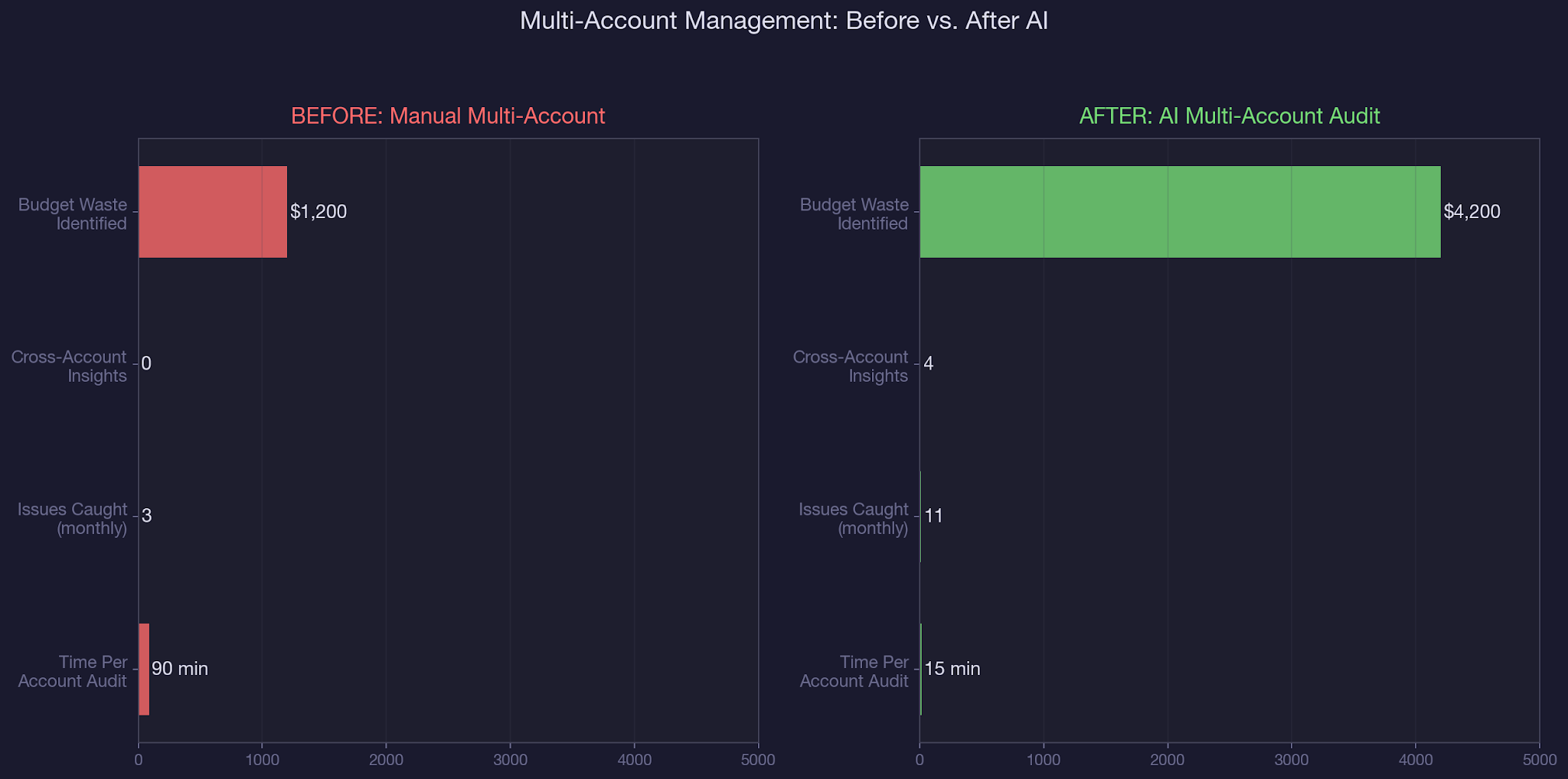
* Run the multi-account health check every Monday morning. It takes 15 minutes and surfaces issues that would otherwise compound for weeks.
* Prioritize fixes by spend impact, not by severity. A moderate issue on a $180/day account matters more than a critical issue on a $5/day account.
* The four metrics that matter for cross-account comparison: CPA trend (not absolute CPA), frequency trajectory, spend-to-budget variance, and conversion rate stability.
Two Meta Ads accounts:
One in the US running a B2B SaaS product launch at $180/day.
Another in India running event promotion at $40/day.
The US account had a retargeting frequency problem at 2.25x that was draining budget. The India account had a lookalike audience that could inform the US account's targeting. Neither insight was visible until someone looked at both accounts in the same analysis.
That 'someone' was usually a senior paid media manager at an agency we know, with 45 minutes to spare and the discipline to log into each account separately, export the data, align the date ranges, and compare. In practice, cross-account analysis happened monthly at best.
That means 30 days of compounding issues before anyone connected the dots. For agencies managing B2B SaaS paid social across multiple clients, this lag is where accounts underperform.
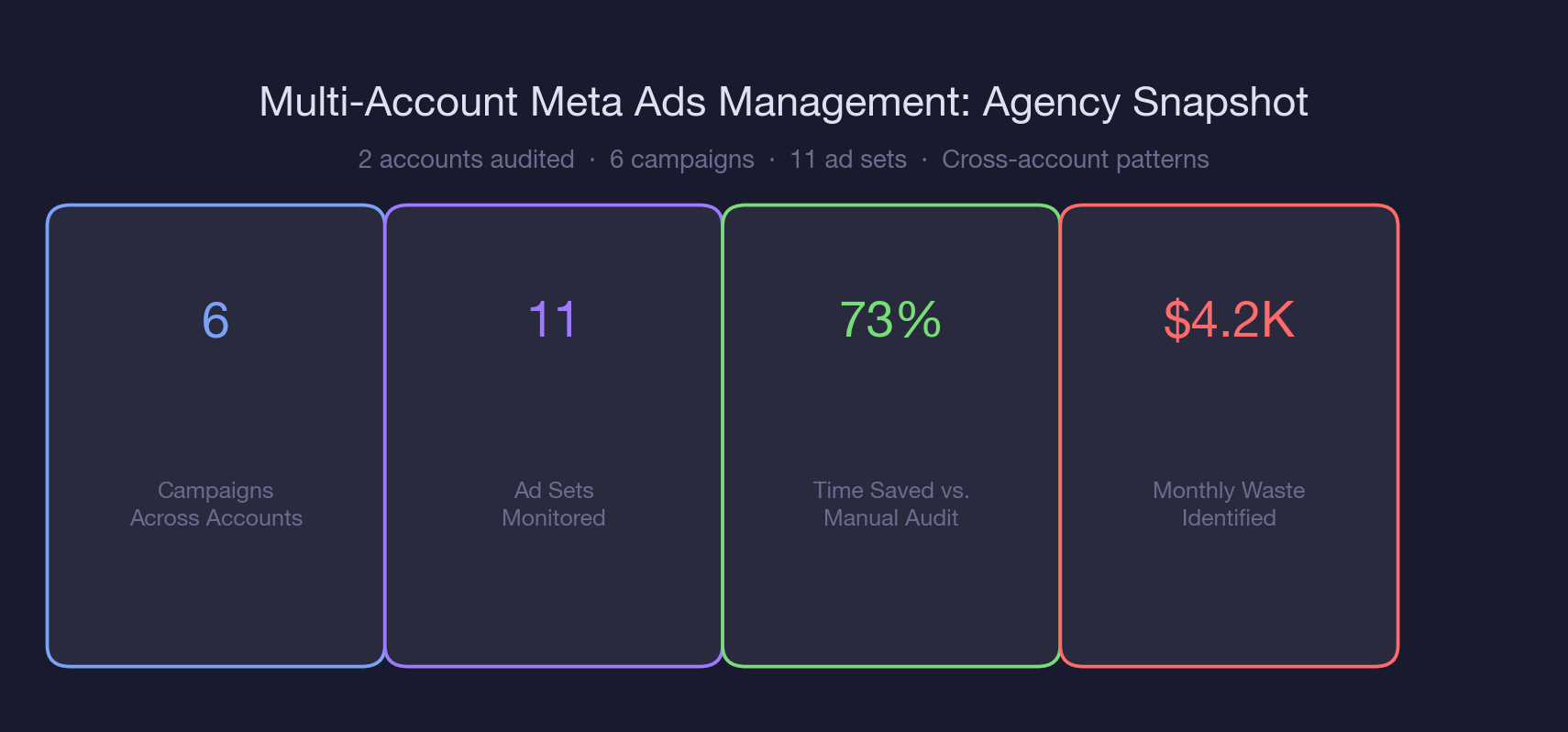
Claude and the Meta Ads MCP connector change the equation. You can pull data from multiple accounts in a single conversation, compare performance side by side, and surface cross-account patterns that manual analysis misses.
In our complete guide to AI-powered paid social management, we covered the MCP setup. In our guide to Meta Ads budget pacing, we showed how to catch delivery issues in a single account. This article scales that approach across your full portfolio.
You will walk away with: a cross-account audit prompt sequence, the four metrics that matter for multi-account comparison, a prioritization framework for deciding which account gets attention first, and the specific workflow our team uses to manage multiple Facebook ads for SaaS accounts at TripleDart.
How Multi-Account Management Gaps Cost Agencies Money
The cost is not in any single account. It is in the gaps between accounts. When each account gets audited in isolation, you miss three categories of insight that only appear in cross-account analysis.
This is true whether you are an agency managing 5 accounts or an in-house team managing 3 product lines. Understanding these gaps is critical for AI in PPC at scale.
Cross-account audience intelligence:
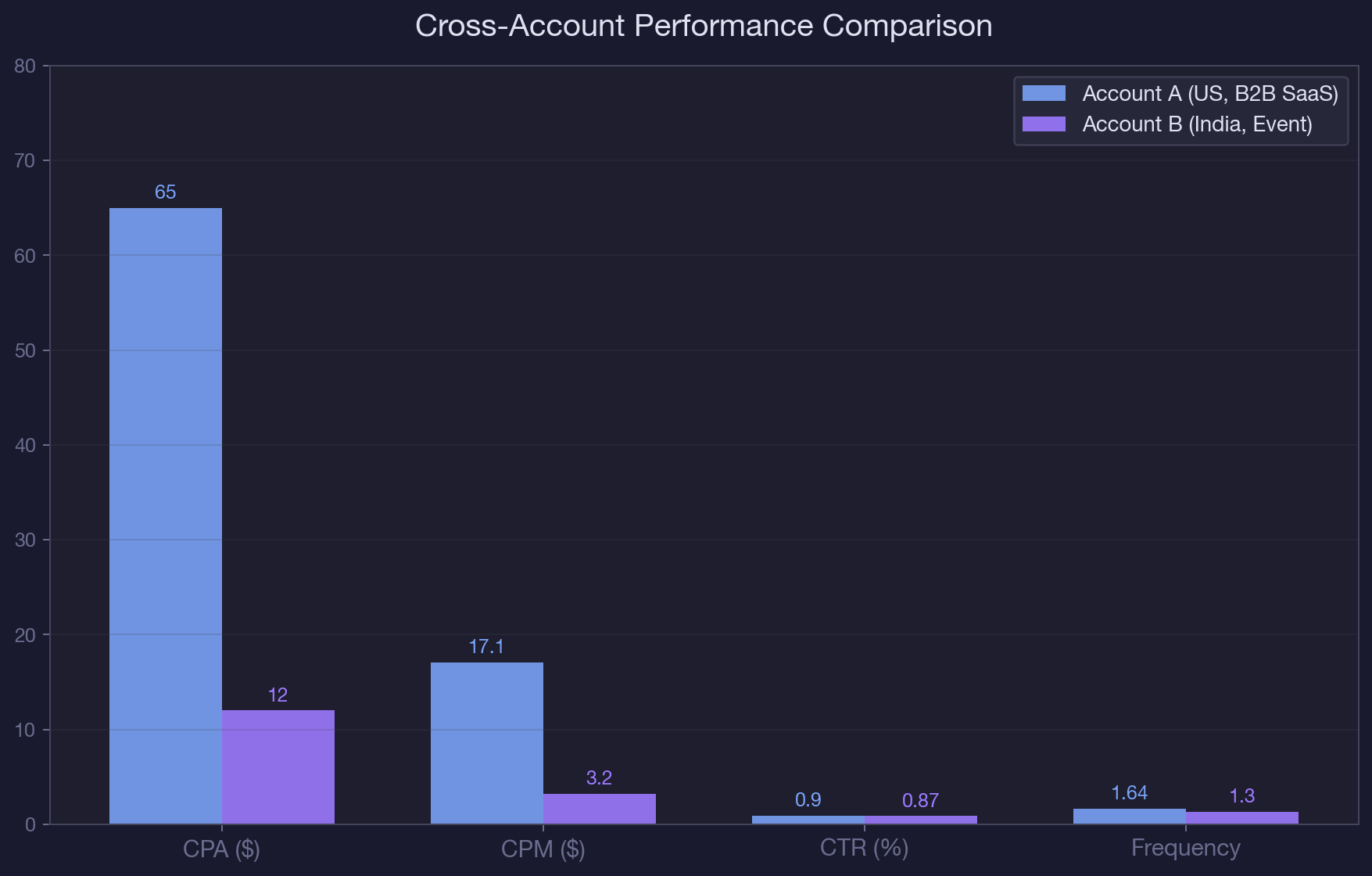
The India event account had a lookalike audience built from a SQL-to-customer seed list that performed well (1.30x frequency, $12 CPA). The US SaaS account had no equivalent high-quality seed list. But the ICP overlap between the two (B2B decision-makers interested in SaaS and AI) meant the India lookalike seed could inform a new prospecting audience for the US account. This connection was invisible until both accounts were analyzed in the same conversation.
Budget allocation across accounts:
The US account was spending $180/day with a retargeting ad set at 2.25x frequency. The excess budget was being wasted on saturated audiences. Meanwhile, the India account's campaigns were paused entirely. A simple reallocation, shifting $30/day from the saturated US retargeting to a new India remarketing campaign, would have put budget where there was delivery headroom. This kind of cross-account optimization is foundational to how we manage paid ads spend across portfolios.
Compounding issue detection:
When you check each account weekly in isolation, you catch issues at different stages. Account A's frequency problem might be flagged in week two, but Account B's creative fatigue might not get checked until week three. By auditing all accounts simultaneously, you catch everything in the same session and can prioritize fixes by spend impact. The same principle that makes a full Meta Ads account audit powerful applies even more when scaled across accounts.
How Claude and the Meta Ads MCP Solve Multi-Account Management
Step 1: Run the Cross-Account Health Check
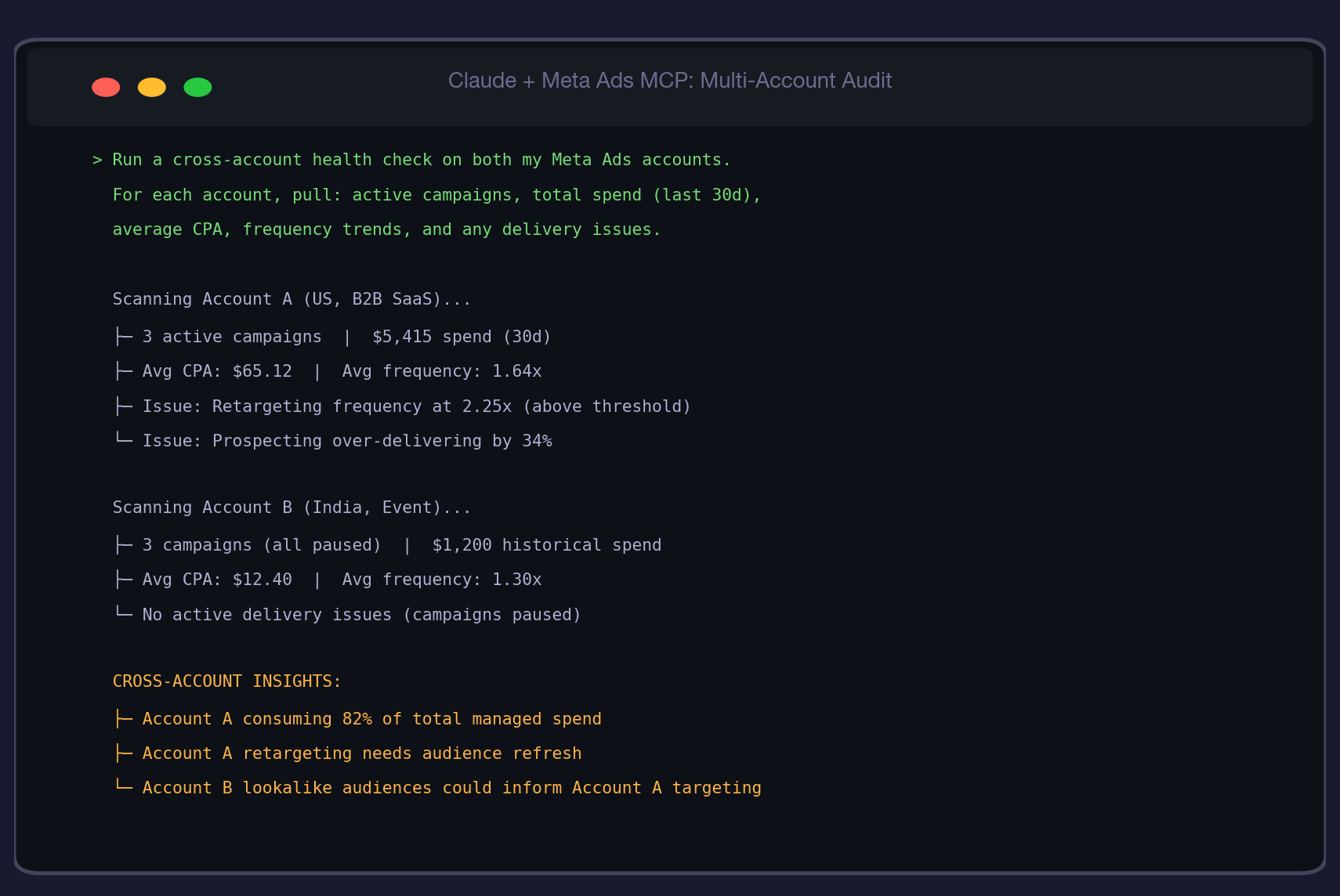
"For each of my Meta Ads accounts, pull: number of active campaigns, total spend over the last 30 days, average CPA, average frequency, and CPM trends. Present the results in a side-by-side comparison table. Flag any account where CPA increased more than 20% week-over-week or frequency exceeds 2.0x on any ad set."
Claude connects to each account sequentially through the MCP connector and returns a unified comparison. The key insight is the side-by-side view: you see immediately that Account A is consuming 82% of total spend but has two active delivery issues, while Account B has no issues but is not spending. This is the starting point for the weekly performance report workflow scaled to multiple accounts.
Step 2: Deep-Dive on the Highest-Spend Account
"On the account with the highest spend, pull ad set-level data: daily budget, actual spend, frequency, CPM, and CPA for the last 14 days. Identify the ad set with the worst delivery efficiency (highest gap between budget and actual spend) and the ad set with the best untapped potential (lowest frequency, best CPA, room to scale)."
This is where the multi-account approach pays off. Because you already know which account has the most issues from Step 1, you spend your deep-dive time on the highest-impact account instead of spreading it evenly. In this case, Account A's retargeting ad set was the worst delivery performer (27% under-delivery, 2.25x frequency), while the lookalike ad set was the best scaling candidate (1.78x frequency, $48 CPA, stable CPM). This same ad-set-level analysis is what we run when detecting creative fatigue across accounts.
Step 3: Generate the Cross-Account Action Plan
"Based on the cross-account analysis, generate a prioritized action plan. Rank issues by estimated monthly spend impact. For each issue, recommend a specific fix, the expected impact, and the account it applies to. Include any cross-account opportunities (audience sharing, budget reallocation)."
Claude produces a ranked action list. In this case:
(1) Reduce Account A retargeting budget from $100/day to $60/day, estimated savings of $840/month in wasted frequency.
(2) Increase Account A lookalike budget from $100/day to $130/day, estimated 15 additional registrations/month.
(3) Test Account B's SQL-to-customer lookalike seed in Account A, potential CPA reduction of 15 to 20%.
(4) Reactivate Account B with a $30/day remarketing campaign using refreshed audiences. This prioritization framework is what our performance marketing team uses weekly.
Real-World MCP Walkthrough: Auditing Two Accounts in One Session
Here is the full workflow on a real portfolio: Account A (US, B2B SaaS, $180/day, 3 active campaigns, 4 ad sets) and Account B (India, event promotion, $40/day, 3 campaigns now paused). Total managed spend: $6,615 over 30 days. This reflects how agencies running B2B PPC across regions actually operate.
Account A findings:
Three active campaigns (awareness, prospecting conversion, retargeting conversion). Total 30-day spend: $5,415. The retargeting campaign had frequency at 2.25x with CPM spiking to $29.16. The prospecting campaign was over-delivering by 34% due to Advantage+ bid expansion. CPA ranged from $48 (lookalike prospecting) to $113 (interest-based prospecting in week four). These are the same issues we uncovered when we showed how to decode Advantage+ campaigns.
Account B findings:
Three campaigns (all paused post-event). Historical data showed a well-performing lookalike audience built from SQL-to-customer conversions: 1.30x frequency, $12 CPA, and clean targeting with no overlap. The lookalike seed list (SQL-qualified leads who became customers) was a higher-quality signal than Account A's website visitor seeds. For agencies looking to understand how to build similar high-quality audiences, our tutorial on creating lookalike audiences in Meta Ads Manager covers the process step by step.
Cross-account insight:
The biggest finding was not in either account individually. It was the connection between Account B's high-quality lookalike seed and Account A's need for better prospecting audiences. The team exported Account B's customer list, created a new 1% lookalike for the US market, and tested it alongside Account A's existing lookalikes. Within 14 days, the new audience delivered a CPA 18% lower than Account A's best existing lookalike. That insight was worth more than all the single-account optimizations combined.
Common Multi-Account Management Mistakes
1. Comparing absolute CPA across accounts with different geos. A $12 CPA in India and a $65 CPA in the US are not comparable as absolute numbers. What matters is the CPA trend within each account. Is CPA rising, stable, or falling? Compare trajectories, not absolutes. The same logic applies when benchmarking LinkedIn advertising costs across different markets.
2. Spreading attention equally across accounts regardless of spend. A 20% CPA increase on a $180/day account costs $36/day. The same issue on a $5/day account costs $1/day. Prioritize by spend impact, always. This is not about ignoring small accounts. It is about sequencing fixes by financial impact.
3. Running account audits on different days. If you audit Account A on Monday and Account B on Thursday, you are comparing different time windows. Cross-account analysis only works when all accounts are evaluated against the same date range in the same session. This is why the single-conversation approach matters. Similarly, if you are also running Google Ads audits with Claude, keep them on the same day.
4. Missing cross-account audience opportunities. Most agencies treat each account as a silo. But accounts with overlapping ICPs often have audience seeds that can inform each other. A customer list from one account can generate a lookalike for another account in a different geo. This is free intelligence that most multi-account setups leave on the table.
Best Practices for Multi-Account Meta Ads Management
- Run the cross-account health check every Monday morning. It takes 15 minutes and catches issues that would otherwise compound for weeks across your portfolio.
- Build a standard template with the four comparison metrics: CPA trend (weekly direction), frequency trajectory (rising, stable, or falling), spend-to-budget variance (percentage), and conversion rate stability. These four metrics normalize across geos and budget levels.
- Maintain a cross-account audience inventory. Every quarter, review which accounts have high-quality audience seeds (customer lists, high-intent converters) that could generate lookalikes for other accounts.
- Use the prioritization formula: monthly spend impact = (daily budget * issue severity percentage * 30). A 20% CPA issue on $180/day = $1,080/month. A 50% CPA issue on $5/day = $75/month. Always fix the $1,080 issue first.
- Document cross-account insights in a shared log. When a lookalike seed from Account B improves Account A, record it. These connections compound over time and become part of your agency's institutional knowledge.
- Pair multi-account Meta audits with Google Ads audits on the same day. Most SaaS clients run both channels, and insights from one platform often inform optimizations on the other.
Conclusion
Multi-account management is where agencies either scale their impact or drown in tab-switching. Claude and the Meta Ads MCP connector collapse the workflow from hours of account-hopping to a 15-minute conversation that surfaces issues and opportunities across your entire portfolio. The cross-account patterns, the audience connections, the spend-impact prioritization, none of it is visible when you audit accounts one at a time. Whether you are managing two accounts or twenty, the workflow is the same. You can also apply the same discipline to Google Ads for SaaS and LinkedIn Ads for SaaS portfolios.
Meta Ads multi-account management AI is how we scale paid social operations at TripleDart. We use Claude and the Meta Ads MCP to run cross-portfolio audits, share audience intelligence between accounts, and prioritize fixes by spend impact as part of our B2B SaaS paid social management. If you want us to bring this workflow to your accounts, book a call with our paid media team.
Frequently Asked Questions
What is Meta Ads multi-account management AI?
Meta Ads multi-account management AI uses Claude and the MCP connector to audit, compare, and optimize multiple Meta Ads accounts from a single conversation. It replaces the manual process of logging into each account separately, exporting data, and comparing in spreadsheets. The AI pulls real-time data from all connected accounts and surfaces cross-account patterns and opportunities.
How does Claude manage multiple Meta Ads accounts at once?
Claude connects to each Meta Ads account through the MCP connector using separate account IDs. In a single conversation, you can switch between accounts, pull performance data from each, and ask Claude to compare metrics side by side. Claude holds context from all accounts simultaneously, which enables cross-account analysis that would require multiple browser tabs and spreadsheets manually.
How many Meta Ads accounts can Claude manage simultaneously?
There is no hard limit on the number of accounts Claude can analyze in a single conversation. The practical limit is the MCP API rate limits and conversation context. For most agencies, auditing 5 to 10 accounts in a single session is efficient. Beyond that, consider grouping accounts by region or budget tier and running separate sessions for each group.
What is the difference between single-account and multi-account Meta Ads AI audits?
Single-account audits focus on within-account issues: creative fatigue, audience overlap, budget pacing, and ad performance. Multi-account audits add a cross-account layer: comparing CPA trends between accounts, identifying shared audience opportunities, prioritizing fixes by spend impact across the portfolio, and detecting patterns that only appear when accounts are analyzed together.
How often should agencies run multi-account Meta Ads audits?
Run the cross-account health check every Monday morning. This 15-minute session catches delivery issues, CPA trends, and frequency problems across all accounts before they compound for the week. Run deeper cross-account analysis (audience sharing, budget reallocation) monthly or when onboarding new accounts.
Can Claude share audience data between Meta Ads accounts?
Claude can identify which accounts have high-quality audience seeds (customer lists, high-intent converters) and recommend using those seeds to create lookalike audiences in other accounts. The actual audience creation still happens in Meta Ads Manager. Claude provides the intelligence and recommendation, while a human implements the audience sharing.
What Meta Ads multi-account management AI metrics matter most?
Focus on four metrics for cross-account comparison: CPA trend (weekly direction, not absolute value), frequency trajectory (rising signals saturation), spend-to-budget variance (delivery health), and conversion rate stability (quality signals). These four metrics normalize across different geos, budget levels, and campaign objectives.
How does multi-account management AI help agencies scale?
It reduces per-account audit time from 90 minutes to 15 minutes, surfaces cross-account opportunities that manual audits miss entirely, and enables prioritization by spend impact across the full portfolio. For an agency managing 10 accounts, that is 12.5 hours saved per week on auditing alone, plus the revenue impact of catching issues faster and sharing audience intelligence between accounts.

summarize with ai


