.png)

![7-Step Workflow for AEO-Ready Content [2026 Framework]](https://cdn.prod.website-files.com/632b673b055f4310bdb8637d/6a0d55ea88913ede1d3a7123_5%20-%20Workflows%20for%20Optimized%20AEO-Ready%20Content%20Creation.png)
Key Takeaways
- AEO-ready content requires a different workflow than traditional SEO because AI engines prioritize direct answers, entities, and structured data over keyword density alone.
- The 7-step AEO framework helps SaaS teams systemize research, drafting, schema implementation, retrofitting, and AI visibility tracking.
- Optimizing existing content for AI parsability and entity coverage is often the fastest way to improve citations across ChatGPT, Google AI Overviews, and Perplexity.
- Measuring AI citation frequency, AI Overview appearances, and conversational query visibility is now critical for modern content performance.
- TripleDart helps B2B SaaS teams operationalize AEO with scalable workflows, entity optimization, schema implementation, and AI visibility strategies that connect directly to pipeline growth.
According to Conductor, scaling AI content generation to increase topical authority is now the number one content priority for B2B marketing teams in 2026. The reason is pretty straightforward: content isn't about driving traffic anymore. It's about shaping how AI models understand your brand and surface it in generated answers.
Most content teams are still running SEO playbooks designed for a link-based SERP. Meanwhile, Google AI Overviews, ChatGPT Search, Perplexity AI, and Microsoft Copilot are changing how buyers find information. Answer Engine Optimization (AEO) is the practice of optimizing content to be surfaced, cited, and quoted by these AI-powered answer engines. Building workflows for AEO-ready content is no longer optional for SaaS teams that want to stay visible.
The problem is that most guides treat AEO as a mindset shift rather than an operational change. They tell you to "write for intent" and "add schema markup" without explaining how those activities connect into a repeatable process your team can run every week.
That gap is what this framework addresses.
What follows is a complete 7-step AEO workflow: from research and intent mapping through drafting, entity optimization, schema implementation, content retrofitting, and measurement. It's designed for content teams at Series A through Series D SaaS companies who already understand SEO fundamentals and need a practical system for AI search visibility in 2026.
What Is AEO and Why Does It Require a Different Workflow?
Answer engine optimization is the practice of optimizing content so that AI-powered answer engines select it as a source, extract information from it, and present that information in AI-generated answers. The user may never visit your site, but your content shapes the answer they receive.
Traditional SEO optimizes for ranking in a list of blue links where the user clicks through to your page. AEO optimizes for being the source material that an AI model synthesizes into a direct answer. That's a different goal, and it requires a different SEO workflow process.
The key answer engines to target in 2026 are Google AI Overviews, ChatGPT with search, Perplexity AI, and Microsoft Copilot. New platforms are emerging regularly, and Profound now runs over 6 million prompts every day across 10 major answer engine platforms to help brands track their visibility across all of them.
Existing SEO workflows fall short for AEO because they don't account for entity optimization, structured data that AI models parse, citation-worthy content formatting, or conversational intent matching. You need a different process, not just a different checklist.
What Is the Overview of the 7-Step AEO Content Workflow?

This framework covers the full lifecycle of AEO-ready content production. Each step builds on the previous one, and once systematized, the workflow dramatically reduces the time required to produce content that AI engines actually cite.
- AEO-Focused Research and Intent Mapping - identify questions, analyze what AI currently surfaces, and map entity clusters
- Building an AEO-Optimized Content Brief - translate research into a structured brief that includes entity maps, schema requirements, and a target AI answer
- Drafting Content for AI Parsability - write using the direct-answer-first pattern so AI models can extract clean, citable passages
- Entity Optimization and Knowledge Graph Alignment - ensure your content demonstrates comprehensive understanding of a topic's conceptual landscape
- Implementing Schema Markup and Structured Data - add the technical layer that removes ambiguity for AI models
- Optimizing Existing Content for AEO (The Retrofit Workflow) - upgrade your existing content library, which is often the highest-ROI AEO activity
- Measuring AEO Performance and Iterating - track citation frequency, AI Overview appearances, and schema validation pass rates
The framework is tool-agnostic. It works whether you use enterprise platforms, free tools, or manual processes. Agentic workflows can accelerate specific steps, but the strategic logic holds regardless of your tooling.
How to Conduct AEO-Focused Research and Intent Mapping?
AEO research differs from traditional keyword research in three critical ways. You're researching questions and conversational queries, not just keywords. You're analyzing what AI models currently surface for your target topics and identifying gaps you can fill. And you're mapping the type of answer the user expects: definition, comparison, step-by-step process, list, or data point.
Start by identifying topics where AI answer engines are actively providing answers in your niche. Then query those topics across multiple AI engines and document what sources they cite, what format the answer takes, and where gaps or inaccuracies exist. Those gaps are your competitive intelligence.
Entity research is the third layer. Identify the key entities, relationships, and concepts that AI models associate with your topic. For a piece about SaaS onboarding workflows, that means mapping related entities like user activation, time-to-value, product-led growth, and customer success. This entity map informs both content creation and schema markup in later steps.
What Tools and Techniques Work Best for AEO Research?
AI answer analysis:
- Perplexity AI - query your target topic and document which sources it cites and in what format
- ChatGPT with search - test current AI answers and identify factual gaps
- Google AI Overviews - check which pages appear and how answers are structured
Question and intent discovery:
- AlsoAsked - maps question hierarchies around any topic
- AnswerThePublic - surfaces conversational query variants
- Google's People Also Ask - shows the questions Google already associates with your topic
- Reddit and Quora - reveal how real users phrase questions in your niche
SERP and data tools:
- Semrush and Ahrefs for keyword volume and competitor analysis
- SerpAPI or DataForSEO for programmatic SERP data
Entity research:
- Google Cloud Natural Language API - analyze entity salience in your draft vs. competitors
- InLinks - maps entity relationships across your content
The practical technique that matters most: query your target topic in at least three AI answer engines before creating any content. For each, document the sources cited, the answer format used, and any factual gaps or outdated information you could fill better.
Discussions on r/AISEOforBeginners confirm this approach. In a thread on AEO automation setups, practitioners consistently report that the research phase -specifically analyzing what AI engines currently cite - is where the most actionable competitive intelligence comes from.
How to Build an AEO-Optimized Content Brief?
The content brief is where AEO strategy becomes operational. It's the bridge between research and execution, and an AEO brief looks meaningfully different from a traditional SEO brief.
In addition to target keywords, word count, and competitor analysis, an AEO brief includes: target conversational queries, the desired answer format, an entity map, schema requirements, an analysis of competing AI answers, and specific content structure requirements for AI parsability. The most important addition is what we call "writing the answer first" - before drafting the full article, define the exact two to three sentence answer you want AI engines to extract from each major section.
According to Rellify, agentic workflows compress brief creation timelines dramatically - what used to take days now happens in hours - and teams report higher-quality output that performs better in organic search and drives improved conversion rates. The key is automating the data gathering while keeping the strategy human.
What Should an AEO Brief Template Include?
A complete AEO brief covers these fields:
- Target topic and working title
- Primary keyword plus conversational query variants
- Target answer engines (Google AI Overviews, ChatGPT, Perplexity)
- Desired answer format (definition, list, comparison, step-by-step)
- "Ideal AI answer" - the two to three sentence answer you want AI to extract
- Entity map - key entities and relationships to cover
- Competing AI answers analysis - what AI currently says and where gaps exist
- Schema markup requirements (FAQPage, HowTo, Article)
- Content structure requirements (H2/H3 hierarchy, lists, tables)
- Internal and external linking targets
- Word count and section breakdown
Teams can use Claude or ChatGPT to accelerate brief creation. Feed in your research data and have AI draft a first-pass brief that a strategist then refines. The automation handles the routine assembly; the strategist validates the entity map and refines the ideal AI answer.
How Do n8n and Zapier Compare for Brief Automation?
A sample automation flow: SerpAPI pulls SERP and AI answer data for a target query, an OpenAI or Claude API call drafts a first-pass brief using a custom prompt template, the output is pushed to Google Docs or Notion, and a Slack notification alerts the content strategist to review and refine.
Start with Zapier for simplicity and graduate to n8n as your workflows mature and complexity increases. The strategic framework matters more than the tooling - teams can execute AEO workflows manually before investing in automation platforms.
How Do You Draft Content for AI Parsability?
How you write determines whether AI engines can extract and cite your content. The core writing principle for AEO is the "direct answer first" pattern. Every major section should open with a clear, concise, factual answer to the question that section addresses - typically one to two sentences - before expanding with supporting detail, examples, and nuance.
This mirrors the inverted pyramid structure journalists use, and it's the pattern AI models are most likely to extract as a quotable passage. As Acquia notes, long-form, well-structured content with clear authorship and current information performs better for AEO because content that answers specific questions directly is more naturally suited to how LLMs synthesize answers.
Four additional writing principles matter for AI content creation:
- Conversational clarity - write in a way that produces clean, self-contained passages AI can quote without needing surrounding context
- Entity-rich writing - naturally incorporate relevant entities, relationships, and contextual terms that reinforce topical authority
- Factual specificity - include specific data points, numbers, and named examples rather than vague generalizations
- First-person expertise signals - include experience-based insights that demonstrate E-E-A-T where appropriate
What Are the Content Formatting Rules for AEO?
Specific formatting choices make content more parsable and citable by AI models:
- Use a clear H2/H3 heading hierarchy where each heading is a question or descriptive phrase, never clever or vague
- Open each section with a definition-style or direct-answer sentence
- Use numbered lists for sequential processes and bullet lists for non-sequential items
- Use comparison tables instead of prose for any side-by-side analysis
- Keep paragraphs to two to four sentences maximum
- Write "citation-worthy sentences" - concise, factual, authoritative statements that stand alone as complete answers
- Include a clear definition near the top of the article for any key term
- Use bold text to highlight key terms and takeaways within paragraphs
Before (traditional SEO): "When it comes to the question of what AEO actually is, there are many different perspectives in the industry, but most experts agree that it involves some form of optimization for AI-powered search tools, which have become increasingly important over the past few years as more users turn to these platforms for answers."
After (AEO-optimized): "Answer Engine Optimization (AEO) is the practice of optimizing content to be cited and surfaced by AI-powered answer engines like Google AI Overviews, ChatGPT, and Perplexity AI. It differs from traditional SEO in that success means being the source AI models extract answers from, not just ranking in a list of blue links."
The rewrite opens with a citation-worthy sentence, uses plain language, and gives AI a clean passage to extract. The original buries the answer in clause after clause.
How to Optimize for Entities and Align with Knowledge Graphs?
Entities are the people, places, organizations, concepts, and things that AI models use to understand topics and their relationships. Unlike keywords (which are strings of text), entities are concepts that AI models map into knowledge graphs - interconnected webs of relationships.
For AEO, this matters because AI answer engines don't just match keywords. They understand topics through entity relationships. If your content about SaaS onboarding workflows doesn't reference related entities like user activation, product-led growth, time-to-value, and customer success, AI models may not recognize your content as authoritative on the topic.
Entity optimization is distinct from keyword optimization. You're not stuffing terms - you're ensuring your content demonstrates comprehensive understanding of a topic's conceptual landscape.
What Are the Practical Entity Optimization Techniques?
Four techniques that work in practice:
- Use the Google Cloud Natural Language API or InLinks to analyze the entity salience of your draft vs. top-ranking competitors. Identify entities they cover that you don't.
- Build an entity map for each content piece during the brief stage. The entity map should show the primary entity, parent entities, sibling entities, and child entities with labeled relationship lines.
- Ensure consistent entity references across your site. If you call it "customer onboarding" in one article and "user onboarding" in another, you're fragmenting your entity signals.
- Link to authoritative external sources - Wikipedia, industry standards bodies, official documentation - that reinforce entity relationships.
- Use structured data (covered in the next step) to explicitly declare entities and their relationships to search engines.
The goal is for AI models to recognize your content as a comprehensive, authoritative source on a topic's full conceptual landscape, not just a page that matches a keyword.
How to Implement Schema Markup and Structured Data?
Structured data is the technical backbone of AEO. It's how you explicitly communicate your content's structure, meaning, and relationships to both search engines and AI models. While AI models can parse unstructured content, schema markup removes ambiguity and significantly increases the likelihood of accurate citation.
Use JSON-LD as your implementation format. It's Google's preferred method, the easiest to maintain, and doesn't require modifying your HTML structure. Schema must be accurate and validated - invalid or misleading schema can actively hurt your AI search visibility.
If you need support with technical SEO implementation at scale, that's an area where specialist expertise pays for itself quickly.
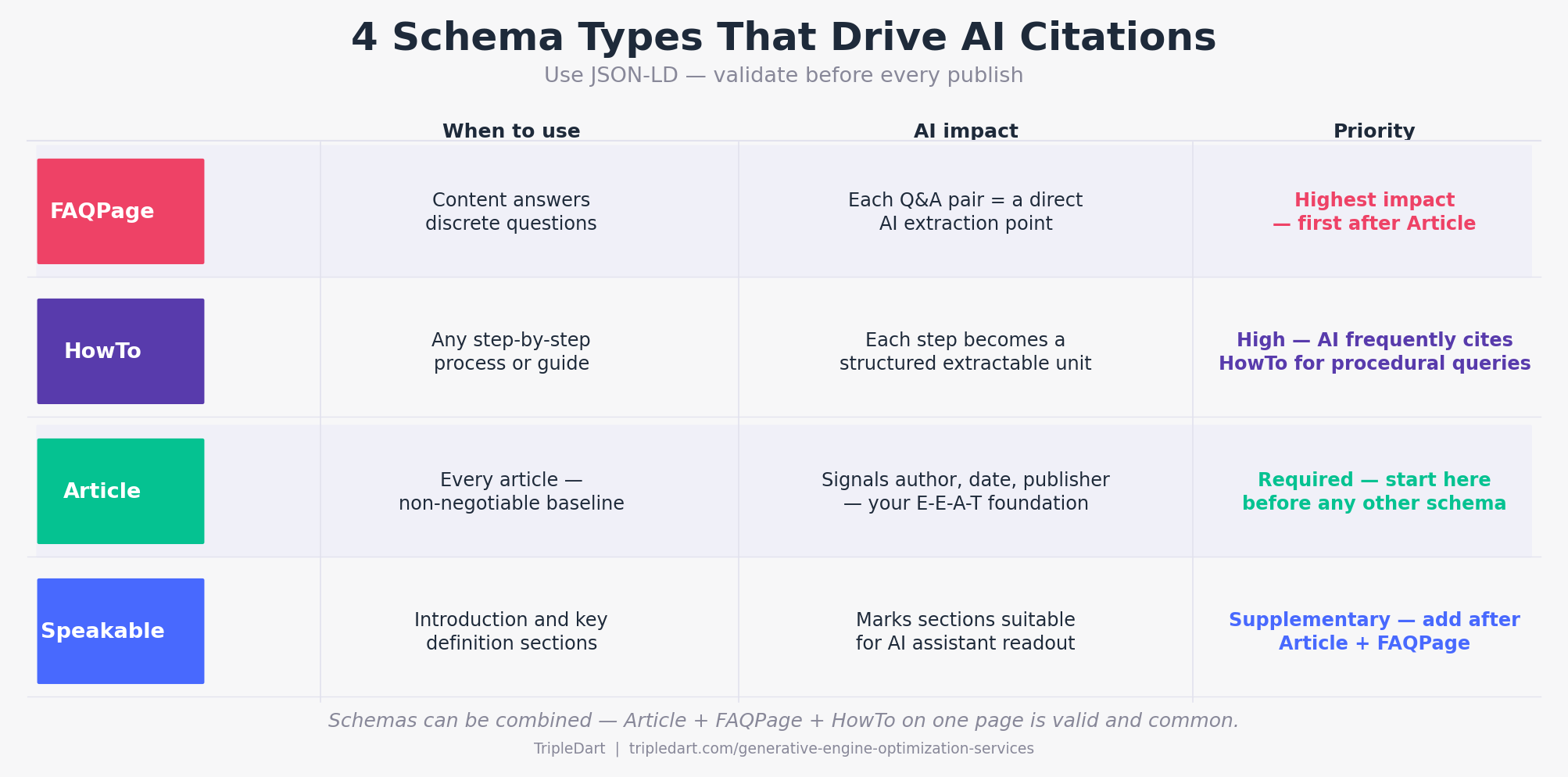
Which Schema Types Drive AI Citations?
- FAQPage - use when your content answers discrete questions. Each Q&A pair becomes a potential AI extraction point. This is the highest-impact schema type for AEO because it maps directly to how AI models structure answers.
- HowTo - use for any step-by-step process. AI models frequently cite HowTo-marked content for procedural queries. Each step becomes a structured, extractable unit.
- Article - the universal baseline. Ensure it includes author (with credentials and bio link), datePublished, dateModified, publisher (Organization schema), and image. This is your E-E-A-T signal layer and the non-negotiable foundation everything else builds on.
- Speakable - marks sections of your content as especially suitable for text-to-speech and AI assistant readout. Use on your introduction and key definition sections.
These schema types can be combined on a single page. An article with both FAQPage and HowTo markup simultaneously is valid and common for comprehensive guides.
Here's a clean FAQPage JSON-LD example:
{
"@context": "https://schema.org",
"@type": "FAQPage",
"mainEntity": [
{
"@type": "Question",
"name": "What is Answer Engine Optimization (AEO)?",
"acceptedAnswer": {
"@type": "Answer",
"text": "AEO is the practice of optimizing content to be surfaced, cited, and quoted by AI-powered answer engines like Google AI Overviews, ChatGPT, and Perplexity AI."
}
},
{
"@type": "Question",
"name": "How is AEO different from SEO?",
"acceptedAnswer": {
"@type": "Answer",
"text": "SEO targets ranking in link-based search results. AEO targets being the source that AI models extract answers from. The best content teams optimize for both simultaneously."
}
}
]
}
Refer to schema.org documentation for the full specification on each type.
How Do You Automate Schema Generation and Validation?
- Generation tools: Merkle's Schema Markup Generator, RankMath or Yoast for WordPress, and custom generation via n8n or Zapier workflows that auto-generate schema from content structure.
- Validation tools: Google Rich Results Test and the Schema Markup Validator at schema.org. Build automated pre-publish validation checks into your CMS workflow.
- Common errors that hurt AEO performance: missing required fields in Article schema, using FAQPage for content that isn't actually Q&A, stale dateModified values, and schema that contradicts visible page content.
Make schema validation a mandatory pre-publish step. No content goes live without passing validation.
How to Optimize Existing Content for AEO Using the Retrofit Workflow?
This is the section most AEO guides skip entirely, and it's arguably the highest-ROI activity for any team with an existing content library. Most content teams have dozens or hundreds of published articles that already rank for relevant queries. Making this existing content AEO-ready is faster, cheaper, and often more impactful than creating new content from scratch.
You're upgrading assets that already have domain authority, backlinks, and indexation. The content audit for AEO starts by scoring each existing page on five dimensions: answer directness, entity coverage, schema implementation, formatting for AI parsability, and citation potential.
Prioritize high-traffic pages that already rank for question-based queries. These are the pages most likely to be surfaced by AI answer engines if properly optimized. For context, when we worked with Meegle, the team published 140 editorial blog pages, 70 scalable content pieces, and re-optimized 30 blog pages specifically for enhanced AI discoverability - the retrofit work on existing pages delivered results alongside the new content program.
"TripleDart is a super helpful team, tremendously aiding in SEO enhancements from blog topics to technical recommendations."- Daniel Henderson, Glean
What Does the AEO Content Retrofit Checklist Look Like?
Apply these eight steps to any existing page to make it AEO-ready:
- Identify the primary questions the page should answer. Query the topic in AI engines to see what questions they're currently answering.
- Add direct, concise answers in the first one to two sentences of each relevant section.
- Restructure headings to match conversational queries. Turn vague headings into question-format or descriptive headings.
- Add or update schema markup. Article schema is the minimum; add FAQPage or HowTo where applicable.
- Audit and improve entity coverage. Add references to related entities identified in your entity map.
- Add structured elements. Convert prose comparisons to tables, convert sequential instructions to numbered lists, add definition callouts.
- Update internal links to reinforce entity relationships across your content.
- Validate schema, test in AI engines, and publish.
Retrofitted content can show AI citation improvements in two to six weeks, compared to four to twelve weeks for brand-new content. That speed advantage makes the existing content library the right place to start for most teams.
How to Measure AEO Performance and Iterate?
Traditional SEO metrics - keyword rankings, organic traffic, bounce rate - are necessary but insufficient for measuring AEO success. Nearly 41% of content teams report relying on overall traffic across organic and AI referral as their primary AEO success metric, but that's a proxy, not a direct measure. The core question shifts from "Are we ranking?" to "Are AI engines citing us?"
AEO measurement is still an evolving space. No single tool captures everything yet, and manual monitoring remains necessary alongside automated tracking. Build a combination of both into your workflow from the start.
What Are the Key AEO KPIs and How Do You Track Them?
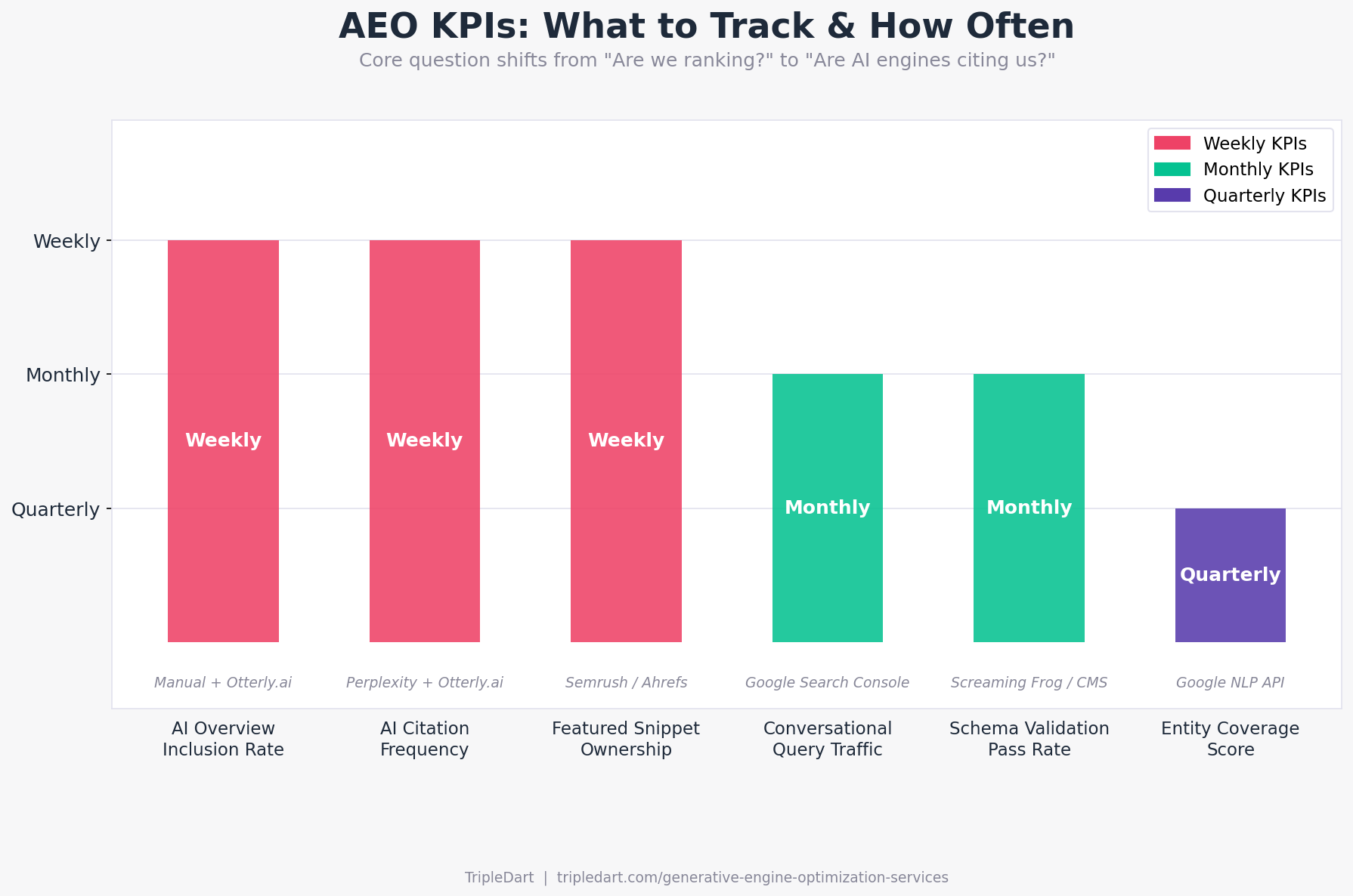
A thread on r/seogrowth testing AEO tools found that tools built specifically for citation monitoring - tracking mentions across ChatGPT, Gemini, and Perplexity - outperformed general SEO platforms for this specific use case. The monitoring layer is where most teams underinvest.
How Do You Build Feedback Loops Into the Workflow?
Run a quarterly review: analyze which content pieces are getting cited most and least, then identify patterns in format, schema type, entity coverage, and topic type. Use those patterns to update your content brief template, drafting guidelines, and retrofit prioritization criteria.
Test different answer formats for the same topic - paragraph vs. list vs. table - and compare citation rates. Test different schema types and track which correlate with higher AI Overview appearances. The goal is continuous improvement: each cycle of the workflow should produce better AEO results than the last.
Set up automated citation monitoring alerts via Otterly.ai or custom n8n workflows so you know immediately when AI engines start or stop citing your content.
Who Is Responsible for What in AEO Workflows?
AEO is inherently cross-functional. It requires content strategy, writing, SEO, and sometimes development to work in sync. Misaligned handoffs are the primary reason AEO initiatives stall.
The five key roles and their ownership:
- Content Strategist - owns research (Step 1), brief creation (Step 2), and content audit prioritization (Step 6)
- Content Writer - owns drafting (Step 3), entity-rich writing (Step 4 execution), and content retrofitting (Step 6 execution)
- SEO Specialist - owns entity optimization strategy (Step 4), schema markup (Step 5), measurement (Step 7), and technical validation
- Developer - owns schema implementation at scale, CMS integration, and automated validation pipelines
- Marketing Leader - owns strategy, prioritization, resource allocation, and the build-vs.-partner decision
R = Responsible, A = Accountable, C = Consulted, I = Informed
Partnering with a specialized B2B SaaS marketing agency makes sense when the team lacks AEO expertise, when speed is critical, when the content library is large enough that retrofitting requires dedicated resources, or when you need a proven framework rather than building one from scratch.
What Are the Common Mistakes That Break AEO Workflows?
- Treating AEO as separate from SEO. Running parallel workflows instead of an integrated one wastes resources and creates conflicting optimization signals. AEO extends SEO; it doesn't replace it.
- Over-automating without human quality checks. Automation accelerates routine tasks but can't replace strategic judgment. AI-generated briefs and schema need human review before they go live.
- Ignoring schema validation. Deploying schema without testing it is worse than having no schema at all. Invalid markup sends negative signals to both search engines and AI models.
- Writing for keywords instead of entities and questions. Keyword density is an SEO-era metric. AEO rewards conceptual comprehensiveness and direct answers, not term frequency.
- Not monitoring AI citations after publishing. AEO is not "publish and forget." AI models update their sources regularly, and you need to know when you gain or lose citations.
- Optimizing only new content while ignoring the existing library. The fastest AEO wins come from retrofitting content that already has authority and rankings. Most teams leave this on the table.
- Using generic AI-generated content without expertise signals. AI models increasingly prioritize content with clear authorship, original insights, and first-hand experience. Generic content without E-E-A-T signals gets filtered out.
The most expensive mistake is treating AEO as a one-time project instead of an ongoing operational capability. AEO workflows must be maintained, measured, and iterated - just like your SEO program.
How to Build Your AEO Content Engine?
TripleDart is an AI-native SEO agency for B2B SaaS, and we work with content teams across every stage of AEO maturity - from teams just starting to audit their existing content library to teams running fully systematized workflows with automated brief generation, schema validation pipelines, and weekly citation monitoring. The pattern we see consistently is that teams who treat AEO as an operational capability, not a one-time project, compound their AI search visibility over time while competitors are still debating whether it matters.
Our SaaS SEO and content services are built around this exact framework - research, brief, draft, entity optimization, schema, retrofit, and measurement - applied to your specific content library, ICP, and competitive landscape. We've helped companies like Glean grow organic traffic by 275%, Signeasy reach 800 monthly LLM sessions with 60-68% consistent growth, and FlowForma achieve 7x AI search visibility growth in six months.
If you're ready to build a content engine that performs across both traditional and AI-powered search, Schedule a Demo and we'll walk through what the workflow looks like for your team specifically.
Frequently Asked Questions
1. What is AEO (Answer Engine Optimization) and how is it different from SEO?
Answer Engine Optimization is the practice of optimizing content to be cited and surfaced by AI-powered answer engines, including Google AI Overviews, ChatGPT, and Perplexity AI. SEO targets ranking in link-based search results where users click through to your site. AEO targets being the source that AI models extract answers from - the user may never visit your page, but your content shapes the answer they receive. The two strategies are complementary, and the best content teams optimize for both simultaneously.
2. Do I need coding skills to build AEO workflows in n8n or Zapier?
No coding skills are required for Zapier, which uses a visual no-code builder. n8n is low-code - basic familiarity with JSON helps but isn't required for most workflows. More importantly, the strategic framework matters more than the automation tooling. Teams can execute AEO workflows manually or with basic tools before investing in automation platforms. Start with the 7-step process, then layer in automation where it saves the most time.
3. Which platform is better for AEO automation - n8n or Zapier?
It depends on your team's technical capacity. Zapier is best for quick setup, cloud-hosted convenience, broad app integrations, and non-technical teams. n8n is best for full control, self-hosting, complex custom workflows, and technical teams who need flexibility at scale. The practical recommendation: start with Zapier for simplicity and graduate to n8n as your workflows mature and complexity increases.
4. How long does it take to see results from AEO-optimized content?
Retrofitted existing content can see AI citation improvements in two to six weeks. New AEO-optimized content typically takes four to twelve weeks. Timelines vary by domain authority, content quality, and topic competitiveness. AEO is a compounding strategy - results accelerate as your content grows and AI models learn to trust your domain as an authoritative source.
5. Can I make my existing content AEO-ready, or do I need to create everything from scratch?
Retrofitting existing content is often the fastest path to AEO results. High-traffic pages that already rank for question-based queries are your best starting point - they have existing authority and just need structural and technical upgrades to become citation-worthy. Step 6 of this workflow covers the complete retrofit process, including a prioritization framework and an eight-step checklist you can apply to any existing page.
6. What schema markup types are most important for AEO?
The four most impactful schema types for AEO are FAQPage, HowTo, Article, and Speakable. Article schema with proper E-E-A-T signals - author name, credentials, organization, datePublished, and dateModified - is the non-negotiable baseline. FAQPage and HowTo build on that foundation by marking specific content structures that AI models frequently extract. Speakable marks sections suitable for AI assistant readout. Refer to Step 5 for implementation details and a JSON-LD code example.
7. How do I measure whether my content is being cited by AI answer engines?
Three approaches work in combination. Manual monitoring: query your target topics in ChatGPT, Perplexity, and Google AI Overviews regularly and document when your content appears as a cited source. Specialized tools: Otterly.ai and Rankability track AI citations at scale. Proxy metrics: conversational query traffic in Google Search Console shows sessions from question-format queries, which correlates with AI engine visibility. No single tool captures everything yet - a combination of manual and automated monitoring is the current best practice.
8. Should I hire an agency for AEO or build the capability in-house?
Both approaches work. In-house is effective for teams with dedicated SEO and content resources who can invest in learning and iteration over time. An agency makes sense for teams that need to move fast, lack AEO expertise, have large content libraries requiring systematic retrofitting, or want to scale across multiple content programs simultaneously. Many companies use a hybrid model - agency for strategy and framework design, in-house team for ongoing execution. As an AI-native SEO agency for B2B SaaS, we use proprietary AI workflows (including Slate) to design the AEO framework and train your team to execute it independently, so the capability stays with you long-term.

.png)



.webp)







.webp)




.webp)

.webp)
.png)





%20(1).png)


.webp)
.webp)
.webp)



%20Ads%20for%20SaaS%202026_%20Types%2C%20Strategies%20%26%20Best%20Practices%20(1).webp)



.webp)






.webp)



![Creating an Enterprise SaaS Marketing Strategy [Based on Industry Insights and Trends in 2026]](https://cdn.prod.website-files.com/632b673b055f4310bdb8637d/6a218bacea463474377dfd32_34%20-%20Creating%20an%20Enterprise%20SaaS%20Marketing%20Strategy.png)































.webp)



%20Agencies%20for%20B2B%20SaaS%20Compared%20(2026).webp)

.webp)
%20with%20Hubspot.webp)


_%20Expert%20Reviews%20%26%20Comparisons.png)






.webp)




_%20Comparison%2C%20Strengths%2C%20and%20How%20to%20Choose.png)









.webp)




.webp)


.webp)

















%20Tools%20in%202026_%20Vetted%20List.webp)


![How to Measure AEO Success: 12 Metrics Beyond Clicks [2026 Framework]](https://cdn.prod.website-files.com/632b673b055f4310bdb8637d/6a0d664b326187e99b3d5960_6%20-%20The%20Ultimate%20Guide%20to%20Measuring%20AEO%20Success%20in%202026.png)
.png)
![How to Structure Content for AEO and GEO [With Templates]](https://cdn.prod.website-files.com/632b673b055f4310bdb8637d/6a0c6a56eb700472e635ff33_1%20-%20How%20to%20Structure%20%20Content%20for%20AEO%20and%20GEO%20%20Summaries%20(2026).png)





.png)
.png)











.webp)

%20Agencies%20in%202027.webp)
.webp)
![Top 9 AI SEO Content Generators for 2026 [Ranked & Reviewed]](https://cdn.prod.website-files.com/632b673b055f4310bdb8637d/6a2a3e3105bc1a127aae4e8e_34%20-%20Top%209%20AI%20SEO%20Content%20Generators%20for%202026%20%5BRanked%20%26%20Reviewed%5D.webp)