Claude Skills for Growth Teams: The Workflow Stack We Run Across 100+ Accounts

Key Takeaways
- Growth teams spend 60 to 70% of time on repeatable execution work across organic, paid, ABM, and content channels. Claude Skills automate that layer
- The Connected Skill Stack (keyword research to content brief to blog draft to fact-check to humanizer to internal linking) turns a six-step manual process into a single pipeline.
- A two-person content team operating with Skills produces the throughput of a five-person team on manual workflows.
- The ABM pipeline processes 100 target accounts (300 contacts) in under 4 hours. Manual: 75 hours.
- Deploy in phases. Content Skills first (weeks 1 to 2), QA Skills next (weeks 3 to 4), ABM last (weeks 5 to 6). Start with the highest-frequency, lowest-risk deliverable.
- Measure recovered hours, content velocity, and pipeline contribution. The compounding effect shows up in quarter two.
Your content strategist spent Monday morning building briefs. Pulling keyword data from Ahrefs. Opening the top four ranking pages in separate tabs. Scanning H2 structures. Cross-referencing internal links. Drafting outlines. Three briefs done by lunch.
Your PPC manager spent Tuesday afternoon reviewing search term reports. Flagging negatives. Checking landing page alignment. Updating ad copy for two campaigns. Half a day gone.
Your demand gen lead spent Wednesday enriching target accounts one by one in Clay. Scoring them against your ICP framework. Writing personalized outreach for the first 12 contacts. Twelve down, 288 to go.
Every one of those workflows follows the same playbook, week after week, with different inputs. And all three team members are spending 60 to 70% of their time on assembly work, leaving 30 to 40% for the strategic work that moves pipeline.
That ratio is backwards. Claude Skills flip it.
The Resource Allocation Problem: A Day-in-the-Life
The list of things that could move pipeline is always longer than the capacity to execute. Every growth team lead knows this. You see the opportunities clearly. You cannot resource them all.
Here is what the typical Series B growth team's week looks like, broken down by where time goes:
The assembly work is where Skills create leverage. Not because the work is unimportant. Because the work follows the same structural pattern every time, and a configured Skill executes that pattern in minutes instead of hours.
Teams using AI-powered workflows report saving 10+ hours per week. But most are still using AI as a chat window: paste text in, get text out, copy it somewhere. That misses the point.
Skills are configured, repeatable workflows with tool integrations. They pull live data, process it through a structured prompt, and deliver formatted output. The difference between "using AI" and "deploying Skills" is the difference between asking a colleague a question and hiring a specialist who already knows your systems.
For agency-specific deployment patterns, see Claude Skills for SEO agencies.
The Four Growth Functions Where Skills Create the Most Leverage
1. Organic Growth and Content
Content-led SEO is the highest-leverage channel for most B2B SaaS companies. It is also the most operationally intensive.
Here is what changes when the content pipeline runs through Skills:
Brief creation: The Keyword to Content Brief workflow in Slate (25 nodes) produces a writer-ready brief in under 10 minutes. Target keyword with live Ahrefs data, H2/H3 outline from SERP analysis, five FAQ questions, internal link suggestions, competitive angle, word count recommendation. Manual equivalent: 45 to 60 minutes.
Keyword research: The keyword research Skill runs clustering, intent classification, and priority scoring against live Ahrefs data. It groups keywords by topic cluster, tags search intent (informational, commercial, transactional, navigational), and ranks opportunities by a composite score of volume, difficulty, and business relevance. Manual equivalent: 60 to 90 minutes per cluster.
Internal linking: The Internal Linking Engine processes every new post before publication. Scrapes the sitemap, categorizes URLs by priority hierarchy, inserts 5 to 8 contextual links, returns an insertion report. Retroactive batch runs across existing archives surface hundreds of missed opportunities. Manual equivalent: 25 to 30 minutes per post, plus retroactive work that never happens because nobody has time.
Fact-checking: The fact-checker Skill extracts every statistical claim, locates the primary source, and classifies each as Verified, Uncertain, or Incorrect. Manual equivalent: 30 to 45 minutes per piece (if it happens at all).
When brief creation takes 10 minutes instead of 60, keyword research takes 10 minutes instead of 90, and internal linking happens automatically, a two-person content team operates at five-person throughput. That is not an aspiration. That is the math.
2. Paid Search
PPC campaigns generate a constant stream of data requiring regular interpretation. The weekly search term review. The landing page audit. The negative keyword update. The performance anomaly investigation. All repeatable synthesis work.
The negative keyword Skill identifies wasted spend from live Google Ads data in 15 minutes. It pulls the search term report, classifies each term by relevance to the campaign objective, flags irrelevant terms consuming budget, and outputs a recommended negative keyword list with rationale per term.
The landing page match audit scores every LP for message match against the ad copy, checks conversion element presence (form above fold, social proof, clear CTA, mobile optimization), and flags alignment gaps. A PPC manager reviewing 20 landing pages manually takes a full day. The Skill does it in 30 minutes.
These are not monthly strategic exercises. They are weekly operational tasks that consume PPC manager time without requiring PPC manager judgment for 80% of the work. The Skill handles the pattern-matching. The PPC manager reviews the output and makes the judgment calls on borderline cases.
The weekly performance report workflow automates the other side: pulling data, structuring it, and surfacing what needs attention. The PPC manager starts the week with a report instead of spending the first half-day building one.
3. ABM and Demand Generation
Account-based marketing requires data processing volume that manual workflows cannot sustain at scale. Here is the full pipeline for a 100-account ABM campaign:
Step 1: Account enrichment. Pull firmographic data from Clay for all 100 target accounts. Company size, funding stage, technology stack, recent news, hiring signals. The Skill enriches accounts in batch, not one by one.
Step 2: ICP scoring. Score each account against your ICP framework on five dimensions: company size fit, technology stack alignment, funding stage match, growth signal presence, competitive displacement opportunity. Each account gets a composite score from 0 to 100 and a tier assignment (Tier 1: 80+, Tier 2: 60 to 79, Tier 3: below 60).
Step 3: Contact identification and persona classification. For each Tier 1 and Tier 2 account, identify 3 key decision-maker contacts. Classify each by persona: economic buyer (CFO, VP Finance), technical evaluator (CTO, VP Engineering), end user champion (Director of Operations, Team Lead). Pull recent LinkedIn activity, published content, and conference appearances.
Step 4: Personalized outreach generation. For each contact, generate a unique opening paragraph that references: the contact's recent activity (a LinkedIn post they wrote, a conference they spoke at, an article they published), a company-specific context point (a recent funding round, a product launch, a hiring push), and a relevance bridge connecting their situation to your product's value prop.
Manual timeline: A junior SDR spends 15 minutes per contact on enrichment, scoring, and outreach writing. At 3 contacts per account across 100 accounts, that is 300 contacts. 300 multiplied by 15 minutes = 75 hours. Nearly two full working weeks.
Skill pipeline timeline: Under 4 hours for the complete batch. Enrichment and scoring run in parallel. Outreach generation runs sequentially on the scored, classified contact list. The SDR's role shifts from data assembly to reviewing the top 20 Tier 1 outreach messages and personalizing the closing lines.
This pipeline feeds directly into HubSpot via MCP connector. Enriched contacts, ICP scores, persona classifications, and outreach drafts push into contact records with custom properties. No CSV export. No manual data entry.
4. Content-Driven Conversion
The gap between content that ranks and content that converts is usually structural. CTAs in the wrong places. Internal links that navigate toward informational pages instead of high-intent pages. FAQ sections that answer top-funnel questions on bottom-funnel pages. Missing schema markup that reduces rich snippet eligibility.
Skills fix these structural gaps systematically across the entire content archive:
- The Internal Linking Engine re-maps link destinations toward conversion pages on commercial-intent content
- The Generate FAQs workflow (v10 in Slate) produces bottom-funnel FAQ sets for product and comparison pages
- The Schema Generator (v1) adds FAQ schema, HowTo schema, and product schema to pages missing structured data
- The AEO Enhancer (v13) optimizes existing content for AI search citation, increasing visibility in the channel that converts at 5x the rate of traditional organic
The compound effect matters. Any one of these changes produces a small conversion lift. Running all four across an archive of 200 posts produces a measurable impact on pipeline within one quarter.
The Connected Skill Stack: Where the Compounding Happens
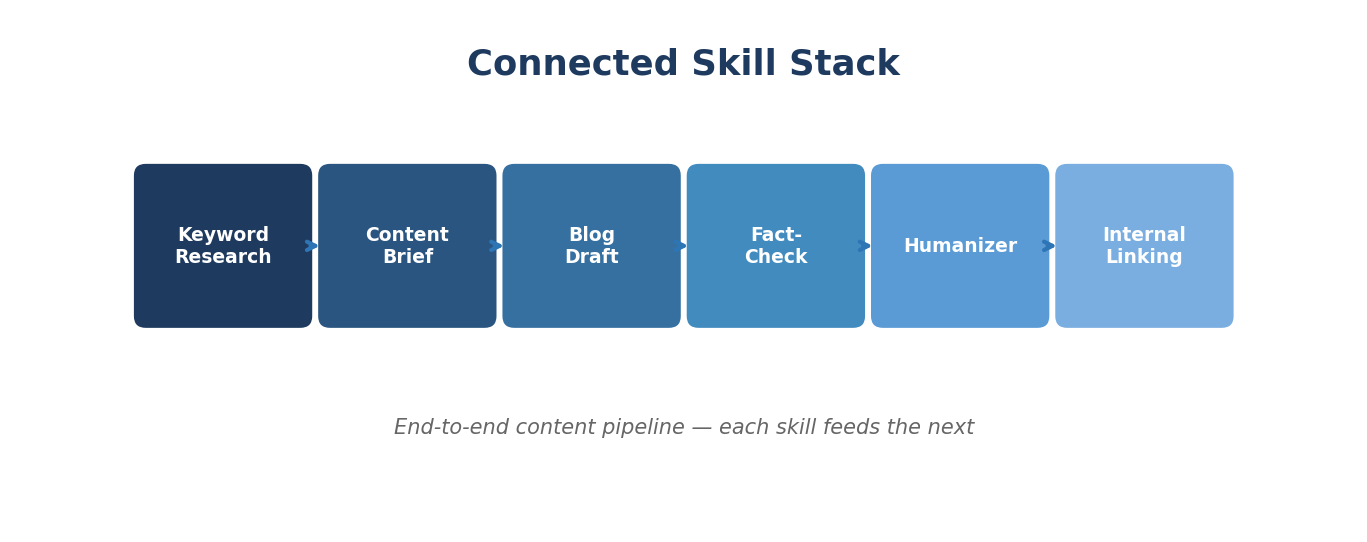
The most powerful Skill configurations are not standalone. They are connected in sequence, where the output of one Skill becomes the input for the next.
Here is the end-to-end content pipeline:
Keyword Research Skill produces: target keyword, supporting keywords, intent classification, competitive gap analysis, recommended angle.
That output feeds directly into the Content Brief Skill, which produces: H2/H3 outline, FAQ questions, internal link targets, word count recommendation, writer instructions.
The brief feeds into the Blog Draft Skill, which produces: a full draft following the outline structure with the recommended angle, incorporating FAQ answers and supporting keywords naturally.
The draft feeds into the Fact-Checker Skill, which produces: a claim-by-claim verification report with source links, date stamps, and confidence classifications.
The verified draft feeds into the Humanizer Skill (Content Brand Enhancer, v11 in Slate), which produces: the draft rewritten to match the client's brand voice, with AI-sounding patterns removed and natural sentence variation applied.
The humanized draft feeds into the Internal Linking Skill, which produces: the final draft with 5 to 8 contextual internal links inserted, plus an insertion report.
Six steps. One pipeline. No manual handoffs between steps.
Manual handoffs are where errors enter, formatting breaks, and strategic context gets lost. When the content brief Skill passes keyword context directly to the draft Skill, nothing gets lost in translation. When the fact-checker receives the exact draft text, there is no copy-paste corruption. When the internal linking Skill operates on the fact-checked, humanized output, it produces the final publishable version.
The ABM pipeline works the same way: ICP scoring feeds into persona classification feeds into outreach personalization. Three-step enrichment pipeline. One batch. No spreadsheet gymnastics in between.
The GEO audit feeds into the Schema Generator: the audit identifies schema gaps, the Schema Generator produces the JSON-LD for the flagged pages. Fix the problem the same day you discover it.
Build Priority Timeline
Not everything deploys at once. Here is the sequence that generates the fastest impact with the lowest risk:
Weeks 1 to 2: Content Skills. Deploy the content brief Skill and keyword research Skill. These are highest frequency, most structurally predictable, and lowest risk if the output needs adjustment. A brief that needs tweaking is a 5-minute fix. Configure for your primary content vertical. Run 10 test briefs, validate against your best manual outputs, deploy to production.
Weeks 3 to 4: QA Skills. Deploy the fact-checker and internal linking engine across all content. These are guardrail Skills. They improve every piece passing through the pipeline regardless of who wrote it. The fact-checker catches outdated stats. The linking engine catches missed internal link opportunities. Both deploy across the full content pipeline with minimal client-specific configuration.
Weeks 5 to 6: ABM pipeline. Deploy the account enrichment, ICP scoring, and outreach personalization Skills. These require more Direction prompt configuration (ICP framework specifics, persona definitions, outreach tone guidelines) but the payoff per batch is enormous. One 100-account batch run justifies the entire configuration effort.
Weeks 7 to 8: Advanced Skills. GEO audit, AEO Enhancer, Schema Generator. These are lower frequency but high strategic value. Deploy after the team has confidence in the Skill framework and the Direction prompt audit cadence is established.
Measuring the Impact
Growth teams need numbers. Here is the measurement framework.
Hours Recovered Per Week
Measure time-per-deliverable before and after Skill deployment. Track it at the task level:
For a team producing 20 pieces per month, that is 63 hours recovered. Nearly 8 full working days returned to strategic work.
Content Velocity
Pieces published per month per team member. The 5x multiplier is what we see in practice: a two-person team producing 40 pieces per month with Skills versus 8 to 10 pieces per month manually. Your starting baseline determines the absolute number, but the multiplier holds.
Pipeline Contribution
Monitor how recovered hours get reallocated. If the strategist spends saved time on conversion optimization, GTM strategy, and ICP refinement, pipeline impact compounds over quarters. Track:
- Organic traffic growth rate (month over month)
- Content-attributed demo requests (should increase as both volume and conversion optimization improve)
- ABM reply rates (should increase with Skill-generated personalized outreach versus template outreach)
- PPC wasted spend reduction (measurable from week one of negative keyword Skill deployment)
Quality Audit
Run a monthly quality audit. Sample 5 Skill-produced deliverables per Skill type. Score them against the quality standard established at launch. The score should stay flat or improve. If it drops, the Direction prompt needs a refresh. This is the same cadence used for fintech Skills, where accuracy metrics get added to the framework.
For fintech and cybersecurity growth teams, add fact-checker accuracy metrics. Track the flagged claim rate over time. A declining flag rate means your content production process is improving upstream... writers internalize the accuracy standards when the fact-checker consistently catches the same categories of errors.
What the Slate Workflow Library Provides
Here are some of the Skills referenced in this article that has a pre-built workflow in Slate:
- Keyword to Content Brief
- Internal Linking Engine
- External Linking Engine
- Refresh Content for SERP
- Add External Links
- AEO Enhancer
- Content Brand Enhancer
- Generate FAQs
- Generate Key Takeaways
- Generate Meta Title and Description
- Schema Generator
- Publish to Webflow
The multi-model grid in Slate means each workflow can route to the optimal model per task. The AI in B2B marketing landscape is evolving fast. Slate's model-agnostic architecture means you are not locked into a single provider as capabilities change.
TripleDart deploys Claude Skills across the full B2B SaaS growth stack for Series A through D companies. We have built and tested the Connected Skill Stack across organic, paid, ABM, and conversion channels for 100+ client accounts. Book a call to map the Skill opportunity against your team's current workflow and see where the highest-leverage automation sits.
Try Slate here: slatehq.com
Frequently Asked Questions
How long does it take to deploy the full growth Skill stack?
Starting from scratch: 6 to 8 weeks phased, following the priority timeline above. Starting from a pre-built Slate framework with existing Direction prompt templates: 2 to 3 weeks of configuration and testing.
Can Skills be shared between SEO and PPC teams?
Some Skills are channel-specific (negative keyword audit is PPC-only). Others benefit both teams. Keyword research feeds into both content briefs and ad group structure. Internal linking improves both organic rankings and quality score. Build shared Skills as shared infrastructure.
Does the ABM pipeline work with HubSpot?
Yes. MCP connectors support HubSpot contact records, property updates, sequence enrollment, and deal creation. Enriched accounts, ICP scores, persona classifications, and outreach drafts push directly into HubSpot without CSV exports.
How do we maintain Skill quality as we scale?
Quarterly Direction prompt audits: five-output sample per Skill, compared against the original quality standard, with updates where output has drifted. Monthly for fact-checker source lists in data-sensitive verticals.
What is the ROI for a mid-size growth team?
A team producing 20 pieces per month saves 60 to 80 hours monthly on content operations alone. At blended senior marketer rates, that is $5,000 to $8,000 in recovered capacity per month. Add PPC and ABM Skill savings and the total monthly recovery typically exceeds $12,000.
Can a two-person team really match a five-person team?
For operational throughput on repeatable tasks, yes. Strategy, creative direction, client relationships, and executive communication still scale with headcount. Skills automate the execution layer. They do not replace the thinking layer.
What is the single highest-impact first Skill to deploy?
The content brief generator. Highest frequency, most structurally predictable, lowest risk of a subpar output causing damage. It delivers measurable time savings on the first run, which builds team confidence before deploying more complex workflows.
How do Skills affect team morale?
Teams report higher satisfaction when repetitive assembly work is automated. The work that remains (strategy, analysis, creative direction, client advisory) is more engaging and more aligned with why people chose marketing careers in the first place.
Can Skills integrate with our existing marketing automation platform?
MCP connectors exist for HubSpot, Google Ads, Google Search Console, Ahrefs, Semrush, ClickUp, Notion, and most major marketing platforms. Skill outputs feed into your existing stack. Existing tool subscriptions become data sources, not workflow bottlenecks.
How do you prevent Skills from producing generic, AI-sounding content?
The Content Brand Enhancer Skill (v11 in Slate) specifically addresses this. It rewrites Skill-produced content to match the client's brand voice, removes AI-pattern markers (predictable sentence structures, hedging language, corporate phrasing), and applies natural variation. The Humanizer is a standard step in the Connected Skill Stack for any client-facing output.

summarize with ai


