

.png)

Key Takeaways
- Structure your Google Ads search campaigns around three rules: automate bidding, consolidate traffic, and optimize creatives. This framework works regardless of your SaaS vertical or ad spend.
- Broad match paired with Smart Bidding and RSAs delivers 20% more conversions at similar cost per action.
- Aim for 3,000+ impressions per ad group per week and 50+ conversions per campaign per month. Below those thresholds, Google's ML doesn't have enough data to optimize.
- SaaS CPCs vary wildly by vertical. Customer Support keywords average $0.25, while HR Tech can hit $18.34. Know your vertical's baseline before you panic at your CPC.
- Improving Quality Score from 5 to 8 cuts your CPC by 28%. Campaign structure directly impacts Quality Score through keyword-ad relevance.
It can be challenging and time-consuming to constantly stay current with Google's numerous changes to its advertising policies and practices. It's normal to feel overwhelmed and unsure of how to keep up, especially when industry experts remind you that not staying up-to-date with the latest tactics can result in missed opportunities.
TripleDart has decided to make your life just a little easier by summing up the major updates and best practices required to smooth sail through your 2026 Google Ads strategy. This has been tried and tested across 100+ B2B SaaS accounts with $150M+ in combined managed spend, and we use this strategies combining with our internal data analytics systems to manage and optimise our client accounts.
If you're also looking for the full SaaS PPC picture — beyond just campaign structure, covering keyword strategy, budgeting frameworks, competitor conquesting, and launch sequencing — our SaaS PPC strategy guide covers all of it.
Recommended SaaS Account Structure for 2026
Here’s the campaign framework we’ve refined across 84+ B2B SaaS accounts.
Brand: Exact match, tCPA, 10–15% of budget. Competitor: Exact + phrase match, tCPA, 15–20%. Category High Intent: Phrase + broad match, tCPA or tROAS, 30–40%. Category Broad Discovery: Broad match, tCPA, 15–20%. Demand Gen / YouTube: Audience-based, Maximize Conversions, 10–15%. Performance Max: tROAS with offline conversions, 0–15% (only at 100+ conversions/month).
Start with the first four campaigns. Add Demand Gen and Pmax once your conversion volume and CRM integration are ready.
Every Search on Google is Unique, For Example, Just 5 of These Data Points Can Generate 1.176 Possibilities
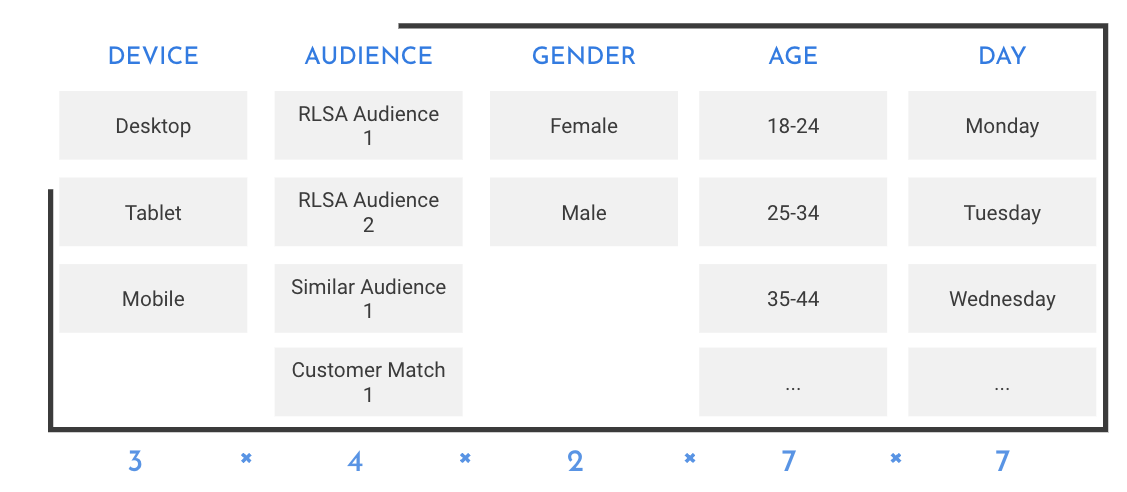
Google ads machine learning algorithm can help you process this and incredible array of signals in real time & deliver more relevance to drive more business results. Google ads ML actually has day to day applications; these models are able to catch complex patterns that could easily overlook human analysis.
And a Universal principle is:
Larger Data Volume = Faster Learning

So How to Structure Google Ads Search Campaign in 2026 for Maximum Success?
It's very simple yet effective. Apply these 3 rules as follows in your google ads search account.
1. Automate Bidding & Grow Coverage
Smart bidding optimizes auction-time for each query. Algorithms automatically factor in device, geo, 1st party audiences and a host of other signals.
Broaden match types within the safeguards of Smart bidding and drive incremental reach with Dynamic Search Ads.
2. Consolidate Traffic
Remove unnecessary traffic segmentations
Maximize the number of impressions at ad group-level (for example 3.000 impr. / week)
Reach a good conversion volume per campaign (for example 50 conv. / month for tROAS)
3. Optimise Creatives
Maintain relevance between queries and ads with Responsive Search Ads and dynamic features (DKI, Ad customizers, If functions). Relevance is key and these solutions help make it easier when reaching more queries per ad group.
Why does this matter more for SaaS? CPCs vary dramatically by vertical. Across our portfolio, Customer Support keywords average $0.25 CPC, while Sales Tech hits $9.13 and HR Tech ranges from $2.45 to $18.34. A poorly structured account in a high-CPC vertical bleeds budget fast. These three rules are your safeguard.
How to Automate Bidding?
a) Increase Broad Match Adoption:
Broad match is able to leverage unique signals not available in other Match Types
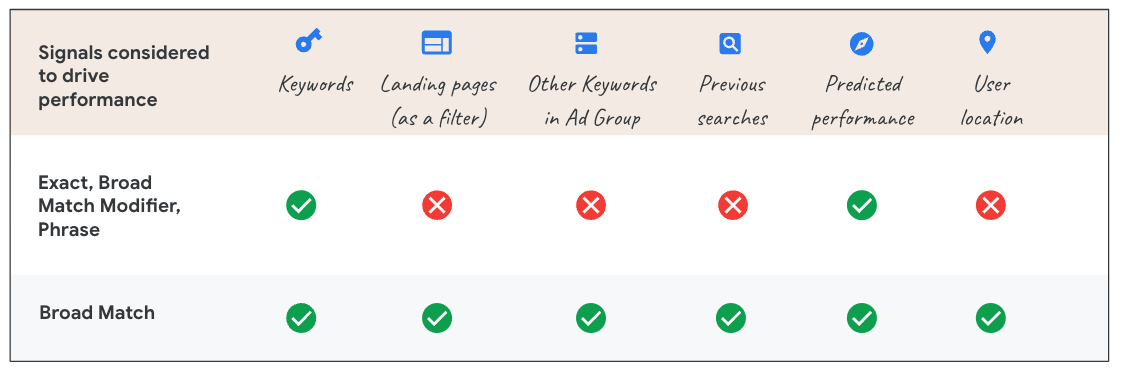
Increasing your use of broad match keywords in your Google Ads campaigns in 2026 may help you reach a larger audience, improve your ad's performance, and save time and effort in managing your campaigns.
That said, not everything should be broad match. Exact match: brand terms and highest-value keywords. Phrase match: high-intent category keywords needing semantic constraints. Broad match: mid-intent and discovery, always paired with smart bidding and robust negatives.
Keep a tab on negative keywords and prune out irrelevant terms on a weekly basis.
Google now supports campaign-level negative keywords — up to 10,000 per campaign, launched in 2025. Use these for universal exclusions. Especially critical for broad match at scale.
For SaaS accounts, start by excluding these categories on day one: "free," "open source," "tutorial," "course," "jobs," and "salary." These terms eat budget without producing pipeline. We've seen SaaS accounts waste 15-25% of spend on irrelevant queries when negative keyword lists aren't maintained weekly.
Scale Your Business with TripleDart's High-Impact PPC Strategies
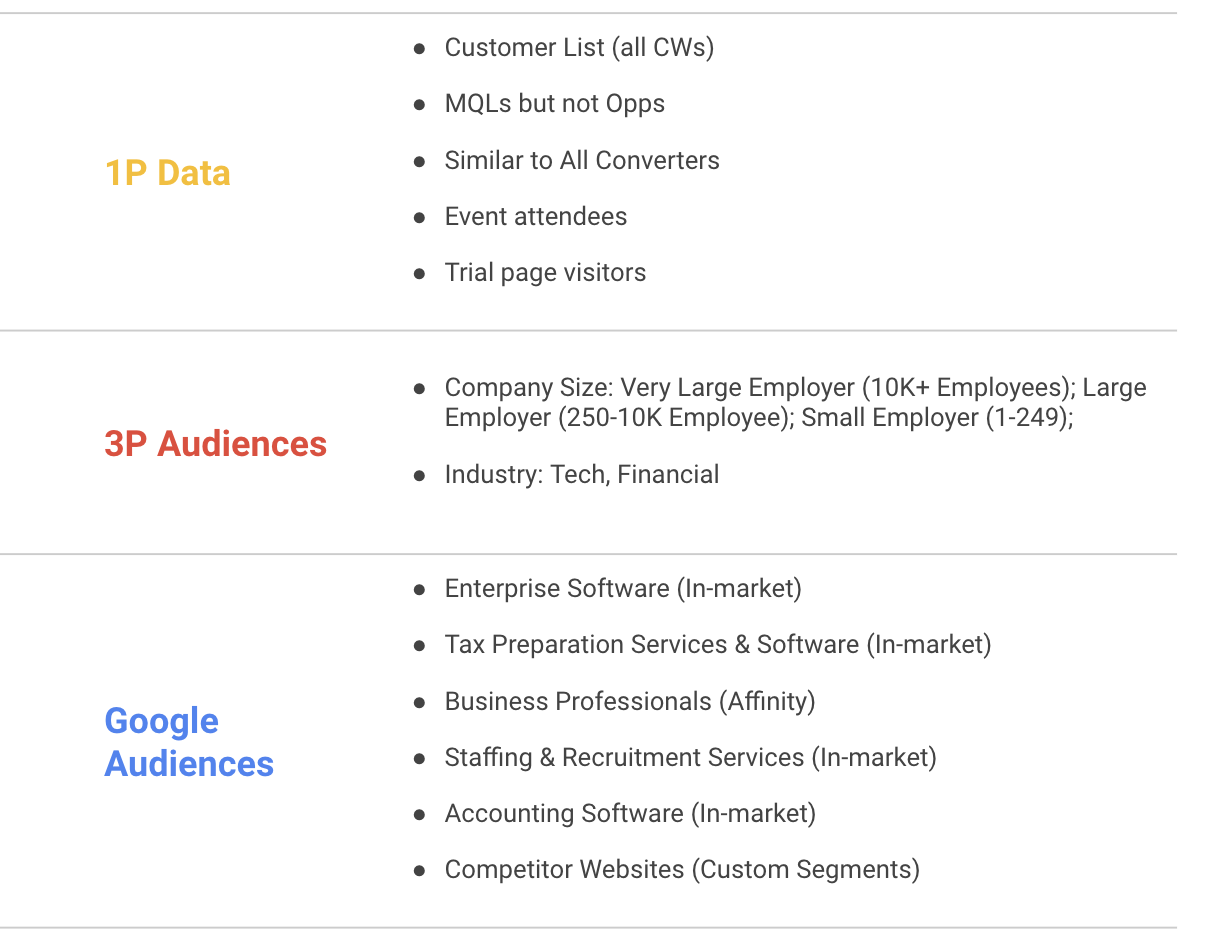
b) Integrate 1st Party, 3P and Google Audiences to Your Google Ads Campaigns:
First-party data is data that is collected by your own company through sources such as your website, customer lists, or point-of-sale systems. Integrating first-party data into your Google Ads campaigns can be a useful way to improve targeting and increase the relevance of your ads to your audience.
There Are Several Ways You Can Integrate First-Party Data Into Your Google Ads Campaigns:
Custom Audiences: Custom Audiences allows you to upload a list of customer email addresses, phone numbers, or user IDs to use as the basis for your targeting. This can be a useful way to reach your existing customers or to target specific segments of your audience.
Customer Match: Customer Match is similar to Custom Audiences, but it allows you to target users who are signed in to their Google account. You can use this feature to show ads to users who have already expressed an interest in your business by visiting your website or interacting with your brand in some other way.
Customer Data Platform (CDP): A CDP is a platform that allows you to collect and manage your first-party data from various sources, such as your website, email campaigns, and customer relationship management (CRM) systems. You can then use this data to create custom audiences and target specific segments of your audience with your Google Ads campaigns.
Website Analytics: Google Analytics allows you to track and analyze the traffic to your website. You can use the data collected by Google Analytics to create custom audiences and target specific segments of your audience with your Google Ads campaigns.
Why Audience Segmentation is Important in Google Ads:
Better Signals
Smart Bidding leverages richer contextual signals like time-on-list and combination of lists to analyze cross-signal effects and improve conversion rates.
Improve Performance
Bidding to the correct value of audience helps advertisers optimize high and low performing audience segments and therefore drive more conversions/revenue within existing CPA/ROAS goals.
Save Time
Target CPA, Target ROAS, Max Conversion, Max Conversion Value, and eCPC automatically use applied first party audience signals, removing the need to continuously manually optimize audience bid modifiers.
c) Value Based Bidding Over Conversion Based
Value-Based Bidding:
- Value-based bidding involves setting your bids based on the estimated value of a conversion.
- This strategy is best suited for businesses that want to maximize the return on investment (ROI) from their campaigns.
- For example, if you are selling a product and have determined that the average customer lifetime value (CLV) is $500, you may want to set your bids based on this value. If a conversion is worth an estimated $100, you would set your bid higher than if a conversion is only worth an estimated $50.
Conversion-Based Bidding:
- Conversion-based bidding involves setting your bids based on the likelihood of a conversion occurring.
- This strategy is best suited for businesses that want to maximize the number of conversions from their campaigns.
- For example, if you are selling a software product and have determined that certain keywords have a higher conversion rate, you may want to set your bids higher for those keywords to maximize the number of conversions.
Conversion based strategy - Reduces bids for low expected value interactions
Value based bidding strategy - Helps drive high quality leads in a competitive landscape.

One structural detail most teams miss: Quality Score. Improving your Quality Score from 5 to 8 reduces CPC by 28% (based on our portfolio data). Campaign structure directly affects Quality Score through keyword-to-ad relevance. Tighter ad groups with single-theme keywords score higher, which compounds savings across every auction.
How to Consolidate Traffic From Various Campaigns?
Consolidate traffic by removing unneeded traffic segmentations + moving to larger volume ad groups and campaigns
- Try to maximize the number of impressions per ad group, ideally 3,000 impr/week
- 1 ad group = 1 URL. This will allow more volume and more variety of queries per ad group, while still staying on-theme
- Mirroring the website is a good way to build a ML-friendly account structure + consolidate ad groups
Example: Remove Unnecessary Traffic Segments for Campaigns
- 0 active campaigns have 50 conv/month
- 3%(75) of all active ad groups are generating 100% of conversions(113) and 1%(49) active ad groups have only 1 conversion
- 0 active ad groups have >3000 impressions/week
- 0.8%(88) of all active KWs are generating 100% of conversions
- 573 KWs have Low search volume
Scale Your Business with TripleDart's High-Impact PPC Strategies
Portfolio Bid Strategies & Shared Budgets
Bundle campaigns w/ similar performance targets if not yet ready to consolidate campaigns.
Shared budgets & bid strategies can be used to prioritize in the most efficient way, across campaigns that have similar goals.
How to Improve Creative Excellence in Google Ads Search Campaigns?
- Responsive Search Ads with Good/Excellent Ad strength per ad group
Aim for two to three RSAs per ad group, each with 15 unique headlines and four descriptions. Let Google’s algorithm test the combinations.
- 4+ extensions per ad group
- Pair responsive search ads with broad match keywords and Smart Bidding
- Enable optimize ad rotation when ad groups have more than one text ad to show your most relevant ad
How to Measure a Good RSA?
While content helps your product establish trust and authority in your industry, good copy is what motivates, encourages, and convinces your audience to engage with your product.
Google Ad strength is a tool that measures the relevance, quantity, and diversity of your responsive search ad content.
Here’s a formula that consistently hits “Excellent” ad strength: write 15 headlines — three value propositions, four benefits, three social proof, three CTAs, and two brand + category. Pin your strongest value prop to Position 1.
For descriptions: one feature-focused, one benefit-focused, one social proof, one urgency/CTA. Keep each under 90 characters.
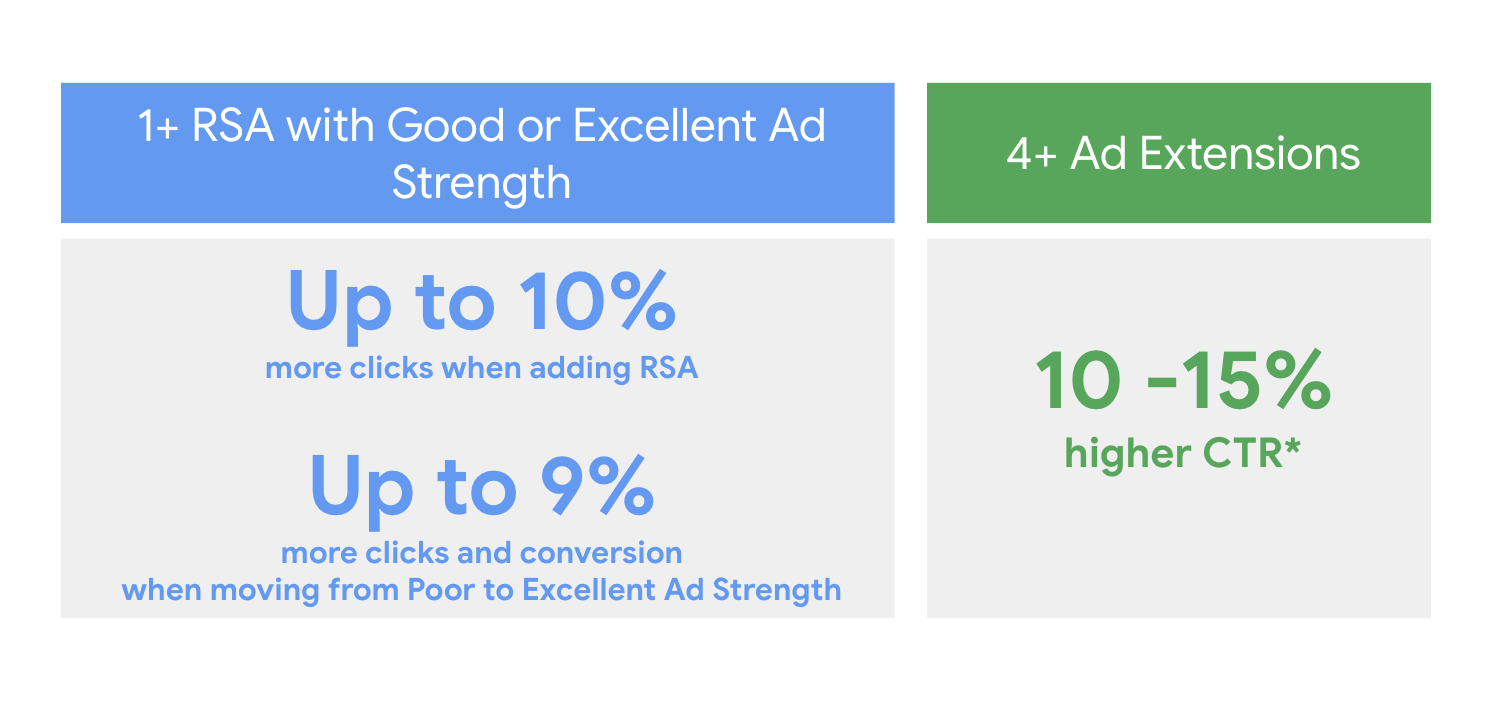
Advertisers who improve ad strength for their responsive search ads from 'Poor' to 'Excellent' see 9% more clicks and conversions on average.
Cheat Sheet for Writing RSA Headlines & Descriptions:

Maximize Engagement With Ad Extensions
Best Practices:
- Keep content fresh, relevant and high quality.
- Watch out for overlap or repetition.
- Cover four key extensions and maximize co-trigger
- Enable all extensions that make sense for your business.
- Always on image extensions. Early results show advertisers are seeing up to a 10% increase in CTR when image extensions or dynamic image extensions show with their Search ads in top positioning.
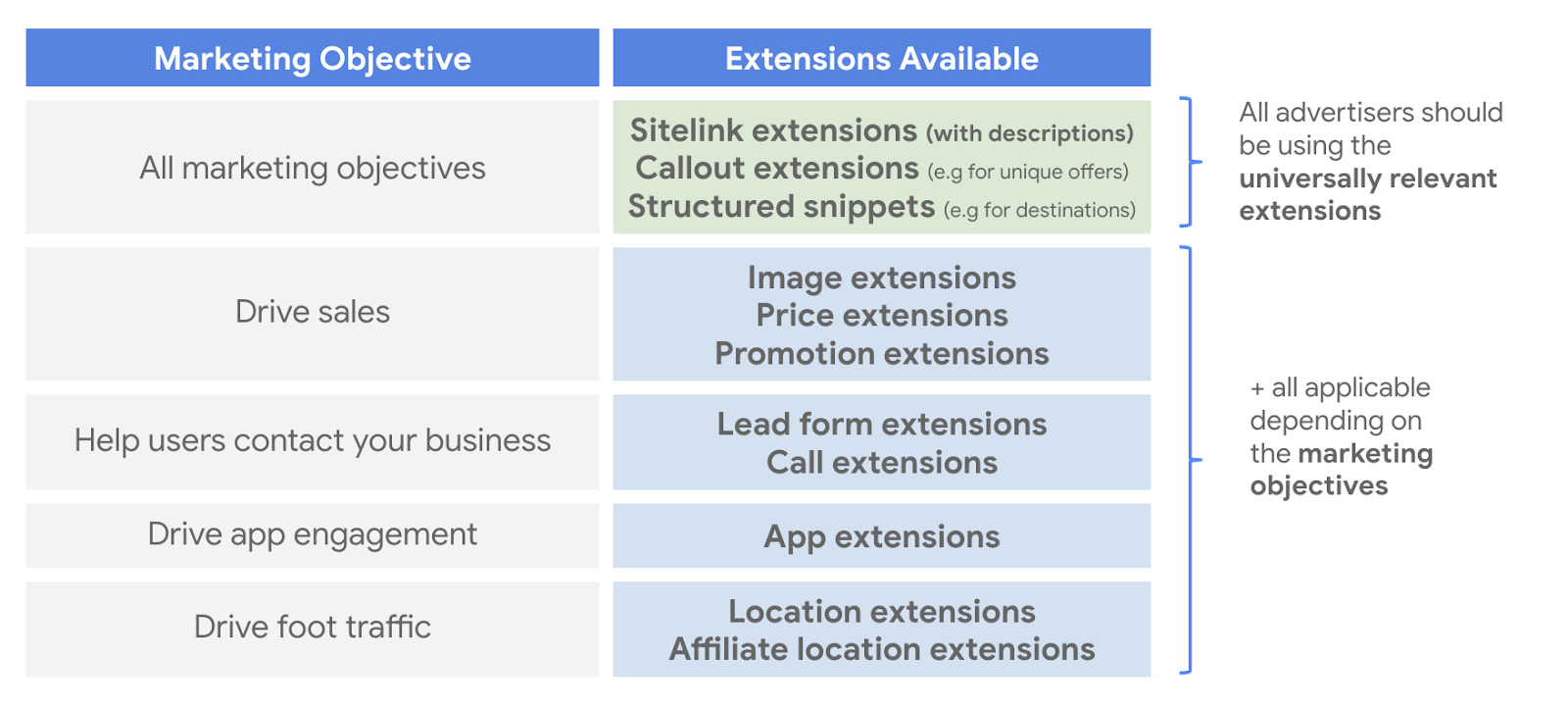
Benefits of Ad Extensions
- Ads that include extensions are more prominent on the search results page, making users more likely to see and engage with them
- Each extension that is enabled increases CTR by 10–15% on average and can also drive other valuable interactions
- Extensions provide more information directly in the ad, so users already know what you offer by the time that they click on your ad
Three-Rule Approach
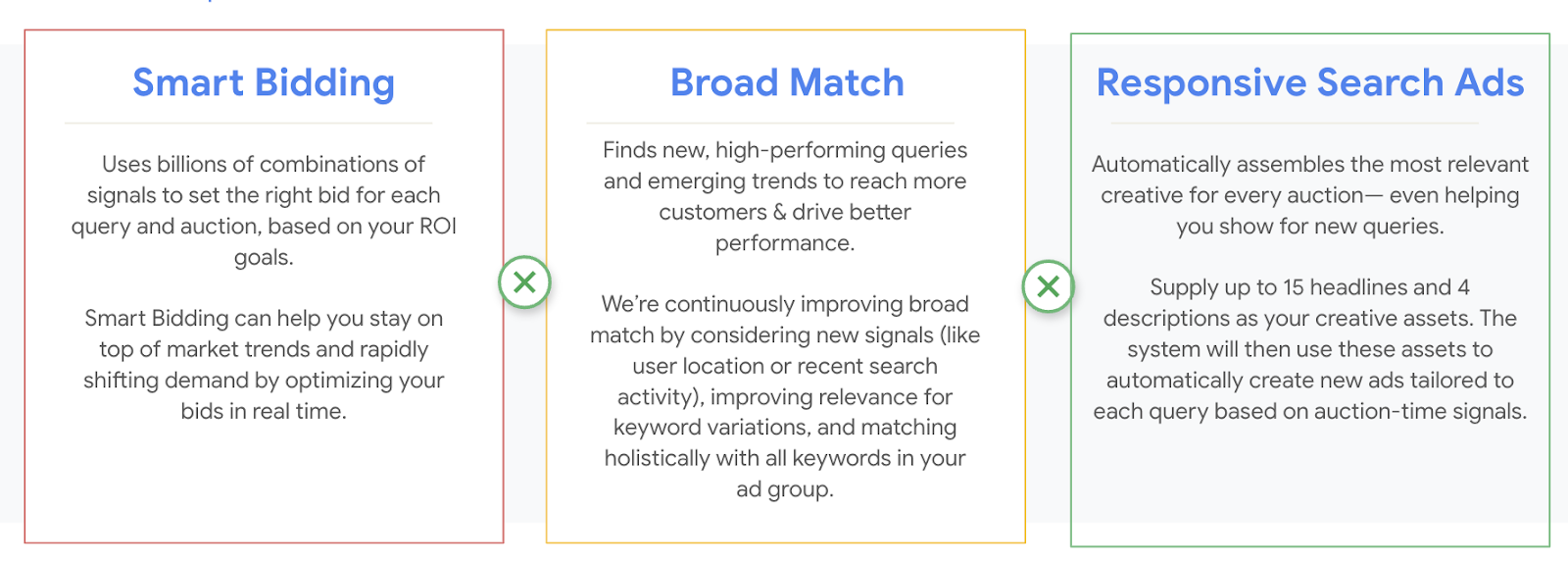
Pair broad match keywords and Smart Bidding with responsive search ads to help you reach new, high-performing queries and optimize your bids in real time. Advertisers that adopt responsive search ads in campaigns that also use broad match and Smart Bidding see an average of 20% more conversions at a similar cost per action.
Google Ads Search Optimisation Effort & Impact Analysis:
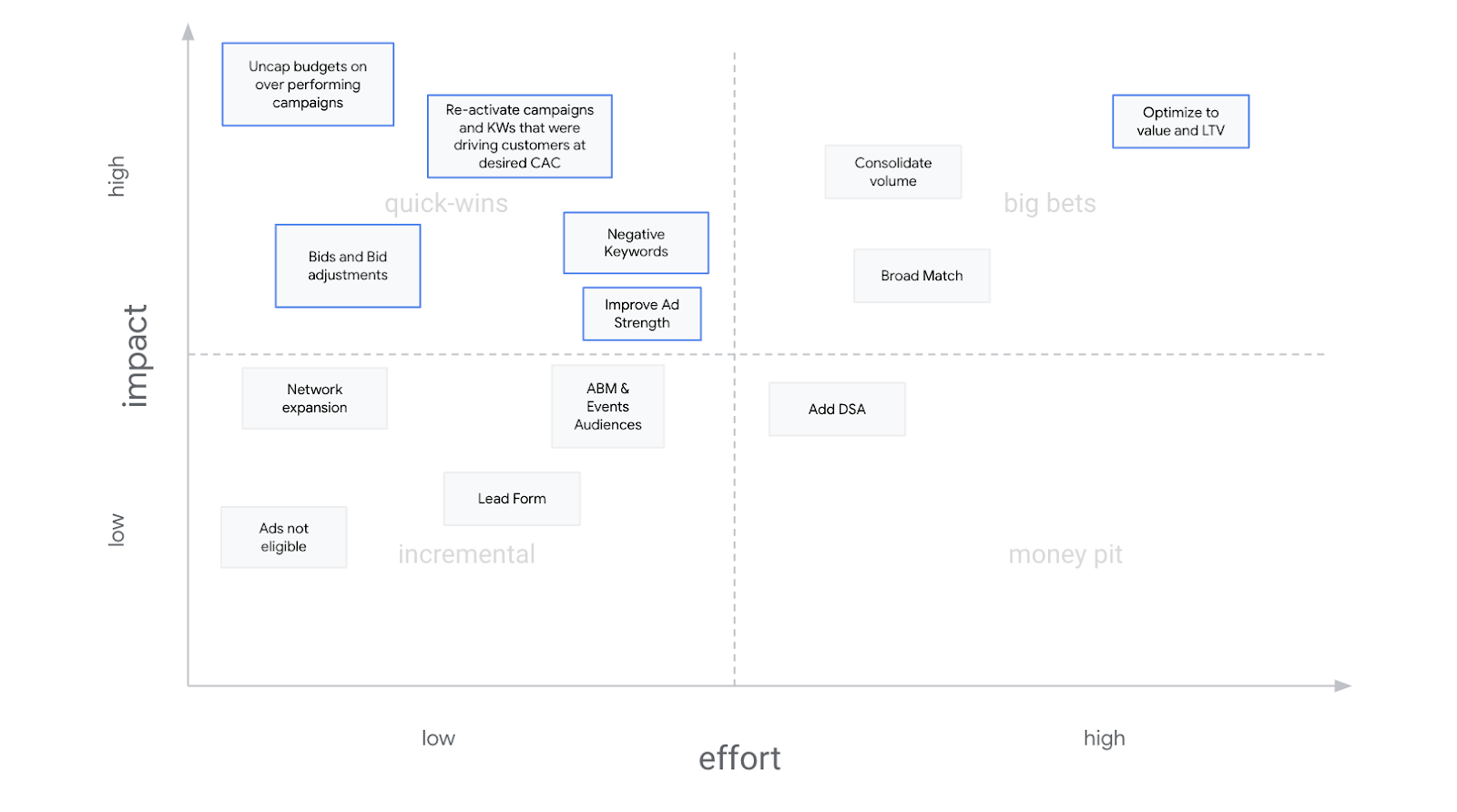
Final Thoughts:
Getting Google Ads campaign structure right is the difference between predictable pipeline and wasted spend. We hope that this article has provided deeper insights into what to include in your Google Ads strategy in 2026.
When to Restructure Your Account
Restructure when your CPA has plateaued for four or more weeks. Restructure when search term reports show more than 30% irrelevant queries. Restructure when campaigns generate fewer than 30 conversions per month. And restructure when you’re running more than 10 fragmented search campaigns.
Don’t restructure mid-learning phase or during Q4 peak season. Plan for Q1, when budgets reset.
We've used this exact three-rule framework to drive results like Plivo's 78% MQL increase with 10% lower CPL (in six months) and Airbase's 6x pipeline growth. The playbook doesn't change by vertical. What changes is how aggressively you consolidate and how quickly you feed the algorithm enough data.
By partnering with a SaaS PPC agency, you can amplify your marketing efforts and achieve remarkable scalability. Compare your options with our breakdown of the top SaaS PPC agencies, or book a free PPC audit to see where your account structure stands today.
Frequently Asked Questions
How Many Campaigns Should a Google Ads Account Have?
There's no magic number. The right count depends on your product lines, budget, and conversion volume. The rule we follow: every campaign should be able to hit 50+ conversions per month. If you're splitting budget across ten campaigns and none of them reach that threshold, consolidate. We've seen SaaS accounts go from 20+ scattered campaigns to five focused ones and double their ROAS.
What's the Best Google Ads Campaign Structure for SaaS?
Start with three campaigns in month one: Brand (15% of budget), Competitor (45%), and High-intent Generic (40%). This structure gives Google's algorithm enough conversion data per campaign to optimize bidding. As you scale past 100+ monthly conversions, you can split into more granular campaigns by product line or funnel stage. Our SaaS PPC guide breaks this down step by step.
Should I Use Single Keyword Ad Groups (SKAGs) in 2026?
SKAGs had their moment, but Google's own recommendation has shifted toward broader, theme-based ad groups. With Smart Bidding and RSAs handling relevance at the auction level, SKAGs fragment your data and starve the algorithm. Consolidate into single-theme ad groups (one ad group per landing page URL) and let broad match plus Smart Bidding do the matching.
How Do I Know if My Campaign Structure is Working?
Track three signals: (1) Are your ad groups hitting 3,000+ impressions per week? (2) Are your campaigns reaching 50+ conversions per month? (3) Is your Quality Score averaging 7 or higher? If any of those are consistently below target, your structure needs consolidation, not more campaigns.
How Much Should a SaaS Company Spend on Google Ads?
We recommend a minimum of $7,500 to $10,000 per month to generate enough conversion data for optimization. The formula: (MQL goal x target CPL) x 1.3 for a learning buffer. If you're spending less, you'll struggle to exit Google's learning phase. If you're scaling beyond $50K per month, a SaaS PPC agency can help you avoid the seven structural mistakes we find in 80% of account audits.

.png)



.webp)









.webp)




.webp)

.webp)
.png)





%20(1).png)


.webp)
.webp)
.webp)




%20Ads%20for%20SaaS%202026_%20Types%2C%20Strategies%20%26%20Best%20Practices%20(1).webp)



.webp)







.webp)



![Creating an Enterprise SaaS Marketing Strategy [Based on Industry Insights and Trends in 2026]](https://cdn.prod.website-files.com/632b673b055f4310bdb8637d/6a218bacea463474377dfd32_34%20-%20Creating%20an%20Enterprise%20SaaS%20Marketing%20Strategy.png)

































.webp)





%20Agencies%20for%20B2B%20SaaS%20Compared%20(2026).webp)

.webp)
%20with%20Hubspot.webp)


_%20Expert%20Reviews%20%26%20Comparisons.png)






.webp)




_%20Comparison%2C%20Strengths%2C%20and%20How%20to%20Choose.png)










.webp)




.webp)



.webp)



















%20Tools%20in%202026_%20Vetted%20List.webp)


![How to Measure AEO Success: 12 Metrics Beyond Clicks [2026 Framework]](https://cdn.prod.website-files.com/632b673b055f4310bdb8637d/6a0d664b326187e99b3d5960_6%20-%20The%20Ultimate%20Guide%20to%20Measuring%20AEO%20Success%20in%202026.png)
![7-Step Workflow for AEO-Ready Content [2026 Framework]](https://cdn.prod.website-files.com/632b673b055f4310bdb8637d/6a0d55ea88913ede1d3a7123_5%20-%20Workflows%20for%20Optimized%20AEO-Ready%20Content%20Creation.png)
.png)
![How to Structure Content for AEO and GEO [With Templates]](https://cdn.prod.website-files.com/632b673b055f4310bdb8637d/6a0c6a56eb700472e635ff33_1%20-%20How%20to%20Structure%20%20Content%20for%20AEO%20and%20GEO%20%20Summaries%20(2026).png)








.png)
.png)













.webp)


%20Agencies%20in%202027.webp)
.webp)
![Top 9 AI SEO Content Generators for 2026 [Ranked & Reviewed]](https://cdn.prod.website-files.com/632b673b055f4310bdb8637d/6a2a3e3105bc1a127aae4e8e_34%20-%20Top%209%20AI%20SEO%20Content%20Generators%20for%202026%20%5BRanked%20%26%20Reviewed%5D.webp)



























.avif)