

.png)


Key Takeaways
- SEO and PPC are different jobs on different timelines, not competing bets. The honest question is the ratio, not either-or.
- AI Overviews now trigger on 82% of B2B tech searches and drop organic CTR by roughly 61% when they appear. SEO is not dead; the definition of winning it has changed.
- B2B SaaS CPCs are up 25% to 40% year-over-year and median cost per SQL now sits between $800 and $2,500. Intent-matched PPC still closes pipeline faster than anything else we run.
- The right SEO-to-PPC mix depends on four things: company stage, ARR, ACV, and sales cycle length. It moves as you grow.
- Brand search defense returns roughly 1,200% ROAS on around 7% of spend. Fund it at every stage, regardless of the wider debate.
- The unlock is integration. Teams that feed PPC data into SEO planning and use SEO rankings to tune PPC creative consistently outperform teams that run the two in silos.
The Question No B2B SaaS CMO Gets to Avoid
"Should we do SEO or PPC?" is the first “bad” question of almost every B2B SaaS budget meeting.
It sounds strategic. It is a dressed-up false binary.
For the teams we onboard, the SEO vs PPC for SaaS debate almost always collapses into a more useful one.
What is the right ratio for the stage we are in, and is it still the right ratio six months from now?
The 2026 answer looks nothing like the 2023 answer. AI Overviews appear on roughly 20% of all searches and 82% of B2B tech queries. Google Ads CPCs are up 25% to 40% year-over-year in most SaaS verticals. Sixty percent of all searches (at least) end with no click at all.
Both channels are harder to run well. Both still work. Which is what makes the ratio question harder than ever.
We have run both sides for 250+ B2B SaaS companies and pushed $150M+ through paid channels alone. Pages we have built now get cited by ChatGPT, Perplexity, and Google AI Mode every second.
None of that makes us vote for one channel over the other. It makes us practitioners of both, and practitioners get asked the same question often enough to have a real frame for answering it.
That frame is what this piece is about. Let's get into it.
SEO vs PPC: The 2026 Search Landscape
Both channels are under pressure in 2026, and the pressure hits them in opposite ways.
SEO is leaking clicks to AI answers and zero-click SERPs. PPC is leaking efficiency to bid inflation and shrinking impression share. Neither channel is broken. Both have stopped behaving the way they did in 2022.
Start with the organic side.
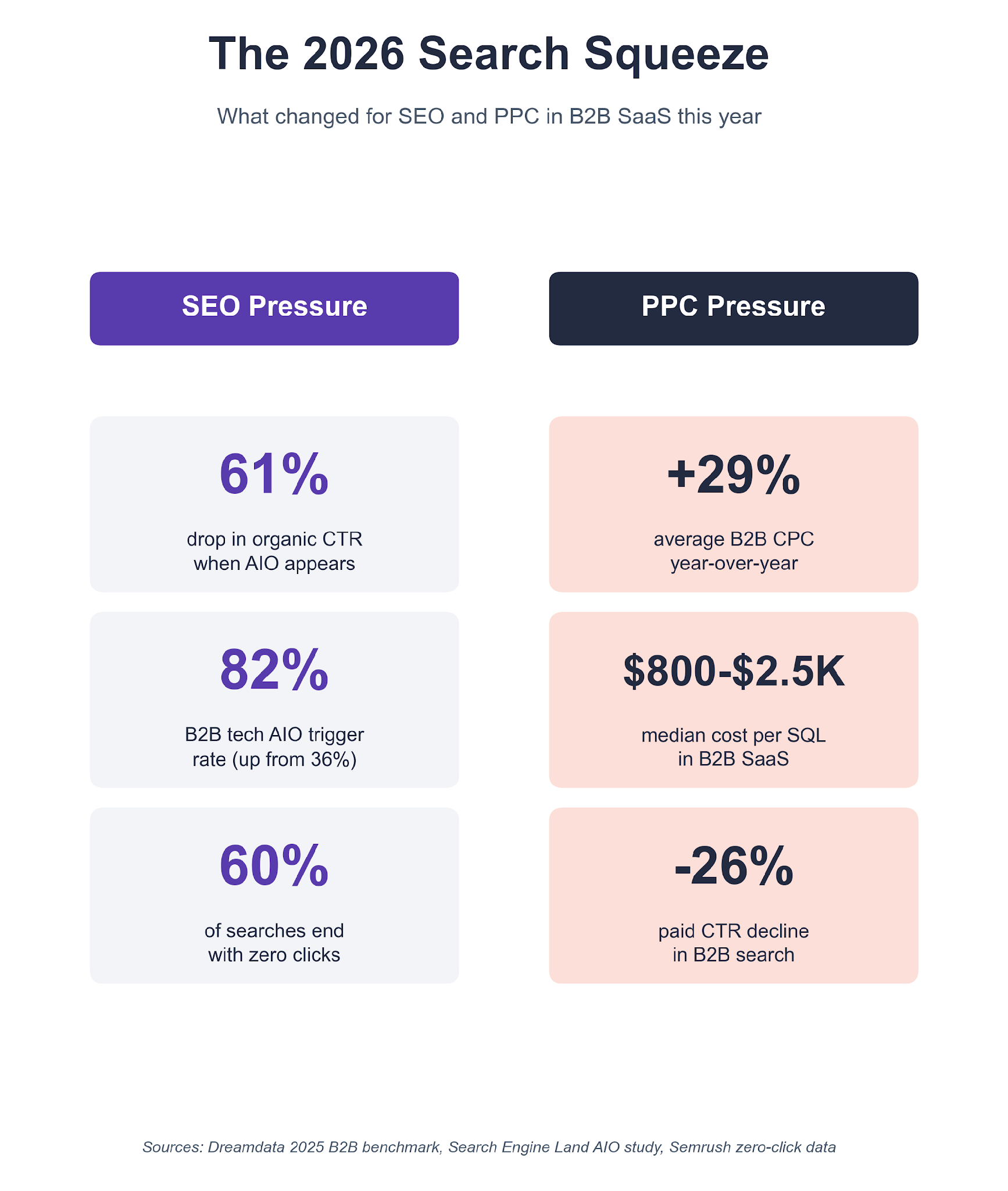
When an AI Overview appears on a result, organic CTR drops from about 1.76% to 0.61%, a 61% decline. For B2B technology specifically, the AIO trigger rate has climbed from 36% to 82% over the last two quarters. The queries the AI is answering first are the exact informational queries most SaaS content engines were built to serve.
Now to paid.
The Dreamdata 2025 B2B benchmark shows average non-branded CPC climbing 29% year-over-year while CTR fell 26%. WebFX puts average B2B SaaS CPC at $5.70, and high-intent keywords like "best CRM for enterprise" now clear $75 to $150 per click. Median cost per SQL sits between $800 and $2,500. The money is still buying pipeline, but the pipeline costs more than the last planning cycle modelled.
What the Citation Data Shows
Tracking AI citation data across the B2B SaaS topics we monitor, one pattern stands out in the last two quarters. ChatGPT, Perplexity, and Google AI Mode increasingly agree on which three to five domains get cited for a given category. The concentration is real, and it is not the same concentration you see on the Google SERP. Domains winning AI citations are frequently not the ones ranking in the top three blue links.
So two old rules are under strain at the same time.
"Rank top three and traffic will come" used to be true. Now the top three on the SERP no longer own the answer box for half the queries that drive SaaS pipeline.
"Put more budget into Google Ads to fix the quarter" used to work. Now the auction moves faster than the budget does.
Neither fact picks a channel for you. Both facts tell you the old answers cannot pick for you anymore.
Which makes the next question unavoidable: what does each channel actually do in 2026?
How SEO Works for B2B SaaS in 2026
SEO in 2026 is no longer just ranking on ten blue links. It is also about earning a seat in the answer layer: the AI Overview, the ChatGPT citation, the Perplexity source card. The work takes 6 to 12 months to compound. The unit cost per lead keeps dropping the longer the engine runs.
A healthy SEO program in 2026 produces three outputs in parallel:
- Bottom-of-funnel blue-link rankings on software comparisons and category searches, which still convert even with lower CTR
- AI citations in answer engines, where buyers increasingly start their research
- And brand visibility on educational terms, which builds the category authority both SEO and PPC piggyback on later
The economics are the part most teams underweight. Semrush's analysis reports B2B SaaS SEO programs averaging 702% ROI over three years with break-even around the seven-month mark. That is an average.
In our portfolio the gap between the top quartile and the bottom is wide. It almost always comes down to one thing: how narrowly the content answers a real operator question.
Inside Our Tracked Pages
Across the SEO programs we run for B2B SaaS, the pages that earn AI citations are doing one thing consistently. They answer a narrow operator question with specific numbers and specific steps, instead of shipping a generic 2,000-word explainer..
What SEO does not do in 2026 is speed.
It cannot save your Q2 pipeline plan, and it cannot narrow audience to the ICP with the precision paid social can. Week-over-week volume predictability is Google Ads territory, full stop.
Case Study: SentinelOne
A global cybersecurity leader needed organic growth to keep pace with an aggressive category expansion. We rebuilt the SEO engine around operator-intent content and a clean technical foundation, generating 250% growth in organic traffic over the engagement. The number the board cared about was not the traffic total. It was that the traffic concentrated on the exact categories the sales team was actively selling into.
Read the full SentinelOne case study
Which lands the SEO-first team in the uncomfortable truth of 2026. You cannot build a compounding organic engine fast enough to hit a quarterly target that is already behind. That is PPC's job.
And PPC has its own 2026 problem to untangle.
How PPC Works for B2B SaaS in 2026
PPC in 2026 buys three things: speed, narrow intent targeting, and tight feedback loops. It costs more than it used to.
Average B2B SaaS CPC now sits at $5.70, with high-intent keywords clearing $75 to $150. And PPC still delivers the only channel that can move pipeline inside a quarter.
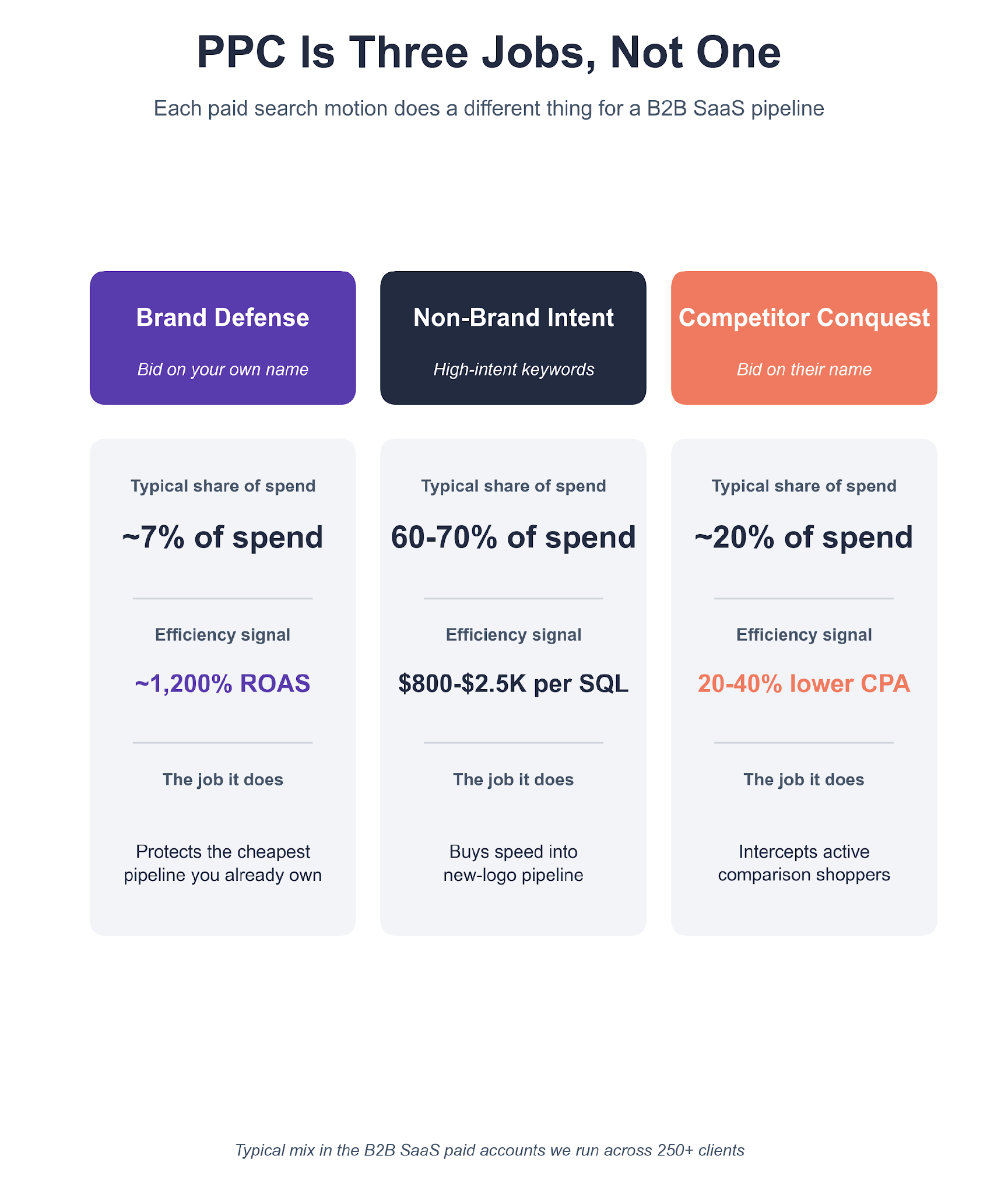
Here is the part most teams miss. Paid search for SaaS is not one campaign. Three distinct motions live under the same budget line, and each is doing a different job for pipeline:
- Brand defense: Bidding on your own name protects the pipeline you already own from competitors who are actively bidding against it. Cheapest, highest-ROAS slice of any B2B SaaS account we run.
- Non-brand intent: High-intent commercial queries (software comparisons, solution-category searches, problem-aware queries) hold most of the spend. This slice buys new-logo pipeline at the market-clearing CAC.
- Competitor conquest: Bidding on competitor names intercepts buyers who are mid-comparison. Competitor-intent keywords convert at 10% to 20% form-to-SQL, at 20% to 40% lower cost per SQL than generic non-brand.
Each motion has a different economic profile. Lumping them into one blended number is how accounts end up optically profitable and structurally sick.
The 10x Brand-vs-Non-Brand Gap
Looking at one expense-management SaaS account we manage, the 90-day cost-per-click gap between brand and non-brand sits at roughly 10x. Brand keywords cleared at a $7 blended CPC while the core non-brand business-keyword clusters cleared between $58 and $103.
Brand campaigns in the B2B SaaS accounts we run regularly clear 1,200% ROAS on around 7% of spend. Dropping them to "save money" is the single most common failure mode in the first audits we run. The team saves 7% of the budget and loses a much larger slice of pipeline to the competitor bidders waiting in the wings.
Performance Max is the other 2026 conversation most accounts are getting wrong. PMax works in B2B SaaS only after Search is stable, offline conversions are feeding at least 30 signals a month, and the Customer Match list has 100+ users.
Without those conditions, PMax optimises for the cheapest form fills, which in B2B SaaS means the worst leads your CRM will ever see.
Case Study: Airbase
A spend management platform came to us needing paid search to scale new-logo pipeline without breaking CAC. We rebuilt the account structure around intent tiers, then layered brand defense with non-brand and competitor motions. The program boosted Airbase's pipeline by 6x over the engagement. The first 60 days were structure and tracking. Most of the 6x compounded after the structure was right.
Read the full Airbase case study
PPC gives you speed. SEO gives you compound. Framed that way, the either-or debate collapses. What remains is the real question: how do the two compare on the dimensions that show up in actual budget meetings?
SEO vs PPC: Six Dimensions That Shape the Split
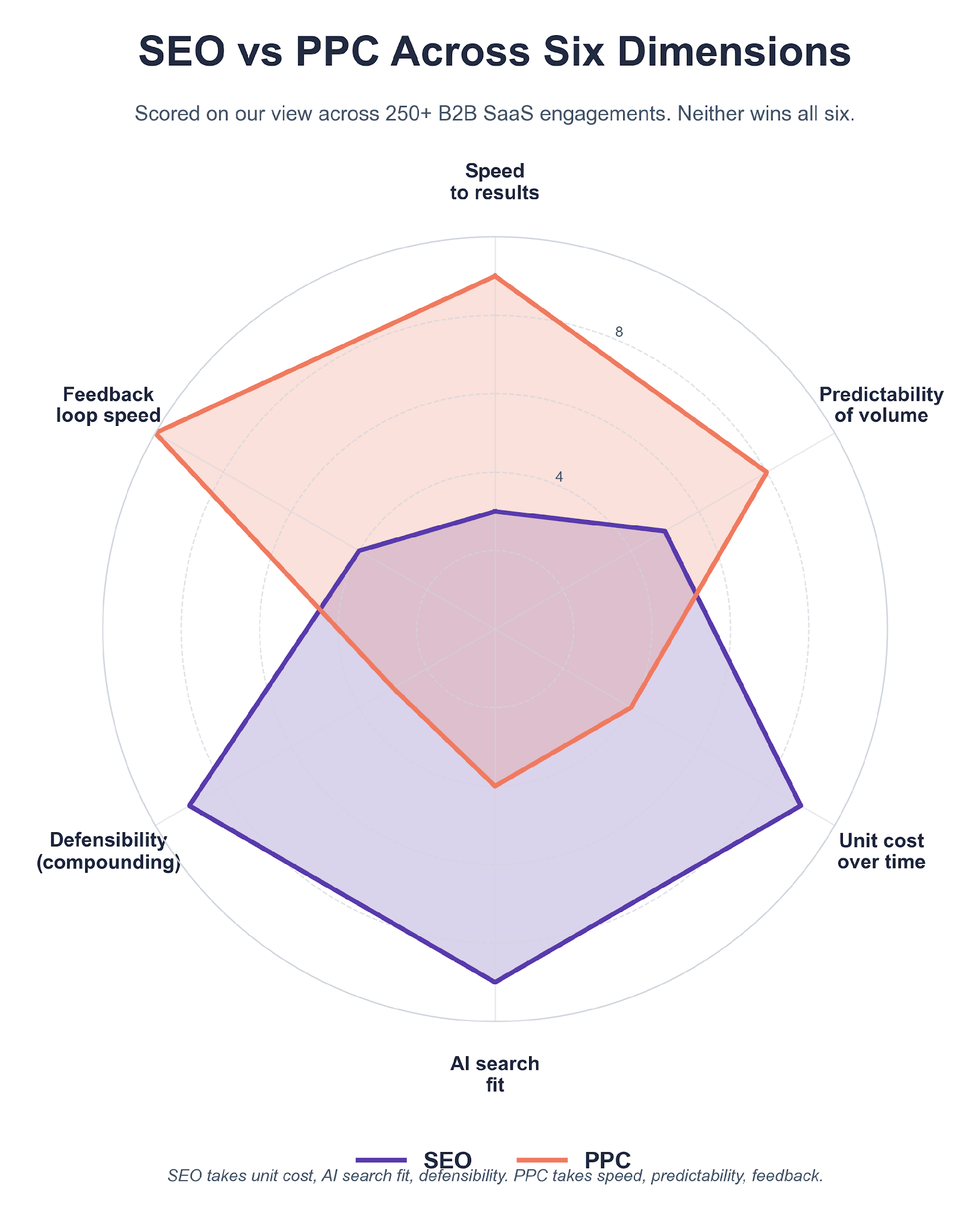
Neither channel wins all six. SEO wins on unit cost over time, AI search fit, and defensibility. PPC wins on speed to results, predictability of volume, and feedback loop speed. That distribution is what the right mix should be reasoned from, not a single headline metric.
Start with where SEO leads.
Unit cost per lead drops as the engine scales, because the cost is largely fixed to the team running it, rarely variable with every click. AI search fit has become a real SEO advantage. Brands cited in AI Overviews see 35% more organic clicks and 91% more paid clicks than uncited brands. Defensibility is the one that compounds quietly over years. A ranked, cited page keeps earning long after the last edit.
Now look at where PPC leads.
Speed is obvious, a new campaign can deliver pipeline inside 30 days. Predictability of volume is less obvious but more valuable to the CFO. PPC gives you a dial you can turn up or down to hold the quarter. Feedback loop speed is the underrated one. A paid search account tells you which messages, which keywords, and which landing pages are closing inside a week. No SEO program can offer that velocity of learning.
The dimensions that look like ties are the ones to audit carefully. Predictability looks tied on paper, but in practice it is PPC's territory, because organic rankings can disappear in a single algorithm update or AIO rollout. Unit cost looks like PPC's weak spot. A well-run brand and competitor motion can clear unit economics most SEO pages will not touch in year one.
The Failure Pattern We See Most Often
Over-indexing on the channel leadership is most comfortable with. An ex-agency founder builds a team that is 80% PPC and starves the content engine. An ex-content marketer builds a team that is 80% SEO and gets blindsided by a missed quarter. The CMOs who beat plan keep both dials live, and re-weight them every quarter as the category and the company change.
The six dimensions give you the shape of the trade-off. They do not give you the split. That one depends on where your company actually is in its lifecycle, which is the single question no benchmark report can answer for you.
How to Decide the Right SEO-to-PPC Mix for Your Stage
The right split depends on four things: company stage, ARR, ACV, and sales cycle length.
- Early-stage B2B SaaS under $3M ARR usually needs to buy speed first
- Growth-stage SaaS between $5M and $25M ARR typically balances the two
- Scale-stage SaaS above $25M with complex buying committees tilts back toward organic and GEO as the dominant engine
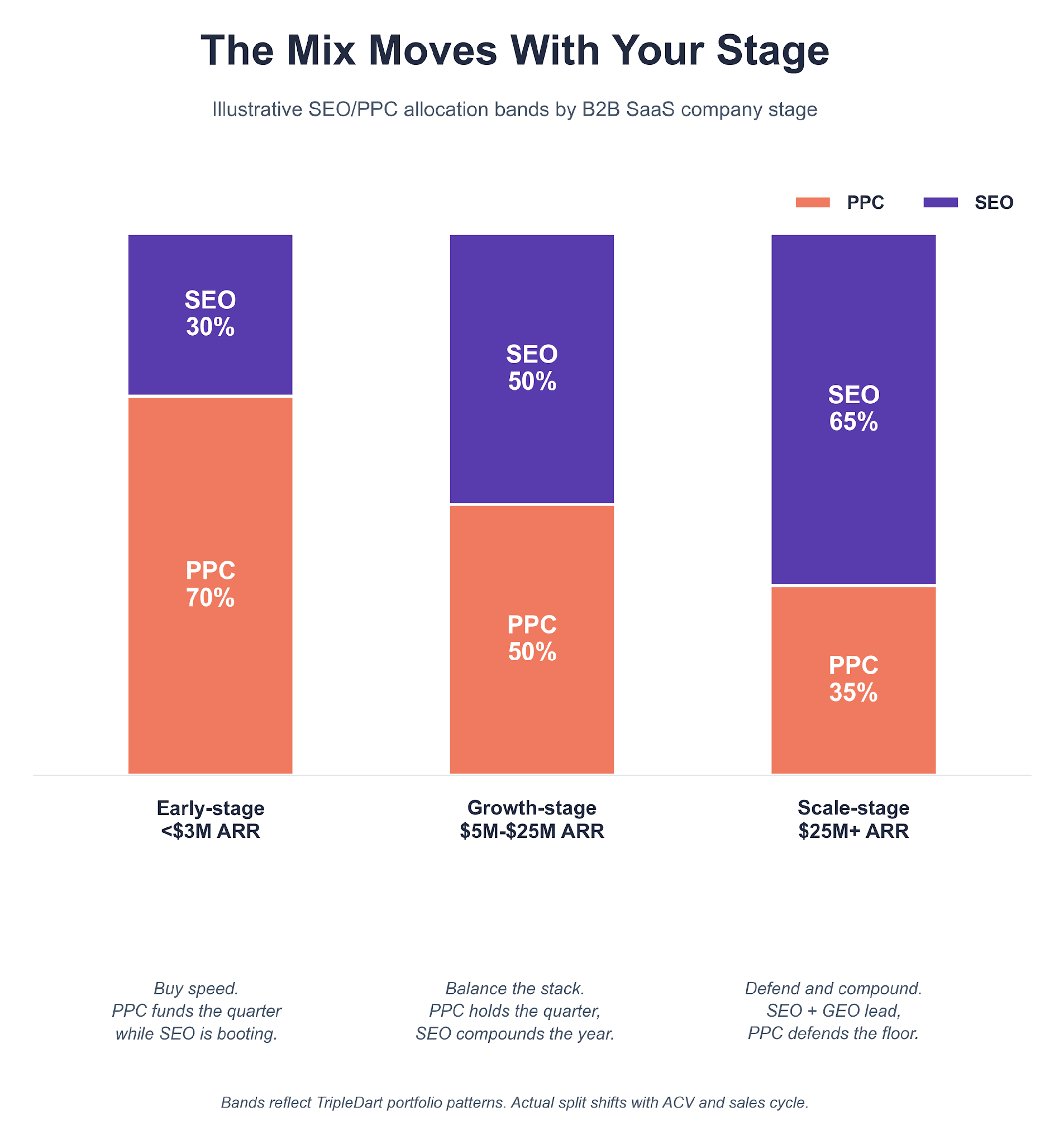
The chart shows the allocation shape. The table below adds the questions we walk every client through to land on the right band for their business:
Three calibration rules apply at every stage, regardless of which band you land in:
First, fund brand defense at every stage, regardless of split. The ROAS is hard to beat, and leaving your brand undefended is how competitor bidders fund their growth on your back. HubSpot's paid search alignment research arrives at the same conclusion from a different angle.
Second, let the sales cycle length guide PPC aggressiveness, not just the ARR number. A $10M ARR company with a 14-day cycle gets faster paid feedback than a $25M ARR company with a 120-day cycle. The feedback loop is what turns PPC spend into compound learning. Shorter cycle, more PPC early.
Third, pick your SEO entry point based on ACV, not traffic potential. A company with a $30K ACV cannot afford to chase a high-volume top-of-funnel keyword for 12 months. A company with a $300K ACV can, because even five closes a year justify the investment. Our 2026 SaaS inbound benchmarks break this down by vertical for teams building the case internally.
The split is not a one-time decision. It moves every two to three quarters as your company, your category, and the 2026 search landscape keep evolving. What does not move is the discipline of running both sides well enough to let the other one compound.
Bringing Both Engines Under One Roof
The SEO vs PPC for SaaS conversation is a recurring allocation decision, gated on stage, ACV, and cycle, with a wider context that keeps shifting under AI Overviews, CPC inflation, and new buyer behavior.
Get the six dimensions right, pick the stage-based band that fits, and revisit every quarter. That is the frame.
We run both sides for B2B SaaS companies every day.
Our SaaS SEO services and SaaS PPC services work as one engine. Our GEO services sit on top, so the organic content you invest in compounds in AI search as well.
If the question on your whiteboard is "SEO or PPC, and how much of each," we can help. The answer comes from your economics, not a category benchmark.
Book a strategy call and we will spend the first 30 minutes on your specific mix.
Frequently Asked Questions
What is the typical ROI of SEO vs PPC for a B2B SaaS company?
B2B SaaS SEO programs average roughly 702% ROI over a three-year window with seven-month break-even, per Semrush and Ahrefs research. PPC ROI depends on the motion. Brand defense can clear 1,200% ROAS on around 7% of spend. Non-brand typically runs at a 3x to 5x ROAS with a 4 to 12 month CAC payback. PPC cash flows faster; SEO compounds harder.
How long until SEO starts delivering for a SaaS company?
Plan for four to twelve months before SEO produces meaningful pipeline contribution, depending on domain authority, content quality, and the competitiveness of your category. Our experience across Series B SaaS programs puts the first compounding inflection somewhere between month six and month nine. If you need pipeline inside 90 days, you need paid, not organic.
Can a SaaS company grow on PPC alone in 2026?
In short bursts, yes. Structurally, no. CPCs in B2B SaaS are inflating 25% to 40% a year, and without organic brand equity pulling paid CAC down over time, unit economics deteriorate fast. The B2B SaaS companies we see scaling profitably past $25M ARR all run both channels, even if the mix leans heavily paid in the earlier stages.
How should we allocate budget between SEO and PPC at Series A?
For most Series A SaaS companies under $3M ARR, the paid-plus-content budget typically tilts 60% to 70% into PPC, heavy on brand and non-brand intent. The remaining 30% to 40% funds the SEO and content foundation. The goal is to let PPC fund the quarter while the organic engine boots toward its first compounding. Revisit the split at $5M ARR.
Does AI search kill the case for SEO?
No. It changes what you are optimising for. Search Engine Land's AI Overviews research (cited above) shows brands mentioned in AI Overviews get 35% more organic clicks and 91% more paid clicks than uncited brands. SEO in 2026 is the discipline of earning citations in AI answers alongside classic blue-link rankings. The underlying work (topical authority, clean technical foundations, structured content) is more valuable than ever.
Should we still run branded PPC if we already rank #1 organically?
Yes. Brand defense is the cheapest, highest-ROAS paid motion for nearly every B2B SaaS account we audit. Ahrefs's SEO vs PPC research backs the same conclusion. Competitors bid on your brand name whether you run the campaign or not. The pipeline they convert on your organic intent costs more than the brand clicks ever would.
How do CPL and close rates compare between SEO-sourced leads and PPC-sourced leads?
Close rates vary by SaaS category, but the pattern we see in our accounts is consistent. SEO-sourced leads tend to have longer cycles and higher close rates because they self-educated on the way in. PPC-sourced leads close faster with lower overall close rates because the intent is compressed. HubSpot's 2025 CPL and CAC benchmarks put paid search CPL roughly in line with SEO-sourced CPL on a multi-year view. The speed of the paid path is why it keeps winning CFO approval.
What is the one mistake SaaS teams make most often when deciding between SEO and PPC?
Picking one based on the marketing leader's personal comfort zone instead of the company's stage and economics. The second most common mistake is starving brand defense PPC to fund something else. Brand campaigns look boring on the reporting dashboard, and they return the highest ROAS in the entire account. Cutting them is usually the first sign that the attribution model is reading the wrong signal.
.webp)


.webp)
.webp)

.webp)




.webp)



.webp)

.webp)


%20(1).png)


.webp)
.webp)
.webp)



%20Ads%20for%20SaaS%202026_%20Types%2C%20Strategies%20%26%20Best%20Practices%20(1).webp)





.png)


.png)




.webp)


![Creating an Enterprise SaaS Marketing Strategy [Based on Industry Insights and Trends in 2026]](https://cdn.prod.website-files.com/632b673b055f4310bdb8637d/6965f37b67d3956f981e65fe_66a22273de11b68303bdd3c7_Creating%2520an%2520Enterprise%2520SaaS%2520Marketing%2520Strategy%2520%255BBased%2520on%2520Industry%2520Insights%2520and%2520Trends%2520in%25202023%255D.png)



.png)




















.png)

.png)
.png)
.png)
.png)
.png)









.webp)
.webp)
.png)
.png)





.png)
















.webp)
.png)

.png)







.png)

.png)



%2520Agencies%2520(2025).png)

![Top 9 AI SEO Content Generators for 2026 [Ranked & Reviewed]](https://cdn.prod.website-files.com/632b673b055f4310bdb8637d/6858e2c2d1f91a0c0a48811a_ai%20seo%20content%20generator.webp)
.webp)
.webp)






.webp)













.avif)