

.png)

Key Takeaways
- strongest examples pick one, the weakest try to do all four at once.
- Hook ads win the first three seconds through a clear product statement (HubSpot), a relatable user prompt (Anthropic), a satirical frame (Fiverr), or mobile-native pacing (Canva).
- Connection ads build trust above the product through brand philosophy (Linear), emotional storytelling (monday.com), concept-led creative (Miro), and celebrity comedy (Rippling).
- Authority ads close the trust gap with proof, customer testimonials (Zoom featuring HubSpot), celebrity endorsement (Salesforce with McConaughey), founder credibility (Rahul Vohra), and long-form case studies (Atlas HXM).
- Conversion ads turn attention into pipeline through a specific feature reveal (Notion 3.0 Agents), a product-led demo (Slate), or a direct services pitch (TripleDart Extended Growth Team).
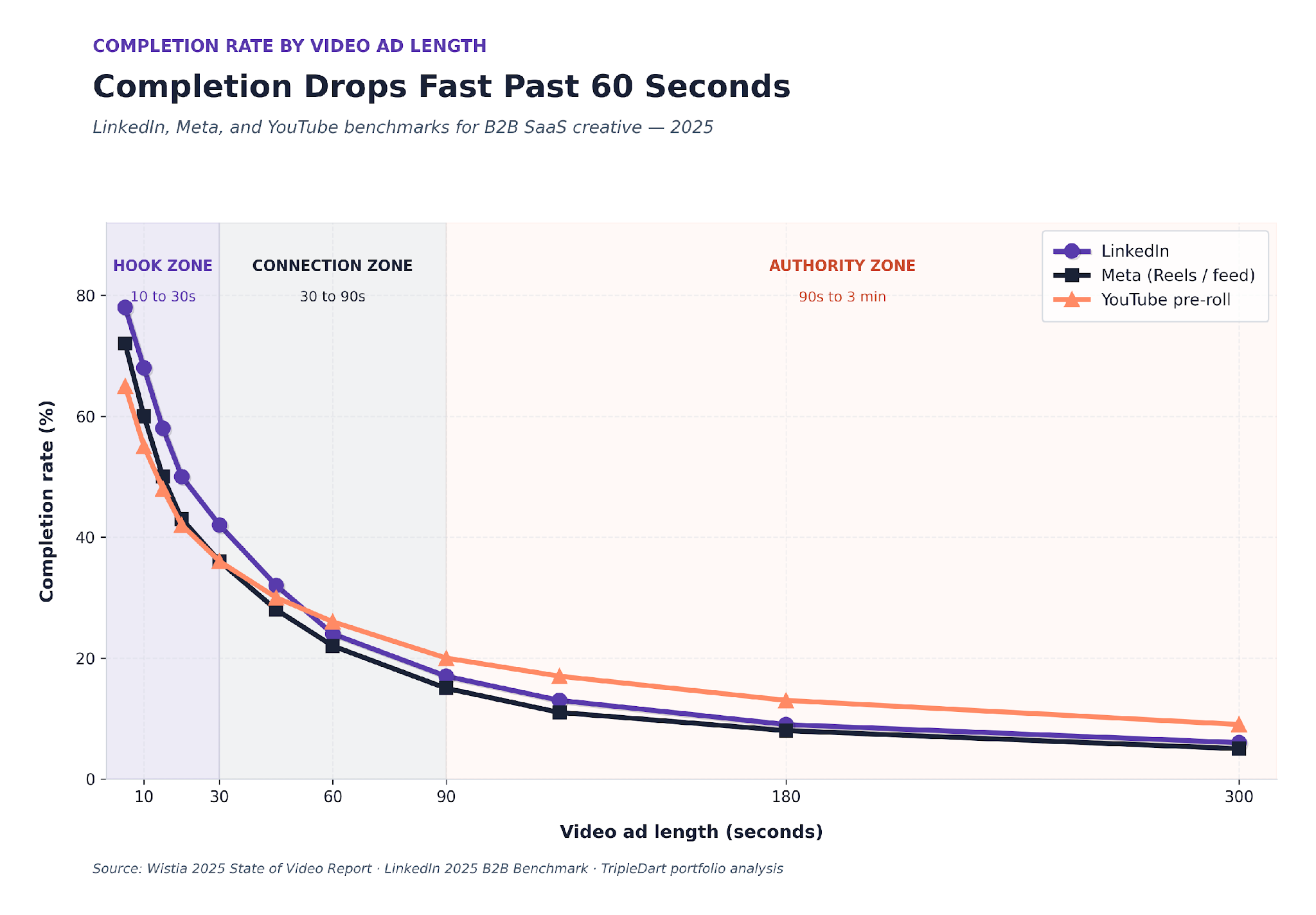
- Short-form vertical under 30 seconds hits a 35 to 45 percent completion rate on LinkedIn. Videos past 60 seconds drop below 20 percent. The length of the ad has to match the job the ad is doing.
Seventy-one percent of B2B video ads generate zero engagement, while creative that lands delivers six to seven times the ROI of the median.
That gap is the whole story of effective video ads for SaaS PPC in 2026.
Most B2B creative is produced the way landing pages are produced, feature-led, linear, templated. The ad gets skipped in 1 second on LinkedIn or scrolled past on Reels before the hook even registers.
The problem is rarely production value. It is job clarity.
A single ad cannot introduce the brand, prove credibility, demonstrate the product, and ask for the meeting in thirty seconds. When a SaaS team tries to cram all four jobs into one cut, the ad becomes forgettable in all four dimensions.
The fifteen ads below each do one job cleanly.
Some are 22-second Shorts. Some are founder-on-camera interviews that function the way modern founder-led ads do.
What they share is a specific creative decision about which layer of the funnel they serve.
This guide walks through those four layers, the fifteen examples inside them, and the patterns you can borrow for the next creative roster you brief.
The Hook Layer: 4 SaaS Video Ads That Win the First Three Seconds
The hook layer exists to stop the scroll. Hook ads run cold on LinkedIn feeds, YouTube pre-roll, Meta placements, and Shorts, and the job is narrow, earn the next two seconds of attention.
Wistia's 2025 video benchmark puts the average engagement rate for sub-60-second videos at 50 percent, roughly 10 points higher than anything over a minute. The four ads below show four different ways to spend those opening seconds.
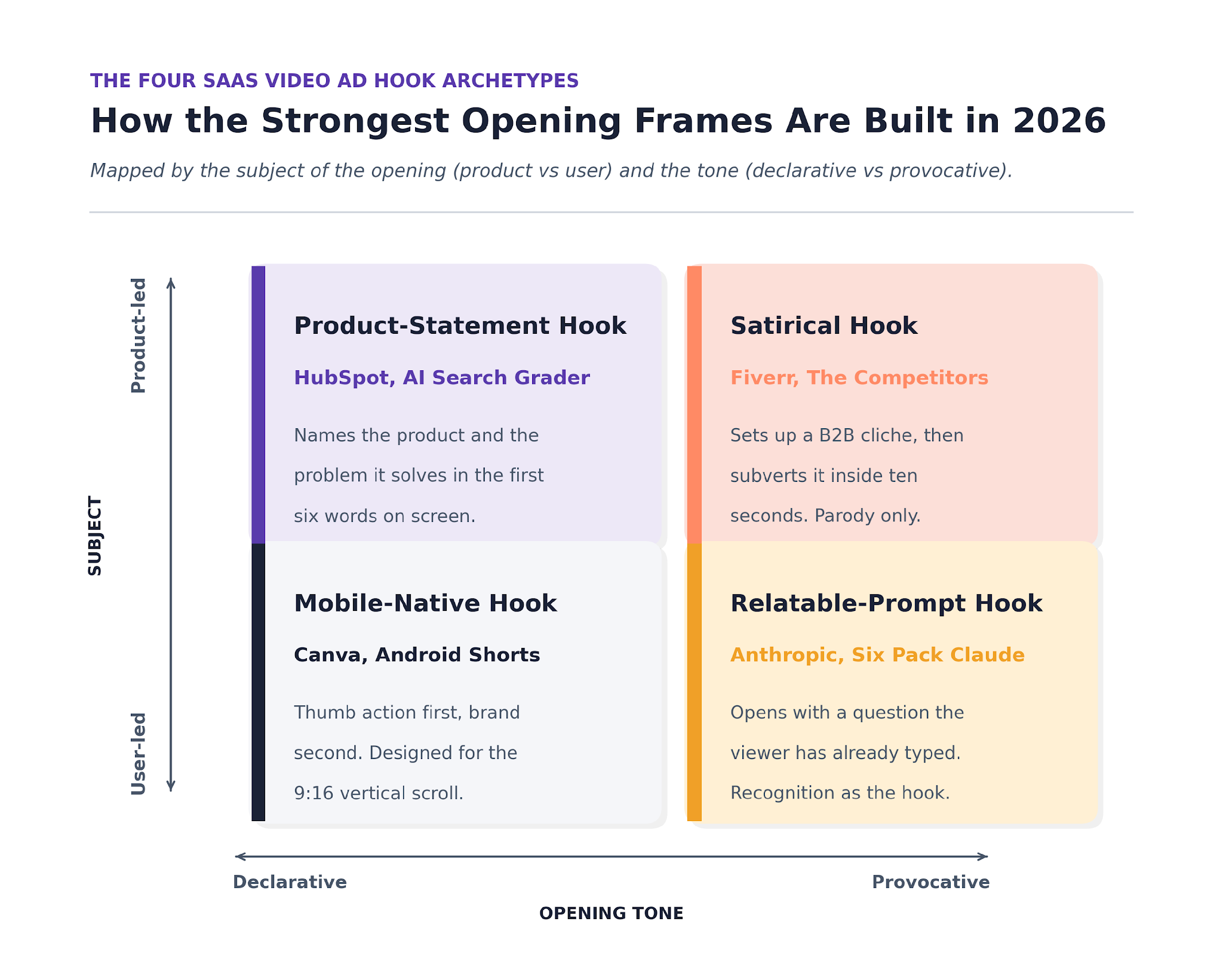
1. HubSpot, Introducing AI Search Grader (Product-Statement Hook)
HubSpot opens this Breeze AI launch ad with the product name and the problem it solves in the first six words on screen. The hook is declarative and category-defining, which is the pattern the HubSpot brand team has been sharpening since the Breeze AI suite rolled out.
What to borrow: if your product solves a new category problem (AI citation visibility, agent evaluation, vibe-coding security), lead with the category itself. The declarative hook works best when the viewer has the problem already but does not yet have a name for it.
Watch the video here:
https://www.youtube.com/watch?v=T_DEcr4MXrM
2. Anthropic, Can I Get a Six Pack Quickly? (Relatable-Prompt Hook)
Anthropic opens this Claude consumer ad with a version of a question most people have typed into an AI model at some point. The hook is the prompt itself. Viewers recognise the behaviour before the brand is named, and the recognition buys the next ten seconds.
What to borrow: when your product plays inside a workflow the viewer already runs (Slack messages, ad copy, customer tickets), lead with a prompt or sentence the viewer has already written. Recognition beats exposition on a cold feed.
Watch the video here:
https://www.youtube.com/watch?v=kQRu7DdTTVA
3. Fiverr, The Competitors (Satirical Hook)
Fiverr's The Competitors opens on a business-school tableau that reads as generic corporate competence, then punctures it within seconds. The hook is the setup-and-subversion rhythm that sitcoms use, and it lands because the first frame looks like every other B2B ad before revealing that it is not.
What to borrow: if your category is crowded with earnest brand films, a parodic hook cuts through. The rule is that the parody has to land inside ten seconds. A satire that needs thirty seconds of context to read as satire reads as a bad ad instead.
Watch the video here:
https://www.youtube.com/watch?v=AzRYJRmuMWg
4. Canva, Android Photo Editing (Mobile-Native Hook)
Canva's vertical Shorts ad runs in the format where most SaaS video consumption now happens. The hook is a single finger action on a phone, edit this photo, watch the output. The product is the hook itself, stripped of intro frames, logo cards, and voiceover setup.
What to borrow: short-form vertical is the format, not an afterthought. On LinkedIn, Reels, and YouTube Shorts, sub-30-second creative completes at roughly twice the rate of longer cuts, according to LinkedIn's 2025 B2B benchmark. Design the ad for the thumb, not the monitor.
Watch the video here:
https://www.youtube.com/shorts/wdFXby-As-o
What Hook Creative Is Doing in 2026
Across the paid accounts we manage, the creative pattern that consistently beats control on LinkedIn and Meta is a declarative or prompt-led hook filmed in under 15 seconds, with captions baked in, running on a sub-20 dollar cost per click. Polished brand films still have a role. They just do not belong at the top of the funnel.
The Connection Layer: 4 Brand Films That Build Trust Before the Sell
Connection ads are longer, more produced, and structurally different from hook ads. Their job is to build the emotional scaffolding that makes the later conversion ad feel trustworthy instead of transactional. Wyzowl's 2025 data shows 87 percent of businesses say video influences sales directly, and connection ads are where that influence gets built.
5. Linear, In Software You're Building Sandcastles (Brand Philosophy)
Linear's Sandcastles brand film argues that software ages, gets rewritten, gets abandoned. The ad is philosophical, not promotional, and it positions Linear as a tool worth building with because the craft of software is worth taking seriously. Product never appears on screen.
What to borrow: when your ICP is developers, designers, or anyone who makes for a living, a philosophy ad earns more trust than a feature ad. The signal is, we understand the craft you take seriously.
Watch the video here:
https://www.youtube.com/watch?v=WLlAqA0_vLs
6. monday.com, Give Your Team a Platform They'll Love (Emotional Brand Film)
monday.com's platform-love ad treats a productivity tool as an object of affection rather than utility. The through-line is the team, not the software. The ad was produced entirely inside monday's in-house creative department, signalling how seriously the brand is taking emotional territory in a category that had been almost entirely rational.
What to borrow: in commodity SaaS categories (work management, CRM, messaging), the rational benefit argument is saturated. Emotional positioning is the remaining moat. Shoot the people using the product, not the interface.
Watch the video here:
https://www.youtube.com/watch?v=fAj9MVkPDas
7. Miro, Monster Problem? Solve Anything, Together (Concept-Led Creative)
Miro's Monster Problem ad anchors the visual metaphor that "hard problems" are literal monsters. The team in the ad defeats the monster by collaborating on a Miro board. The concept is specific enough to rerun for 18 months across campaign variants, which is the creative longevity SaaS teams need to offset the production cost of concept films.
What to borrow: invest in a visual metaphor that can carry an entire campaign system, not a single ad. A concept that survives three creative refreshes is worth three times what a one-off spot is worth.
Watch the video here:
https://www.youtube.com/watch?v=shy3tqvHb4g
8. Rippling, The Mastermind ft. Tim Robinson (Celebrity Comedy)
Rippling's Big Game 2026 commercial with Tim Robinson runs in the deadpan-awkward register Robinson is known for. Rippling is not the first SaaS brand to spend on the Big Game, but the creative choice is instructive, pick a comedian whose register aligns with the brand's voice, not a generic celebrity endorsement.
What to borrow: celebrity ads only work when the celebrity's natural voice pulls in the same direction as the brand. A finance-adjacent platform hiring a dry, awkward comedian communicates "we do not take ourselves too seriously," which is exactly what an HR-and-payroll buyer wants to feel.
Watch the video here:
https://www.youtube.com/watch?v=YuKZwEwbuP0
The Authority Layer: 4 Proof-Driven Ads That Close the Trust Gap
Authority ads answer the viewer's unspoken "prove it" question. They are typically mid-funnel, run after the hook and connection work has put the brand on the consideration list, and they use specific proof, customer names, outcomes, founder credibility, to close the trust gap.
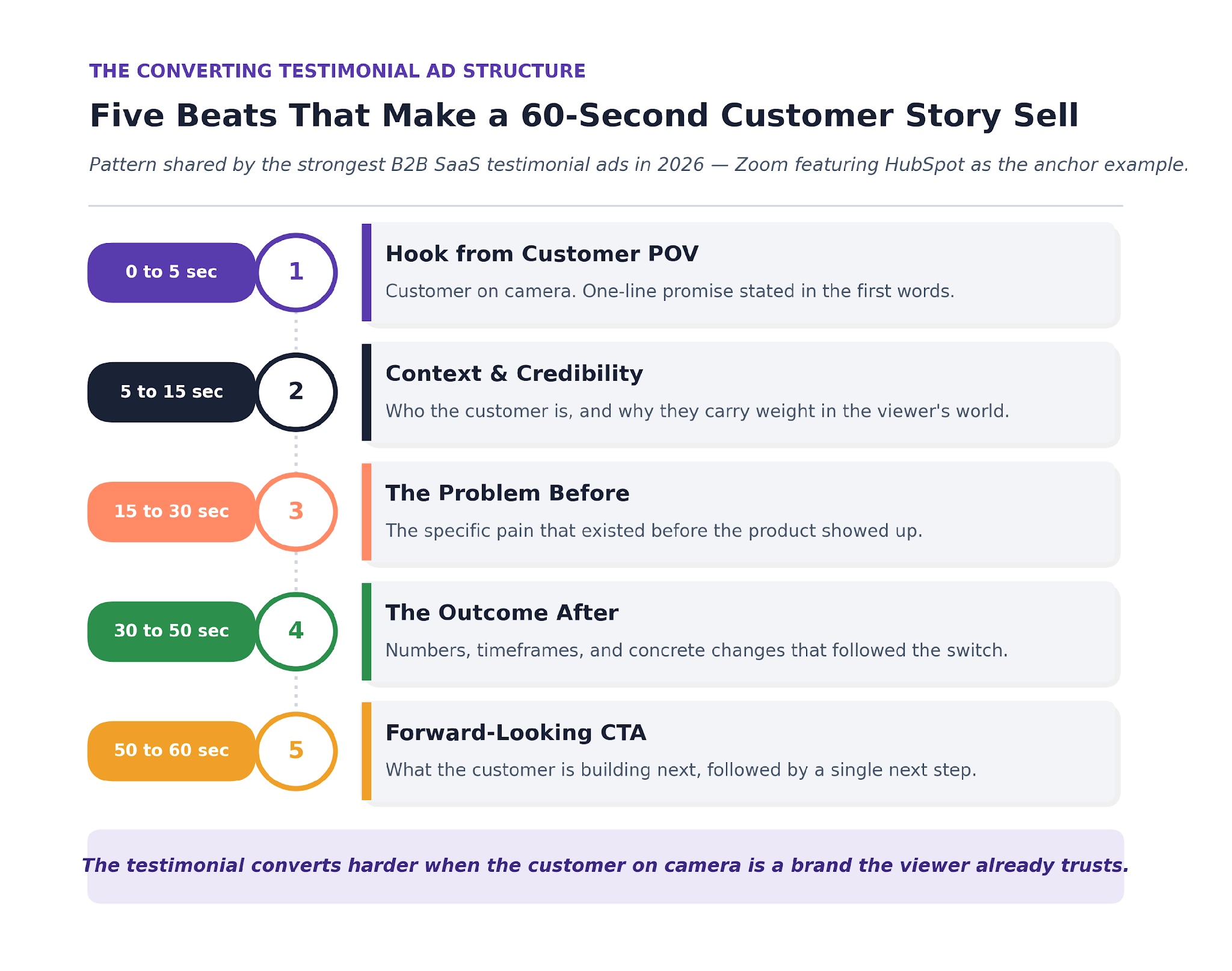
9. Zoom, HubSpot Customer Testimonial (Customer Proof)
Zoom uses HubSpot on camera as a customer in this cut. The structure follows the five-beat testimonial formula, hook from the customer's POV, context on the business, the problem before Zoom, the outcome after, and the forward-looking CTA. HubSpot is the customer, which makes the proof load heavier because HubSpot is itself a credible SaaS operator.
What to borrow: when possible, recruit a customer who is themselves a respected brand in your buyer's world. A CMO at a random mid-market SaaS is a fine testimonial. A CMO at a brand the buyer already trusts is a ten times stronger testimonial, because the endorsement travels.
Watch the video here:
https://www.youtube.com/watch?v=ppawFI1u6Po
10. Salesforce, The New Frontier ft. Matthew McConaughey (Celebrity Endorsement)
Salesforce's New Frontier #TeamEarth spot is the campaign Salesforce has sustained across multiple Super Bowls, expanding into the Agentforce Dining Al Fiasco cut in 2025. McConaughey is paid more than 10 million dollars annually per Fortune's reporting, which tells you the category and budget bar celebrity SaaS endorsement now sits at.
What to borrow: most SaaS brands are not running Super Bowl budgets. The takeaway is still directional, celebrity endorsement transfers authority only when the celebrity has credibility in the buyer's mental world. McConaughey reads as earnest and slightly contrarian, which is exactly how Salesforce wants Agentforce to read.
Watch the video here:
https://www.youtube.com/watch?v=vNYf6b9Yg9Y
11. Superhuman, How Rahul Vohra Built an $825M Email Revolution (Founder Credibility)
Superhuman's founder Rahul Vohra appears in this EO interview telling the origin story of the product, the pricing model, and the scaling decisions. The format is technically a podcast interview, not a paid ad, and it works the way modern founder-led paid creative is designed to work, unpolished, specific, and conversational.
What to borrow: founder-led content does not require a studio budget. A founder on camera, articulating the specific insight that made them build the product, is the most repeatable authority format available to early-stage SaaS. Cut the interview into six 45-second LinkedIn posts and run them as paid creative.
Watch the video here:
https://www.youtube.com/watch?v=5d8tOtdcN2Q
12. TripleDart, How Atlas HXM Built a High-Converting Marketing Engine (Long-Form Case Study)
Our own Atlas HXM case study video is a quick customer success story cut as paid creative, not an organic keynote clip. It follows a documentary structure, the customer's problem, the engagement, the specific plays we ran, and the outcomes.
It runs to warm audiences who already saw the hook and connection layers, and the completion rate on those audiences stays above 50 percent.
What to borrow: customer stories belong in warm retargeting, after the hook and connection layers have qualified the viewer, never at the top of the funnel. When the audience is already considering, long-form case studies convert at rates shorter ads cannot match.
Watch the video here:
https://www.youtube.com/watch?v=ir5HkCyJSg0
The Conversion Layer: 3 Ads That Turn Attention Into Pipeline
Conversion ads do the unglamorous work, they ask for the meeting, the trial, the demo. They are typically product-led, feature-specific, and placed after the viewer has been warmed by the hook, connection, and authority layers.
HubSpot's 2025 research finds 87 percent of marketers say video directly helps lead generation. Conversion ads are the vehicle that carries that load.
13. Notion, Introducing Notion 3.0: Agents (Feature Launch)
Notion's 3.0 Agents launch is the archetype of a modern feature-launch ad. It opens with the new capability on screen inside the first two seconds, walks through three specific use cases, and closes on a clear "try it now.”
What to borrow: feature-launch ads should look like what they are, a product tour cut tightly for paid placement. The mistake most SaaS teams make is attaching a brand-film intro to a feature ad, which buries the feature reveal in the first ten seconds of scene-setting.
Watch the video here:
https://www.youtube.com/watch?v=R1cF4T4lgI4
14. Slate, Meet Slate: Your Always-On AI Marketing Co-Worker (Product-Led Demo)
Slate's "Meet Slate" launch ad walks through the product the way a prospect would use it, typing a prompt, watching the output, picking the best version, shipping. It positions the tool as a coworker rather than software, which is the framing AI SaaS categories are increasingly adopting.
What to borrow: when your product replaces a workflow rather than a tool, demo the replacement. Do not demo the product against its own interface. Show the user's old workflow alongside the new one, and let the time delta be the argument.
Watch the video here:
https://www.youtube.com/watch?v=vBCe8IMBuUU
15. TripleDart, How We Help SaaS Brands Achieve Explosive Growth (Services Pitch)
Our own Extended Growth Team brand film is the archetype of a services-pitch ad. It opens with the positioning promise, walks through the specific plays we run, and closes on the booked meeting. The ad is >150 seconds, which is long for a hook placement and short for a case study, which is exactly where services-led SaaS selling sits.
What to borrow: if you run managed services or hybrid tool-plus-service motions, the conversion ad should articulate the positioning first, the plays second, and the booked meeting third. Services buyers convert on clarity about scope, not on feature lists.
Watch the video here:
https://www.youtube.com/watch?v=SQV91zYJp6k
The Pattern We See Across Paid Accounts
In the B2B SaaS accounts we run, the single biggest lift on video ad performance comes from structuring the creative roster by funnel layer, not by campaign theme. A typical account goes from running six unrelated hero cuts to running a system, four hook ads at top, three connection ads at mid, three authority ads at consideration, two conversion ads at decision. The same production budget produces two to three times the pipeline once the system is in place.
How Much Should Your SaaS Video Ad Budget Be in 2026?
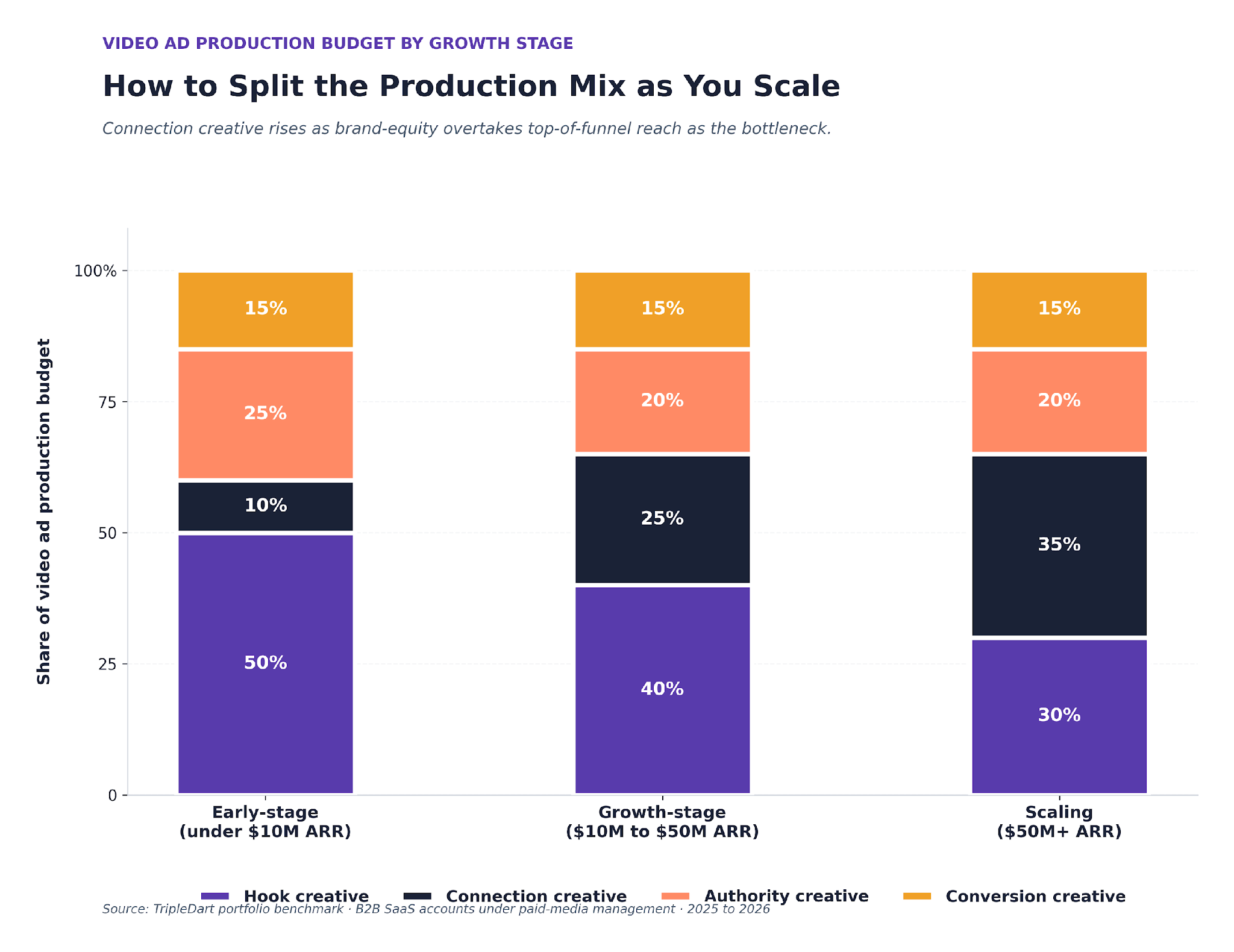
A rough benchmark for an effective SaaS video ads program at a mid-market to growth-stage company with 10 million dollars or more in ARR:
The production mix rotates with growth stage. A Series A SaaS team is spending most of the budget on hook and authority creative because brand-film budgets cannot pay back inside 12 months of runway. A scaling SaaS team crossing 50 million dollars in ARR starts shifting 30 percent of production spend into connection creative because brand-equity compression is the bottleneck, not top-of-funnel reach.
Building Your SaaS Video Ad Stack
The fifteen ads above argue one thing, a SaaS video ad is only effective when it is built for a specific funnel job. Hook ads stop the scroll. Connection ads build trust. Authority ads close the gap. Conversion ads ask for pipeline. The best SaaS brands on the market run all four at once, rotated across the calendar, sized to the growth stage.
We run paid programs for SaaS brands including Atlas HXM, MakeMyTrip, Pluto, and Apty. The production system behind those programs is the same one the fifteen ads above follow.
The roster is briefed by funnel layer, the creative is rotated every six weeks to beat fatigue, and the spend is measured by pipeline contribution, not by CPL or CTR in isolation. Ship a systemized video engine with TripleDart and the same playbook moves into your account.
Frequently Asked Questions
What makes a SaaS video ad effective in 2026? Effective SaaS video ads in 2026 share three properties. They open with a specific hook inside three seconds. They do one funnel job (hook, connection, authority, or conversion) rather than trying to do all four. They are produced in the format their placement demands, vertical Shorts for LinkedIn and Reels, horizontal for YouTube pre-roll. Wistia's 2025 benchmark shows sub-60-second creative engages 50 percent of viewers, well ahead of longer formats.
How long should a SaaS video ad be? Length depends on the funnel job. Hook ads run 10 to 30 seconds. Connection and brand films run 60 to 90 seconds. Authority and long-form case studies run 60 seconds to 3 minutes, but only when placed against warm audiences. Conversion ads run 30 to 90 seconds. LinkedIn's 2025 B2B benchmark finds completion rates drop below 20 percent past 60 seconds, which is why length has to match the audience temperature.
What is the best format for a SaaS video ad on LinkedIn? Short-form vertical (9:16 or 1:1) with captions baked in performs 2 to 3 times better than horizontal reuploads, per LinkedIn's video benchmark study. The hook must land inside the first 1.7 seconds because that is the median scroll-through time on the LinkedIn feed. Design for sound-off viewing.
Do founder-led SaaS video ads outperform brand-led ads? In the paid accounts we run across B2B SaaS, founder-led cuts consistently beat brand-led cuts on engagement rate and cost per booked meeting. The effect is strongest at early and growth-stage companies, where the founder carries more brand weight than the brand itself. The trade-off is longevity, founder-led creative fatigues faster than brand films because the viewer recognises the founder by week three.
Is B2B humor worth the risk in SaaS video ads? When the humor matches the brand voice and lands inside the first ten seconds, humor outperforms earnest brand film across every platform we track. Fiverr's The Competitors and Rippling's Tim Robinson Mastermind ad are strong examples. The risk is when a team attempts humor without a clear creative voice to carry it, which is how most bad B2B humor ads happen.
How much should a growth-stage SaaS company spend on video ad production? Directional benchmark, 8 to 15 percent of total paid media budget on production, with 70 percent of that allocated to hook and authority creative and 30 percent to connection and conversion creative. A scaling SaaS spending 100,000 dollars a month on paid should be producing 8 to 12 new video cuts per quarter to offset creative fatigue, per Ahrefs' creative rotation guidance. Scaling SaaS over 50 million dollars in ARR pushes the connection share higher.
What is the best short-form video ad length for TikTok, Reels, and YouTube Shorts? 15 to 30 seconds is the sweet spot for B2B SaaS on short-form platforms. Under 15 seconds is too short to establish the product context. Over 30 seconds loses completion rates. The hook must land in the first 2 seconds, the product or claim in seconds 3 to 10, and the CTA in the final 5 seconds. Wyzowl's 2025 video stats confirm this curve holds across categories.
Should SaaS companies use AI to generate video ads in 2026? Wistia's 2025 State of Video Report finds AI-assisted video production has more than doubled year over year. Overall engagement has declined in the same window, suggesting teams are producing more AI video than they can promote. The usable application is AI for localisation, caption generation, and variant production from a single hero cut. The brands winning on video are still investing in original concept work, then using AI to multiply it.

.png)







.png)




.png)


.webp)


.webp)

.webp)
.png)
.png)
.webp)


.webp)
.png)


.webp)
.webp)
.webp)




%20Ads%20for%20SaaS%202026_%20Types%2C%20Strategies%20%26%20Best%20Practices%20(1).webp)





.png)







.webp)


![Creating an Enterprise SaaS Marketing Strategy [Based on Industry Insights and Trends in 2026]](https://cdn.prod.website-files.com/632b673b055f4310bdb8637d/6965f37b67d3956f981e65fe_66a22273de11b68303bdd3c7_Creating%2520an%2520Enterprise%2520SaaS%2520Marketing%2520Strategy%2520%255BBased%2520on%2520Industry%2520Insights%2520and%2520Trends%2520in%25202023%255D.png)





























.png)

.png)
.png)
.png)
.png)
.png)














.webp)
.webp)
.png)
.png)





.png)


















.webp)
.png)

.png)









.png)




%2520Agencies%2520(2025).png)

![Top 9 AI SEO Content Generators for 2026 [Ranked & Reviewed]](https://cdn.prod.website-files.com/632b673b055f4310bdb8637d/6858e2c2d1f91a0c0a48811a_ai%20seo%20content%20generator.webp)




.webp)
.webp)











.webp)














.avif)