
Google just showed which schema types the web actually uses
Contributor

Abishek Balaji
Content Marketing Manager
In this article
Twelve schema types now appear on more than ten million domains each.
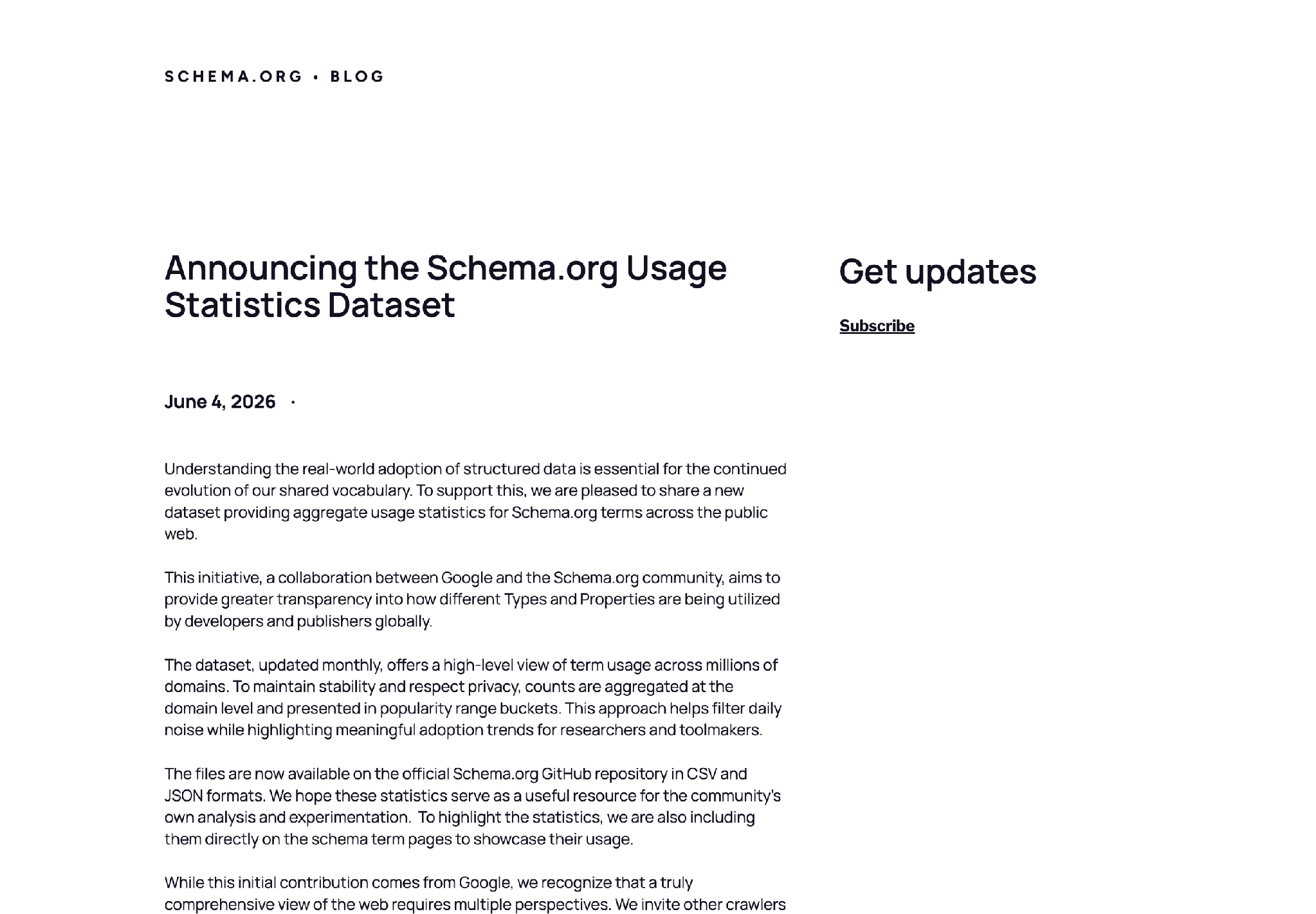
Until last month, nobody outside Google could put hard numbers on that. On June 4, Google and Schema.org published the first public dataset showing how their whole vocabulary gets used across the web, and they promised to refresh it every month. It is free and hosted on GitHub. And it settles a few long-running arguments about schema and AI search.
The story
The dataset is a Google and Schema.org collaboration. Using its web crawl, Google counts how many domains use each Schema.org type and property, and publishes the totals. The first release covers May 2026 and holds 5,545 entries: 958 types like Organization or Product, and 4,587 properties like "name" or "price".
The numbers come as ranges rather than exact counts.
Google groups every type into domain-count bands, from more than ten million domains at the top down to fewer than a thousand at the bottom, and says the ranges keep the data stable and protect individual sites. Ryan Levering, the Google engineer who worked on it, explained why Google was the one to publish it: its index reaches far deeper than most open web crawls, so it can report usage that others cannot.
A couple of weeks back, Google drew a line around third-party SEO tools and told SEOs which metrics to trust. This release is the same instinct pointed the other way, with Google handing the data over instead of narrowing it. The numbers also show up on the Schema.org term pages themselves, so you can look up any type and see how common it is.
Which schema types does the web use most?
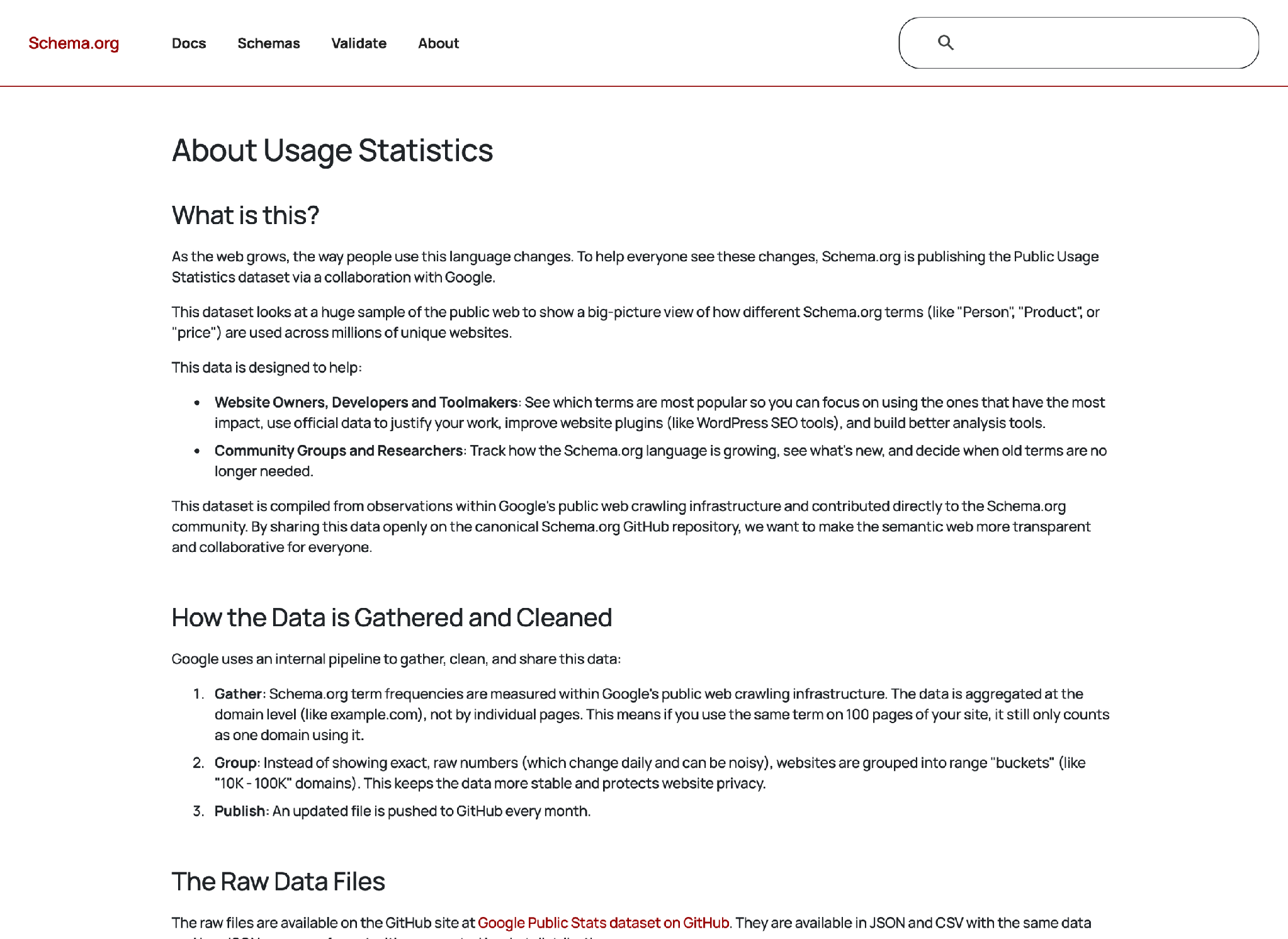
Only twelve types appear on more than ten million domains each: BreadcrumbList, EntryPoint, ImageObject, ListItem, Organization, Person, PropertyValueSpecification, ReadAction, SearchAction, Thing, WebPage, and WebSite. This is the basic markup almost every CMS adds by default, which is why WebPage and WebSite lead the list.
The next band down holds 35 types, the ones you add on purpose: Article, BlogPosting, FAQPage, Product, Review, AggregateRating, LocalBusiness, VideoObject, and Question.
Below that, the drop is steep. 485 types, more than half the vocabulary, appear on fewer than 1,000 domains. Across all 5,545 entries, 76.9% sit under that 1,000-domain line. Most of Schema.org, it turns out, is barely used.
What the numbers don't tell you
Popularity here counts how many sites use a type, and nothing else. It says nothing about whether that markup helps you rank or gets you cited in an AI answer. Four things are worth keeping in mind before you read too much into the list:
- Counted per domain. A type used on one page of a site counts the same as one used on every page. Reach and depth look identical here.
- Google-indexed only. Pages blocked in robots.txt are invisible to the count, so the data reflects the web Google sees.
- Format-blind. It does not separate JSON-LD from Microdata or RDFa, so you cannot tell how the markup was written.
- Grouped into bands. Inside the top group, there is no way to tell WebSite from Organization. They are all just "10M+".
So the dataset is best read as a benchmark. It shows what the rest of the web has already adopted, which is exactly what you want when deciding what markup to add next.
How can SEO teams use this data?
The dataset is most useful as a free way to check your own markup against the web and find the gaps. Start with the bedrock: Organization, WebSite, WebPage, and BreadcrumbList should already be on your site, and if they are missing, they are quick to add.
But the interesting work is in the middle band. FAQPage, Article, Product, and Review are common enough that AI engines and search crawlers expect them, yet far from universal, so they are where a B2B SaaS site can still gain ground.
Across the B2B SaaS sites we run, the bedrock types are almost always already in place. The gap is that middle band: an Article or FAQPage markup that was never added, or a Product schema that stops at the name and skips the pricing and review fields. Adding structured content for AEO and GEO is one of the cheaper SEO wins left right now.
The long tail is the judgment call. A rare type might set you apart in your category, or it might be markup nobody reads. The dataset will not decide that for you, but it will tell you how alone you would be in using it.
The headline list is a floor, and most sites already clear it. The value is in the middle band, where knowing that FAQPage and Product markup are expected but not universal tells you where there is still ground to take. If you want a second set of eyes on where your schema stands against the web, map your markup with us.