
ChatGPT users are now mostly non-English
Contributor

Abishek Balaji
Content Marketing Manager
In this article
When a buyer asks ChatGPT to recommend tools in your category, you want it to name you. Plenty of teams track whether AI cites them now, the same way they track rankings or paid.
This week OpenAI put out a usage number that should change where you aim that work, and it has more to do with the language your buyers type in than with anything on your site.
The story
More than half of active ChatGPT users on OpenAI's consumer plans now work mainly in a language other than English. That's from OpenAI's usage report on how the app has grown since 2023, and Search Engine Journal has the full breakdown.
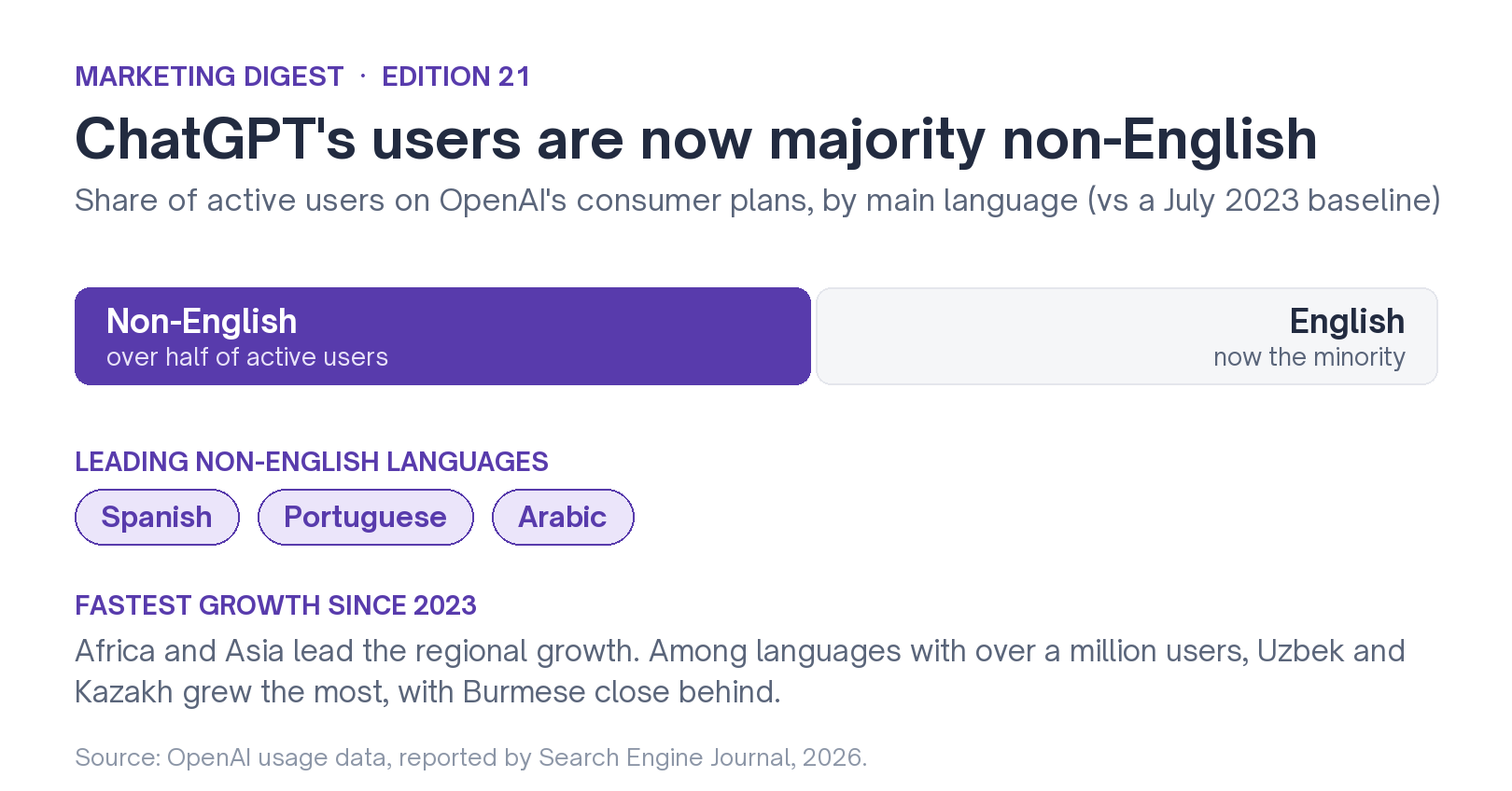
Spanish is the most common non-English language, then Portuguese and Arabic. Africa and Asia are growing fastest. Among languages with more than a million users, Uzbek and Kazakh jumped the most, with Burmese close behind. OpenAI compared all of it to July 2023, back when ChatGPT was mostly a US, English-first product.
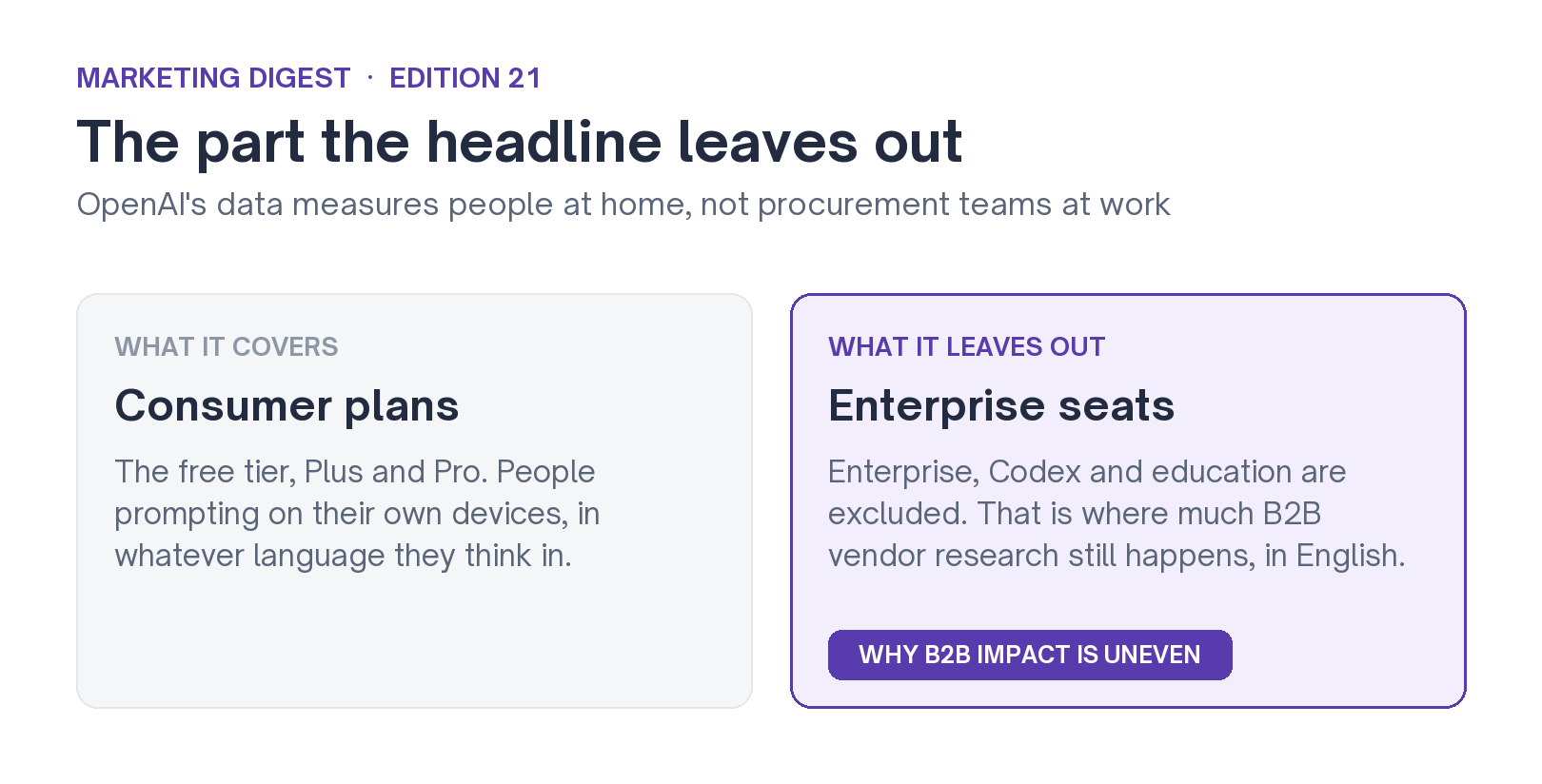
One detail in how they measured this matters more than the headline. The data only covers consumer plans, the free tier plus Plus and Pro, and leaves Enterprise out. So the number describes people at home and on their phones. The buying committees you sell to are in the Enterprise data OpenAI left out.
That's the line between a Q3 project and a watch-item.
Does this mean your buyers stopped searching in English?
Mostly not, at least not yet. OpenAI measured personal-account use here, and it left out the Enterprise seats where a lot of B2B research happens. In most markets, buyers still vet vendors in English, because that's where the docs, the review sites and the comparison posts are. A procurement lead in São Paulo has probably been prompting in English for years.
You can see the same thing in what we track. Across the B2B SaaS accounts we run GEO for, including brands selling into the Gulf and Southeast Asia, almost every prompt we monitor is in English, even the ones aimed at Dubai or Singapore buyers. That's how most of the industry watches AI search right now. So if buyers in those markets have started asking in their own language, we wouldn't spot it yet.
But the behaviour is changing faster than the buying. For most B2B teams, the impact is still a few quarters out.
Where this reaches your pipeline
The markets where this already touches B2B revenue are the ones growing fastest in OpenAI's data: Spanish and Portuguese across Latin America and Iberia, Arabic across the Gulf. If you sell there, the answer your buyer gets in their own language is the one that builds their shortlist. Your English page may never come up.
And AI doesn't fall back to your English content the way a Google result sometimes did. If nothing in its sources speaks the buyer's language, you're just not in the answer.
A few weeks ago we wrote about Google drawing a line around GEO and AEO tools. This widens that map. GEO holds up as a discipline, and in a few markets it now has to run in a second language.
Where your buyers are decides whether this is on you:
What we'd do about it now
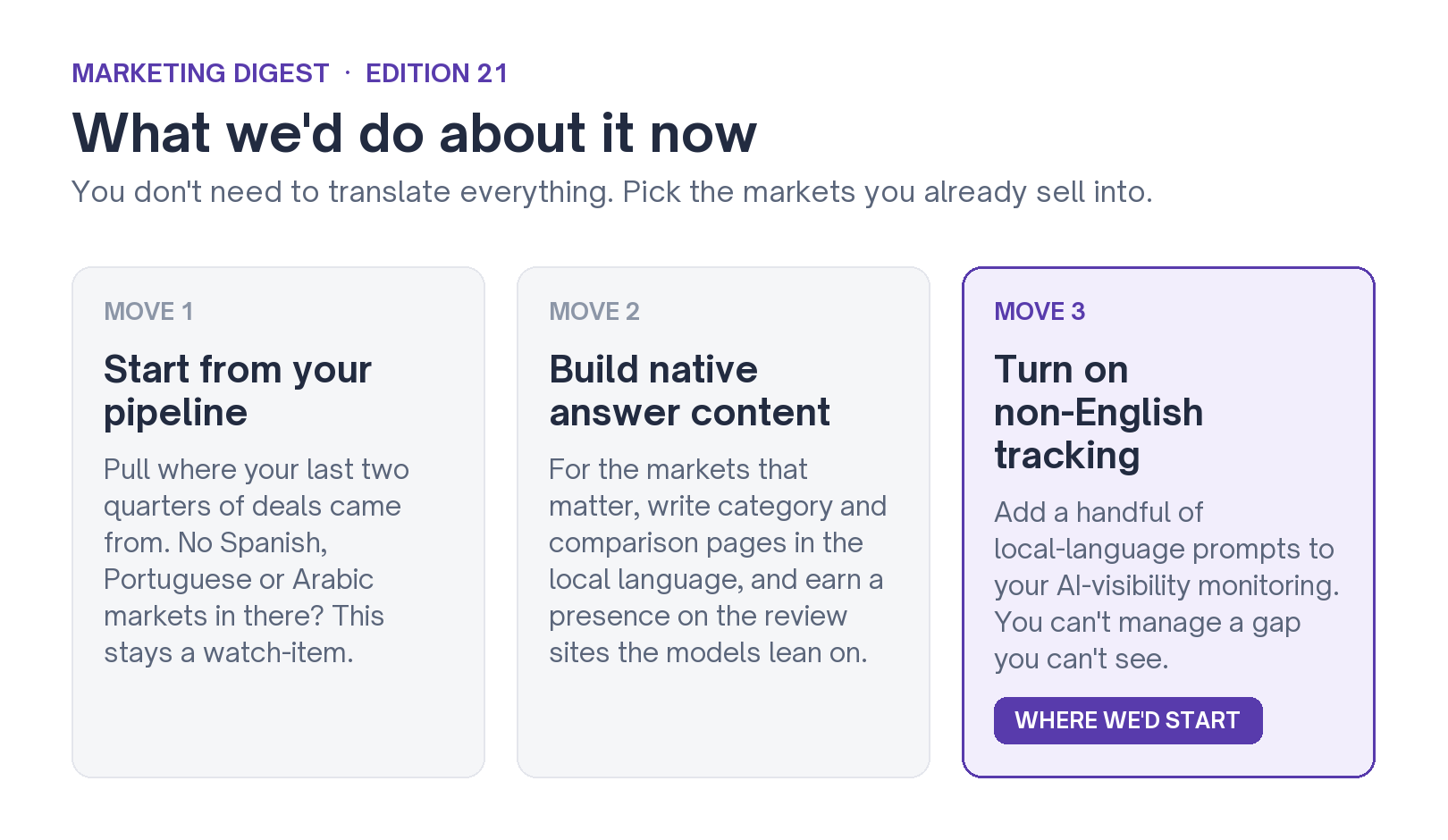
Skip the full-site translation. Find the one or two markets you already sell in, and build for the language your buyers there use.
- Start with your pipeline. Look at where your last two quarters of deals came from. If none are in Spanish, Portuguese or Arabic markets, park this as a watch-item and move on.
- Build answer content in the local language. For the markets that matter, write your category and comparison pages in that language, and get onto the review sites and directories the models lean on there. It's the same answer-engine work you already do in English, in the market's own words.
- Track non-English prompts first. Add a few local-language prompts to whatever you use to watch AI visibility. You can't close a gap you can't see, and most dashboards, ours until this quarter, can't see this one.
We're adding non-English prompts to the GEO reporting for the accounts that sell abroad, starting this quarter. If your buyers have started asking in a language you're not tracking, compare notes with us.