
Google builds a machine to catch AI slop at scale

Contributor

Abishek Balaji
Content Marketing Manager
In this article
Last week Google's research team published a paper almost no marketer will read, with a title only an engineer could love: detecting "Adversarial Synthetic Slop and Coordinated Media Abuse."
The system underneath it spent six months on a major video platform doing one job: deleting AI spam.
Not “demoting” it. Deleting the accounts behind it.
50,000 clusters and 130,000 channels, gone. We've spent two years telling clients the same thing about AI content and SEO: Google grades on quality and ignores who typed the words. This is the first time it has shown the machine that does the grading.

How the machine works
The old way to catch spam was to look at a video, score it, decide if it's junk. That stopped working the day AI made it free to produce a thousand slightly different versions of the same junk. Score them one at a time and you lose, because there's always another upload.
So Google stopped looking at videos. Its system, S-CTS, looks for what the paper calls Generation Clusters: groups of accounts running one script through the same infrastructure. Find the shared template and the shared plumbing, and you don't take down a video. You take down the whole operation.
The speed is the part that should get your attention. Matching a piece of content to a known spam template used to take 65 hours. With a lighter model it now takes about 5 seconds, Search Engine Journal reported in June 2026. Enforcement that used to arrive after the damage now arrives while it happens.
Google never names the platform. It owns YouTube.

Can Google detect AI content now?
Yes, though not the way the panic on LinkedIn assumes.
The machine doesn't read your blog post and stamp "written by AI" on it. It reads the network: how many accounts there are, and whether their near-identical output all traces back to one setup built to flood a topic. One good AI-assisted article is invisible to it. A thousand pages spun off a single template to own a keyword is the entire point.
The paper is blunt about why the old approach failed. The abstract calls it out: "Traditional content-centric moderation fails against this coordinated, adversarial generation strategy." If you publish at volume, that sentence is about you. The thing being measured is your footprint. Your prose barely enters into it.
Why this should make content teams nervous
Right now the targets are spam rings on a video platform. Marketers aren't in the crosshairs yet. Fine. But nothing about the method is specific to video. Embedding text to find reused templates, reading the infrastructure behind a network of pages: both work on the open web just as well, and Google has spent two years telling us the web is next.
And the method is built to never fall behind. When spammers move to a newer generator like Sora or Kling, Google retrains one small adapter (the LoRA in the title) rather than the whole detector, and carries on. They're planning for synthetic content to get cheaper and better for years, and building enforcement that gets cheaper alongside it.
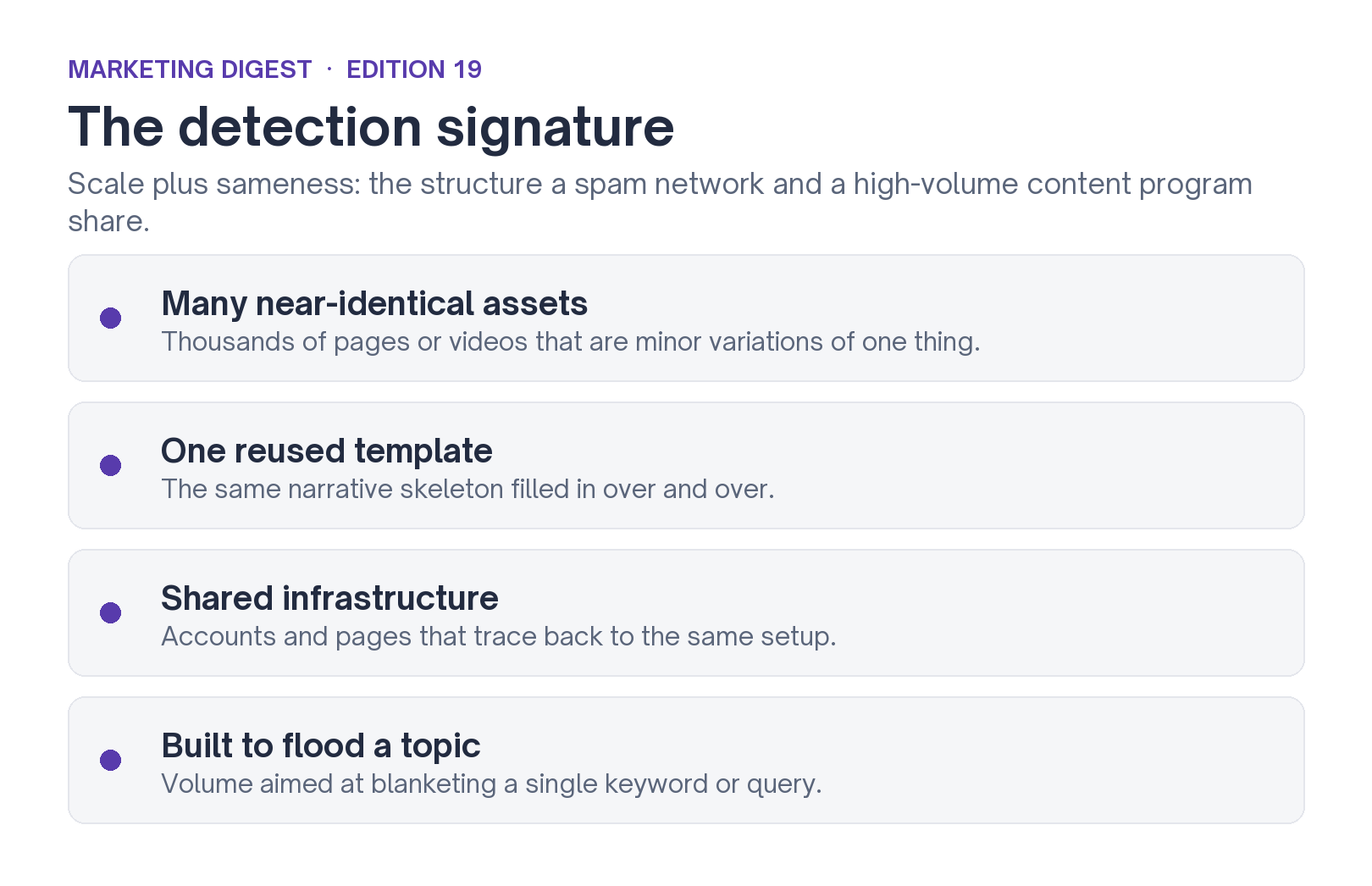
Now hold that up against the B2B content playbook of the last two years. Thousands of programmatic pages off one template. Comparison pages spun up for every competitor you can name. Take the intent out of it and the shape is identical: many pages, one skeleton, shared infrastructure, all pointed at blanketing a topic. It's the exact pattern that just cost someone 130,000 channels.
Nobody is calling your content program spam. The point is narrower and more awkward than that. The signature Google now hunts at machine speed is scale plus sameness, and a lot of what gets sold as "AI content strategy" is a machine for producing scale plus sameness.
Two weeks back we wrote about Google's stance on third-party SEO tools. Same story, other end. That was Google saying what it won't tolerate. This is Google showing the engine that finds it.
What we're not changing
The strange comfort here is that the machine rewards the slow, expensive version of content that good teams already do, and it punishes the cheap version everyone got tempted by. Four things stay, and we're leaning on them harder.
- Original data beats volume. On the AEO and GEO programs we run for B2B SaaS, the pages that keep their citation share are built on first-party numbers a model can't reproduce from everyone else's posts. A template can't fake that.
- Fewer pages, more weight. One page worth linking to beats forty near-identical ones, and there's now enforcement logic that agrees.
- A person owns anything you publish at scale. The gap between AI-assisted and AI-generated is the gap between a draft someone shaped and a template a script filled in. The first is fine. The second is what gets clustered.
- GEO stays a quality program. Our generative engine optimization work was never a volume play, and papers like this are the reason.

The paper is about video today. Text is next, and the teams that come out fine are the ones that were never running a content farm with better fonts. We're already pressure-testing the roster's libraries for the scale-and-sameness pattern. Bring yours in and we'll run the same check on it.
More once this reaches search.