
Claude went down for everyone but the government
For about 85 minutes on Tuesday, Claude stopped working for everyone except its government customers. It was back within the hour, but it showed how much of our daily work now runs on one company's servers.
Contributor

Abishek Balaji
Content Marketing Manager
In this article
For about 85 minutes on Tuesday morning, a lot of people's work just stopped. Engineers hit a wall of 500 and 529 errors.
And the content and reporting that marketing teams now run through Claude froze mid-task.
The story
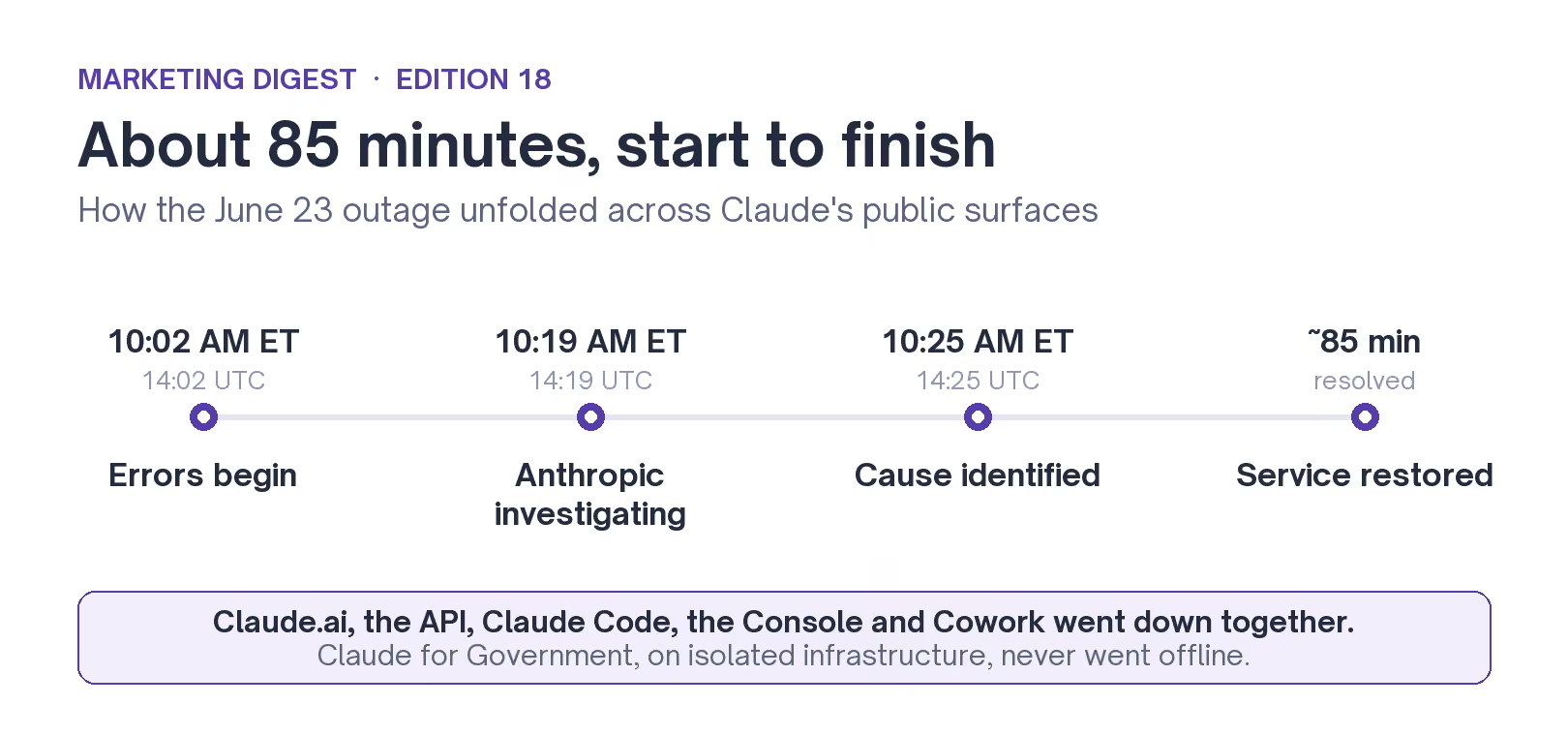
Claude went down on Tuesday, June 23. Anthropic's status page logged elevated error rates across every model, and the problem hit almost every Claude product: claude.ai, the API, Claude Code, the Console, and Cowork.
It started around 10 a.m. Eastern. Within minutes, Downdetector reports climbed into the thousands as people in the US realized it wasn't just them. Anthropic moved quickly: it opened the incident, identified the cause within six minutes, and deployed a patch soon after. The whole thing lasted around 85 minutes.
One part of Claude stayed up the whole time. Claude for Government runs on separate FedRAMP-authorized infrastructure inside Palantir's federal cloud, and it never went down.
Why it happened
Anthropic hasn't published a root cause for Tuesday's outage, so we don't fully know yet. The weeks around it explain a lot, though.
This wasn't a one-off. Barely 14 hours earlier, a separate outage took down five models at once, from Opus 4.8 to Haiku 4.5, and Anthropic found that cause internally without sharing it either. That's two outages in a single day.
Anthropic has been open about the underlying problem: demand has grown faster than its servers can keep up with. The company has throttled Claude at peak hours to cope, and has described infrastructure built for a user volume it now runs at two to three times over. Tuesday's outage hit during peak hours. New capacity from its Amazon and Google deals is coming, but it isn't online yet.
Anthropic did explain one June outage. It traced to a bug in Claude Code's sub-agent system, where the feature that spins up helpers to work in parallel kept multiplying instead of finishing. The more these tools do on their own, the more ways they have to fail.
Who the outage hit
Engineers were not the only ones hit. Plenty of marketing and support teams moved work onto Claude this year, and most never planned for it being gone.
Ken Mugrage, who runs insights at Thoughtworks, said developer velocity dropped by about half and automated workflows froze, and not only in engineering: the same problem reached the teams that now lean on Claude, from marketing to finance. As he put it, "AI tools should amplify engineers' capabilities. It shouldn't act as a structural crutch."
For most people the first reaction was a joke. Memes about writing code by hand again, and the line that Claude was down for everyone except the government. The jokes aside, a lot of teams found out how big their dependency was only when it disappeared.
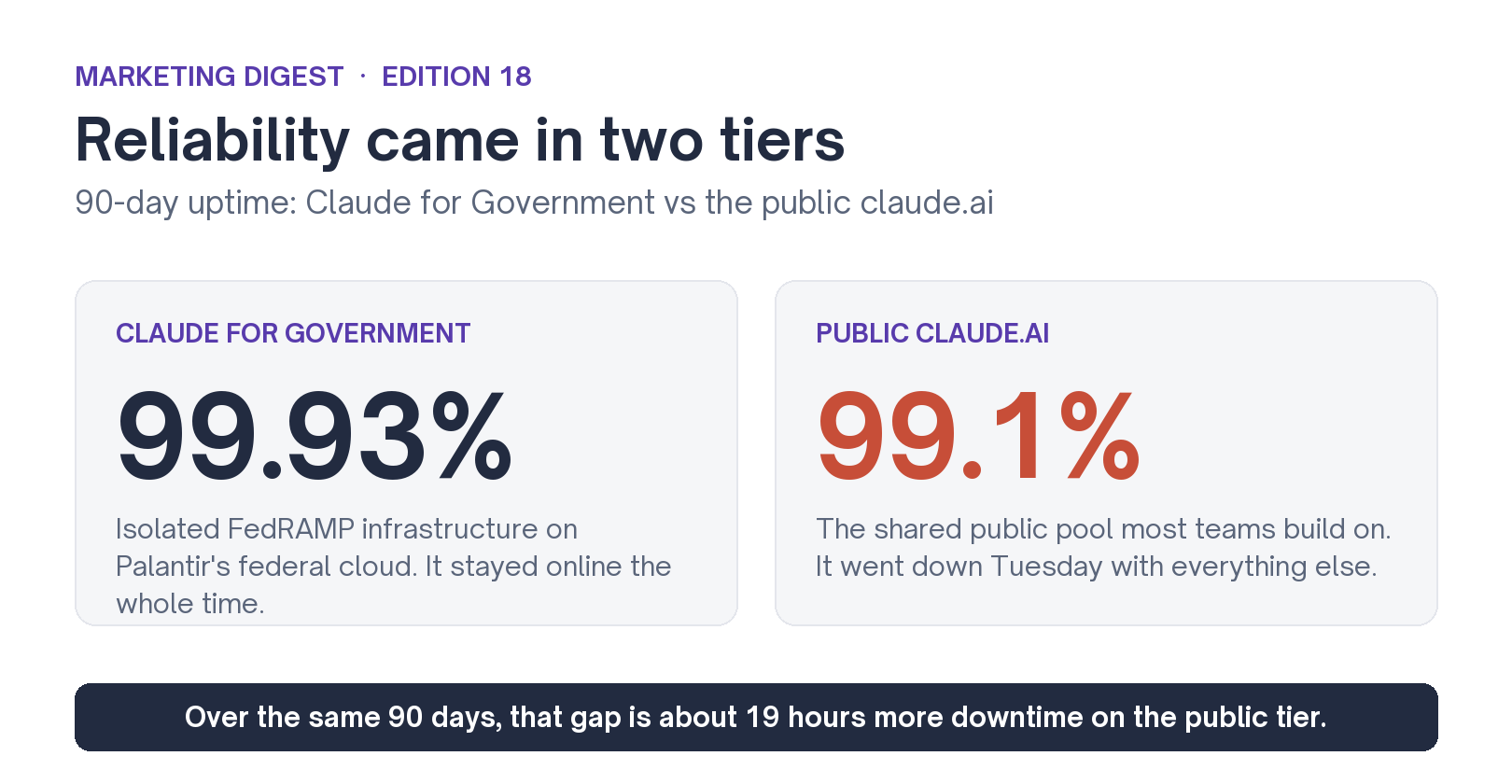
Then there's the government tier. Over the last 90 days, Claude for Government ran 99.93% uptime, while the public claude.ai that most of us build on ran 99.1%. It's the same models on both. The difference is that one runs on isolated infrastructure and the other shares the crowded public pool.
Reliability was something you could pay for. Almost nobody reading this did.
How Anthropic handled it
The incident response itself was quick and public. The status page updated continuously, the cause was found within about six minutes of the first alert, and the patch held. No complaints there.
Anthropic still hasn't explained itself afterward. There's no post-mortem for Tuesday, or for most of the June incidents before it. For a tool people now run businesses on, marking an incident "resolved" is only the start. People need to know what broke and what changes so it doesn't happen again.
We wrote three weeks ago about Anthropic filing to go public, with almost all of the money it's raising going to compute. A company heading for the public markets is one that other businesses depend on, and they'll judge it on whether it stays up more than on how it scores on a benchmark.
What it means for the rest of us
If your team runs production work through Claude, Tuesday was a small taste of a worse day that will eventually come. The sensible move is to plan for the model being down before it happens.
We run a lot of our own marketing work on Claude. Drafts, research, reporting, the Skills our team uses to run campaigns end to end. Tuesday froze part of that for us too.
So this isn't a lecture from the sidelines.
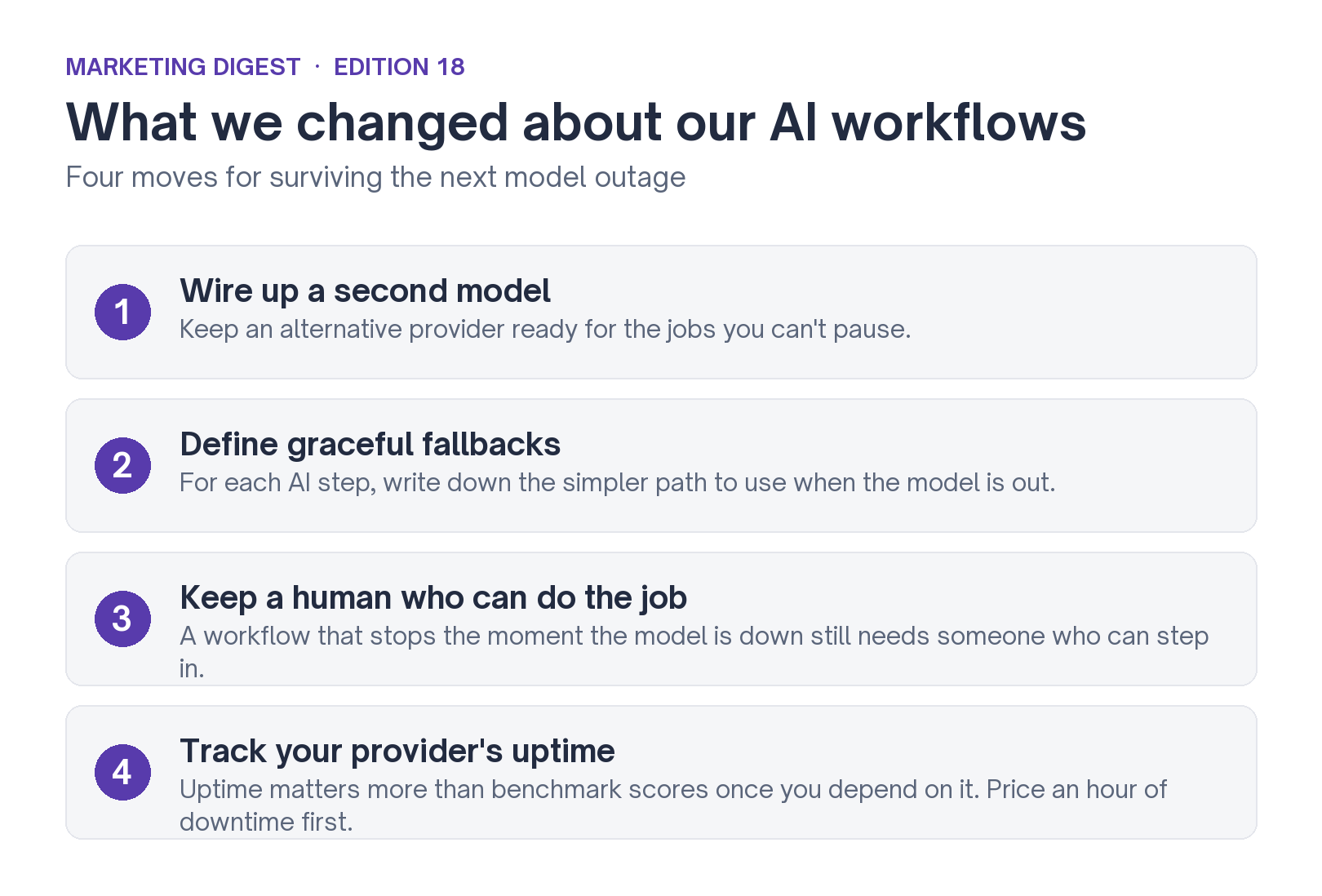
Here's what the outage changes about how we'd set up an AI-dependent workflow:
- Don't hardcode one provider as the only path. Wiring a single API endpoint into everything was a reasonable call two years ago. In 2026 it's a single point of failure for the business. Keep a second model ready for the jobs you can't pause.
- Decide now what degrades gracefully. For each AI step in a workflow, write down the simpler fallback in advance: keyword search when semantic search is out, a templated reply when the support bot goes quiet.
- Keep a human who can still do the job. A workflow that stops the moment the model is down still needs someone who can step in. The teams that coped on Tuesday had exactly that.
- Watch the right number. Know your provider's uptime and price an hour of downtime before you move a revenue process onto it. Once you depend on a tool, its uptime tells you more than its benchmark scores.
Claude will have more bad days, and so will whatever you'd run instead. The teams that come through are the ones that planned for the model being down. None of it is exciting work. It's just the difference between losing an hour and losing a day. If you want a second set of eyes on where your stack breaks when the model does, stress-test it with us.
We'll be watching uptime more closely than the next benchmark.