.png)

This report explains which page types large language models (LLMs) send traffic to. It also covers which page types convert that traffic into leads, and how each of the five major LLMs behaves differently for B2B SaaS.
The data comes from 28 B2B SaaS companies in our client portfolio across January, February, and March 2026.
The findings sit at the intersection of three related disciplines:
- SEO targets traditional search rankings.
- Generative engine optimization (GEO) targets citations inside LLM answers.
- Answer engine optimization (AEO) targets featured snippets and direct-answer surfaces, including Google's AI Overviews.
Together these describe how B2B brands earn visibility across classic search and AI-driven discovery surfaces today.
Before we go further, a quick word on the two numbers that anchor this study. We tracked LLM-sourced sessions first.
These are visits to a portfolio company's website that originated from an LLM citation, like a user clicking a brand link inside a ChatGPT or Perplexity answer. We also tracked AI-attributed leads.
These are HubSpot contacts whose Original Source field recorded one of the five LLM platforms as the referrer at form-fill. The portfolio recorded 65,583 sessions and 82 leads across the quarter.
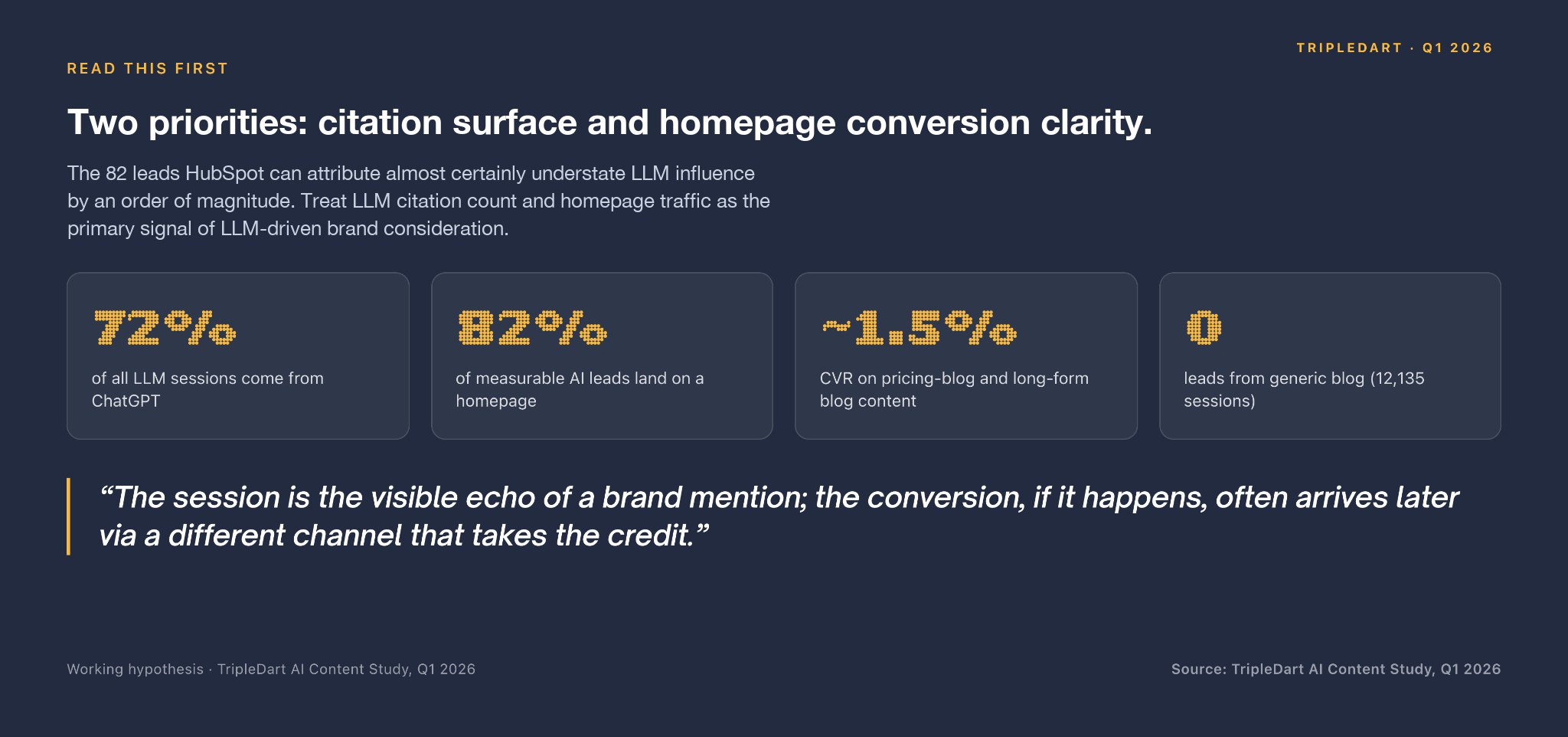
That gap between 65,583 and 82 is the picture this report sits inside.
Every other visitor in the 65,583 saw a brand from our portfolio cited in an LLM answer and clicked through to the site. That larger group is where most of the brand consideration is happening today.
Most of those visitors will eventually convert through a different channel that takes the last-click credit (Organic Search, Direct, Paid retargeting). The second section unpacks why this attribution gap shapes the data and how to measure around it.
How We Ran the Study
We pulled session and lead data for 28 B2B SaaS companies in our portfolio between January and March 2026. Every URL that received an LLM-sourced session was classified into one of 35 page types.
Leads were counted when HubSpot recorded the contact's Original Source as "AI Referrals" with one of the five LLM platforms as the source drill-down. For background on how HubSpot classifies and credits these sources, see HubSpot's attribution modeling guide.
Brand names are anonymized throughout.
The setup:
- Companies: 28 B2B SaaS brands across multiple verticals.
- Platforms: ChatGPT, Gemini, Perplexity, Claude, Copilot.
- URLs studied: 11,513 unique URLs across the quarter.
- Page types: 35 classifications - Home Page, Blog (split into seven sub-formats like Pricing, Listicle, Long-form, Alternatives, Comparison), Tools, Templates, Login, Dashboard, Location-based, and others.
- Metrics: Sessions from an LLM citation, and leads attributed to AI Referrals in HubSpot during the same session window. CVR (conversion rate) is leads divided by sessions for each page type.
Why LLM Lead Attribution Understates the Real B2B SaaS Picture
The 82 leads HubSpot can directly attribute to LLMs are leads where the contact submitted a form right after an LLM click. The LLM source is captured at form-fill. This is strict last-click attribution.
That definition misses most of how LLMs influence buying decisions in B2B SaaS. The 65,583 LLM-sourced sessions are a more reliable signal of LLM influence than the 82 leads.
Each session is a buyer who clicked through to a brand's website after seeing it cited in an LLM answer. B2B SaaS buyers now touch five to ten research surfaces before any form fill, a pattern documented across recent buyer-journey research from 6sense and similar firms.
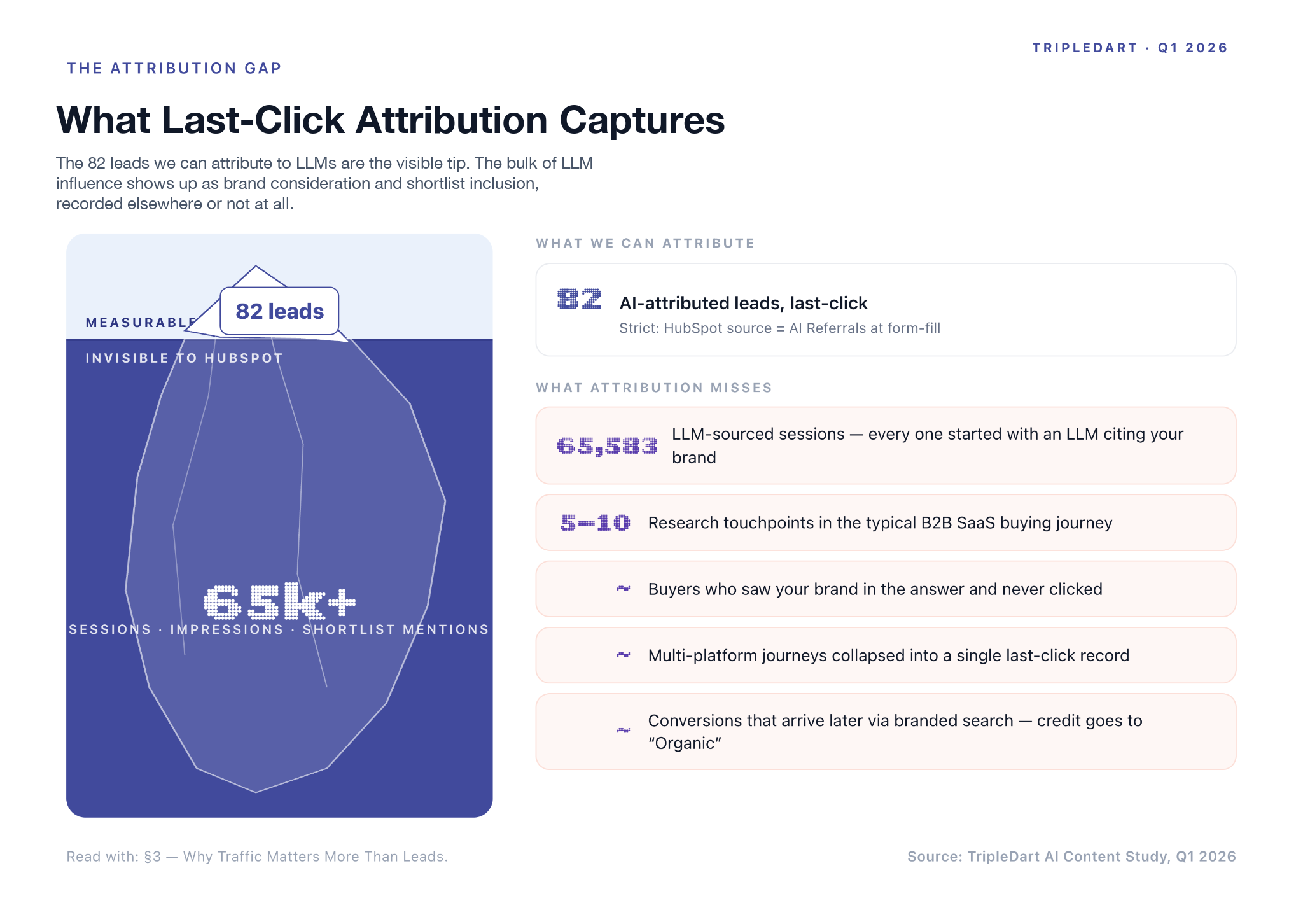
Four common buyer behaviors sit invisible to first-click attribution:
- Branded search after an LLM mention: A buyer asks ChatGPT for the best e-signature tools, sees a brand listed in the answer, then searches that brand on Google two weeks later and books a demo. HubSpot records the lead source as Organic Search. The LLM mention that put the brand in the buyer's head is uncredited.
- Last click from a different channel: A buyer sees a brand cited in a ChatGPT answer, then converts later through a competitor comparison page, a peer recommendation, or a paid retargeting ad. The LLM influenced the shortlist, but another channel takes the conversion credit.
- Impression with no click: A ChatGPT response that lists five e-signature tools puts five brands in front of the buyer. Most buyers do not click any of them. The brand exposure is real, but there is no measurable touchpoint in HubSpot.
- Multi-platform research: A buyer queries the same need across ChatGPT, Perplexity, and Gemini over a week, clicks through twice, then converts through a different surface a week later. HubSpot records one lead, but three or more LLM touchpoints fed the decision.
Here is how the 82 leads break down by LLM platform, with session volumes for context:
ChatGPT carries the bulk of the measurable picture. It produces 86.6% of all AI-attributed leads on 72.2% of total sessions.
Perplexity converts at the second-best rate (0.10%) on smaller volume. Gemini sends similar volume to Perplexity but converts at half the rate.
Claude and Copilot combined produced one lead in the quarter, although they sent 4,237 sessions of measurable traffic.
The takeaway: for the next twelve months, track LLM citation count and homepage traffic alongside the AI Referrals lead line. These two metrics together are the most reliable way to measure LLM impact on B2B SaaS pipeline today.
Treating the 82 as the full picture badly understates the influence LLMs are having on buyer consideration. For teams setting up multi-touch attribution against this kind of B2B SaaS buyer journey, our marketing analytics work covers the data model.
What Page Types LLMs Cite Most for B2B SaaS
Four page types drive 64.6% of all LLM citations and traffic in this dataset: Home Page, generic Blog, Listicle, and ‘Others.’
Only Home Page converts that traffic into leads at a meaningful rate. The other three accumulate citations and clicks that do not show up as first-click leads in HubSpot.
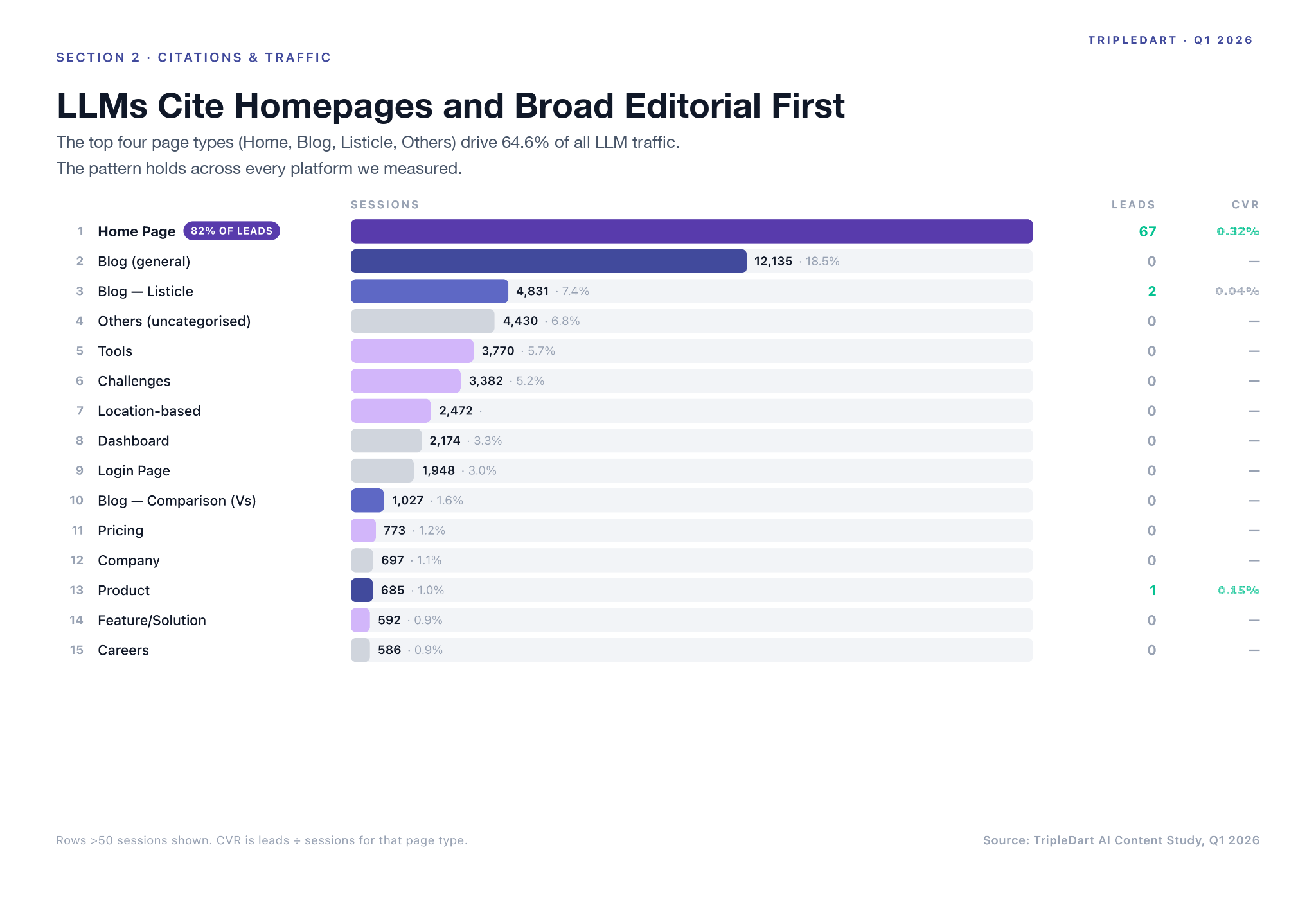
Five things to take from this table:
- Top four page types carry 64.6% of total LLM traffic: When LLMs answer buyer questions, they default to two types of pages. Brand homepages (the most reliable answer to "what is this company") and broad informational content like blog posts and listicles (the most reliable answer to "what are the options in this category"). This pattern holds across every platform in the study.
- Home Page is the only page type where traffic and conversion line up: It receives 31.9% of all LLM citations and produces 81.7% of all measurable leads. Across the portfolio, the homepage is where LLM traffic converts into pipeline.
- Tools pages received 3,770 sessions but produced zero AI-attributed leads: Tools traffic is real and useful. Buyers landing on a free calculator or template gallery are valuable for brand exposure. But Tools pages are not first-click conversion surfaces, which is something to set expectations on with clients.
- Login Page, Dashboard, and Challenges together account for about 12% of LLM traffic: This is mostly existing users who already know the brand using the LLM as a navigation shortcut. It looks like branded search behavior leaking into LLMs, which means it should be read as retention signal rather than new buyer demand.
- The "Others" category covers 4,430 sessions (6.8%) and 1,908 URLs we could not fit into our 35 page-type classifications: We will do a manual review of these URLs in Q2 to understand which page types are missing from our taxonomy. For background on how we structure page-type taxonomies at scale, see TripleDart's programmatic SEO approach.
Which Blog Formats Convert LLM Traffic Into Leads
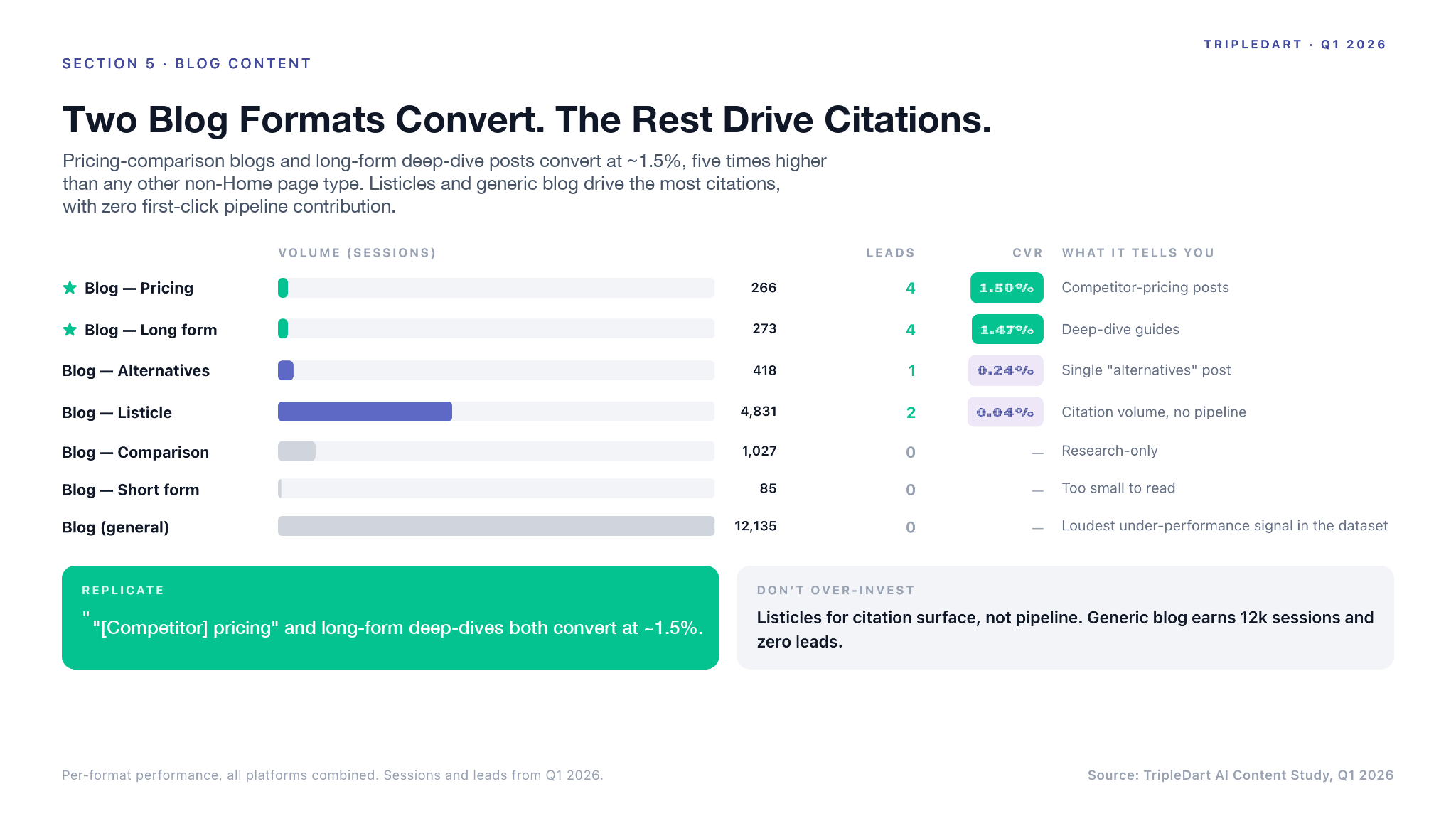
Two blog formats produce LLM-attributed leads at a meaningful rate. Pricing-comparison blogs convert at 1.50% CVR. Long-form deep-dive blogs convert at 1.47%.
Every other blog format converts at less than 0.25%. Generic blog posts (the largest single source of LLM citations in the dataset) convert at zero.
Here is what converts:
- Pricing-comparison blog content: Articles like "[Competitor] pricing" or "how much does X cost" target buyers who are already in commercial-intent research mode. LLMs surface these articles when buyers ask price-related questions. The format produced 4 leads from 266 sessions in Q1, all from one company in our portfolio (Company B), at a 1.50% CVR. Any client willing to publish pricing-comparison content against named competitors can replicate this pattern. See TripleDart's content marketing approach for how we build this content out.
- Long-form deep-dives: In-depth articles on the core topics buyers research before evaluating a category. The format produced 4 leads from 273 sessions in Q1, also mostly from Company B. The Perplexity CVR for long-form content is 3.39%, the highest blog-platform combination in the dataset. TripleDart's playbook library is built around this format.
Here is what brings traffic but rarely converts on first click:
- Listicles: Posts like "best e-signature tools for small business" received 4,831 sessions in Q1 (the third-largest source of LLM citations in the study) and converted at 0.04%. Listicles are useful for brand exposure and citation surface, but rarely produce a directly attributable lead on the first click.
- Comparison ("Vs") posts: Articles like "DocuSign vs HelloSign" received 1,027 sessions and produced zero leads. LLMs cite these posts during research. The conversion happens through other surfaces.
- Generic blog posts: This is the largest single category of LLM-cited content in the study: 12,135 sessions across 5,481 unique URLs, with zero AI-attributed leads. Generic blog content (informational posts that aren't pricing, alternatives, comparison, or long-form deep-dives) brings real LLM traffic without producing direct conversions. The biggest opportunity here is to route this traffic into homepage and product-trial flows through internal links and CTAs (calls-to-action) inside the article.
For reference, here is the full CVR ranking across all page types that produced any leads in Q1:
One important caveat: almost all converting pricing-blog and long-form leads in Q1 came from a single company (Company B).
The format pattern is replicable across the portfolio, but it has only been validated at one-client volume in this dataset. We expect the pattern to hold as more clients publish in these formats.
How ChatGPT, Gemini, Perplexity, Claude, and Copilot Behave Differently
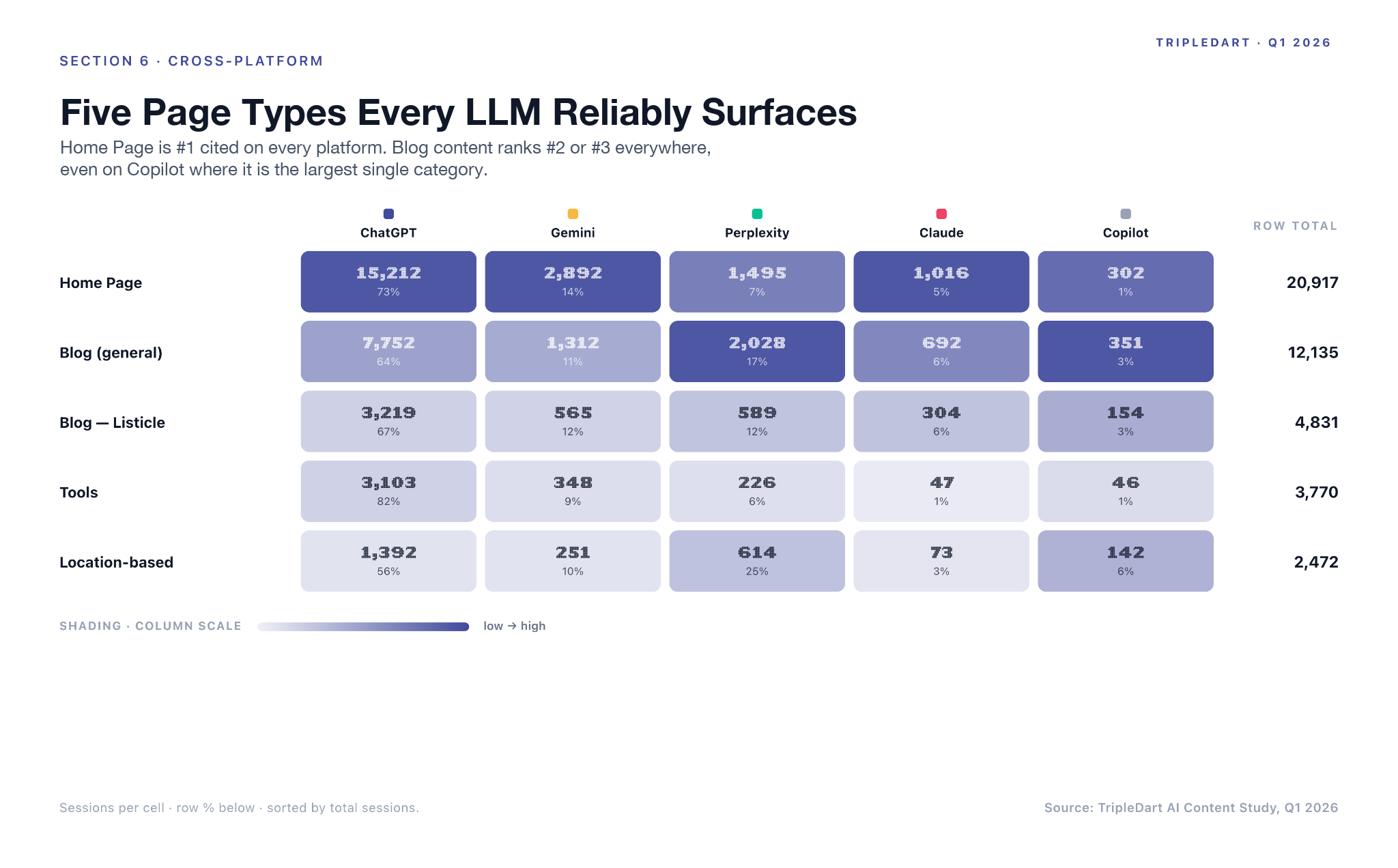
Each LLM cites different page types in different proportions for B2B SaaS. ChatGPT cites homepages and tools roughly evenly. Gemini concentrates on homepages and broad blog content.
Perplexity is the only platform where generic blog outranks homepages for citation volume. Claude and Copilot behave more like classic search engines, where homepages and editorial blog content dominate and commercial pages barely appear.
The full per-platform breakdown across the metrics that drive Q2 decisions:
Three patterns carry the per-platform decisions for Q2.
First, ChatGPT is the conversion engine and the homepage is the conversion surface. Inside ChatGPT, pricing blogs (1.56% CVR) and long-form blogs (1.37% CVR) are the only non-homepage formats that produce leads at meaningful rates.
Pricing landing pages produced 2 leads from 36 sessions (5.56% CVR), worth flagging as a directional signal on a small sample.
Second, Perplexity is the depth platform. It's the only LLM in the study where generic blog citations (2,028) outrank homepage citations (1,495).
Long-form deep-dives convert at 3.39% on Perplexity, the single highest platform-blog combination in the dataset. Long-form and pricing-comparison content are the right investments for any Perplexity-specific gains.
Third, Gemini, Claude, and Copilot are all sub-volume surfaces today. Gemini delivers homepage-only conversion at half of ChatGPT's homepage rate.
Claude and Copilot together produced one lead in the quarter. The right approach for all three: tune the homepage and editorial blog content well enough to earn citations, and hold dedicated builds until conversion behavior changes.
Why Claude Deserves a Closer Look
Claude is the only one of the five platforms where Q3 could look meaningfully different from Q1. The traffic is measurable today (3,018 sessions, ~40% of Gemini's volume), but commercial intent is not.
Claude's citation profile leans hard toward homepages (33.7% of its traffic) and editorial blog content (33%). Only 47 Tools-page sessions across the entire quarter, compared to 3,103 from ChatGPT.
What we are watching: Claude's usage share inside the B2B SaaS buyer cohort is growing fast enough that the citation-to-conversion ratio could move by Q3. Anthropic's newsroom is the cleanest place to track product and adoption updates that affect this trajectory.
The broader industry context for how LLMs cite content is tracked by publications like Search Engine Land.
The single Q2 action for Claude: report homepage sessions and brand-citation counts monthly. If any single client's homepage starts showing 100+ Claude sessions and any leads, that is the early signal Claude is becoming pipeline-relevant.
What to Do in Q2: Your B2B SaaS LLM Readiness Plan
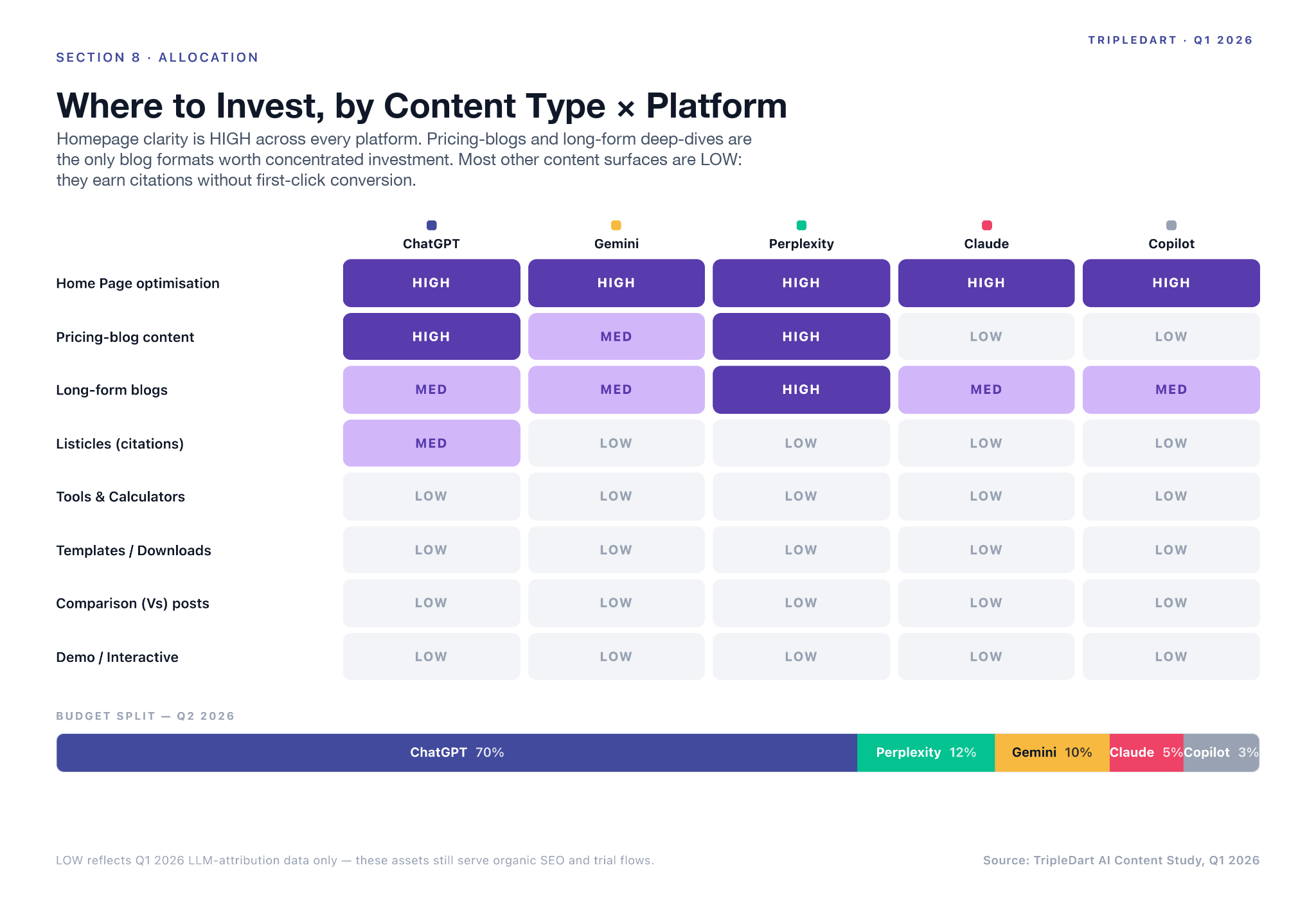
The Q2 priorities come out of the data above. Two things stand out.
First, make sure every client's homepage is set up to convert LLM traffic. Second, build pricing-comparison and long-form deep-dive blog content, because these are the only blog formats that produce leads at a meaningful rate.
Everything else has value as brand-exposure but does not produce direct first-click leads.
Homepage Tuning Comes First
The homepage is the most-cited page type on every single one of the five LLMs we studied. It produces 81.7% of all measurable AI-attributed leads.
If a client's homepage is structured as a brand statement rather than as a clear, action-ready destination, that is the biggest LLM-readiness gap they have.
What a homepage built for LLM traffic needs in 2026:
- A clear H1 that names what the company does
- A one-sentence value proposition above the fold
- A prominent call-to-action (CTA) above the fold
- A machine-extractable summary in the first 200 words, written so an LLM can quote it directly
The 5 companies in our portfolio that converted any LLM traffic in Q1 all hit these basics on their homepages. The companies that received thousands of LLM-driven sessions and produced zero leads (and there are several in the dataset) generally do not.
Build the Two Blog Formats That Convert
Two formats produce first-click leads on a repeatable basis. Both target buyers in commercial-intent research mode.
- Pricing-comparison blogs: Articles in the form "[Competitor] pricing" or "how much does [Competitor] cost" or "[Competitor] alternatives". 1.50% CVR. Replicable for any client willing to publish against named competitors.
- Long-form deep-dives: In-depth guides on the core topics the buyer is researching before evaluating a category. 1.47% CVR. Especially strong on Perplexity (3.39%).
Set Expectations on Formats That Don't Convert Directly
Two formats generate citations and traffic, but rarely first-click leads. The recommendation is not to stop publishing them.
The recommendation is to set the expectation with clients up front that these are brand-exposure surfaces. Direct pipeline contribution happens elsewhere.
- Listicles: Useful for citation count and LLM brand visibility. Report this separately from pipeline contribution.
- Generic blog posts: 12,135 sessions and zero direct leads in Q1. The biggest "traffic without conversion" line in the dataset. Worth a programmatic audit of which generic posts can be retired, which can be re-routed with CTAs into homepage and product-trial flows, and which can be rewritten into a converting format.
What Not to Do Based on the Q1 Data
Three things to avoid promising clients on the basis of this dataset:
- Do not promise Tools pages will convert LLM traffic on first click. Tools received 3,770 sessions and produced zero AI-attributed leads in Q1. The traffic is valuable, but it does not show up as direct LLM-attributed conversions in HubSpot.
- Do not build Vs/comparison content with a first-click conversion goal. 1,027 sessions, zero leads. LLMs use these articles for research. The conversion happens through other surfaces.
- Do not promise meaningful pipeline from Claude or Copilot yet. They produced 1 lead between them in Q1. Measure them. Make sure homepages and editorial blog content are high enough quality to earn citations. Hold off on building dedicated assets until the conversion mix changes.
Budget Allocation by Platform
For teams allocating LLM-readiness spend by expected first-click conversion return:
- 70% to ChatGPT: 86.6% of all measurable LLM-attributed leads come from ChatGPT.
- 12% to Perplexity: Highest non-ChatGPT CVR. Smaller volume, but quality-weighted traffic.
- 10% to Gemini: Large volume share, low conversion rate. A hedge in case the conversion mix changes through the year.
- 5% to Claude: Tune homepage and editorial blog content so the platform surfaces the brand. No dedicated builds yet.
- 3% to Copilot: Measurement-only.
What This Means for B2B SaaS in the Next 12 Months
Two changes will define LLM-driven B2B SaaS pipeline between Q1 2026 and Q1 2027. The Q2 plan above handles what to do today. This section is about what to start preparing for now so the next four quarters do not catch the team off-guard.
Change 1: The attribution gap closes
Multi-touch LLM attribution tooling will mature through 2026. HubSpot, Salesforce, and the broader marketing-attribution category will surface LLM influence well before the form-fill click.
Today the 82 leads is what HubSpot can credit, and 65,583 sessions sit invisible behind it. In 12 months that ratio will be measurable.
The teams that started tracking LLM citation count and homepage LLM traffic in Q2 2026 will have 9 months of trend data when the new attribution layer arrives. Teams that wait will start from zero.
Two actions follow from this change. Add brand-anchor tuning to every homepage so LLMs can extract a clean summary from the first 200 words. Add LLM citation count and homepage LLM traffic to monthly client reporting today, alongside the AI Referrals lead line.
Change 2: Claude crosses the conversion threshold
Of the five LLMs, Claude is the one with measurable Q1 traffic and meaningful Q3 risk. Its usage share inside the B2B SaaS buyer cohort is growing fast enough that the 0.03% CVR could look meaningfully different by Q3 2026.
The leading indicator to watch: any single client's Claude homepage sessions crossing 100 per month with any directly attributable lead.
Teams running monthly reporting on Claude citation count and homepage traffic in Q2 will catch the inflection within one cycle. Teams that wait for the AI Referrals lead line to move on Claude will catch it a quarter late.
The 82 leads is a real number. The 65,583 sessions is a bigger one.
Reporting both is what gets B2B SaaS marketing teams to the right Q2 decisions for LLM SEO, generative engine optimization (GEO), and answer engine optimization (AEO) together.
If you want the same B2B SaaS LLM citations and traffic cut on your own portfolio, book a TripleDart session. We will run the analysis with you and walk through your Q2 priorities live.
Frequently Asked Questions
Which LLM Sends the Most Traffic to B2B SaaS Sites?
ChatGPT sends 72.2% of all LLM-sourced traffic to the B2B SaaS companies in our Q1 2026 study, on 47,319 of 65,583 total LLM-sourced sessions. Gemini is second at 11.8%, Perplexity third at 9.6%, Claude fourth at 4.6%, and Copilot fifth at 1.9%.
ChatGPT also drives 86.6% of all AI-attributed leads, which makes it the highest-ROI platform for B2B SaaS LLM readiness today.
Which Page Types Do LLMs Cite Most for B2B SaaS?
Four page types drive 64.6% of B2B SaaS LLM citations and traffic across the five LLMs studied. The breakdown is Home Page (31.9%), generic Blog (18.5%), Listicle (7.4%), and other uncategorized pages (6.8%).
Only the homepage converts that traffic into leads at a meaningful rate, producing 82% of all directly attributable AI Referrals leads in the dataset.
What Is Generative Engine Optimization (GEO)?
Generative engine optimization (GEO) is the practice of structuring web content so that large language models like ChatGPT, Claude, and Perplexity surface and cite it in their answers.
GEO sits alongside answer engine optimization (AEO) and traditional SEO as a discipline focused on AI-driven search surfaces. For B2B SaaS, GEO covers two main areas: homepage clarity, and content format selection (pricing-comparison blogs and long-form deep-dives over generic blog).
How Do You Optimize a B2B SaaS Homepage for LLM Citations?
A B2B SaaS homepage built for LLM citations needs four things:
- A clear H1 that names what the company does
- A one-sentence value proposition above the fold
- A prominent call-to-action above the fold
- A machine-extractable summary in the first 200 words
The 5 companies in our Q1 2026 portfolio that converted any LLM traffic hit all four basics. Companies with thousands of LLM-driven sessions and zero leads generally do not.
Do Claude and Copilot Drive B2B SaaS Leads?
In our Q1 2026 study, Claude and Copilot together generated 1 lead from 4,237 LLM-sourced sessions. Both platforms are real traffic surfaces but commercially immature for first-click conversion in B2B SaaS today.
The right Q2 approach is to track both as awareness signals and tune homepage and editorial blog content so they earn citations. Dedicated landing pages for Claude or Copilot do not produce return at current adoption levels.
What Is the Difference Between SEO, GEO, and AEO?
SEO (search engine optimization) targets traditional ranking on Google and Bing. GEO (generative engine optimization) targets citations in LLM answers from ChatGPT, Claude, Perplexity, Gemini, and Copilot.
AEO (answer engine optimization) targets featured-snippet and direct-answer surfaces, including Google's AI Overviews. All three disciplines overlap, and the strongest B2B SaaS programs in 2026 invest across the three together.
Which Blog Formats Convert LLM Traffic Into Leads for B2B SaaS?
Two blog formats produce LLM-attributed leads at a meaningful rate. Pricing-comparison blogs convert at 1.50% CVR. Long-form deep-dive blogs convert at 1.47%.
Every other blog format converts at less than 0.25%. Generic blog posts (the largest single source of LLM citations in our dataset) convert at zero, despite producing 12,135 sessions across 5,481 unique URLs.
Should B2B SaaS Companies Build Dedicated Landing Pages for ChatGPT, Claude, or Perplexity?
For ChatGPT, tune the homepage and pricing-comparison blog content first. ChatGPT-specific landing pages are not necessary, because ChatGPT cites the homepage as the #1 page type in 100% of the platforms we studied.
For Claude and Perplexity, the same applies. Dedicated AI-specific landing pages do not earn return at current LLM adoption levels.
Tune the homepage, build the two converting blog formats, and measure LLM citation count alongside lead volume.
How Big Is the LLM Attribution Gap for B2B SaaS?
In our Q1 2026 study, 65,583 LLM-sourced sessions produced only 82 directly attributable leads (0.13% blended CVR). The gap is roughly 800 to 1, which means HubSpot's last-click "AI Referrals" lead line captures less than 0.2% of buyer interactions LLMs are driving.
The 65,583 sessions are a more reliable signal of LLM impact on B2B SaaS pipeline than the 82 leads. Citation count plus homepage traffic should both be reported alongside the AI Referrals line in monthly client reporting.
What Should B2B SaaS Marketing Teams Track for LLM SEO in 2026?
Three metrics carry the picture. First, LLM citation count: how often each LLM surfaces the brand in answers to category questions.
Second, LLM-sourced sessions: how many buyers click through from LLM answers, with breakdowns by platform and page type.
Third, AI-attributed leads in HubSpot or your CRM, with the understanding that this number captures less than 0.2% of total LLM influence. Report all three together to give clients a complete picture of LLM impact on pipeline.
.webp)