ChatGPT Ads have gone from something people speculated about on LinkedIn to a line item you have to form an opinion on. If you own paid media at a B2B company, someone senior has already asked whether you're testing them.
Most answers online are press-release summaries or invented pricing benchmarks. Neither helps you brief a budget.
So this guide covers what OpenAI has documented, what you still have to verify inside your own account, how contextual matching rewrites the paid playbook, and how to design a pilot that ends in a defensible scale, iterate, or pause decision. Let's break it down.
Verification note: ChatGPT Ads availability, formats, targeting controls, and commercial terms change quickly. Confirm account-specific details in OpenAI Ads Manager before committing budget.
What Are ChatGPT Ads?
ChatGPT Ads are sponsored placements that render near an eligible ChatGPT response, visually separated from the answer and clearly labeled. You buy them through OpenAI Ads Manager; they match conversation context instead of bid keywords, and they don't touch the model's output.
For paid search teams, the unit of purchase changes. In Google Ads you buy against a query string. Here there's no string to own. A conversation moves through several turns, and a system decides whether your offer fits the moment.
That's useful for B2B because so much early research now happens in dialogue. A buyer describes a messy internal problem, gets a framework back, asks three follow-ups, and only later types a branded search into Google.
ChatGPT Ads sit in the middle of that arc. That's why they work best alongside organic visibility in ChatGPT, not in competition with it.
What ChatGPT Ads are not:
- Not embedded inside the AI answer, and not an endorsement from ChatGPT
- Not a keyword auction in the Google Ads sense
- Not visible to every ChatGPT user
- Not a source of user conversation data for advertisers
TripleDart Tip
Treat ChatGPT Ads as a selective channel, not a replacement for the rest of the mix. OpenAI says ads currently appear only to users on Free and Go plans (not Plus, Pro, or Business plans) and are kept separate from ChatGPT's answers. For B2B marketers, that means evaluating fit against the audience you need to reach and testing the channel alongside established demand-capture and account-targeting channels, instead of assuming it reaches every ChatGPT user.
What Is Available Right Now, And What Must You Verify?
Some mechanics are documented by OpenAI. Much information isn't public, varies by market, or is still in beta.
Eligibility and commercial terms are account-specific. So here's what you can rely on, separated from what you have to confirm yourself.
Verify before launch. No third-party article, including this one, is the final authority on formats, markets, billing, or measurement.
Why bother with the verification work at all? Because ChatGPT's user scale and monetization trajectory are the entire reason a contextual ad layer exists. Reach isn't the constraint here. Reach of the right plan tier is.
How Do ChatGPT Ads Work?
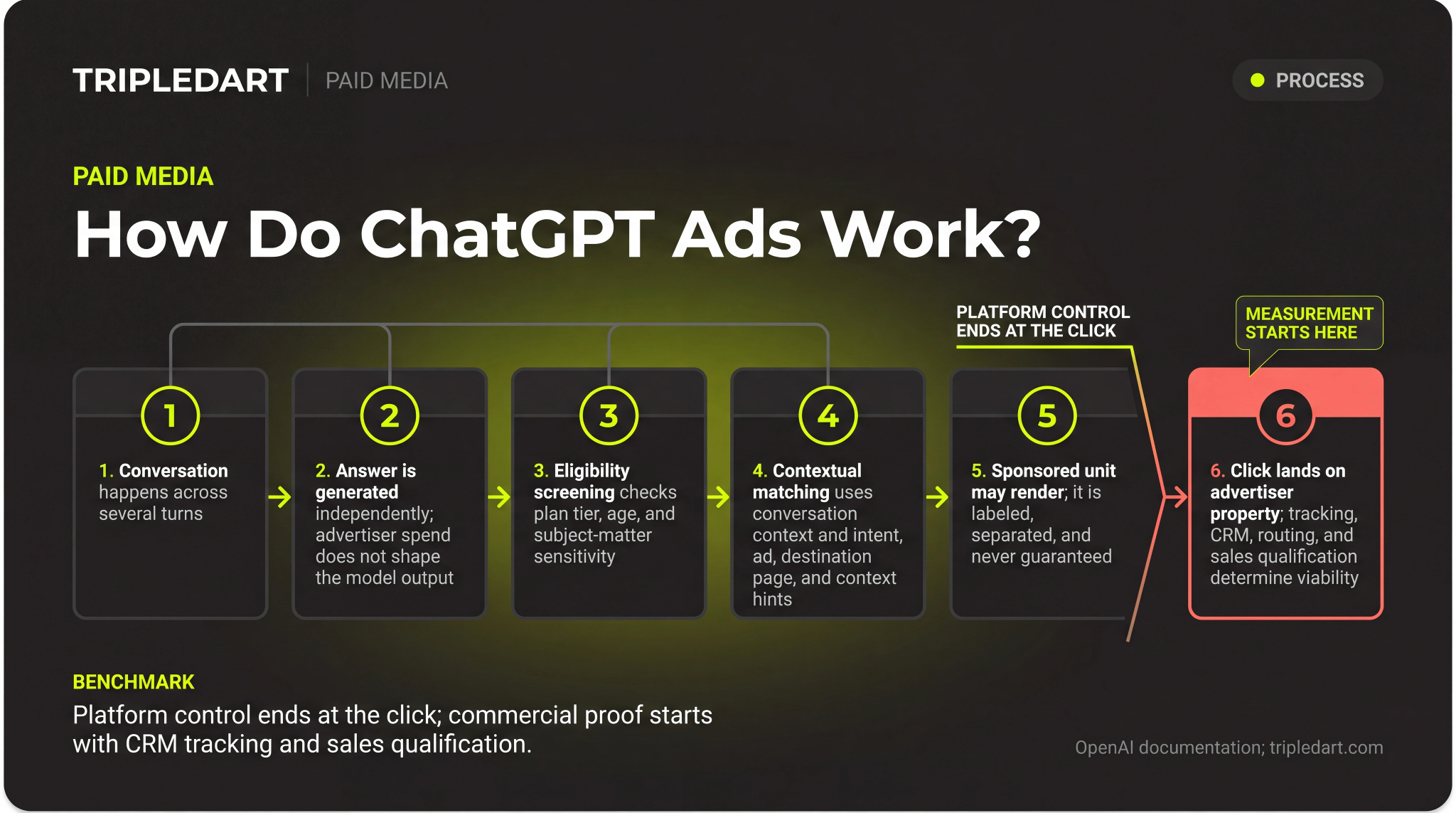
A user asks something. ChatGPT answers. Eligibility and safety checks run; the system matches available advertisers against conversation context, your creative, your landing page, and your context hints, and an eligible sponsored unit may beside the response.
Then everything that determines B2B value happens on your side of the click.
Here's the chain in order:
- The conversation happens: The buyer describes a problem, often across several turns.
- The answer is generated independently: Advertiser spend does not shape the model output.
- Eligibility screening runs: Plan tier, age, and subject-matter sensitivity gate whether any ad is eligible.
- Contextual matching occurs: Conversation context and intent, your ad, your destination page, and your context hints all feed relevance.
- A sponsored unit may render: Labeled, separated, and never guaranteed.
- The click lands on your property: Tracking, CRM, routing, and sales qualification decide whether the channel is viable.
Step six is where most emerging-channel tests fall apart. The auction rarely breaks these pilots. The attribution does.
We make the same argument about AI-native paid media channels in general: platform control ends at the click, and commercial proof starts one step later.
Where Do ChatGPT Ads Appear, And Who Sees Them?
Ads render alongside eligible ChatGPT responses, visually separated and labeled as sponsored. OpenAI states they're shown to users on Free and Go plans, and not to Plus, Pro, or Business plan users.
For B2B, that one fact should shape your reach expectations more than anything else on this page.
Think about who inside your target accounts sits on a free plan. Often it's individual contributors, analysts, junior operators, and people researching long before they hold budget authority. Senior buyers at larger companies are frequently on paid or company-provisioned plans, which puts them out of scope.
That doesn't make the channel useless. It makes it an early-stage research layer where you can reach the influencer and the champion, but usually not the economic buyer. Plan your offers around that reality.
Sensitive subject areas are excluded too. Health, mental health, and political contexts have been widely reported as off-limits, which is worth checking early if you sell into healthtech, govtech, or regulated categories.
How Does Contextual Targeting Differ From Keyword and Audience Targeting?
Contextual targeting reads the conversation instead of matching a string. You can't own a keyword, apply exact match, or build a conventional negative list.
Your levers are context hints, creative, and landing-page relevance. Directional inputs that shape where you're eligible to appear, with no guarantee you will. When personalization is enabled, the system also uses broader ChatGPT experience signals. This is a documented targeting signal, not a beta feature.
This is the biggest operational adjustment for paid search teams. The habits that make you good at Google, including match-type discipline, negative keyword hygiene for B2B SaaS, and query mining, don't transfer cleanly.
TripleDart Tip
B2B campaign planning here should focus on context, not keyword lists. OpenAI says ad relevance can depend on the current conversation's context and intent, the ad and landing page, and advertiser-provided context hints. Those hints guide matching but are not exact-match keywords and do not guarantee placement. That makes mapping buyer questions and use cases a more appropriate starting point than treating conversational ads like conventional keyword campaigns.
How To Build A B2B Context-Hint Map
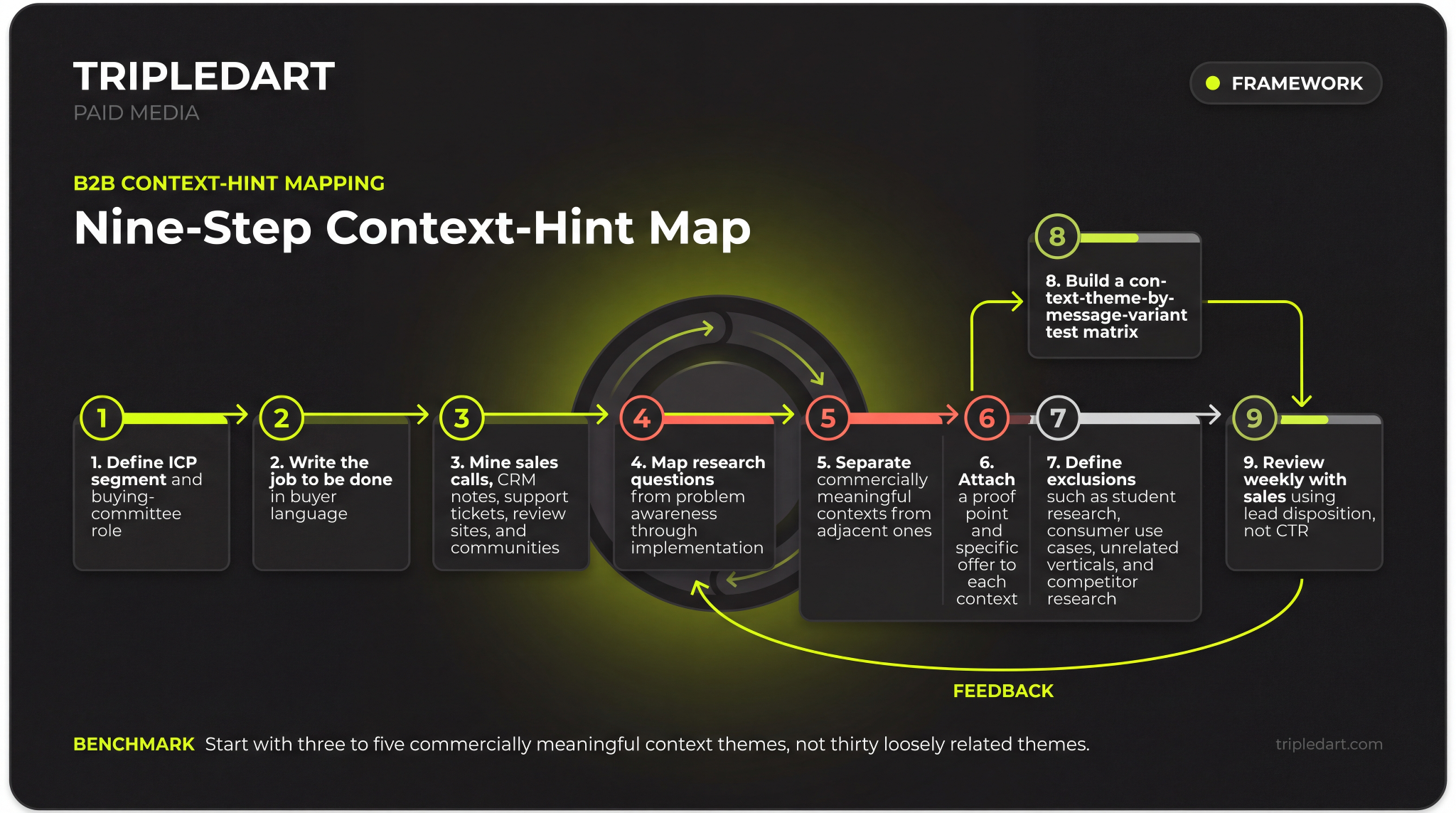
We run this as a nine-step research process, borrowed directly from how we approach AI search visibility.
- Define the ICP segment and the buying-committee role you want.
- Write the job to be done in the buyer's language, not your product's.
- Mine sales calls, CRM notes, support tickets, review sites, and communities for verbatim phrasing.
- Map research questions from problem awareness through implementation.
- Separate commercially meaningful contexts from merely adjacent ones.
- Attach a proof point and a specific offer to each context.
- Define exclusion themes: student research, consumer use cases, unrelated verticals, competitor research.
- Build a context-theme-by-message-variant test matrix.
- Review weekly with sales using lead disposition, not CTR.
How Query Fanout Research Feeds Your Context Map
If you've done AI-search work, you already own most of this. Query fanout keyword generation expands one seed question into the cluster of sub-questions an AI system answers on its way to a response, and it's the closest existing discipline to context-hint planning.
The practical difference in query fanout versus traditional keyword research is intent shape. Traditional research ranks strings by volume. Fanout maps how one problem branches into follow-ups.
Learning how to create query fanout keywords is mostly a matter of prompting your own category questions and recording every sub-question that surfaces.
Good query fanout keyword examples for SEO in B2B look like "how do I consolidate revenue reporting," "what breaks when we move attribution into Salesforce," and "what should a RevOps team own." The best tools for query fanout research are the assistants themselves plus your call recordings; there's no substitute for buyer verbatim.
Applied well, query fanout strategies for AI search improve search visibility across both answer engines and this new ad surface, because both reward topical fit over string matching. Using query fanout keywords for content planning also hands you the landing pages your ads will need.
Two common query fanout keyword research mistakes: collecting 40 loosely related themes when five commercially meaningful ones would do, and measuring results from query fanout keywords at the click stage when the qualification stage is what tells you anything. Our generative engine optimization work holds the same evidence standard.
TripleDart Tip: Start with three to five context themes. Not thirty.
What Ad Formats Exist, And What Do They Mean For B2B Creative?
A sponsored unit carrying advertiser name, headline, description, image, and destination link is the format most relevant to B2B. Commerce-oriented formats like product carousels have been referenced publicly but rarely suit considered-purchase software.
Confirm what's enabled on your account before anyone designs assets.
Creative principles that hold up in a conversational environment: lead with the problem being explored instead of your category label, state a concrete outcome in place of an adjective, use the buyer's own phrasing from your context map, include one substantiated proof element, and offer a lower-friction next step for someone still mid-research.
This carries more weight than usual, and there's data behind why. In the 2026 B2B content research from Content Marketing Institute and MarketingProfs, 40% of marketers named creating content that prompts a desired action as a top challenge. A conversational ad click is precisely where that problem shows up.
How Much Do ChatGPT Ads Cost?
There's no reliable public B2B benchmark for ChatGPT Ads pricing in 2026. You'll need to confirm buying models, objectives, floors, and commitments in your own Ads Manager account.
Any article publishing an "average CPC" for this channel without first-party, representative methodology is reporting an anecdote and calling it a planning input.
What we can say about planning: size your budget by learning requirement, not by a cost assumption copied from a blog.
Use this instead of a benchmark:
Required learning budget = number of qualified outcomes needed for a confident decision × your current cost per qualified outcome on a comparable channel
Swap that second input for live account data the moment you have it. If you need 20 sales-accepted leads to read a signal, and a comparable channel produces one at a known cost, you now have a defensible starting number and a defensible stop-loss.
Five things cannot be benchmarked: effective cost by context, available inventory in your themes, conversion rate on conversational traffic, opportunity rate, and how costs move as advertiser density grows. We treat all five as unknowns until the account proves otherwise, the same discipline we bring to B2B PPC budget planning.
TripleDart Tip: Fund this from an experimentation allocation. Don't cut proven demand capture to pay for a beta.
How Do ChatGPT Ads Compare With Google, LinkedIn, And Meta Ads?
ChatGPT Ads are a contextual research-and-exploration layer. They don't replace Google demand capture, LinkedIn account targeting, or established retargeting.
The useful question is what job each channel does, and how you stop them from double-counting the same buyer.
Pipeline warning: ChatGPT-influenced buyers often convert later through branded search, direct traffic, or retargeting. A last-click model will undercount this channel and over-credit LinkedIn ads for B2B or brand search. Document your attribution treatment before launch, not after the first report lands on someone's desk.
Case Study - Helpshift
Helpshift Achieved 16x Pipeline Influence and 5x ROAS in 24 months with LinkedIn ABM, SEO, and AI SEO.
“They helped us define our ICP more tightly, segment our audiences more effectively, and build messaging tailored to each account segment and persona. That work also fed into how we approach performance: the targeting and messaging became more aligned rather than running in silos,” Viral Patel, Head of Marketing, Helpshift.
Read the full Helpshift case study →
How Do You Launch a Pipeline-First ChatGPT Ads Pilot?
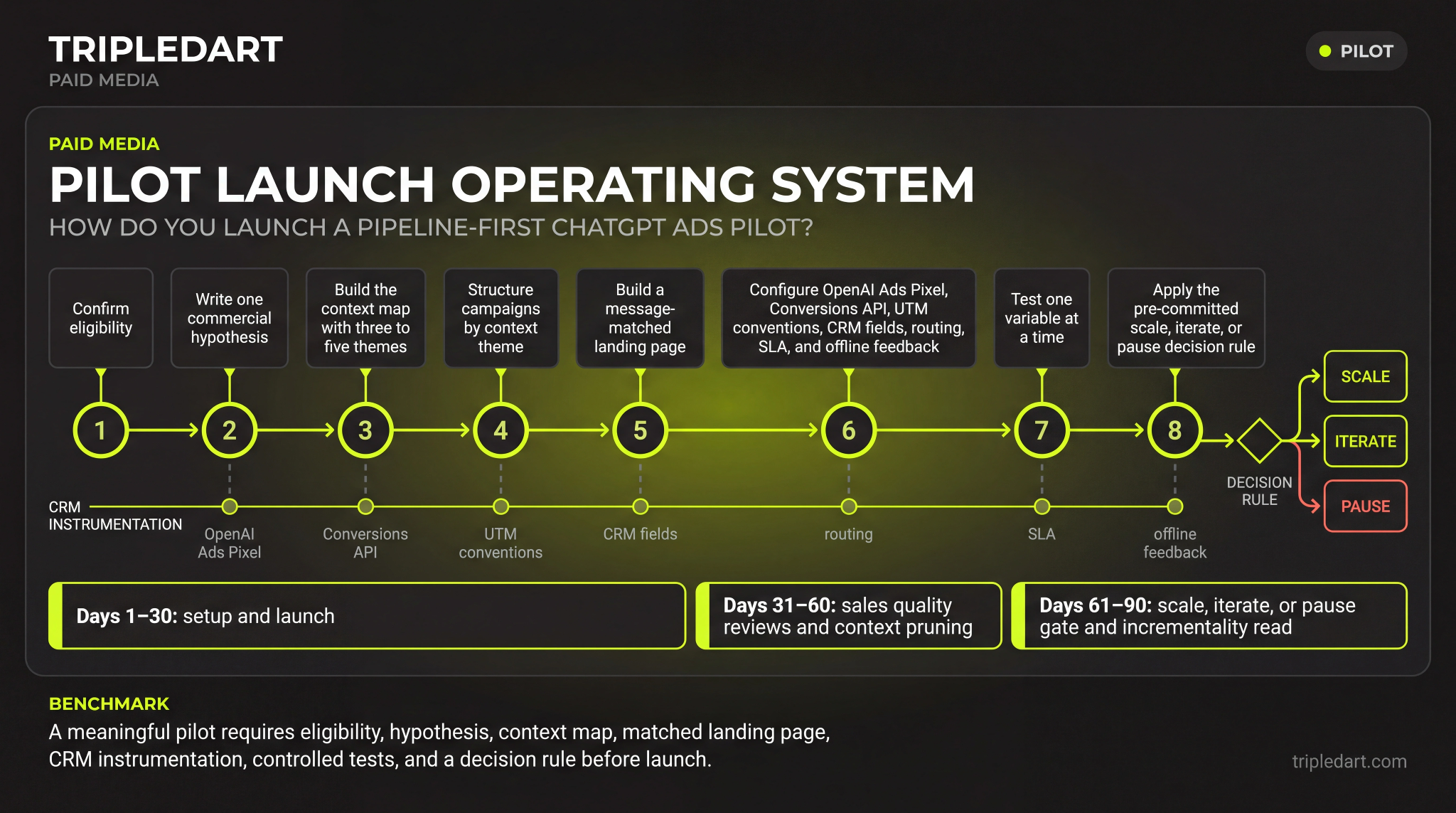
A meaningful pilot needs eight things in place before launch: confirmed eligibility, one written hypothesis, a small context map, a campaign structure organized by theme, a message-matched landing page, CRM instrumentation, controlled tests, and a pre-committed decision rule.
Step 1: Confirm eligibility. Entity approval, country availability, category restrictions, Ads Manager access, and review timelines. This alone can take longer than the media test.
Step 2: Write one commercial hypothesis. For example: when mid-market RevOps leaders research how to consolidate revenue reporting, an assessment offer will generate demo-qualified interest at an acceptable cost per opportunity. ICP, context, offer, and success metric all named in one sentence.
Step 3: Build the context map. Three to five themes from the nine-step framework above, each tied to a defined ideal customer profile.
Step 4: Structure by context theme. Organize campaigns so you can read lead quality by theme. Keep the three live objectives in mind: reach, clicks, conversions.
Step 5: Build a message-matched page. Immediate problem match above the fold, plain-language offer, one proof element, a primary CTA, a lower-friction secondary path, and qualification fields. Never send conversational traffic to your homepage.
Step 6: Configure tracking on both sides. On the OpenAI side, install the OpenAI Ads Pixel for browser events and the Conversions API (CAPI) for server-side events, passing the same event ID through both so conversions aren’t double-counted. On the CRM side, set UTM conventions, lead-source and campaign fields, conversion definitions, enrichment, routing rules, a follow-up SLA, and disposition values. Then close the loop by pushing SQLs and closed-won deals back to OpenAI through CAPI. Our guidance on CRM tracking systems covers the build.
Step 7: Test one variable at a time. Context theme, value proposition, offer type, or landing page. Keep an experiment log with hypothesis, change, cost, quality outcome, and next action.
Step 8: Apply the decision rule you wrote in week one. Strong qualified-lead signal, scale and add adjacent themes. Weak quality with strong volume, fix the offer and context before touching bids. Weak on both, pause and re-check eligibility and reach before blaming creative.
30/60/90 shape: Days 1 to 30 are eligibility, hypothesis, context map, landing page, instrumentation, launch. Days 31 to 60 are sales quality reviews, context pruning, and first pipeline signals. Days 61 to 90 are the scale, iterate, or pause gate plus a cross-channel incrementality read.
How Should You Measure ChatGPT Ads Beyond Clicks?
Measure in five tiers: platform signals, site signals, qualification signals, commercial signals, and incrementality. Platform metrics are optimization inputs only.
The channel decision belongs to tiers three and four, qualified-lead rate and opportunity creation, because click-level results never justify a B2B channel commitment.
The measurement architecture runs: ad click → UTM-tagged landing page → conversion event → CRM record with source and campaign fields → enrichment and scoring → routing and SLA → sales disposition → opportunity stage → pipeline dashboard → offline conversion feedback.
First-party data discipline pays off here, and the numbers back it up. In the 2026 CMI and MarketingProfs research, 52% of B2B marketers said collecting first-party data improved their targeting and personalization. On a channel that gives you no audience data, your CRM is your only signal.
TripleDart Tip
A ChatGPT ad test needs downstream measurement, not just click reporting. OpenAI says advertisers receive aggregated, non-identifying performance information, without access to individual chats or chat histories. The practical implication is to connect campaign reporting to consented lead and CRM outcomes, then assess qualified leads and pipeline alongside views and clicks. Platform reporting alone cannot show which individual conversation led to a conversion.
Keep an eye on ChatGPT Ads conversion matching developments too, since matching capability is the single variable most likely to change how readable this channel becomes.
Case Study - CleverTap
CleverTap Reduced Cost per SQL by 42% and CP-Opp by 20% in 24 months
“TripleDart is our trusted partner for paid marketing. With a wealth of experience working within the SaaS marketing space, TripleDart brings invaluable insights and best practices to get the most out of paid campaigns,” Rahul Mantena, Lead of Performance Marketing, CleverTap
Read the full CleverTap case study →
Who Should Test ChatGPT Ads Now, And Who Should Wait?
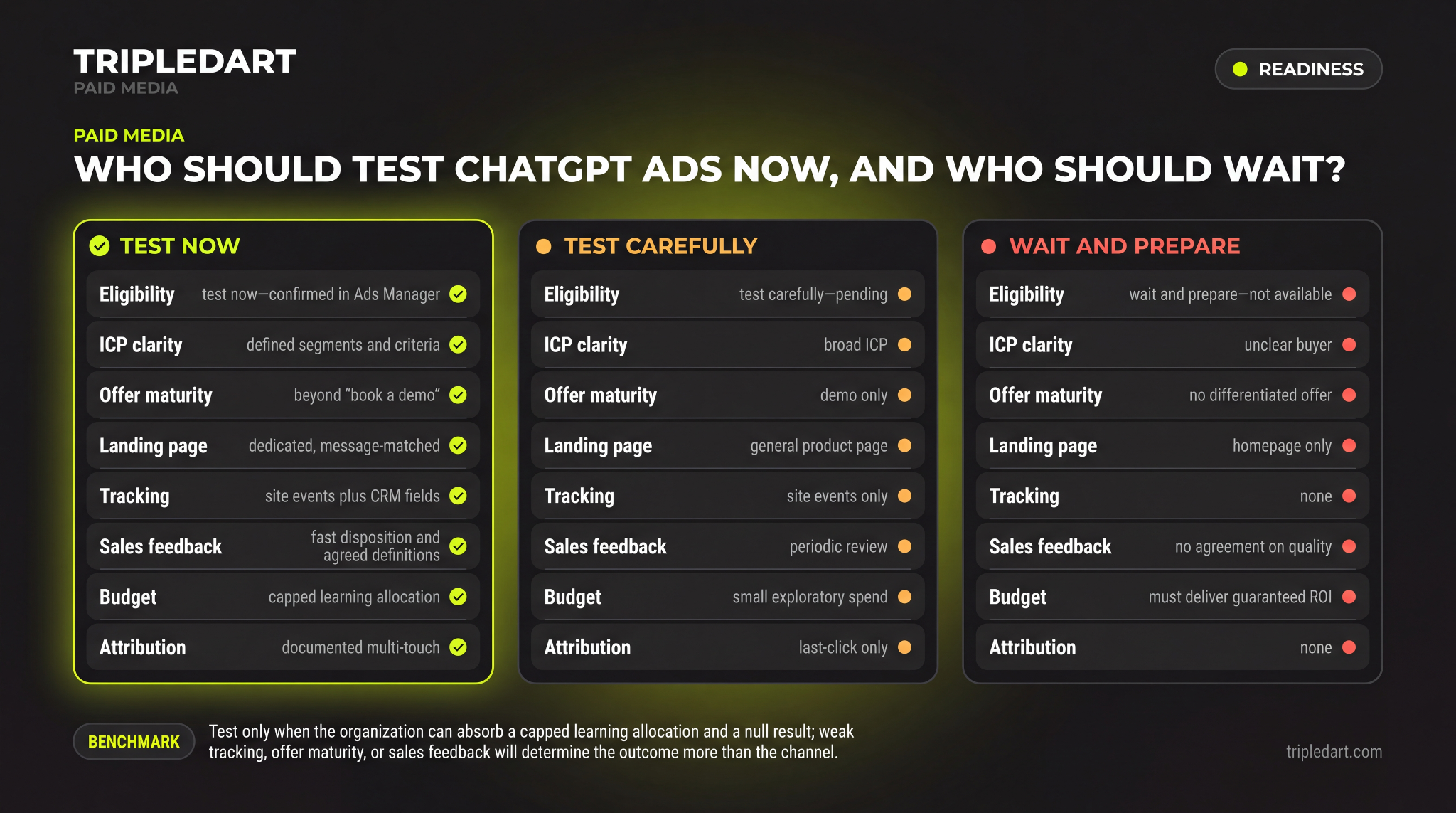
Test now if you're eligible, have clear ICP definitions, a stage-appropriate offer, a dedicated landing page, CRM-level tracking, a fast sales feedback loop, and a capped budget that can absorb a null result.
Wait if any of the last four are missing. The channel won't be the reason your test fails.
Strong-fit profiles: products buyers research in natural language, self-serve or product-led SaaS, high search-and-compare categories, and teams with existing AI visibility that reinforces paid claims.
Wait-and-prepare: narrow named-account requirements, regulated categories with unresolved eligibility, and any team that can't accept a null result.
One more thing worth noting. AI fluency stopped being the differentiator a while ago. 95% of B2B marketers said their organizations use AI-powered applications in the 2026 CMI and MarketingProfs report, while only 39% of those using AI for content said it improved performance.
Access is common; disciplined application is not.
What About Privacy, Brand Safety, And Internal Approval?
Advertisers receive aggregated, non-identifying performance reporting. No chat logs, no conversation history, no memories, no individual user identity.
Ads are separated from generated answers and shouldn't be presented as endorsements. Your privacy and legal stakeholders will ask for these points in writing, so have them ready.
Two things to clarify internally before approval: turning off ad personalization isn't necessarily the same as removing ads, and sensitive-topic exclusions apply regardless of your targeting intent.
A short pre-launch checklist: data-use and DPA review, landing-page consent and tracking review, substantiation for every creative claim, regulated-category approval, a documented brand-safety position, Ads Manager access roles, and spend authorization. None of this is legal advice, so have counsel review before launch.
How Can You Build A ChatGPT Ads Test Plan With TripleDart?
Buying the media is the easy part. Converting contextual attention into qualified pipeline, and learning enough within a quarter to make a real allocation decision, is where these pilots are won or lost.
That's the work we do. TripleDart is an AI-native PPC agency, and we build contextual demand research and a context-hint map, creative and message-matched landing pages, campaign execution, and the RevOps layer underneath: CRM fields, routing, enrichment, scoring, offline feedback, and attribution. The pilot delivers a commercial answer.
Our paid media team, led by co-founder and Head of Paid Media, Sabarinathan, has managed more than $300 million in advertising spend across B2B SaaS, AI, fintech, and enterprise software. We hold the same standard whether the channel is AI performance marketing, AI-assisted Google Ads, or a brand-new surface like this one.
Before you spend on an emerging channel, get the test design right. Talk to TripleDart about a ChatGPT Ads readiness assessment covering eligibility, context strategy, landing pages, measurement architecture, and pipeline reporting.
Frequently Asked Questions About ChatGPT Ads
What Are ChatGPT Ads?
They're sponsored placements shown alongside eligible ChatGPT responses, clearly labeled and separated from the AI-generated answer. They match conversation context instead of bid keywords, and eligible business advertisers purchase them through OpenAI Ads Manager.
Are ChatGPT Ads Based on Keywords?
No. Relevance depends on the conversation's context and intent, your ad, your landing page, and context hints provided by the advertiser. Hints are directional signals that guide matching. They aren't exact-match keywords, and they don't guarantee your ad will appear.
Who Sees Ads in ChatGPT?
OpenAI states that ads appear to users on Free and Go plans, and not to Plus, Pro, or Business plan users. For B2B teams, this constrains reach meaningfully, so plan around influencers and researchers instead of assuming access to senior economic buyers.
How Much Do ChatGPT Ads Cost?
There's no dependable public benchmark. You'll need to confirm buying models, objectives, minimum spend, and billing terms in your Ads Manager account. Size your budget by the number of qualified outcomes you need to make a decision, not by a published average CPC.
Can Advertisers See Users' ChatGPT Conversations?
No. OpenAI says advertisers receive aggregated, non-identifying performance information and can't access individual chats or chat histories. That's why CRM-side instrumentation is the only reliable way to evaluate lead quality from this channel.
What Is the ChatGPT Ads Manager?
OpenAI Ads Manager is the campaign environment where eligible advertisers create, target, and report on ChatGPT Ads. Availability is limited by market, entity eligibility, and category, so confirm your access before building creative or landing pages.
Can ChatGPT Ads Support ABM?
Only indirectly. Contextual relevance carries no firmographic guarantee, so you can't reach a named account list the way you can on LinkedIn. Treat it as a complement to account targeting and outbound, never a substitute.
Should B2B Marketers Test ChatGPT Ads in 2026?
Test if you're eligible, instrumented, and funded with a capped learning allocation you can afford to write off. If your tracking, offer, or sales feedback loop is weak, fix those first. They'll determine the result more than the channel does.
How Does TripleDart Help With ChatGPT Ads?
As an AI-native PPC agency, we design and run the full pilot: eligibility checks, context-hint research, creative, message-matched landing pages, CRM and attribution setup, and a pre-committed scale-or-pause rule. It's the same operating model we use across demand generation and LLM SEO programs.