B2B buyers no longer research software the way they did three years ago. About 50% of Google searches now return AI summaries, and that figure is expected to exceed 75% by 2028. Buying committees shortlist vendors inside ChatGPT and Perplexity before they ever land on your site. Traditional SEO output (pages per month, keyword rankings, organic sessions) can't keep pace with that shift through headcount alone.
TripleDart has rebuilt its entire workflow around AI agents for SEO after running SEO and AI search across 300+ B2B companies in 12 countries. AI agents are the only way to operate at the speed and scale this market demands. Senior operators remain accountable for outcomes.
Each of the eight tasks an AI SEO agent does is supervised by a senior operator. Each one is measured against a single metric: pipeline.
Agents are the leverage. The system converts that into revenue.
How Are AI SEO Agents Different From AI Writing Tools?
An AI SEO agent is an autonomous, multi-step system that plans, acts, monitors, and self-corrects across SEO tasks. It doesn't wait for a prompt. It ingests data from multiple sources, makes decisions based on defined objectives, executes actions across tools via APIs or MCP connections, and feeds results back into the next cycle.
Tools like ChatGPT, Jasper, or Copy.ai generate output on a single command. They're powerful for specific tasks and useless for anything that requires planning or persistence. An AI SEO agent handles the full loop: research, analysis, brief creation, technical audit, publishing, monitoring, and flagging for human review.
In our stack, these agents are the execution layer beneath senior human strategy. Humans set direction and own judgment. Agents handle the repeatable work at a volume no team could sustain manually.
How Do AI Agents Compare With AI SEO Tools and AI Writing Tools?
Most guides collapse this three-way distinction into two categories.
AI SEO tools like Ahrefs or Semrush analyze and report, but they wait for a human to act on the data. AI SEO agents connect those data sources, interpret the output, and execute the next action. The human approves decisions.
Why Is 2026 The Turning Point for Agentic SEO?
2026 is the year agentic SEO stopped being experimental and started being operational.
First, AI Overviews became the default on commercial queries, not an edge case. Second, ChatGPT, Perplexity, and Gemini matured into discovery engines where buyers research categories, build shortlists, and form vendor opinions before a first-party visit. Third, according to HubSpot, over 92% of marketers now plan to optimize for both traditional and AI-powered search engines, which means the competitive field inside AI answers is filling fast. Fourth, the Model Context Protocol (MCP) integrated tool access so that agents could operate across a client's full stack without brittle custom connectors.
For our B2B clients, this shift moved pipeline discovery upstream into AI answers. A Head of Engineering at a Series B company isn't starting her vendor search on Google anymore. She's asking ChatGPT which platforms handle her specific use case. AEO and GEO aren't optional overlays on our B2B SEO strategy.
- AI Overviews now appear on the majority of commercial queries
- LLMs function as the new category research layer for B2B buying committees
- MCP standardized multi-tool agent access, making production deployment practical
- Reasoning models became reliable enough to trust with multi-step SEO workflows
How Do AI Agents Fit Into Our SEO System?
TripleDart runs a six-stage loop across every client: Research, Strategy, Create, Audit, Monitor, Fix. AI-powered SEO agents handle the high-volume, repeatable work at each stage. Human operators own the strategy layer and the approval gate before anything touches brand or creates ranking risk.
Slate, our proprietary AI execution layer, connects this loop. It holds shared memory across client contexts, runs our agent library, and feeds output into MarkOps workflows that route tasks to the right operator at the right time. Nearly 60% of companies now have AI agents in production. TripleDart goes one step further and runs single-task agents as a coordinated system.
The human-in-the-loop model is deliberate. Agents propose and execute low-risk tasks automatically: pulling keyword clusters, flagging technical errors, generating draft briefs, monitoring citation counts. High-risk decisions go to a senior operator for review before execution: angle changes, link-building strategy, major redirects, anything that affects brand positioning.
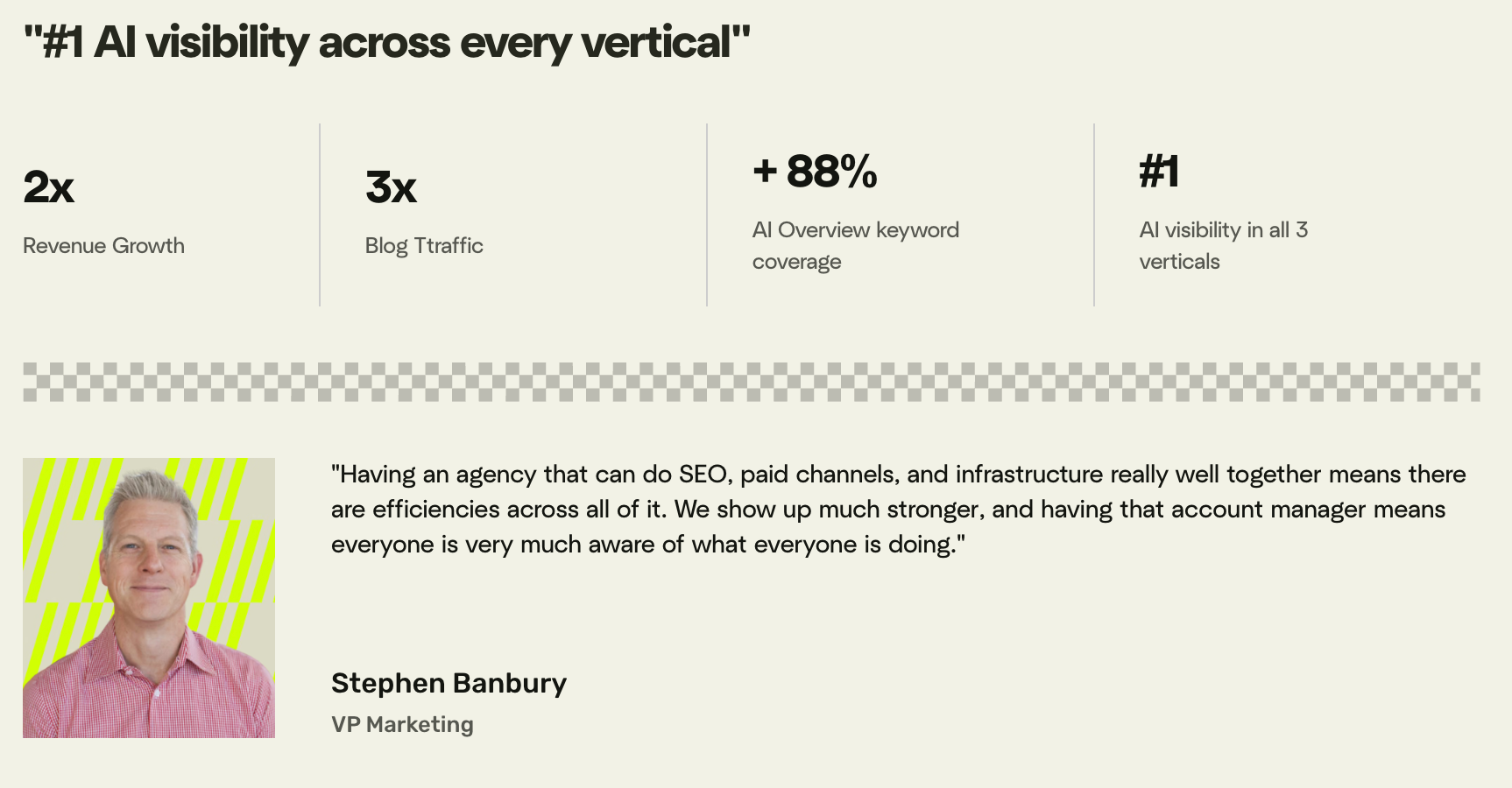
Client Spotlight: ClearlyRated - #1 AI visibility in 3 verticals and 2x revenue growth in 9 months.
This is the unclaimed middle in AI-native SEO. We deliver the operating system the agent runs, with a senior operator accountable for the outcome.
What Are The 8 Ways We Use AI Agents For SEO?
Here's how these agents run in our production workflow, each one supervised by a senior operator and measured against pipeline, not rankings alone.
Keyword and Opportunity Research
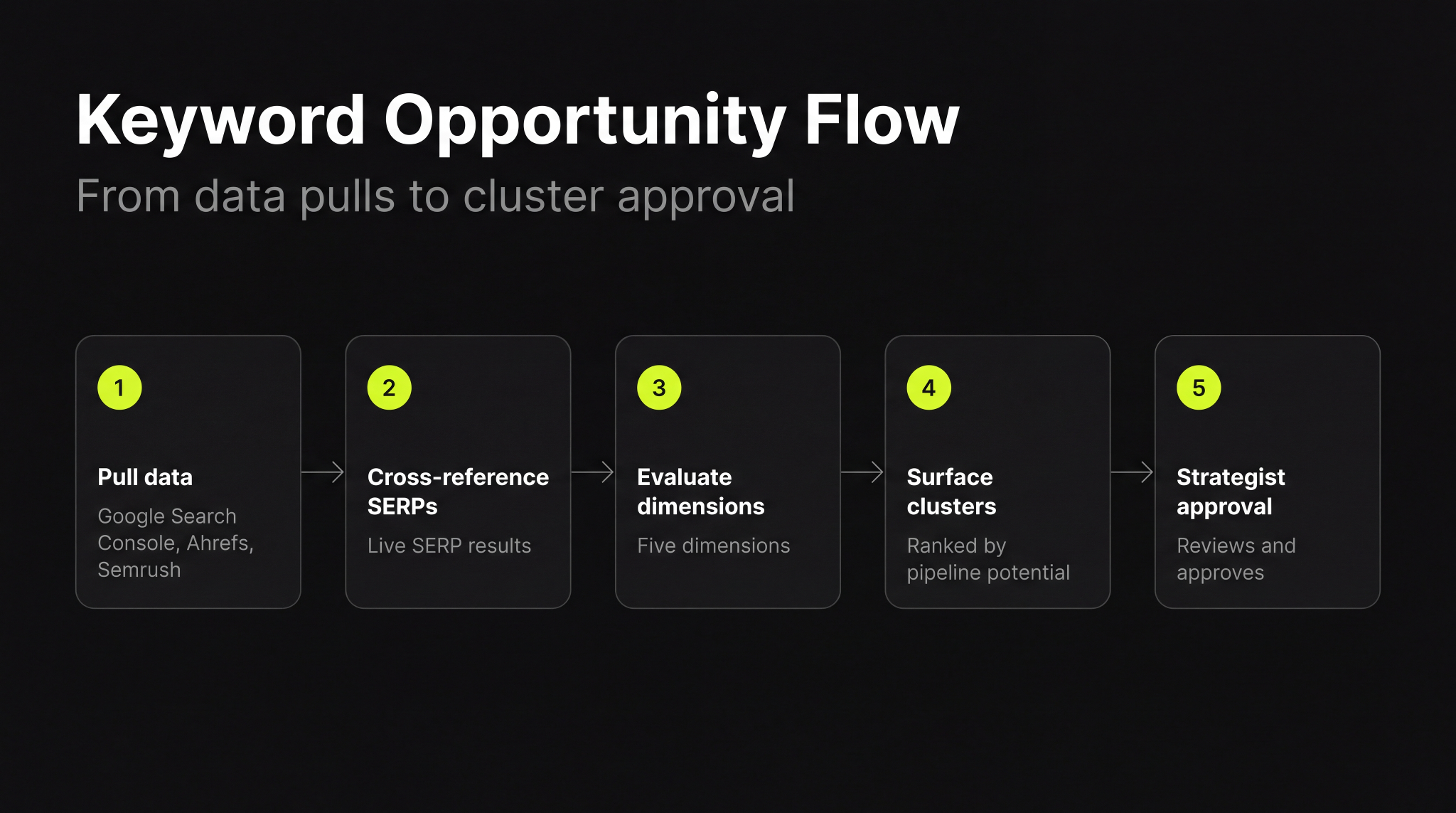
Our agents pull data simultaneously from Google Search Console, Ahrefs, and Semrush, cross-reference live SERP results, and surface keyword clusters.
The agent evaluates each opportunity across five dimensions:
- Search intent and buyer stage fit (informational, navigational, commercial, transactional)
- SERP difficulty relative to existing domain authority
- Topical proximity to clusters where we already hold ranking authority
- Competitive density and content format requirements
- Estimated pipeline value based on category and funnel position
Our keyword research agents surface the terms our clients' buyers search before a purchase decision.
The output feeds directly into a cluster map with priority scores, which a strategist reviews and approves before any brief moves into production.
Topical Authority Map
GSC data contains more signals than most teams extract from it. Our agents analyze impressions, positions, and query clusters to identify topical gaps where a client has partial authority but hasn't fully covered the cluster. A few strategic pages in the right cluster can tip an entire topic into ranking.
The agent maps existing pages against query clusters, identifies which clusters have gaps, and scores each gap by authority proximity and pipeline value. Clusters where a client already ranks for several related terms but is missing one or two supporting pages get flagged as fast-win targets. Clusters where the client has no presence and low authority get deprioritized for later.
Across 300+ clients, this is consistently where we find the fastest ranking wins. The gap identification isn't novel. Routing those gaps by pipeline value rather than traffic potential is what separates this from standard topical authority work.
Content Strategy and Brief Creation
Our agents generate data-backed outlines and SERP-informed briefs by pulling from GSC, Ahrefs, Clearscope, and live SERP analysis simultaneously. The brief they produce is the starting point. A human strategist owns the final angle, voice, and competitive positioning.
A well-built agent brief contains:
- Target keyword and intent classification
- Recommended angle based on SERP gap analysis
- H2 and H3 skeleton with entity coverage requirements
- Internal link targets and anchor text suggestions
- Schema type recommendation
- AEO passage structure requirements
- CTA and conversion hook
The human review step is integral to our content strategy. Senior operators check angle differentiation, brand voice fit, and whether the brief serves bottom-of-funnel intent or is being written for traffic that won't convert.
On-Page and Technical SEO Audits
Technical debt accumulates faster than most in-house teams can clear it. Our agents run continuous audits across crawl errors, broken internal links, schema gaps, Core Web Vitals regressions, orphaned pages, and duplicate content, pulling from Screaming Frog, Semrush Site Audit, Ahrefs, and GSC simultaneously.
What sets us apart is how we operate. The agent classifies issues into two tracks.
Instant fixes are executed automatically via Webflow or WordPress CMS integration: meta description length corrections, missing alt text, broken canonical tags, redirect chain resolution. These carry low ranking risk and don't require brand judgment.
Flagged-for-review issues go to a senior operator before anything executes: site architecture changes, large-scale redirect maps, internal link restructuring, schema implementation on product pages. Anything that could move rankings in the wrong direction if done incorrectly gets a human review gate.
Our technical SEO agents monitor continuously, not on a quarterly audit cycle. The difference is catching a crawl budget issue in week two versus discovering it when a client asks why their rankings dropped.
AEO and GEO
This is the section that matters most for the B2B pipeline in 2026. Technical buyers and buying committees are forming opinions and building shortlists inside LLMs before they ever visit a vendor's site. Our GEO and AEO work is built around earning citations in those conversations.
Our agents optimize for AI answer engines through four mechanisms: structuring answer-first passages that are extractable without context, strengthening entity coverage so models can confidently identify and cite the brand, adding structured data that signals credibility, and monitoring which prompts surface the client across each engine.
TripleDart analyzed its client portfolio across January, February, and March 2026 and found that each engine has different citation logic. Perplexity weights freshness and source credibility heavily. ChatGPT pulls from authoritative, well-structured content. Google AI Overviews prioritize pages that already rank well and have clean schema. Our agents run differentiated optimization for each, monitored against the specific prompts our clients' buyers use.
Signeasy’s AI-driven search visibility reached 800 monthly LLM sessions with 60 to 68% monthly growth over six months after TripleDart rebuilt its content architecture for extractability. The sessions came before direct-site visits, which means LLM visibility was functioning as a pipeline trigger.
Struggling with getting your brand cited in AI answers while competitors dominate the conversation? We've helped 300+ B2B SaaS companies build AI search visibility tied directly to pipeline.
Book a call with our SEO Experts
Citation Dashboard
Rank tracking tells you where you appear in traditional SERPs. Citation tracking tells you whether your brand is being cited when a buyer asks ChatGPT to evaluate software choices. We monitor both, and we treat them as connected signals.
Our agents track the following across each client:
- Traditional SERP positions for target keyword clusters
- AI citation count across ChatGPT, Perplexity, Gemini, and Google AI Overviews
- Share of voice relative to named competitors in LLM responses
- Specific prompt coverage for high-intent buyer queries
- Competitor citation trends as a leading indicator
When visibility drops on a high-intent prompt cluster, the agent flags it on the dashboard. An operator reviews, identifies the cause (content staleness, a competitor publishing fresher data, a schema issue, a new SERP entrant), and routes the fix.
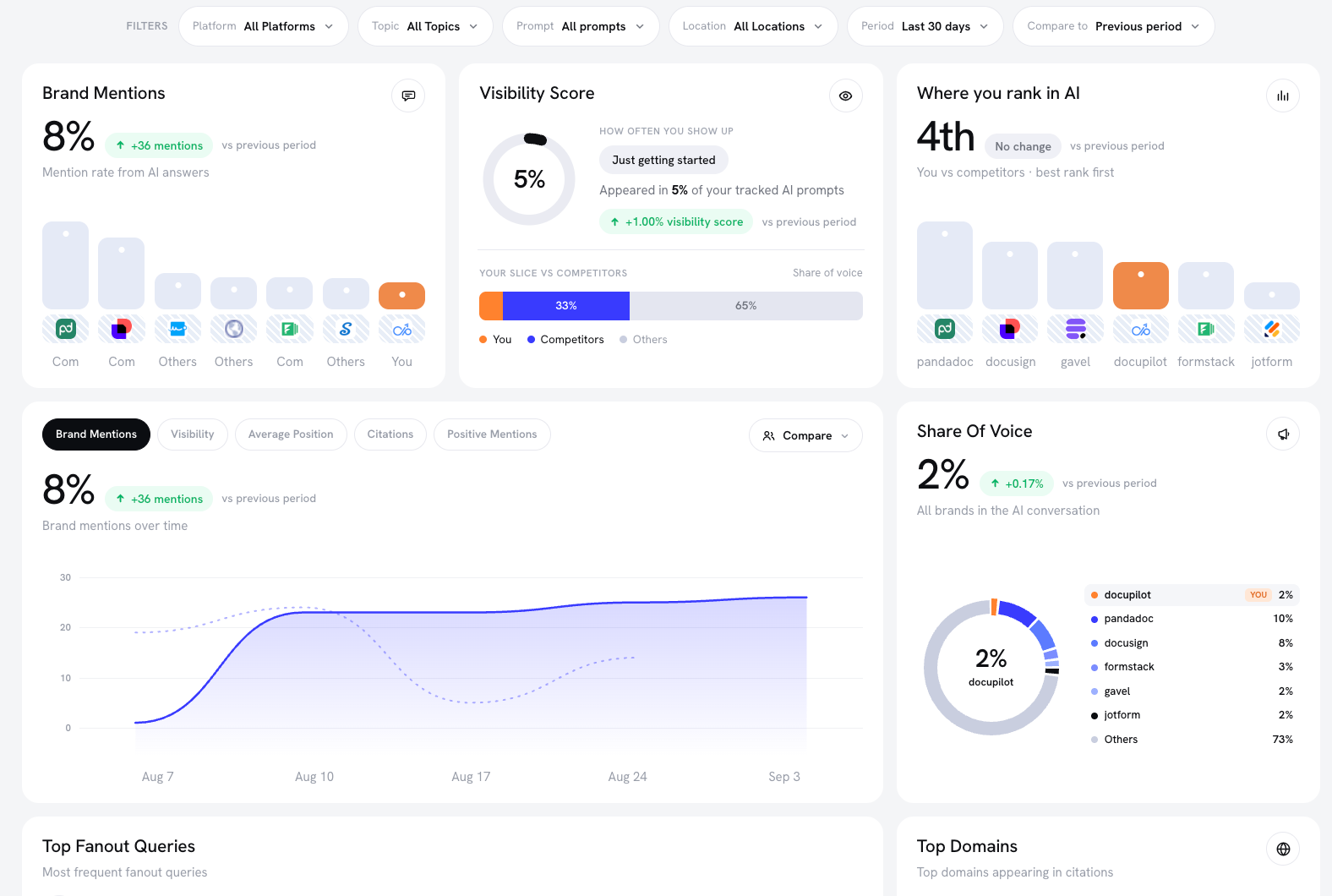
We report on AI visibility as a leading indicator of pipeline. If a client's brand is disappearing from the prompts buyers use to research their category, that's a revenue signal.
Content Refresh
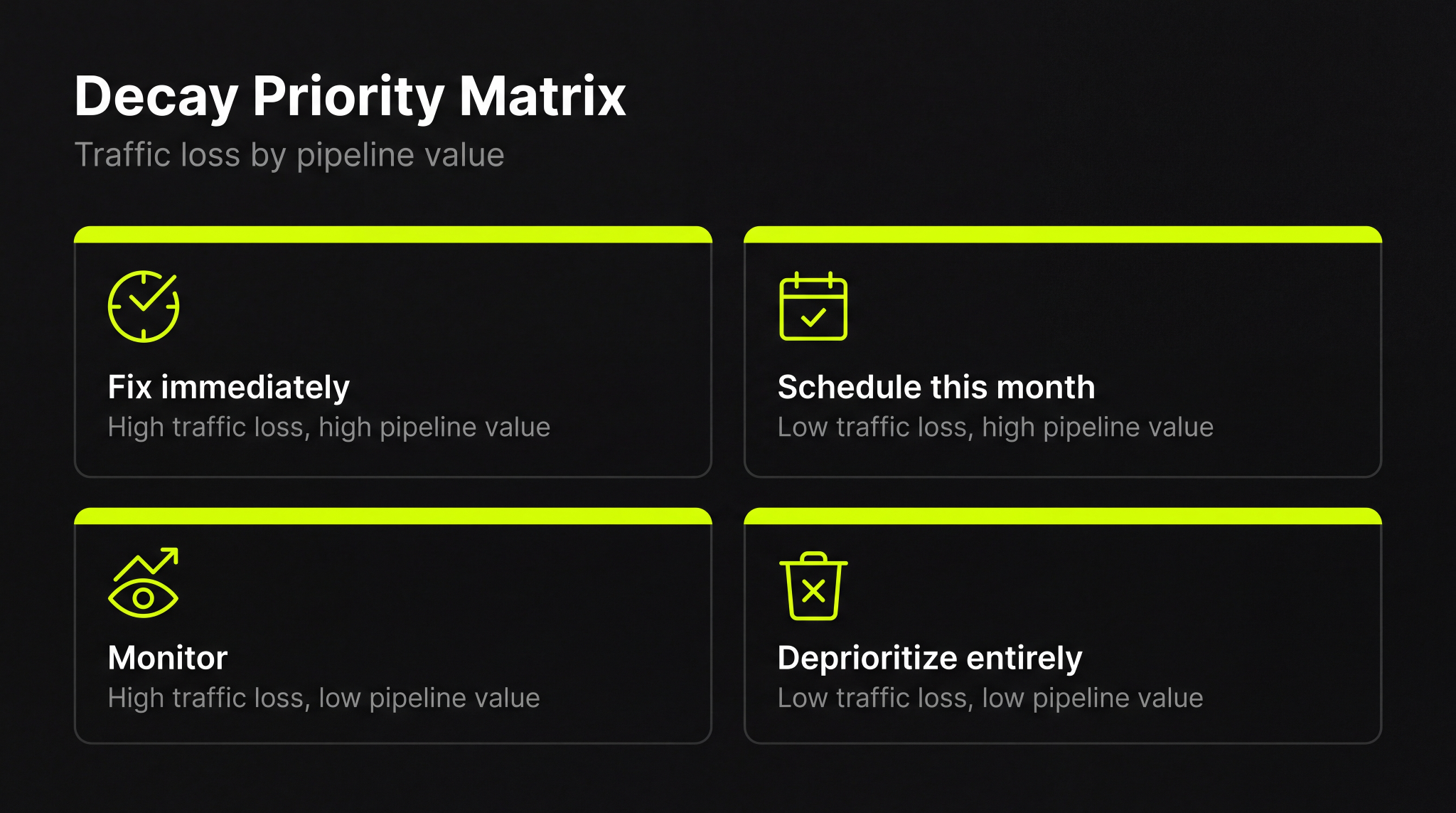
Every site has pages losing ground. The question is which ones to fix first. Our agents flag pages with declining traffic or rankings and score them by a two-axis prioritization: traffic loss magnitude and pipeline value of the affected page.
The result is a four-quadrant decay matrix:
- High traffic loss, high pipeline value: Fix immediately
- Low traffic loss, high pipeline value: Schedule this month
- High traffic loss, low pipeline value: Monitor and deprioritize
- Low traffic loss, low pipeline value: Deprioritize entirely
A bottom-of-funnel comparison page losing 15% of its traffic gets a same-week refresh. A top-of-funnel awareness post losing the same volume gets added to the backlog. The agent flags and scores. A senior operator confirms priority and route.
What a refresh touches depends on why the page is decaying: outdated statistics, SERP format shifts, a competitor publishing a better answer, schema gaps that are now costing featured snippets, or internal link equity that has drained away. Our agents diagnose the cause.
TripleDart’s approach helped Meegle produce a 1,429% increase in blog traffic over nine months alongside a 134% rise in AI citations and 1,185% growth in keyword rankings. The decay detection piece identified which existing pages were underperforming the fastest and had the most pipeline-adjacent intent. Refreshing those before creating new content was the deciding factor.
MCP-Powered Workflow
Model Context Protocol is the standard that gives agents secure, structured read-write access to external tools, CMS platforms, and data systems. Before MCP, connecting an agent to a client's Ahrefs account, Webflow CMS, and Looker Studio required brittle custom API connectors that broke constantly. MCP standardized that interface and turned an AI agent from an advisor into an operator.
Our MCP-powered workflows connect Slate to each client's full stack: GSC for query and impression data, Ahrefs for authority and link signals, Semrush for technical audit data, Webflow or their CMS for content staging. Automation tools handle the orchestration between steps.
Human approval gates stay in the workflow. An agent can draft and stage a content update. It cannot publish without operator sign-off. The speed is agentic. The accountability is human.
Should You Build, Buy, Or Partner for Your AI SEO Agent Approach?
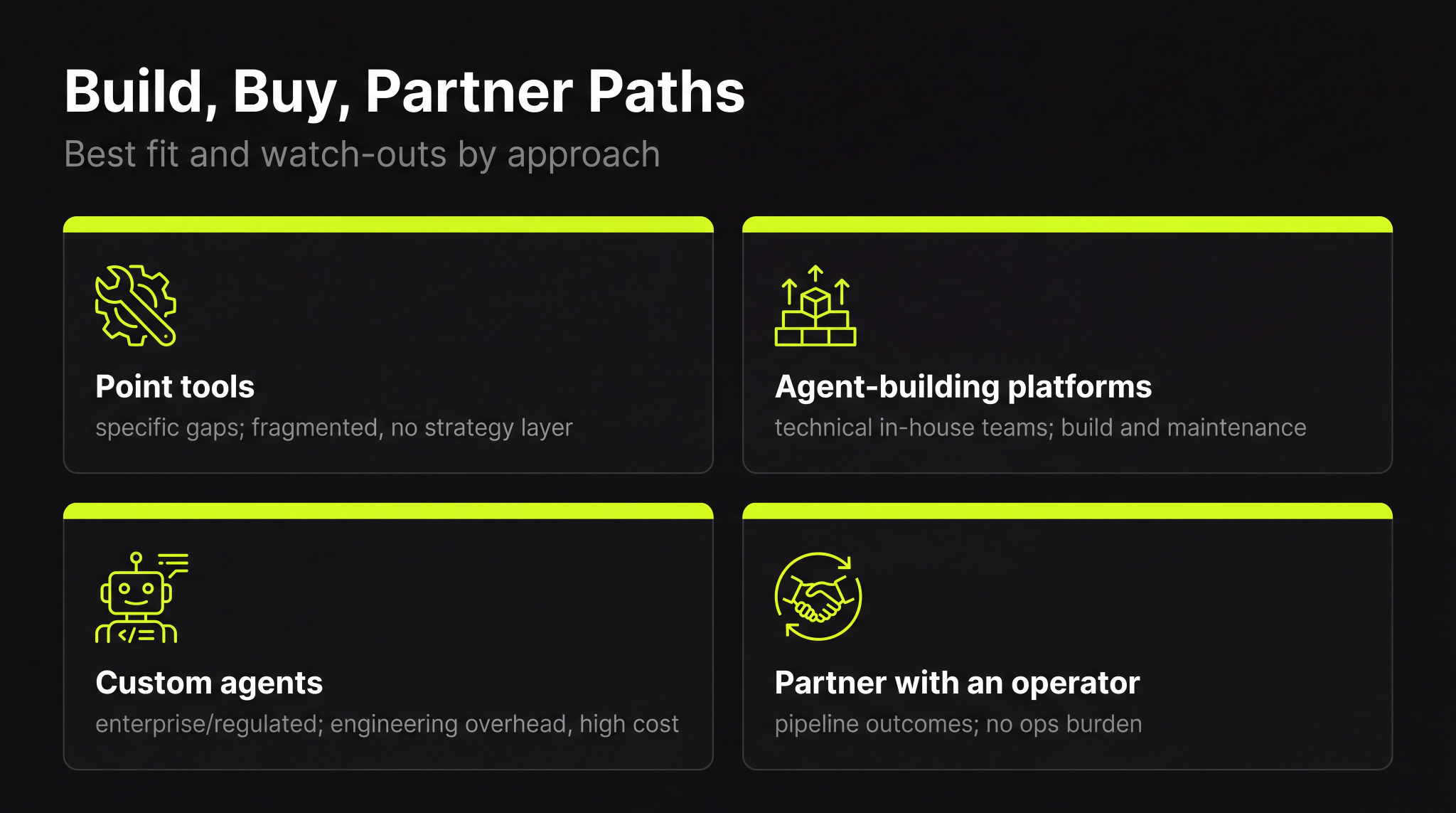
The answer, we’ve found, depends on your team, your budget, and what you're trying to achieve.
Point tools like Frase, Surfer SEO, and Nightwatch are genuinely useful for teams filling specific gaps. They don't connect into a coordinated system, and they have no strategy layer, but they're fast and relatively low-cost.
Agent-building platforms like Gumloop or Claude Projects give in-house technical teams the ability to build and own their workflows. The build time and maintenance overhead are high, and the capability ceiling is lower than a production system running across hundreds of clients.
Custom-built agents make sense for enterprise organizations with engineering resources and specific compliance requirements. The time-to-value is long and the cost is high.
Partner with an operator when you want pipeline outcomes without the operational burden of building and running the agent infrastructure yourself. It’s built for teams that need the outcome.
If you'd like to work with a team running AI-native SEO across 300+ B2B clients with a system already in production, our B2B AI SEO services start at $5000 per month and are built on tested playbooks.
What Can't AI SEO Agents Do?
AI SEO agents are powerful at scale. But they're also limited in ways that break programs when those limits are ignored.
Agents handle tasks where speed and consistency matter more than nuanced judgment: research, audits, monitoring, first-draft briefs, citation tracking, reporting, technical flag generation.
Humans own the work that requires judgment: strategic positioning, brand voice calibration, relationship-based link building and digital PR, reading a market shift before the data shows it, prioritization under ambiguity, and final quality approval on anything that carries the client's name.
A thread on r/n8n about whether AI SEO agents actually work surfaced something we see consistently in practice: agents work well when context and data preparation are handled properly. When they fail, it's almost always because the human setup was insufficient, not because the agent technology is broken.
But can AI agents replace SEO specialists? This question has a clean answer: no. Our model pairs senior operators with agents because the pairing is the product.
"TripleDart is a super helpful team, tremendously aiding in SEO enhancements from blog topics to technical recommendations." — Daniel Henderson, Glean
Glean's organic traffic grew 275% in a 20-month period after working with TripleDart. That result came from agents running the volume work and operators making the strategic calls.
Why Partner With TripleDart For Your AI SEO Operations?
TripleDart is a GTM Operating System for B2B tech, delivered as a service. We've been running AI agents for SEO in production since before most vendors were using the term. Slate, our proprietary AI execution layer, connects every stage of the workflow, from keyword research and topical gap analysis to content decay detection and LLM citation monitoring, with senior operators accountable for every strategic decision.
We've built the playbooks, the governance model, and the attribution infrastructure that make agentic SEO produce pipeline by working with 300+ B2B clients in 12 countries.
If your SEO program needs to work harder and your team doesn't have the bandwidth to build and run an agentic system from scratch, book an SEO audit and we'll show you exactly how we'd run our model for your business.
FAQs
How do AI SEO agents connect to tools like Ahrefs, Semrush, and a CMS without breaking?
Model Context Protocol (MCP) is the standard that gives agents structured read-write access to external tools and data systems. Before MCP, connecting an agent to multiple platforms required brittle custom API connectors. MCP standardizes that interface so an agent can read GSC data, push content to a CMS staging environment, trigger a Semrush crawl, and log results to a reporting dashboard inside one workflow, without constant maintenance.
Can a small B2B SaaS team with limited engineering resources run AI SEO agents?
Yes, but the right approach depends on your team's capacity. Point tools like Frase or Surfer fill specific gaps quickly with no build time, though they have no coordinating strategy layer. Agent-building platforms give technical in-house teams more control but carry build and maintenance overhead. For most scaleup teams without dedicated SEO engineering, partnering with an operator who already has the infrastructure in production is faster and produces results against pipeline.
How do you measure whether AI SEO agents are contributing to the pipeline?
Every agent action, from a brief generated to a schema fix deployed to a page refreshed, gets logged against a pipeline attribution model. That means tying organic activity to SQLs and opportunities. LLM citation counts are treated as a leading indicator of pipeline rather than a content metric, because a buyer researching a category inside ChatGPT before visiting any vendor site represents a revenue signal.
What SEO tasks should always stay with a human even when agents are running the program?
Strategic positioning, brand voice decisions, relationship-based link building, digital PR outreach, reading market shifts before data confirms them, and final quality approval on anything client-facing require human judgment that agents can't replicate. Agents fail most often when the human setup (context, data preparation, and governance) are insufficient. The agent scales the work; the operator guarantees the result.
How does TripleDart help B2B SaaS companies implement AI agents for SEO?
We run the full agentic SEO loop, keyword and opportunity research, topical gap mapping, brief creation, technical auditing, AEO and GEO optimization, content decay detection, and LLM citation monitoring, with senior operators owning strategy and every approval gate. Slate, our proprietary AI execution layer, connects each stage and feeds into pipeline attribution. Our B2B SEO services are built on playbooks tested across 300+ clients, not experimentation, and measured against SQLs and opportunities.