All content was geared for Google. Now, you write for search engines, voice assistants, and AI chatbots.
They all want the same thing: clear, direct answers to specific questions. Answer engine optimization is how you give it to them.
In 2024, Gartner predicted traditional search volume would drop by 25% as buyers moved to AI chatbots and virtual assistants. That change plays out in every B2B SaaS buying committee we brief today.
Your content strategy now has to account for how AI platforms find, interpret, and surface information. That starts with structuring your content so an answer engine can quote it without extra scaffolding.
In this guide, we cover what answer engine optimization means, how it compares to traditional SEO and GEO, and the exact steps we run at TripleDart to keep B2B SaaS content visible across AI search.
What Is Answer Engine Optimization?
Answer engine optimization structures your content for AI platforms to extract and cite. The goal is to appear inside featured snippets, voice results, and AI summaries while still earning organic traffic.
Our SaaS AEO practice spans the platforms that matter most in 2026:
- Google AI Overviews (now woven into AI Mode)
- ChatGPT with browsing and citations enabled
- Perplexity AI
- Claude
- Microsoft Copilot
- Voice assistants: Siri, Alexa, Google Assistant
Search engines don't pull one sentence and move on. They synthesize across sources, weight recency and authority, and format responses conversationally. Users ask detailed natural-language questions and expect immediate clarity.
This is the core of how answer engine optimization works. AEO-optimized content solves a real problem in fewer words than competitors, formatted so machines can quote you as a source confidently.
A user in r/AskMarketing described it as: "build(ing) pages and assets that AI can confidently quote as a 'source', not just rank as a search result."
That mental model drives every B2B SaaS engagement we run.
If you're new to this, the fastest way to understand answer engine optimization is simple: write the answer first, prove it second, and mark it up so a machine can find it.
How Does Answer Engine Optimization Differ From Traditional SEO?
Traditional SEO puts you in the search results. AEO puts you directly into the conversation. The AEO vs SEO difference matters because visibility alone no longer converts. Users expect an answer.
The technical work differs too. AEO leans harder on:
- Structured data: FAQPage, HowTo, and Article schema help AI systems understand your content's purpose.
- Entity optimization: clearly defining people, products, and their relationships builds accurate knowledge graphs.
- Voice readiness: conversational copy that matches natural speech.
- Content chunking: short paragraphs and direct answers models can pull without losing context.
Traditional SEO builds the authority that helps AI discover your content, and AEO makes sure they can extract and cite it. For deeper breakdowns, see our guides on SEO vs GEO and the full AEO vs SEO comparison.
51% of B2B software buyers now begin vendor research in an AI chatbot rather than Google, up from 29% in April 2025. Classic ranking is no longer the front door.
What Are The Differences Between AEO And GEO?
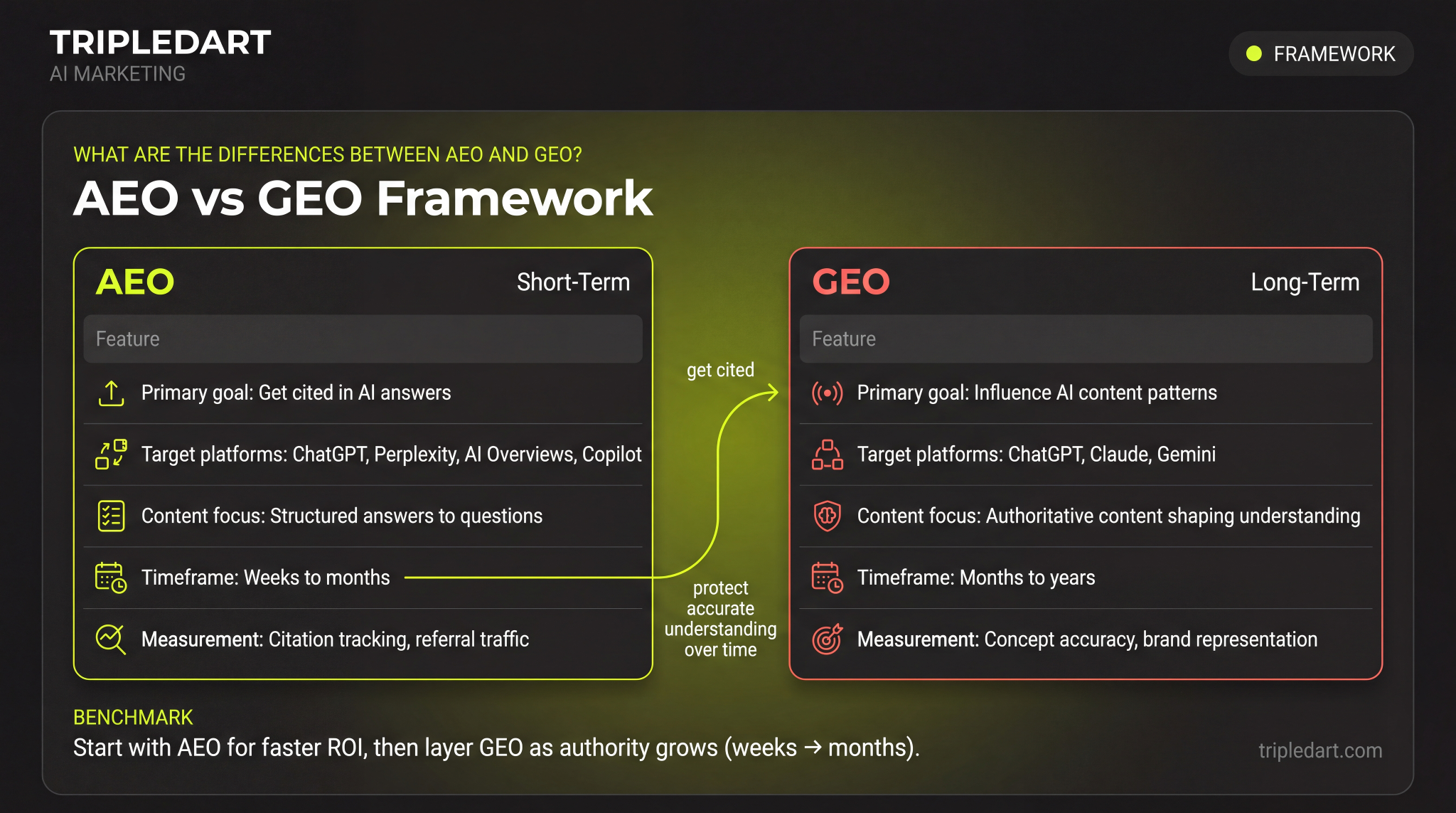
AEO and Generative Engine Optimization both address AI-driven discovery, but they target different parts of the stack. AEO focuses on getting cited in answers to specific queries. GEO takes a longer view, shaping how AI systems understand concepts tied to your business over time.
Here's a practical example. When someone asks "How do I implement hreflang tags for a multi-regional SaaS site?", AEO makes your content the clearest, most authoritative answer. GEO makes sure AI systems represent your methodology accurately when they generate content about multi-regional SaaS strategy in general.
Most B2B SaaS companies start with AEO for faster ROI and layer in GEO as authority grows. Our co-founder Manoj Palanikumar breaks down AI search myths in his interview, and our generative engine optimization guide covers the full picture.
Users in r/DigitalMarketing are also learning these terms in real-time. Their conclusion is that AEO makes your content easy for an AI to lift as the answer when someone asks a question. GEO is about influencing how the generative model represents your space.
Should Your Business Invest In Answer Engine Optimization Now?
Yes. The data is unambiguous, and the window to establish citation dominance is open now.
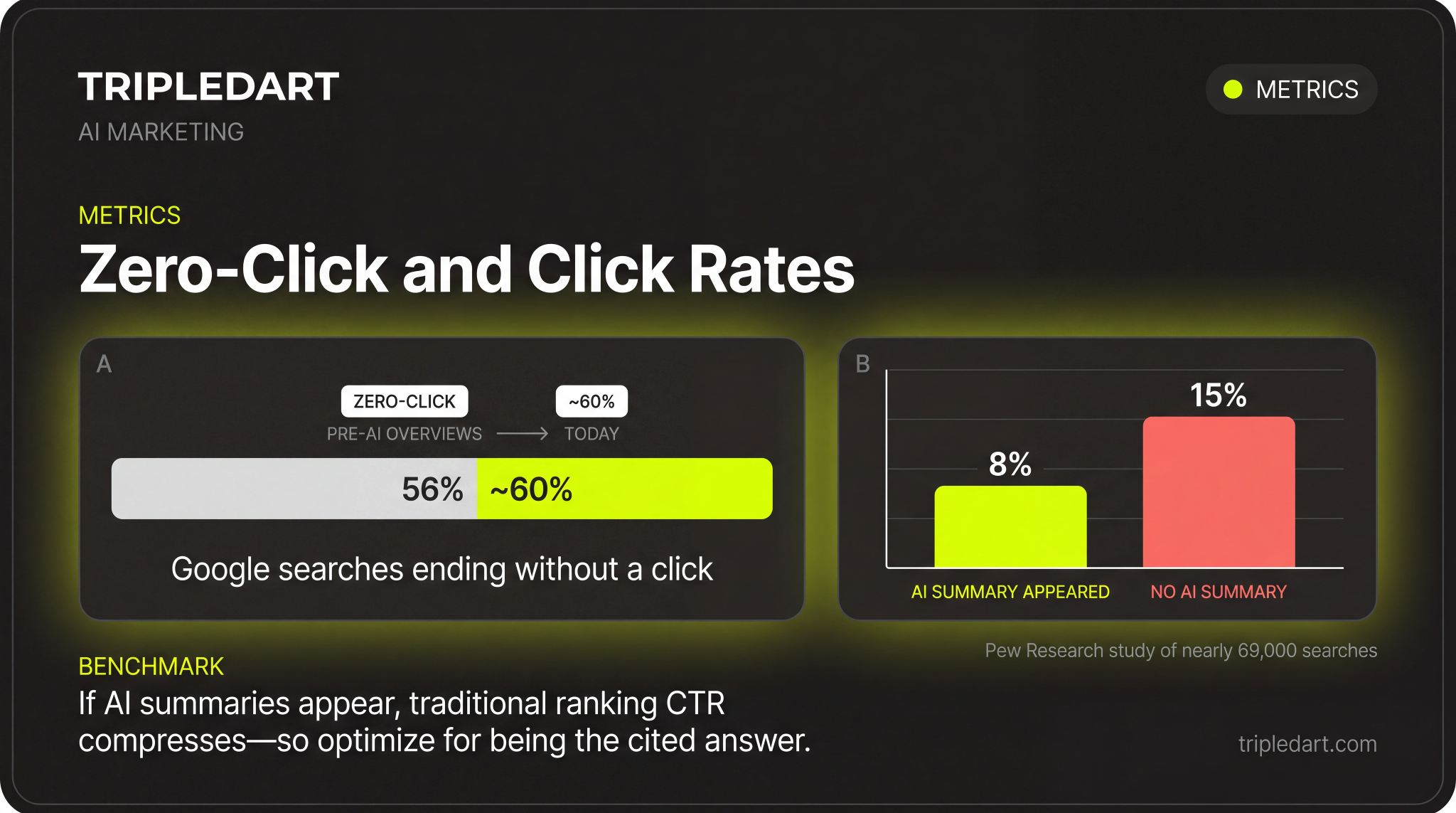
Zero-click search has climbed from 56% pre-AI Overviews to roughly 60% of Google searches ending without a click today. In a Pew Research study of nearly 69,000 searches, users clicked a traditional result on just 8% of visits when an AI summary appeared, versus 15% when it didn't.
The upside is where it gets interesting. AI referral traffic converts at 11.4% globally in ecommerce, compared with 5.3% from organic search. Fewer visits, far higher intent, because the engine pre-qualifies your visitor before they land.
Scale isn't a question either. ChatGPT alone has 900 million weekly users, and AI referral traffic is growing by roughly 1% each month on average across the web.
For B2B SaaS, this is both a threat and an opportunity. If a buyer asks an AI tool "What's the difference between SEO and SEM?", your content should be structured so the model recognizes, summarizes, and cites it instantly. That's the new standard for visibility.
A practitioner in r/seogrowth said the best approach is a combination of strong SERP analysis, schema implementation, and AI-assisted content structuring. No single lever does it alone.
How Can You Optimize Content For AI Search Visibility?
Optimizing content for answer engines comes down to three levers: extraction, structure, and intent. Good writing alone won't get you cited. You need a repeatable system built around how AI platforms actually serve answers.
Here's the playbook we run across our AI SEO services.
Start With User Intent
People don't search keywords. They ask questions, sometimes bizarrely specific ones. You either show up clearly, or you're invisible.
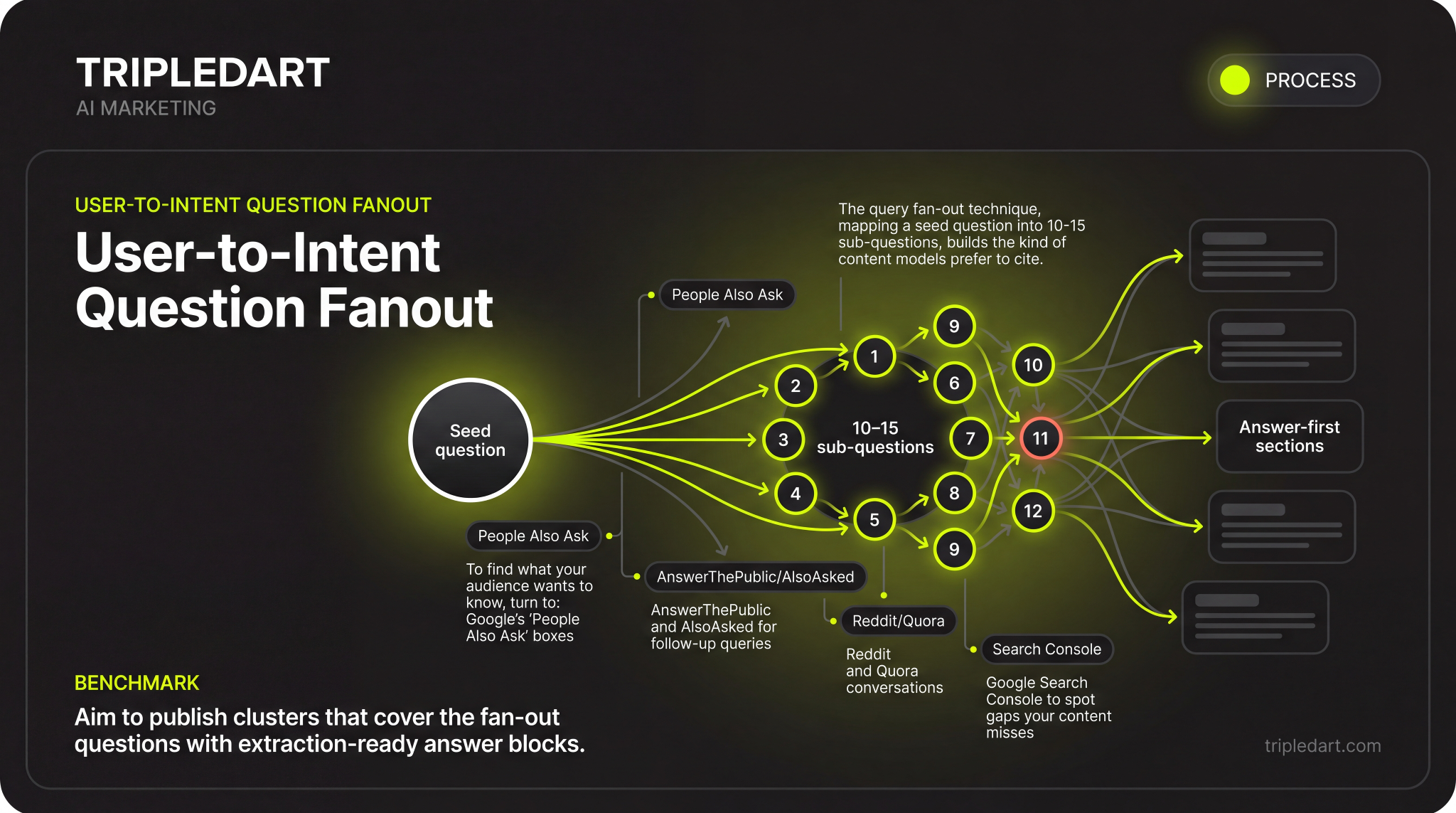
To find what your audience wants to know, turn to:
- Google's "People Also Ask" boxes
- AnswerThePublic and AlsoAsked for follow-up queries
- Reddit and Quora conversations
- Google Search Console to spot gaps your content misses
Not every question is worth building around. Look for clear search volume, commercial or informational intent, and product fit. Use the query fan-out technique: map a seed question into 10 to 15 sub-questions and build the kind of content models prefer to cite.
That work overlaps cleanly with keyword research and customer journey mapping. AEO is a layer on top of strong intent work.
Make Structured Data Your Priority
Schema markup is your ticket to getting noticed by Google, voice assistants, and AI tools. Mark up your content as FAQs, how-to guides, product specs, and service details. If your CMS makes this hard, Google's Structured Data Markup Helper closes the gap fast.
For B2B SaaS specifically, schema that ties your product entity to feature, integration, and category entities is what makes a page eligible for entity-level citation. Loose, unmarked copy rarely gets picked. Our guide on schema markup for AI SEO walks through the exact types to prioritize.
How RAG fits in: Retrieval-Augmented Generation is how modern AI finds and folds in external information. To use it, build clear entity relationships (Product to Features to Benefits), use consistent terminology instead of synonyms, and answer the what, why, how, and when explicitly.
Write Like Humans Talk
Voice search is conversational. Keep sentences short. Drop jargon unless you need it. Write exactly as you'd say it out loud.
Instead of optimizing for a typed keyword like "seo tools," optimize for a spoken question: "What is the best SEO tool for a small marketing team?" When your written answers sound natural, they translate better across voice, text, and AI summary formats.
Deliver Quick, Scannable, Direct Answers
Featured snippets deliver answers in around 40 to 60 words, the length users prefer for direct queries. Get straight to the point:
- Lead with your key insight
- Bullet supporting points clearly
- Include summaries and FAQs
- Use comparison tables for head-to-head data
Keep answer blocks to one to three sentences. Each section should stand alone well enough that a model can pull it without surrounding context. Every H2 should work as a standalone answer. These AEO content structure guidelines are what make a page extractable.
Build A Trust Block
One structural element competitors overlook: a trust block near the top of high-value pages. Show the author and credentials, the last-updated date, cited sources, and a one-line answer summary. AI systems weight recency and provenance heavily, and buyers do too.
Optimize for Specific AI Models
Different platforms reward different signals. The mix that wins a Google AI Overview citation isn't the mix that wins a Perplexity citation.
Google AI Overviews prioritizes E-E-A-T, clear headings, and schema, and rewards recent updates. See our guide on how to rank in AI Overviews.
ChatGPT values topic depth and strong domain authority with clear entity relationships. Build definitive guides with clean definitions. Our ChatGPT ranking guide has the full playbook.
Perplexity weights recency heavily and favors direct answers with numerical data. Keep time-sensitive content fresh. Our Perplexity ranking guide covers the specifics.
Voice assistants prefer concise spoken-language answers, often pulled from snippets. Keep answers brief and cover who, what, when, where, why, and how.
Keep Refreshing What's Working
Search changes fast. You can't optimize once and walk away. We run a monthly loop on top pages: check which queries surface us, audit snippet wins, review scroll and bounce behavior, then refresh in 100 words or less.
Sometimes a single rewritten sentence lifts visibility. Regular content refresh work separates one-time wins from sustained AI visibility.
How Can You Start Answer Engine Optimization From Scratch?
If answer engine optimization is new to you, a four-step framework gets you moving. It maps to the pipeline we run on every engagement, and it works whether you're a startup or an enterprise team.
Step 1: Analyze Top AI Responses
Ask ChatGPT, Perplexity, and Google AI Overviews your target questions. Note which sources appear, what format they use, and what makes them citable. Cross-reference the cited domains against your own topical authority map. Gaps between what AI cites and what you cover are your backlog.
Step 2: Create Answer-First Content
Answer specific questions concisely. Lead with a direct answer in the first 40 to 60 words, then expand. Use headings and FAQs as extraction points. Skip the long ramp-up intros, because an engine picks the page that states the answer first.
Step 3: Build Topic Authority
Show depth. Cover related subtopics, cite authoritative sources, and add original insight. Combining text, tables, and visual summaries signals depth to models and protects your citations when competitors publish on the same queries. Clusters beat standalone posts, so a pillar reinforced by six to 10 supporting articles routes back to the same entity and wins faster.
Step 4: Monitor AI Visibility
Track your appearance in AI Overviews, chatbot responses, and voice results. For a fast read on where you stand, run TripleDart’s free AI visibility report. It pulls your top citation gaps into one view in minutes. We cover the full tracking stack next.
How Can You Monitor And Measure AEO Performance?
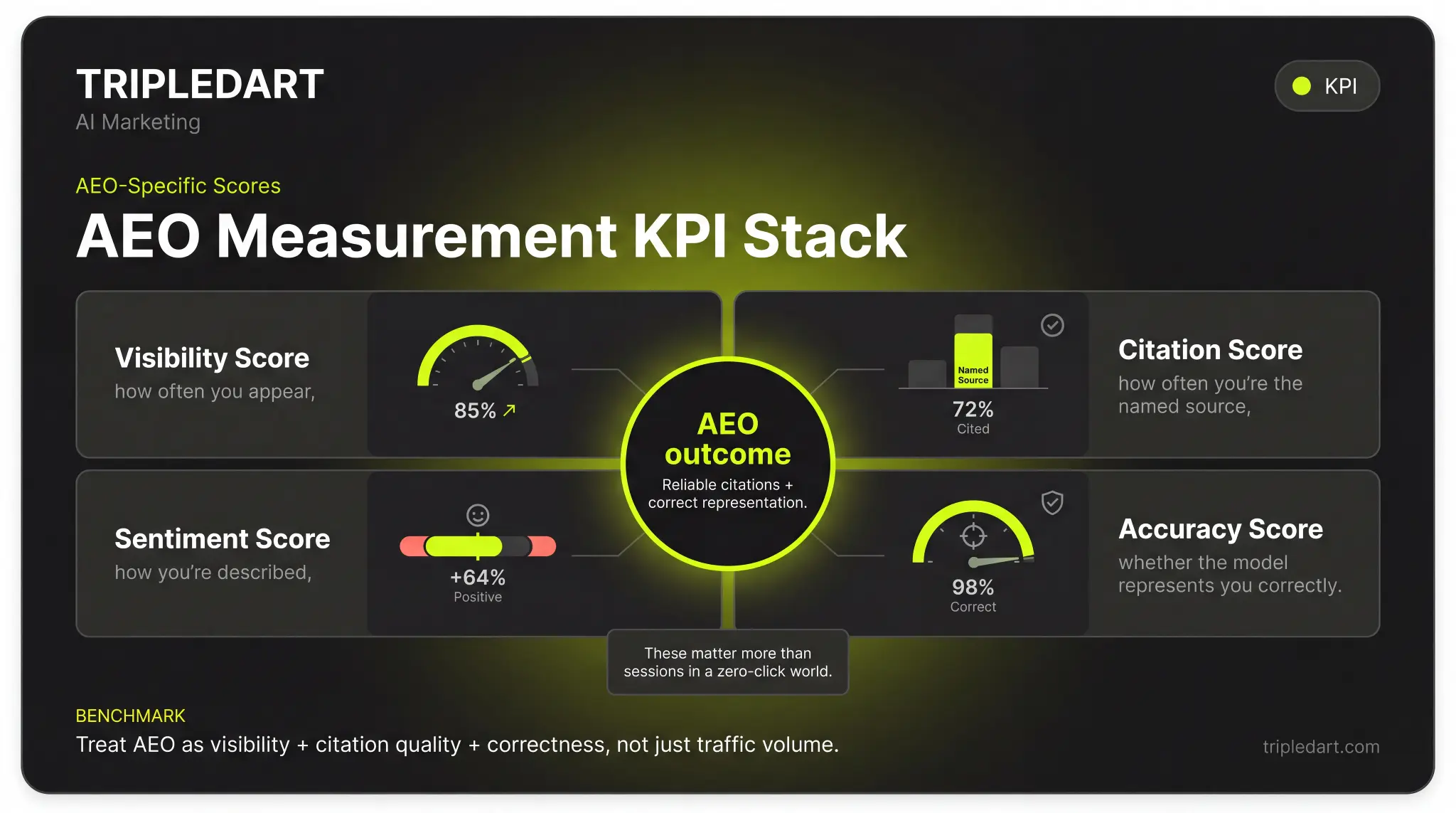
You wouldn't launch a marketing program without tracking it. Answer engine optimization is no different, but the metrics that matter have shifted beyond raw traffic.
Organic Traffic And AI Referrals
Check whether AEO-focused pages bring in more visitors. Monitor Google Search Console for AI Overview appearances, referral traffic from chatgpt.com and perplexity.ai, and Bing Webmaster Tools for AI signals.
Our guide on tracking LLM chatbot traffic shows how to set this up in GA4.
One note: it's common to see traditional organic traffic decline while AI citations climb. Don't panic. It often means AI is pre-qualifying your visitors before they land.
Click-Through Rates and Engagement
If your content appears in snippets but CTR is low, the answer is probably too vague or gives everything away upfront. Test your titles and intros. Once visitors land, watch time on page, bounce, and scroll depth to confirm the content is genuinely useful.
AEO-Specific Scores
Sophisticated programs track a Visibility Score (how often you appear), a Citation Score (how often you're the named source), a Sentiment Score (how you're described), and an Accuracy Score (whether the model represents you correctly). These KPIs matter more than sessions in a zero-click world.
What Tools Should You Use To Track AEO Results?
You don't need a massive stack. A few core tools plus one AI-specific tracker cover most B2B SaaS programs.
Core tracking:
- Google Analytics for traffic, bounce, and time on page
- Google Search Console for keyword data, CTR, and visibility
- AnswerThePublic or AlsoAsked for new question discovery
AI-specific tracking:
- Slate for citation volume, source domains, and prompt-level response mix
- OmniSEO for snippets, knowledge panels, and AI Overview appearances
- Semrush and Ahrefs AI features for competitor AI visibility
For the most accurate picture, combine sources. Track traditional metrics in Analytics, monitor AI appearances with a specialized tracker, and cross-reference with conversion data. For the wider view, see our round-up of AI SEO tools and our SaaS AI search strategy deep dive.
How Can TripleDart Help You Win In AI Search?
Search has changed. The brands winning today show up with clear, direct answers wherever people ask questions, from ChatGPT to Perplexity to Google AI Overviews to voice assistants. TripleDart is the GTM Operating System for B2B tech, delivered as a service, and builds the answer engine optimization engine to make that happen. Senior operators set the strategy and AI-powered workflows run execution at a speed a manual team can't match.
We create content that gets picked by search engines, AI tools, and users, and we focus on the formats that matter most: snippets, voice responses, and AI answers. From strategy through execution, our approach drives visibility and pipeline where it counts.
As an AI-native SaaS marketing agency with a 300+ B2B brand portfolio spanning bootstrapped founders through publicly traded SaaS, we've built AEO engines across contract management, developer tools, revenue operations, finance, and workspace software.
Whether you need a full GEO strategy, an AI SEO audit, or help getting cited by specific models, we've done it across hundreds of B2B SaaS companies. Every program blends schema rebuilds, entity reinforcement, answer-first restructuring, and a monthly refresh cadence on your top cluster pages.
Frequently Asked Questions
What is answer engine optimization (AEO)?
AEO is the process of structuring content and site architecture to increase the likelihood of being selected, cited, or surfaced by AI-powered search engines like ChatGPT, Google AI Overviews, Perplexity, and Microsoft Copilot. Traditional SEO focuses on ranking positions. AEO aims to get your content cited directly inside AI-generated answers.
How is AEO different from SEO and GEO?
AEO targets AI-driven engines and answer boxes. SEO targets traditional rankings. GEO influences how generative platforms understand and represent concepts over time. SEO emphasizes keywords and backlinks, AEO prioritizes clear answers and structured data, and GEO shapes AI understanding across months and years.
What are the best tools for AEO?
Top tools include Slate, OmniSEO, Semrush AI features, and Ahrefs AI tracking. Google's Rich Results Test validates schema, while AnswerThePublic surfaces question-based queries. For a broader view, see our list of AI SEO tools.
How do I measure AEO performance?
Track AI citations, snippet wins, zero-click appearances, and referral traffic from AI engines. Look beyond volume to conversion and lead quality. AI-driven traffic often converts higher despite fewer visits because the engine pre-qualifies the buyer before they arrive.
What are common AEO mistakes?
Ignoring structured data, failing to update content for AI models, neglecting entity optimization, and not tracking citations are the most frequent. Many teams also optimize for typed keywords instead of specific questions, or give vague answers that models can't extract confidently.
How does TripleDart help with answer engine optimization?
TripleDart is an AI-native SaaS marketing agency that builds AEO strategies tailored to each platform: ChatGPT, Perplexity, Google AI Overviews, and voice assistants. Senior operators set the strategy and AI-powered workflows handle schema implementation, entity optimization, citation tracking, and monthly refreshes end to end. Our AEO agency services have helped brands like Signeasy grow LLM sessions 3,650% and Meegle lift AI citations 134%. Book a strategy call to start.