Most SaaS buyers don't start vendor research on a blue-link results page anymore. They ask ChatGPT for the best tools in a category, ask Perplexity how two products compare, and read a Google AI Overview before they visit a single site. That's why so many marketing leaders keep asking the same question in 2026: why should I track AI brand visibility?
Your dashboards still center on rankings, sessions, and clicks, but discovery has moved into AI-generated answers. Traditional reporting no longer reflects how buyers find and shortlist vendors. AI brand visibility is becoming a core organic growth KPI for SaaS because it captures what happens before the click.
This guide defines the term, explains why it matters now, gives you a KPI model with leading and lagging metrics, shows you how to track and prioritize prompts, and maps who should own it inside your team.
What Is AI Brand Visibility?
AI brand visibility is the extent to which AI tools like ChatGPT, Gemini, Claude, Perplexity, and Google AI Overviews mention, cite, compare, or recommend your brand when users ask relevant questions. It measures your presence inside AI-generated answers.
Traditional SEO visibility is about where a page ranks for a keyword. AI brand visibility is about whether an AI engine positions your brand during a buyer's research.
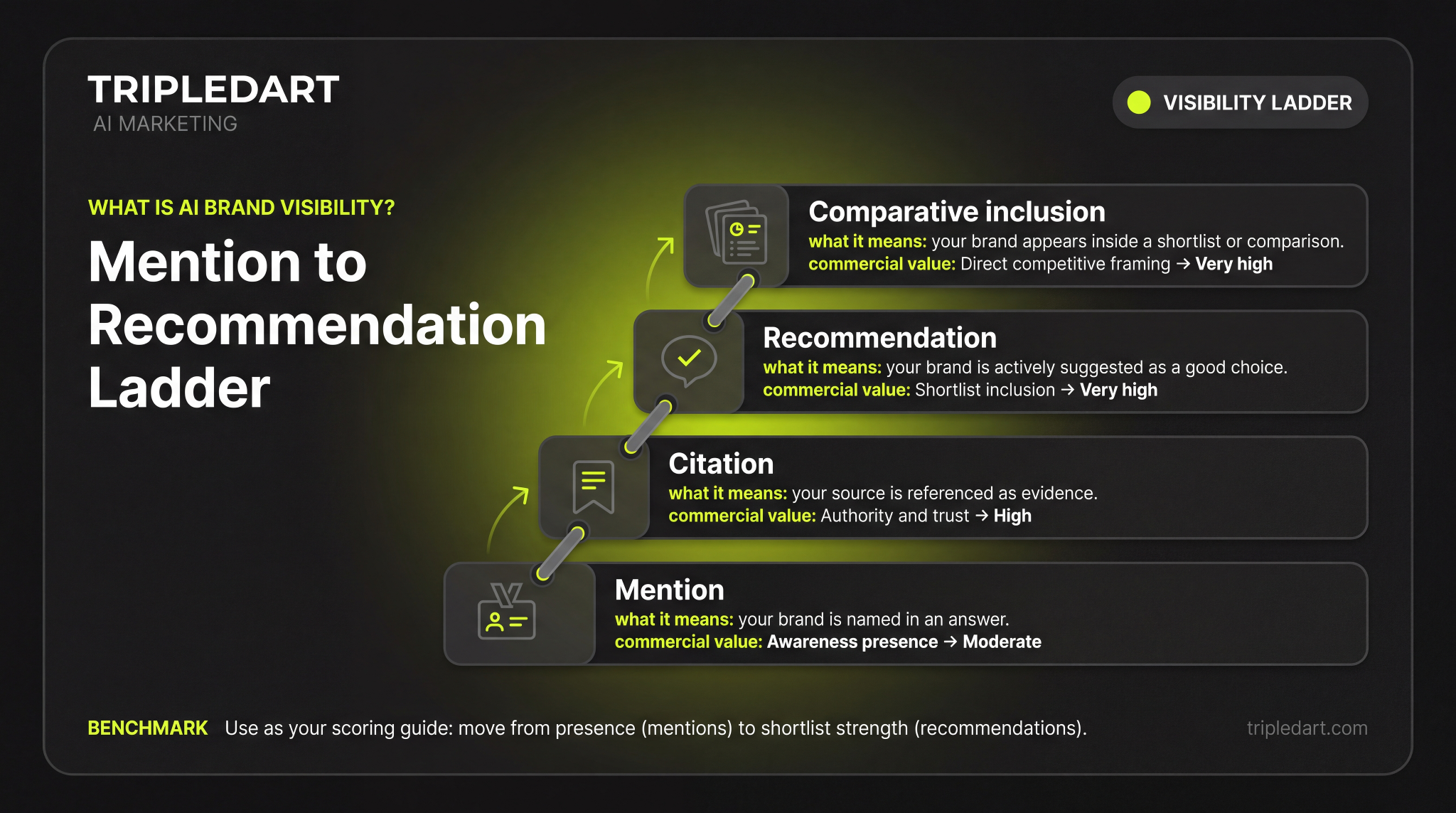
Most teams blur the four layers together, and separating them changes how you report:
- Mention: your brand is named in an answer.
- Citation: your source is referenced as evidence.
- Recommendation: your brand is actively suggested as a good choice.
- Comparative inclusion: your brand appears inside a shortlist or comparison.
For SaaS, this comes down to whether AI engines put your brand in front of buyers who are forming opinions during the research and shortlist stage. If you want a deeper contrast between search and generative discovery, our guide breaks it down in detail.
Mention vs. Citation vs. Recommendation: What Counts As A Win?
Not every appearance in an AI answer carries the same commercial value. A mention means you're named. A citation means an AI answer uses your content as a source. A recommendation means the AI actively suggests you, which is the strongest signal for a buyer forming a shortlist.
Citations reveal which of your pages AI engines trust. Our research on AI citations tracking shows which page types get referenced most often. It helps you prioritize what to build.
Why Does AI Brand Visibility Matter More In 2026?
Buyers are increasingly relying on suggestions from LLMs to make business decisions. This non-click influence is why organic teams can't measure success by clicks alone.
Three drivers make this urgent this year.
First, the shift in search behavior. Buyers open ChatGPT or Perplexity to explore a category before they touch a search engine. The research happens in the chat window.
Second, zero-click doesn't mean zero influence. AI answers pre-filter vendors, so branded searches and direct visits often follow an AI conversation, and the influence shows up in channels that look unrelated at first glance.
Third, AI acts as a shortlist-former. Comparisons that once happened across multiple browser tabs now happen inside one chat. If your brand is missing from that comparison, you're invisible the moment a decision takes shape.
This raises the bar on organic traffic quality over raw volume. A smaller number of AI-influenced visitors who arrive already informed can be worth more than a flood of top-of-funnel clicks.
Why Should AI Brand Visibility Belong On Your Organic Growth Dashboard?
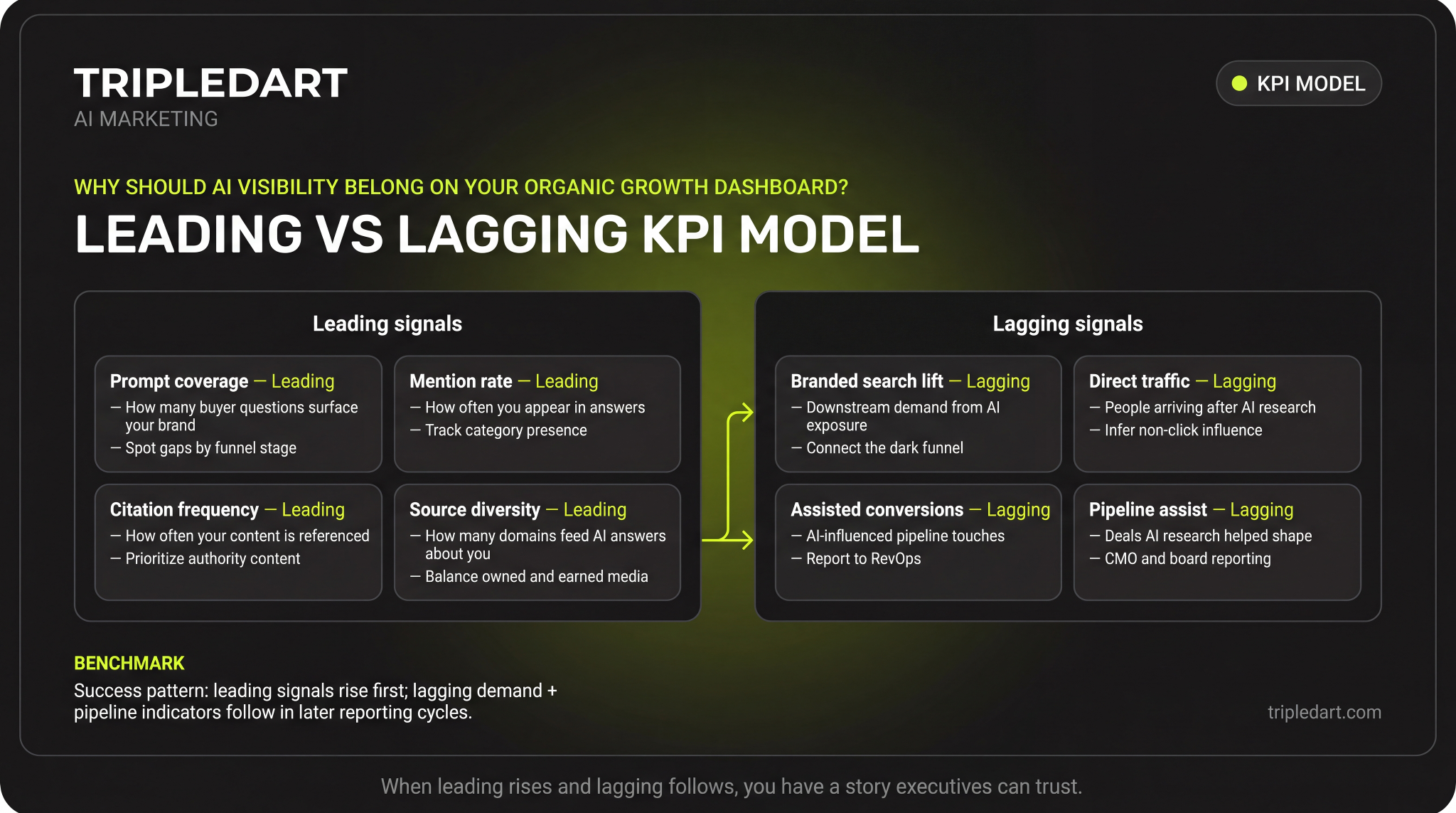
SaaS companies should track AI brand visibility because it's a leading indicator of demand that shows up before branded search, direct traffic, and pipeline move. It complements rankings and conversions, giving your team early warning about where category discovery is heading.
This is the reframe most competitors miss. AI brand visibility isn't a monitoring curiosity you check once a quarter. Treated right, it's a commercial leading indicator that connects to revenue outcomes.
The clearest way to make it dashboard-ready is to split your metrics into leading and lagging groups.
When leading signals rise and lagging signals follow, you have a story executives can trust. That's the point where AI visibility becomes CMO- and board-reportable. For a framework on tying these to outcomes, our guide to measuring AEO success metrics.
The global B2B SaaS market was valued at $390 billion in 2025, according to Mordor Intelligence, and is projected to reach $1,578 billion by 2031. In a market that crowded, being absent from AI answers means ceding shortlist space to competitors who are present.
Why Should SaaS Teams Track AI Brand Visibility Now?
You should track AI brand visibility because it shapes category discovery before the click, exposes competitor shortlist wins, explains shifts in branded demand, and gives SEO, content, and PR a shared growth KPI.
If you wait, competitors will define your category inside AI answers unopposed.
Here's why AI brand visibility belongs on your roadmap this quarter.
Your brand's positioning inside AI answers shapes category discovery before a buyer visits any site. Opinions form in the chat window, and by the time someone lands on your homepage, they may already have a shortlist in mind.
Tracking visibility also reveals whether competitors are winning AI recommendations. If a rival consistently appears in "best tools" answers and you don't, that's shortlist displacement happening in real time. Our research explains why some sites stay invisible to ChatGPT and Claude.
It explains branded search and direct-traffic shifts that otherwise look random. When AI research drives someone to search your name later, visibility tracking connects that dark-funnel dot.
Source tracking also shows which sources influence AI answers, so you know where to invest in digital PR and content. And it gives SEO, content, and PR a shared KPI, which resolves the fuzzy ownership problem that stalls so many programs.
The stakes are commercial. If AI answers reroute how buyers discover software, protecting that pipeline means protecting your presence in AI answers.
Which AI Visibility Metrics Matter Most For SaaS Teams?
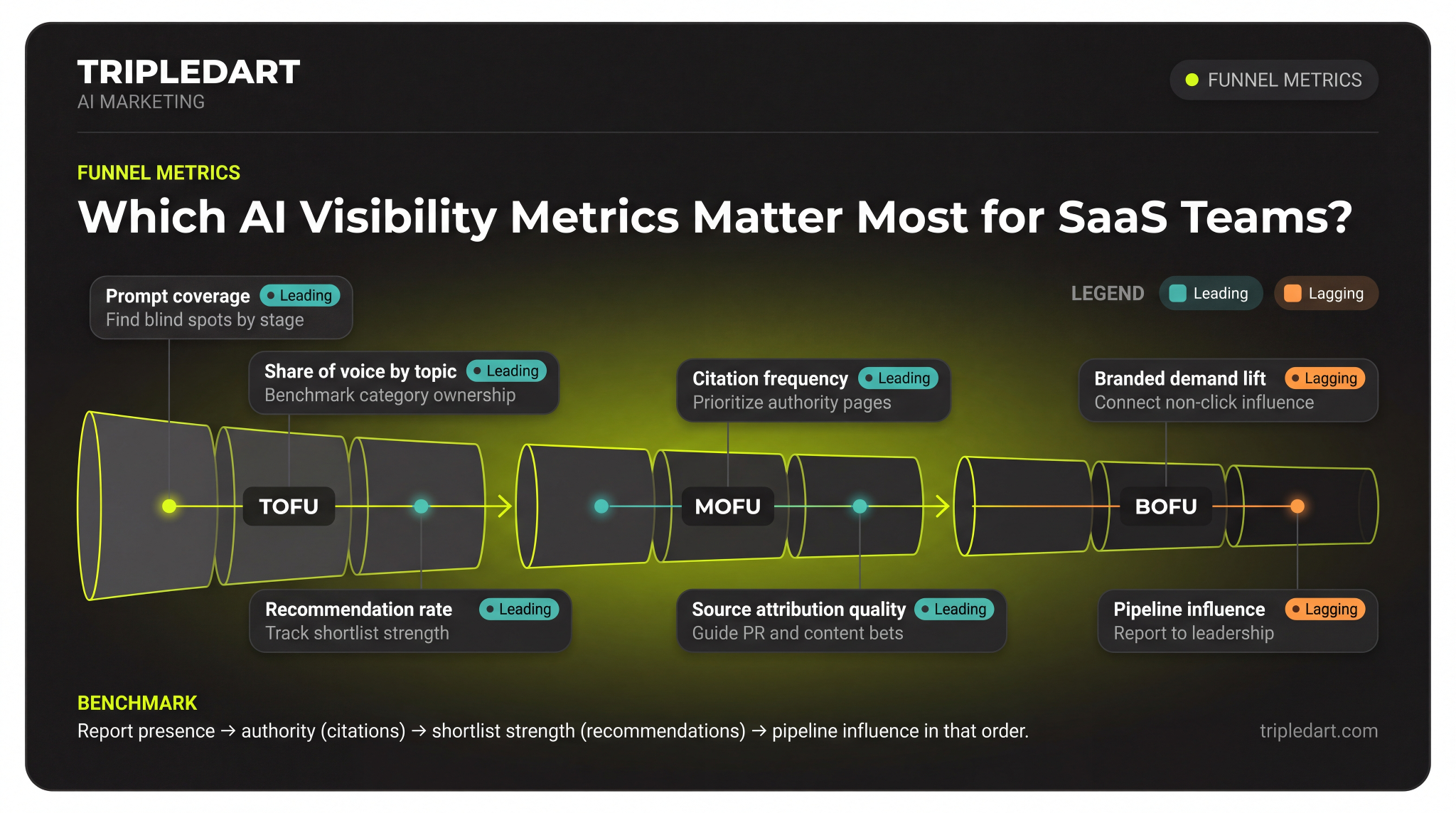
The AI visibility metrics that matter most for SaaS are prompt coverage, share of voice by topic, citation frequency, recommendation rate, source attribution quality, branded demand lift, and pipeline influence. Together they move from early presence signals to commercial outcomes, so your report tells a full story.
Here's how the core metrics map across the funnel.
Prompt coverage and query coverage tell you where you're missing. Recommendation rate tells you how strongly AI vouches for you. Source attribution quality tells you which domains you need to win. Work from presence toward pipeline influence, in that order.
Don't confuse these metrics. A pile of mentions isn't the same as a recommendation, and citation quantity isn't the same as citation quality. Ten citations from thin directories matter less than one citation from a source AI engines trust. Separate vanity mentions from commercially valuable visibility every time you report.
For deeper metric definitions, see our guide on GEO metrics, and to close the loop with analytics, see our walkthrough on tracking AI and LLM traffic in GA4.
How Do You Track AI Brand Visibility Across Platforms?
To track brand mentions in AI search tools, define prompt sets by topic and funnel stage, choose which platforms to monitor, set a baseline, record mentions, citations, and recommendations, benchmark competitors, and set a review cadence. Consistency and clear methodology matter more than a single tool.
Here's a workflow you can run.
- Define your prompt sets grouped by topic and funnel stage.
- Select platforms to monitor based on where your buyers actually research.
- Establish a baseline so you can measure trends.
- Record mentions, citations, and recommendations separately.
- Benchmark competitors on the same prompts.
- Set a review cadence and a reporting format leadership will read.
Prioritize platforms by buyer behavior: Google AI Overviews, ChatGPT, Perplexity, Gemini, and Claude. Most B2B SaaS buyers touch Overviews and ChatGPT first, so start there.
Methodology transparency is an E-E-A-T lever and a trust builder internally. Document how prompts are grouped, how coverage is weighted, and how you interpret baseline versus trend. When a stakeholder questions a number, that documentation is your answer.
This is where our operating model applies: human governs, agents execute. Our operators set positioning, prompt priority, and governance, while AI-powered workflows in our proprietary platform, Slate, monitor prompts, citations, and source shifts at scale through an AI Search Tracker.
To go platform-specific, see our resources on tracking LLM brand visibility, brand mentions in ChatGPT, ranking on Perplexity, and ranking on Google AI Overviews.
How To Prioritize Prompts By Funnel Stage
A weighted prompt framework separates useful tracking from noise. Build your prompt sets across these categories and score each group by commercial value.
- Category prompts (awareness): "best [category] tools"
- Use-case prompts: "software for [job to be done]"
- Alternatives prompts: "alternatives to [competitor]"
- Competitor comparison prompts: "[brand] vs [competitor]"
- Integration prompts: "[tool] that integrates with [X]"
- Branded prompts: "is [your brand] good"
Comparison and decision-stage prompts usually carry more commercial value than awareness or branded ones, because they map to a buyer close to choosing. Building your query fanout keywords around these stages, gives you a clearer read on where visibility actually converts. Awareness prompts still matter, but they shouldn't crowd out the prompts where a shortlist forms.
How Can SaaS Brands Improve AI Visibility?
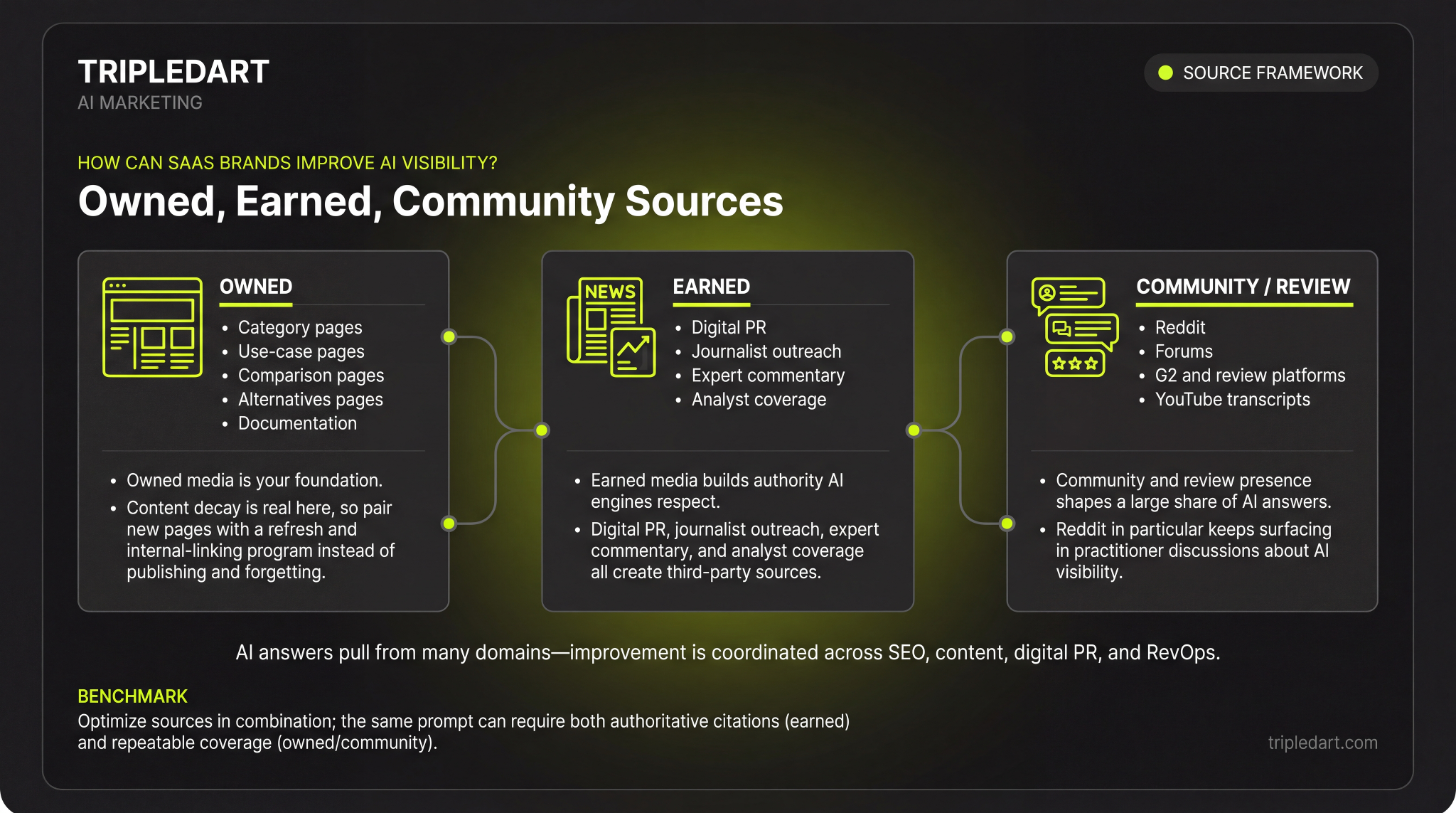
SaaS brands can improve AI visibility by strengthening the sources AI engines draw from: owned pages, earned media, and community or review signals. Because AI answers pull from many domains, improvement is a coordinated GTM effort across SEO, content, digital PR, and RevOps.
Group your improvement work by source class.
Owned media is your foundation. Build category, use-case, comparison, and alternatives pages, plus clear documentation. These are the pages AI engines cite when a buyer asks a decision-stage question. Content decay is an issue here, so pair new pages with a refresh and internal-linking program.
Earned media builds authority AI engines respect. Digital PR, journalist outreach, expert commentary, and analyst coverage all create third-party sources that AI answers lean on when forming recommendations.
Community and review presence shapes a large share of AI answers. Reddit, forums, G2 and review platforms, and YouTube transcripts feed AI models constantly.
Reddit in particular keeps surfacing in practitioner discussions about AI visibility, and our own research on why Reddit matters for B2B covers why community sources punch above their weight in AI answers.
Because AI visibility improvement sits across SEO, content, digital PR, and RevOps, treat it as a GTM system.
Who Should Own AI Brand Visibility?
AI brand visibility is a shared KPI, but shared doesn't mean unowned. Map responsibilities clearly so nothing falls through the cracks.
- SEO: technical foundation and rankings that feed citations.
- Content: page creation, refreshes, and comparison assets.
- Digital PR: earned sources and third-party authority.
- Product marketing: category and comparison narrative.
- RevOps: attribution and connecting visibility to pipeline.
- Growth: the dashboard, prioritization, and cadence.
Framing AI visibility as one shared KPI across these functions resolves the fuzzy ownership that stalls most programs.
What Common Mistakes Should You Avoid When Tracking AI Brand Visibility?
The biggest mistakes are tracking only branded or vanity prompts, ignoring source quality, separating SEO from PR, failing to tie visibility to pipeline, and treating a mention as equal to a recommendation. Each one turns a useful KPI into a vanity report.
Watch for these traps:
- Tracking only branded or vanity prompts: If you only monitor "is [your brand] good," you miss the category and comparison prompts where shortlists form.
- Ignoring source quality and citation authority: Not all citations are equal, and treating them as equal inflates your numbers.
- Separating SEO from PR when improving visibility: AI answers pull from both owned and earned sources, so siloed teams underperform.
- Not connecting AI visibility to pipeline: Visibility without a line to branded demand or assisted conversions stays a curiosity.
- Treating a mention as equal to a recommendation: A name-drop and an active recommendation carry very different commercial weight.
Avoid these and your reporting stays honest, which is what earns it a place on the executive dashboard.
How Does TripleDart Approach AI Brand Visibility For SaaS?
TripleDart is an AI-native SaaS marketing agency, and we treat AI brand visibility as part of an integrated organic growth system tied to SQLs, pipeline, and revenue. Our Search Everywhere Optimization approach helps brands appear wherever buyers research, from Google and ChatGPT to Perplexity, Gemini, Claude, Reddit, and YouTube.
Our model is simple to state: human governs, agents execute. Senior operators set positioning, prioritize prompts, and own commercial outcomes. AI-powered workflows handle continuous monitoring of mentions, citations, and source shifts at scale. That pairing gives you strategic judgment and execution capacity in one system.
If you want a low-friction starting point, our free AI visibility report shows where your brand stands across AI platforms today, and our enterprise GEO platform supports larger programs. When you're ready to connect AI visibility to pipeline, book a free audit call with us.
What Are The Most Common Questions About AI Brand Visibility?
What is AI brand visibility?
AI brand visibility is how often AI tools like ChatGPT, Gemini, Claude, Perplexity, and Google AI Overviews mention, cite, compare, or recommend your brand when users ask relevant questions. It measures your presence inside AI-generated answers.
Why is AI visibility important for SEO?
AI visibility matters because buyer research now happens inside AI interfaces, and those answers pre-filter vendor decisions. Even without a click, AI answers shape which brands make a shortlist, which affects branded search, direct traffic, and pipeline downstream.
Does AI brand visibility replace traditional SEO?
No. It expands SEO. Rankings, traffic, and conversions still matter. AI brand visibility adds a layer that captures how buyers discover and shortlist vendors before they click, so the two work together.
What’s the difference between a mention and a citation in AI search?
A mention means your brand is named in an answer. A citation means your content is referenced as a source that informed the answer. Citations signal authority and trust, mentions signal presence, and both differ from an active recommendation.
Which AI platforms should SaaS brands track first?
Start with Google AI Overviews and ChatGPT, then add Perplexity, Gemini, and Claude. Prioritize by where your target buyers actually research, since most B2B SaaS buyers touch Overviews and ChatGPT earliest in their journey.
How do you know if AI visibility is helping pipeline if users don’t click?
Look at branded search lift, direct visits, assisted conversions, and self-reported attribution on demo forms. Combine those signals with sales feedback about how prospects found you. Together they infer non-click influence even when no direct click exists.
Can smaller SaaS brands improve AI visibility without high domain authority?
Yes. Focused comparison, alternatives, and use-case pages, clear documentation, expert commentary, and active community presence can earn citations and recommendations without a large domain. Narrow, high-intent coverage often beats broad authority for specific buyer prompts.
How does TripleDart help with AI brand visibility?
TripleDart is an AI-native SaaS marketing agency that tracks and improves AI brand visibility as part of an integrated organic growth system tied to pipeline. Using Search Everywhere Optimization and our Slate platform, our operators set strategy while AI-powered workflows monitor mentions, citations, and recommendations across every major AI platform. Start with our free AI visibility report or book a call to get a free AI visibility audit.