
Adam Holmgren's LinkedIn Ads Setup: How Fibbler Grew to $1.2M ARR With Two People
Contributor

Adam Holmgren
Co-Founder & CEO, Fibbler

Glenn
Organic Growth Manager @ TripleDart
In this article
Adam Holmgren's LinkedIn Ads Setup: How Fibbler Grew to $1.2M ARR With Two People
A full walkthrough of the LinkedIn ads account structure behind Fibbler, built and run by a two-person bootstrapped team with no sales function. Episode 17 of Coach by TripleDart covers the 70/30 cold and retargeting split, the six ad formats Adam Holmgren runs and the job each one does, his targeting and manual bidding rules, and the leading indicators he trusts more than form fills.
Introduction
Most B2B marketers open their LinkedIn ads account, see a $25 CPC and a handful of demo requests, and quietly write the channel off as a luxury. The math looks indefensible next to Google, next to content syndication, next to almost anything programmatic.
Adam Holmgren thinks the math is being done against the wrong denominator. On LinkedIn, 95% of a market isn't buying today, and nearly every advertiser is bidding for the 5% that is. That fight is expensive, and the 5% is close to impossible to identify anyway.
So Fibbler spends against the other 95%. The goal is to be the name that surfaces the moment a buyer has the problem, which means the account is built for memory rather than for form fills.
This playbook walks through the exact structure Adam runs, from the two-layer campaign architecture down to bid multiples, creative thresholds, and the metrics he uses to grade B2B LinkedIn ads when nobody clicks. It's based on his session during Episode 17 of Coach by TripleDart.
Adam spent about 10 years in B2B marketing before founding anything, the last 5 of them buried in LinkedIn ads. In 2023 he was spending heavily at a startup and struggling to prove the case to his CEO and CMO, so he started stitching attribution together by hand.
That side project became Fibbler, launched in May 2024. Two years on it's at roughly $1.2M ARR with two people, no sales team, and no outside funding.
He also runs the ads himself. So every number in this account belongs to an operator spending his own money.
Why Adam Holmgren Advertises to the 95% Who Aren't Buying
Adam's starting position has nothing to do with ad platforms. It's about how quickly a product can be copied.
Building software got easy. Most products, his own included, can be rebuilt by a competent team in a few weeks, which means the feature set stopped being defensible somewhere around 2023. What's left is whether anyone remembers you, which drags the B2B SaaS marketing strategy conversation back in front of the roadmap.
"Most of us aren't OpenAI, most of us aren't Anthropic," he says. The rest of us have to win on being recalled.
That's why he spends against the 95%. Nobody in that group converts this quarter, and trying to push them into a funnel you invented is how LinkedIn budgets get burned. The job is patience plus repetition until the brand is sitting in memory when the problem finally shows up.
It's also the least glamorous part of B2B demand generation, and the part most teams skip because it doesn't produce a lead this week.
Adam went the other way. Fibbler started running paid ads in month 2 of the company's existence, on about $1,000 a month, before there was any pipeline worth attributing.
Fibs the Pink Lion: A Distinctive Brand Asset Before a Campaign Structure
Winning on memory is easy to say and brutal to execute. Adam's answer was to give people something to hook the memory onto.
Fibbler has a mascot. It's a pink lion called Fibs. Pink because pink cuts through a feed that's mostly blue, and a lion because Adam likes animals and the shape stuck.
Fibs now appears in almost everything the company publishes. Ads, organic posts, the product, the deck he presented from.
The results are the part worth stealing. People show up to Fibbler having never heard of Adam and never heard of the company, but they recognize the pink lion. The asset carries the recall that the name hasn't earned yet.
A mascot isn't the requirement. Adam's point is that some asset has to do this job, whether it's a color, an illustration style, a recurring format, or a way of writing. Anthony Pierri makes the same argument about homepage messaging in Episode 4. Adam's only hard rule: don't be another blue SaaS brand.

Fibs earns its keep twice, and the second time is inside the campaign structure, where it rescues Adam from a trap he walked into early.
Inside Adam Holmgren's Two-Layer LinkedIn Ads Structure
The account itself is two layers, and Adam narrates the whole slide slowly because everything else hangs off it.
The cold layer holds every campaign pointed at a brand-new audience, people who've most likely never encountered Fibbler. The retargeting layer holds everyone who's engaged in some way.
Four sources feed that second layer: website visitors, LinkedIn company page visitors, anyone who engaged with a cold-layer ad, and anyone who watched a cold-layer video. Silvio Perez covered the multi-channel remarketing version of the same idea in an earlier Coach episode.
Budget splits roughly 70% cold, 30% retargeting. Most of the B2B SaaS accounts in TripleDart's LinkedIn ads playbook land somewhere in that neighborhood.
The two layers get deliberately different frequency targets, and this is the mechanic that makes the whole thing work. In cold, Adam wants each person seeing 1 to 2 ads per 30 days. Any more and he's paying to repeat himself to strangers instead of finding new ones.
In retargeting he pushes to 4 to 10 impressions per 30 days. These people did something. Frequency here is the point.
Audience penetration follows the same logic. He doesn't care how much of the cold audience he reaches in a month. In retargeting he wants 100%, and pushes toward it as far as budget allows.
Anyone who enters the retargeting layer is excluded from cold, so the two layers never bid against each other.
Geography splits it once more. Adam runs the US and EMEA as separate builds, so the account is 4 campaign groups: cold US, cold EMEA, retargeting US, retargeting EMEA. That separation matters later, because US bidding needs a heavier hand.
The Formats in Each Layer and the Job Each One Does
Six formats run across those two layers, and each one is there for a specific reason rather than for coverage. Adam works through them in the order he added them, which doubles as a decent build sequence for anyone starting LinkedIn ads for SaaS from scratch.
Text ads sit in both layers and do the least glamorous work. They're the small units on the right rail of LinkedIn, and Adam runs them because they cost close to nothing. He treats them as a billboard, sets no KPI, and just wants impressions. "As long as they're free, I don't care."
Thought leader ads carry the weight. Adam runs two versions in cold, one with an image attached and one with a video, both built from his own organic posts.
On the image version he wants a 10% to 15% click-through rate. That's high, and he's quick to note he sells to marketers, who are a friendly, high-fiving audience. On the video version he wants 5% or more of viewers completing a 60-second cut.
Regular image ads are the classic company-page unit, and the numbers put the gap in perspective. LinkedIn's average image ad CTR sits around 0.4%. Adam wants above 1%. Against a thought leader ad pulling 10% or better, the comparison stops being close.
Retargeting runs the same formats with different content, plus two additions. CTV puts Fibbler's ads onto streaming inventory through LinkedIn, which Adam runs only in the US so the brand turns up on Hulu and HBO Max alongside the feed.
Message ads are the last addition, and the only placement in the whole account where Adam pitches the product outright.
The content changes between layers even where the format doesn't. Cold thought leader ads talk about subjects adjacent to the product, which for Fibbler means LinkedIn ads themselves. Retargeting thought leader ads talk about attribution and the problems the product solves.
Adam's advice on the structure is to run less of it than he does. Text ads, thought leader ads, and image ads was the entire account for a long stretch. CTV and message ads came later, once the budget could carry them.
Thought Leader Ads Do the Heaviest Lifting in Fibbler's LinkedIn Ads Account
For the first months of Fibbler, the entire paid strategy was one move: take Adam's organic posts and sponsor them to people outside his network.
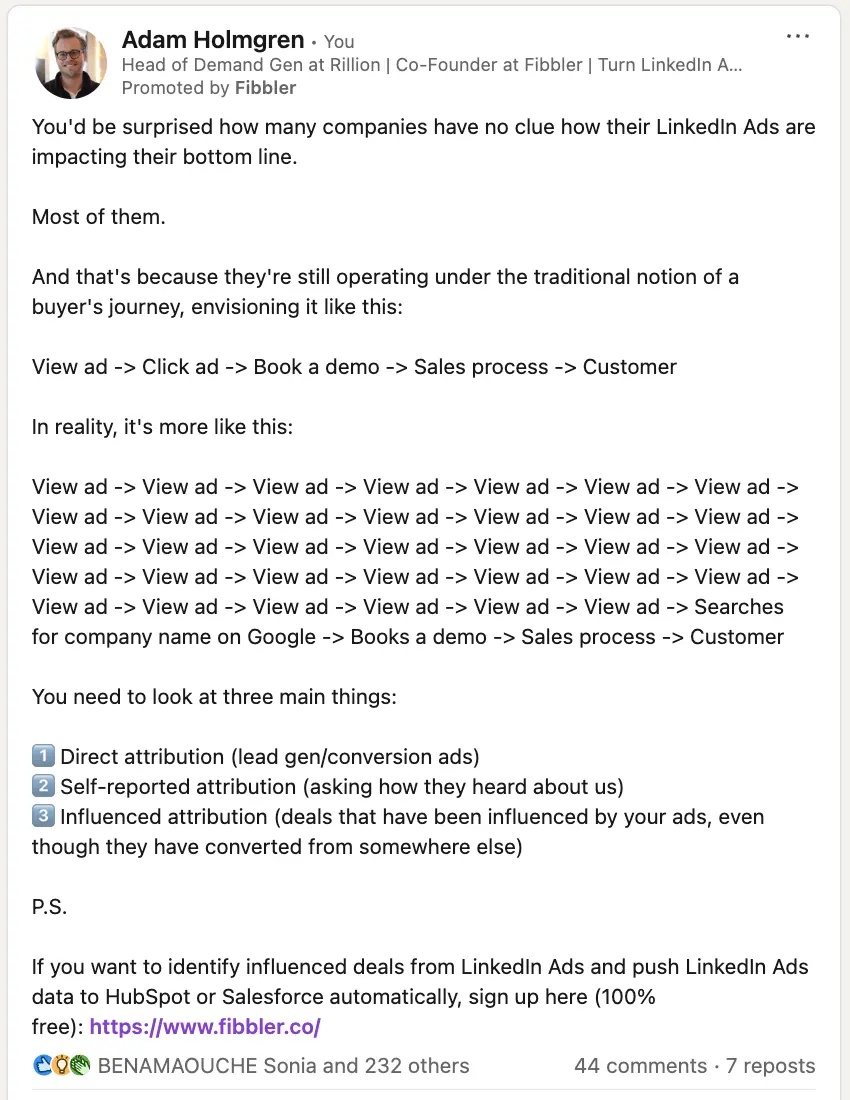
A thought leader ad is any post from a personal profile promoted through the company's ad account. Yours, an executive's, an employee's, even a customer's. It carries a small "promoted" label at the top and otherwise reads as an ordinary post in the feed.
Adam's rule is that the post has to earn it organically first, which makes his personal feed the test bed for every paid content distribution decision. He posts every weekday, maybe 3 of those 5 are appropriate to sponsor, and his bar is 100+ likes.
Below that, he doesn't pay to amplify. "It becomes an expensive lesson if you have to learn it through paying for it."
The 100 number is his, not a benchmark. What he's really watching is whether a post beat his own average.
Every sponsored post gets one addition before it runs. A few days after publishing, he appends a PS to the end of the post: a short pitch for the product and a link. He keeps it out of the original organic version because a link kills organic reach, and adds it only once the post has proven itself.
That link is also the only thing that makes a thought leader ad measurable, since clicks on it get tracked as landing page clicks.
There's a failure mode buried in all of this, and Adam hit it. Lean hard on thought leader ads and people learn your face, your name, and nothing about the company. Prospects were arriving at Fibbler knowing Adam and having no idea what Fibbler was.
The mascot patched it. Fibs goes into the organic posts, which means Fibs rides along into every sponsored version of them. The personal brand does the distribution and the company brand collects the recall.
Image and Video Ads People Remember
Company ads look like ads. Adam's whole problem with them is that everyone can feel the difference at a glance, and the feed punishes it.
His workaround holds up across most industries: build on a meme structure people already recognize. Take a format from the internet at large, translate it into a situation a B2B buyer lives through, and the recognition does half the work. Few LinkedIn B2B marketing programs try it.
One of Fibbler's ads stages a familiar battle-scene meme as a fight against last-touch attribution. It's funny, it's specific to the job, and it sticks.
The current creative theme is CEO versus marketer. Each ad stages a moment the audience has survived, the hard conversation with an executive about why the numbers look the way they do. Nobody's literally been slapped by their CEO. Everybody recognizes the feeling.
Image ads are the one place Adam breaks his own cold-versus-retargeting content rule. He runs the same creatives in both layers, on purpose, because repetition is the mechanism. People need to see the pink lion an absurd number of times before it lands.
Video came later, since it costs far more to produce than a static. What convinced him was how fast video builds a retargeting pool, and how much more invested a viewer is by the end of 60 seconds.
Fibbler's first good video runs the same CEO-versus-marketer premise and ends with the CEO getting slapped. It was produced almost entirely with AI by a young agency called Artificial, and it's been one of the company's biggest performers.
Message ads close the loop. LinkedIn drops them straight into the inbox, and Adam only targets people who've already engaged with his thought leader ads. Same face in the feed, then the same face in the inbox.
He's wary of pitching anywhere else. This is the one placement where he thinks you should say plainly what the product does, why it matters, and what to do next. For Fibbler, that's a single line about connecting LinkedIn and Google ads to the CRM.
Keeping LinkedIn Ads Targeting and Bidding Simple
Most accounts get elaborate on targeting and get nothing back for it. Adam's setup is almost aggressively plain.
Fibbler runs entirely on LinkedIn's native targeting: industry, company size, and job title. No matched lists at all, because the product sells broadly enough that almost any company running ads is a candidate. AJ Wilcox walked through the enterprise targeting blueprint for teams at the opposite end of that spectrum in Episode 7.
The one trap he steers around is supertitles. Pick something like "head of marketing" and LinkedIn quietly pulls in hundreds of thousands of adjacent titles. He goes narrower and more specific instead.
Teams with a tighter ICP should do the opposite. If your buyer needs a particular ERP or CRM in place, Adam recommends building a third-party list and uploading it as a matched audience, the same input that powers most account-based marketing programs and every account list targeting motion built on top of them.
Exclusions are short and permanent: competitors, existing customers, and anyone who's already signed up. Beyond that he prunes as he goes, because native targeting always drags in companies nobody wants to pay for.
On bidding he gets far less relaxed. LinkedIn defaults every campaign to automatic, and Adam moves all of them to manual.
The rule of thumb is to take LinkedIn's recommended bid and enter about two thirds of it. Results hold, LinkedIn ad costs drop.
The US gets pushed harder. Adam sees roughly 2x the cost there compared to EMEA, so he sets US bids closer to a third of the recommendation and lets EMEA sit at two thirds. Some of the premium you can engineer away. The rest you absorb as the price of the market.
How Adam Holmgren Measures LinkedIn Ads Without Form Fills
Measurement is where most LinkedIn programs get killed, and Adam runs an attribution company, so this is the section he could talk through for an hour. He keeps it to two ideas.
Reach as many of the right buyers as the budget allows. Engage them heavily. Do both and pipeline follows.
Everything else is instrumentation built around those two. His leading indicators are format-specific: CTR above 1% on image ads, landing page clicks above 10% of total clicks on thought leader ads, and video completion above 5%. Anything sitting well below its threshold gets replaced.
The landing page click metric is the subtle one. Total clicks on a thought leader ad include everyone who tapped "see more," which tells you nothing. The subset who clicked the PS link is the signal that the post moved someone.
Adam runs about 3 to 4 creatives per campaign at all times. Some image ads have been live for a year because performance never dropped, and he sees no reason to touch them.
Then come the lagging indicators, which are what a CEO will argue with you about. Direct signups from LinkedIn exist but stay thin, and grading the channel on them alone guarantees a bad verdict for plenty of otherwise healthy SaaS PPC programs.
A "how did you hear about us" field on the form catches a surprising volume that the CRM assigns elsewhere. Influenced pipeline shows which deals carried LinkedIn touchpoints before they ever entered the funnel. Customer journeys show the month-over-month pattern for accounts that convert.
The one he thinks is most underused is share of search. Adam tracks Fibbler's branded search volume against its closest competitors in Storybook, and watches the trend rather than the absolute number.
Since the current structure went live, that line has climbed steeply against VC-backed competitors who outspend him many times over. Adam's own read is that he was never competing with them on money.
His closing advice is a sequence. Start with reach and engagement. When Adam audits an underperforming account, the problem is almost always sitting in one of those two before it ever reaches pipeline reporting. Bottom-funnel measurement earns its importance later.
Audience Q&A Highlights
Several questions from the audience surfaced details the deck skipped.
On exclusions: Competitors, customers, and existing signups come off the list from day one. Everything else gets added over time as native targeting surfaces companies that clearly don't belong, which it always does.
On starting budget: Adam started Fibbler at $1,000 a month and sees no minimum viable spend for LinkedIn, a threshold well below what most B2B PPC agencies will take on. More budget buys faster feedback. Less budget buys the same outcome slower, and requires more patience from whoever's approving it.
On thought leader ads versus company image ads: The engagement gap is 5x to 10x, which is why Adam pushes the format so hard. He treats it as the closest thing to a free lunch on the platform.
On posting cadence: Adam posts 5 days a week, and doesn't think anyone needs to. An executive posting once a week gives you roughly one sponsorable ad a month, which is enough to start. Set your own performance bar rather than borrowing his 100 likes.
On US costs versus Europe: US inventory runs about 2x EMEA for Fibbler. Manual bidding at a third of LinkedIn's recommendation absorbs part of that. The rest is the cost of entering the market.
On tight lists and high CPLs: For a 4,000 to 7,000 account list of healthcare CXOs, the audience is too small and too senior for LinkedIn to price kindly. Adam's prescription is to widen it, adding champions and senior influencers who shape decisions rather than only the people who sign. George Coudounaris made a similar argument about buying committees in his session on B2B demand gen.
On third-party audience providers: Primer and Clay's ads product both work. Company-level lists match at above 90%, so most target accounts get reached. LinkedIn will still slip in companies you didn't ask for, which is what the exclusion list is for.
Conclusion
What Adam describes is a channel with a different job description. LinkedIn ads at Fibbler exist to make a market recognize a pink lion long before anyone books anything, and every structural decision in the account, the 70/30 split, the frequency targets, the meme creative, the appended PS link, exists to serve that job.
It's also a reminder that budget size stopped being the deciding variable. A two-person company outgrew its funded competitors in share of search because it committed to being memorable and stayed patient about the payoff. That patience is the part TripleDart argues for across its demand generation work with B2B SaaS companies at every stage.
Key actions to take immediately:
- Split your LinkedIn ads account into a cold layer and a retargeting layer, allocate roughly 70/30, and exclude everyone in retargeting from the cold campaigns so the two layers stop competing.
- Set separate frequency targets per layer: 1 to 2 impressions per 30 days in cold, 4 to 10 in retargeting, and push retargeting audience penetration toward 100%.
- Pick one distinctive brand asset, a mascot, a color, an illustration style, and put it into every ad and every organic post until people recognize it before they recognize your name.
- Turn on text ads immediately. They cost close to nothing, need no KPI, and buy you impressions you'd otherwise pay for.
- Sponsor organic posts that already cleared your own engagement bar, and append a PS with a product pitch and a trackable link a few days after publishing.
- Switch every campaign from automatic to manual bidding, enter two thirds of LinkedIn's recommended bid, and go closer to a third in the US.
- Build image ads on meme structures your buyers already recognize, and run the winners in both layers so repetition does its work.
- Reserve message ads for people who've engaged with your thought leader ads, and make that the one placement where you pitch the product directly.
- Grade the channel on CTR, landing page clicks, and video completion first, then layer on self-reported attribution, influenced pipeline, and share of search before anyone asks you about CPL.
Watch the full video here: