AI-generated content sparks a heated debate among marketers. Some say it's the future of SEO, while others fear it could lead to penalties. But the answer isn't as complicated as it seems.
Let's go straight to Google's official stance:
"Our focus on the quality of content, rather than how content is produced, is a useful guide that has helped us deliver reliable, high-quality results to users for years."
That clears things up. Google doesn't care who (or what) creates the content. What matters is quality.
But here's where things get tricky:
"When it comes to automatically generated content, our guidance has been consistent for years. Using automation, including AI, to generate content with the primary purpose of manipulating ranking in search results is a violation of our spam policies."
So, if the goal is to boost organic traffic, how do you ensure AI-generated content doesn't violate Google's spam policies? Let's dive into it.
The Core Concern: Does Google Penalize AI Content?
Short answer: no. Google penalizes content that is thin, unoriginal, or built only to manipulate rankings, whether a human or an AI wrote the first draft.
The confusion is understandable. Most SaaS SEO teams we work with, including the ones reading our SaaS SEO playbook, have watched a competitor ship 200 AI-spun posts in a week and wondered if Google was about to drop the hammer.
Sometimes Google does. Sometimes it doesn't. The difference is what's inside the post, not what generated it.
Google has already addressed this with clear guidelines. Their focus is creating helpful, reliable, people-first content.
A Search Engine Land analysis of 4,200 articles found that purely AI-generated content reaches the #1 spot only 9% of the time, while human-written content does so 80% of the time. That gap closes dramatically when AI drafts are heavily edited with original data and expert attribution.
Here's what Google actually asks, cited directly from Google's helpful content guidance:
Content and Quality Questions
- Does the content provide original information, reporting, research, or analysis?
- Does the content provide a substantial, complete, or comprehensive description of the topic?
- Does the content provide insightful analysis or interesting information that is beyond the obvious?
- If the content draws on other sources, does it avoid simply copying or rewriting those sources, and instead provide substantial additional value and originality?
- Does the main heading or page title provide a descriptive, helpful summary of the content?
- Does the main heading or page title avoid exaggerating or being shocking in nature?
- Is this the sort of page you'd want to bookmark, share with a friend, or recommend?
- Would you expect to see this content in or referenced by a printed magazine, encyclopedia, or book?
- Does the content provide substantial value when compared to other pages in search results?
- Does the content have any spelling or stylistic issues?
- Is the content produced well, or does it appear sloppy or hastily produced?
- Is the content mass-produced by or outsourced to a large number of creators, or spread across a large network of sites, so that individual pages or sites don't get as much attention or care?
Expertise Questions
- Does the content present information in a way that makes you want to trust it, such as clear sourcing, evidence of the expertise involved, background about the author or the site that publishes it, such as through links to an author page or a site's About page?
- If someone researched the site producing the content, would they come away with an impression that it is well-trusted or widely-recognized as an authority on its topic?
- Is this content written or reviewed by an expert or enthusiast who demonstrably knows the topic well?
- Does the content have any easily-verified factual errors?
If all this feels overwhelming, here's a simplified way to evaluate content quality.
- Is it original? Does it offer unique insights, not just reworded content?
- Is it trustworthy? Backed by expertise, clear authorship, and reliable sources?
- Does it satisfy users? Will readers leave feeling informed, not needing another search?
- Was AI used transparently? If automated, does it add real value rather than just mass-producing content?
These four questions also align with the Google E-E-A-T framework we use on every SaaS SEO engagement. To make this more concrete, let us consider two use cases.
Portfolio Benchmark
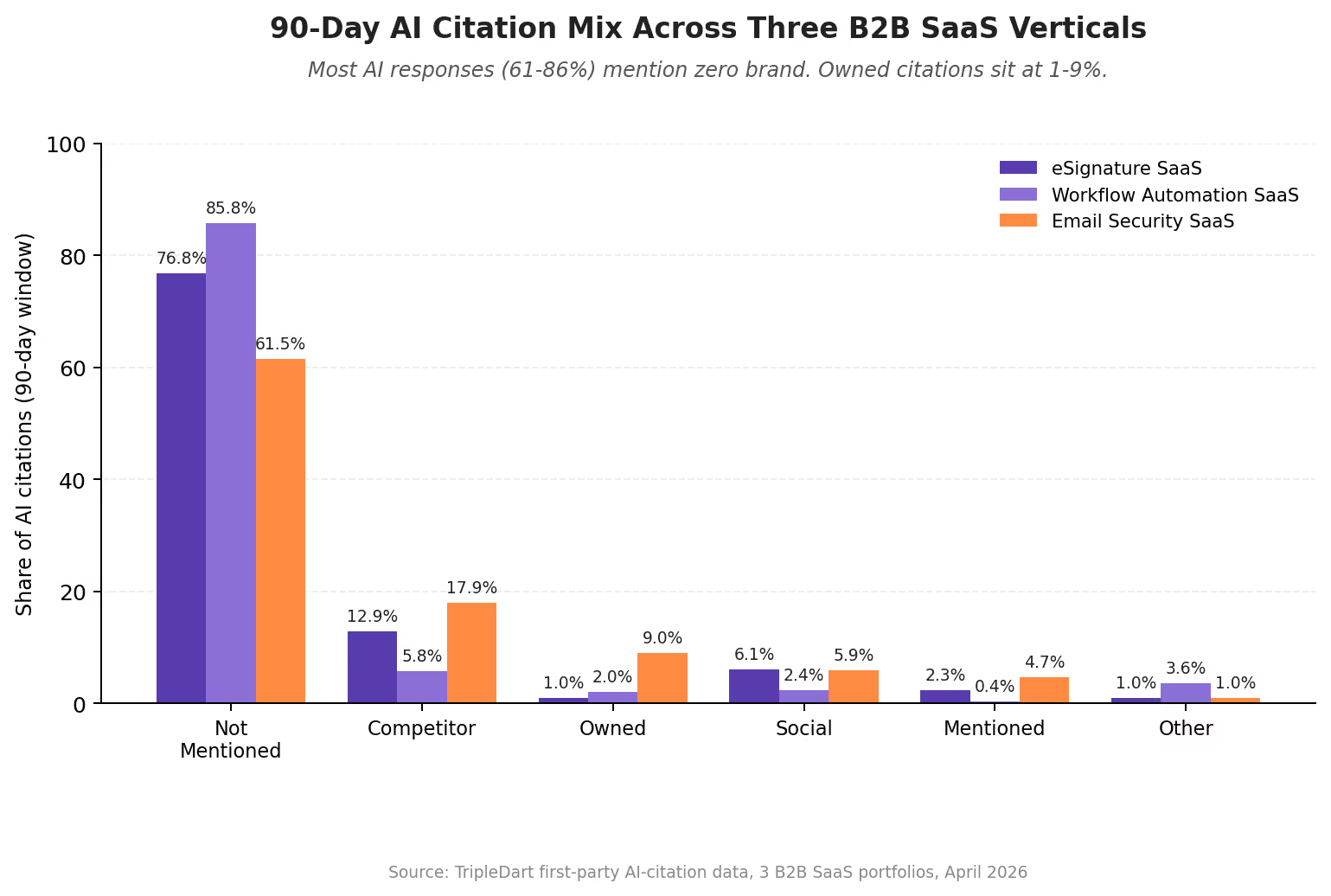
"Across our aggregate AI-citation data from three B2B SaaS verticals we audit, 61% to 86% of AI answers mention zero brand. Owned-domain citations sit at 1% to 9% in the 90-day window, and that range holds whether the client publishes heavily with AI assistance or almost entirely by hand."
The takeaway: the ceiling on AI-citation visibility is not about "does AI write it." It's about whether the page deserves to be cited at all.
Good vs Bad: How AI Impacts SEO Depending on How It's Used
Not all AI-generated content is bad for SEO. It all depends on how it's used. Here are two real-world examples, one that aligns with Google's guidelines and one that doesn't.
Example 1: AI-Assisted Content Creation (The Right Way)
The blog you're reading right now is a perfect example of AI being used without violating Google's policies.
Here's how:
- The content structure, flow, and key points were planned by me.
- AI was used to refine and enhance readability, not to generate ideas or content from scratch.
- The insights come from hands-on experience. This isn't generic, AI-spun text.
This approach ensures the content remains original, valuable, and people-first, while AI serves as a tool to enhance clarity. Every claim has a source, every framework has a reason, and every section has been pressure-tested against what our SaaS clients actually need.
If you're curious about how I've experimented with AI for SEO, check out my Medium profile for more insights. You can also read our deeper breakdown of AI-generated vs AI-assisted content for the full distinction.
Example 2: AI-Generated Content Without Quality Control (The Wrong Way)
In 2023, Causal used an AI-powered tool (Byword) to mass-produce content, publishing thousands of AI-generated pages in just six months.
At first, the strategy seemed to work. Causal climbed search rankings and saw a surge in traffic. But then Google rolled out its November 2023 core update, which placed more emphasis on E-E-A-T (Experience, Expertise, Authoritativeness, Trustworthiness).
The result? Causal's website lost 99.3% of its traffic.
The 2026 version of the same story is bigger. A JetDigitalPro analysis of 600,000 pages around the March 2026 Core Update showed sites relying on generic AI output saw traffic drops of 60% to 80%, with a median of 71%.
The same update rewarded sites that added original data with a 22% visibility lift.
This is a textbook example of what happens when AI is used to churn out content for rankings instead of users. Google's algorithms will eventually catch up, penalizing sites that prioritize volume over value.
The takeaway? AI should assist, not replace, human expertise in content creation.
Credit: *WebFX case study*
How Do SEOs Use AI Without Risking Penalties?
Use AI as an assistant, not an author. Keep original data, human edits, and clear authorship on every page, and Google's spam policies stop being a worry.
AI can be a powerful tool for SEO, if used correctly. Misusing it can lead to ranking drops or even penalties. Here's how to stay on the right side of Google's guidelines.
AI as an assistant, not a replacement. Use AI for research, content structuring, and summarization, but keep human oversight in place. AI should enhance, not dictate, your content. Our AI-assisted content workflow breaks this down by stage.
Prioritize people-first content. AI-generated text should be original, useful, and valuable to readers. Avoid mass-producing low-quality content just to fill pages. This is especially true for AI SEO for startups: the temptation to ship volume is real, and the penalty is real too.
Maintain E-E-A-T. Show Experience, Expertise, Authoritativeness, and Trustworthiness by citing credible sources, using expert input, and making author credentials clear. Ahrefs analyzed 600,000 pages and found that 86.5% of top-ranking pages contain some AI-touched content. The winning pages all had one thing in common: original contribution on top.
Be transparent when needed. If AI is involved in content creation, disclose it where necessary, especially in sensitive topics like health, finance, or legal advice.
Avoid AI spam tactics. Google actively penalizes AI-generated keyword stuffing, duplication, and low-value content created purely for rankings. Focus on quality over quantity. This is the scaled content abuse policy Google announced in its March 2024 spam update and tightened again in 2026.
AI won't hurt SEO unless it's misused. The key is to combine AI's efficiency with human expertise to create content that actually helps users.
For businesses looking to scale this balance between automation and authenticity, our AI SEO Agency specializes in integrating AI tools strategically, enhancing research, optimization, and content quality while staying fully aligned with Google's guidelines.
Agency Data Insight
"Across our B2B SaaS portfolio, spanning bootstrapped founders to enterprise-scale software businesses, the single strongest predictor of AI-citation lift is not AI authorship. It is the presence of a named, sourced, defensible first-party data point in the article."
Pages with original benchmarks, named case studies, or verifiable screenshots earn citations at a consistently higher rate than pages without, regardless of how the first draft was produced.
How I Use AI in My SEO Workflow
I use AI to speed up research and structuring, never to replace strategic judgment. Here is the exact stack and the handoff points I keep under human control.
Over the past few years, I've integrated AI into my SEO workflow, not to replace strategy, but to streamline research, execution, and content structuring without compromising quality. Here's how AI helps me at different stages.
1. Product Research and Understanding
A solid SEO strategy starts with a deep understanding of the product, its features, and USPs. I use ChatGPT, Perplexity, and other LLMs to:
- Summarize product documentation and extract key insights.
- Convert video transcripts from product demos into structured notes.
- Analyze competitor positioning, messaging, and feature breakdowns, saving hours of manual research.
2. Customer Profile and ICP Mapping
Once I understand the product, I shift focus to the Ideal Customer Profile (ICP). AI helps me:
- Extract key roles, responsibilities, and pain points from LinkedIn job descriptions, sales call transcripts, and battle cards.
- Organize insights into **customer journey maps** and Jobs to Be Done (JTBD) frameworks for better targeting.
3. Keyword Research and Topic Clustering
I use AI to categorize keywords into logical clusters, making my pillar-cluster strategy more structured. But before relying on AI's output, I:
- Train the LLM with product and ICP data to improve accuracy.
- Manually validate the keyword clusters to ensure they align with real search intent, a must when you're working with high-intent keywords.
4. Repurposing Blog Content for LinkedIn
Integrated marketing matters now more than ever. AI helps me convert long-form content into LinkedIn posts, ensuring:
- The key takeaways are clear and engaging for social media.
- The format suits LinkedIn's style and audience preferences.
5. Structuring Content to Match Brand Tone
After writing a first draft, I use AI to restructure and refine it to match the brand's tone.
- The original version? Written by me.
- The version you're reading now? Refined with AI to enhance flow and readability.
That's how I ensure AI works as an assistant, not a replacement, keeping strategy, creativity, and quality intact.
What Mistakes Should You Avoid When Using AI for SEO?
The five biggest AI SEO mistakes we see across SaaS SEO audits: over-reliance, zero originality, ignored refresh cycles, search-intent drift, and AI-driven link spam. Each one is avoidable with a simple human review gate.
AI can be a game-changer for SEO, but it's not a magic bullet. Many companies make costly mistakes when integrating AI into their content strategy, mistakes that can lead to ranking drops, penalties, or wasted efforts. Here's what to avoid.
Mistake 1: Over-Reliance on AI Without Human Oversight
AI is not a subject matter expert. It pulls from existing data without adding real-world experience or unique insights. Many brands make the mistake of publishing AI-generated content as-is, assuming it's good enough for SEO.
What to do instead:
- Treat AI as an assistant, not an author. Always review and refine AI-generated content.
- Have industry experts fact-check and enhance AI content with real insights.
- Keep brand voice and storytelling intact. AI tends to sound generic without human input.
Mistake 2: Publishing AI-Generated Content Without Originality
Google rewards unique, valuable content, not regurgitated information. AI often repeats what's already online, which leads to thin, unoriginal content. This is a big red flag for Google's algorithms.
What to do instead:
- Add original research, case studies, and expert opinions to AI-generated drafts.
- Avoid AI-written content that just summarizes top-ranking pages. Bring something new to the table.
- Use AI for structuring content, but ensure it reflects your company's expertise.
Mistake 3: Ignoring Content Refresh and Updates
SEO isn't just about creating new content. It's about keeping existing content fresh. AI-generated content that isn't regularly updated can quickly become outdated, reducing its ranking potential.
What to do instead:
- Set up a content refresh schedule. Review AI-assisted articles every 90 days.
- Update statistics, examples, and trends to keep content relevant.
- Use AI for quick refresh suggestions, but always validate with human judgment.
Mistake 4: Not Aligning AI Content with Search Intent
One of the biggest AI limitations is that it doesn't fully understand search intent. AI might generate an article that matches keywords, but if it doesn't answer the user's actual question, it won't rank well.
What to do instead:
- Start with a manual intent analysis before generating AI content.
- Ensure content matches the depth and format users expect: how-to guides, listicles, product comparisons, and so on.
- Use AI for content structuring, but optimize manually for search intent. This is the same principle that underpins our SaaS content strategy for B2B clients.
Mistake 5: Using AI for Link-Building Spam
Some marketers use AI to generate mass guest posts, forum comments, or AI-spun articles just to build backlinks. Google actively targets this kind of AI spam in its algorithm updates.
What to do instead:
- Focus on earning high-quality backlinks through valuable content, not AI automation.
- Use AI for outreach personalization and research, but not for mass content spinning.
- Prioritize brand-building content that naturally attracts organic backlinks.
Agency Data Insight
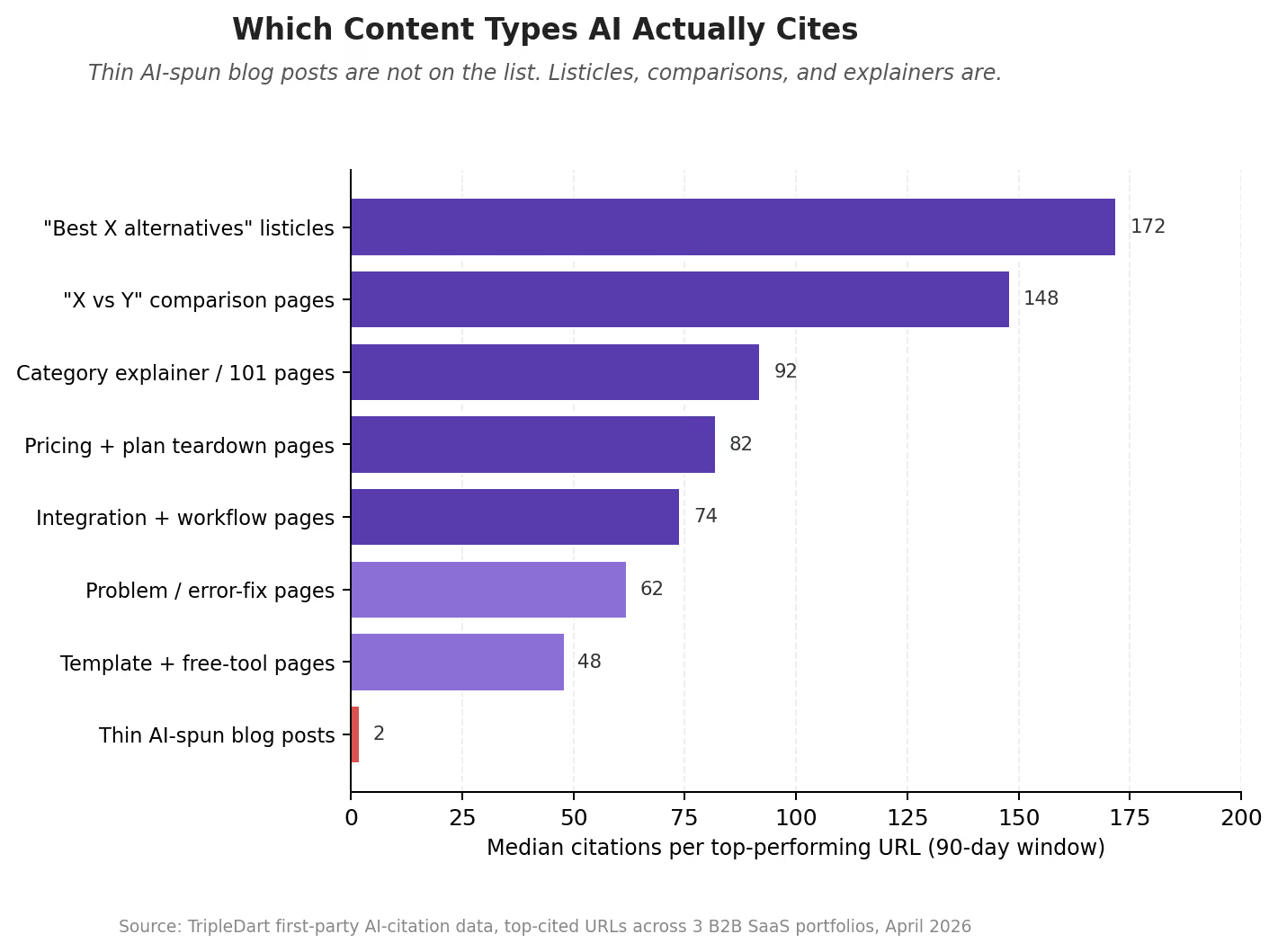
"In every SaaS vertical we audit, the same five content formats dominate AI citations: alternatives listicles, comparison pages, category explainers, pricing teardowns, and integration walkthroughs."
Thin AI-spun blog posts do not appear on that list, which is why they keep showing up in search-intent drift audits and almost never in AI-citation wins.
What Experts Are Saying About AI Content and SEO
The expert consensus in 2026 is consistent: AI is a drafting aid, not a ranking strategy. Quality, originality, and human review remain non-negotiable.
1. Rand Fishkin, Co-founder of Moz and SparkToro
Fishkin has expressed concerns about the over-reliance on AI for content generation, stating, "AI can create content at scale, but it often lacks the depth and authenticity that resonates with audiences." He emphasizes the importance of human insight in crafting content that builds trust and engagement with users.
This aligns with the 2026 ranking data: AI-only content gets 61% fewer editorial backlinks on comparable topics, per the DigitalApplied 16-month study of 4,200 articles.
2. John Mueller, Google
Mueller expresses skepticism about AI-generated content, cautioning that it often contains inaccuracies or lacks value. He advises SEO professionals to be careful and ensure that AI-generated texts are reviewed and adjusted by humans to maintain quality and accuracy. Source
3. Danny Sullivan, Google Public Liaison for Search
Sullivan has been the clearest voice on Google's AI content position. He states that Google does not oppose AI-generated content as long as it provides value to users and is not merely created to manipulate search rankings.
He also notes, "Google aims to reward high-quality content that serves user intent. If AI-generated content fails to meet these standards, it risks being demoted in search rankings." The 2026 core updates bear this out.
4. Ann Handley, Chief Content Officer at MarketingProfs
Handley highlights that while AI can help streamline content processes, it should not replace the human touch. She says, "Content should be created with empathy and understanding of your audience. AI can assist in generating ideas, but it cannot replicate genuine human connection."
Handley encourages marketers to use AI as a tool to enhance their storytelling, not as a crutch.
5. Marie Haynes, SEO Consultant
Haynes emphasizes the importance of E-E-A-T in SEO. She states, "Using AI to create content without ensuring it meets E-E-A-T standards could lead to penalties from Google."
Haynes advocates for using AI to assist in research while ensuring final outputs are vetted by knowledgeable humans. Her framing has grown more relevant as Google rolls AI Overviews and AI Mode into mainstream search.
6. The Reddit Perspective
Reddit itself has become a signal Google trusts. CMS Wire's analysis showed Reddit citations grew 450% between March and June 2025 across Google AI Overviews and Perplexity.
Threads in communities like r/SEO and r/DigitalMarketing show SEOs reporting sharp traffic drops from mass-AI strategies and steady gains from hybrid AI-plus-human workflows. That matches what we see across our portfolio audits.
Portfolio Benchmark
"For a client, a single human-edited alternatives listicle accumulated 170+ AI citations in 90 days across Perplexity, Gemini, Claude, ChatGPT, and Google AI Mode. That one page outperformed every AI-only article they had ever published."
The pattern repeats in every portfolio we audit. Original comparison data beats AI volume, every quarter, without exception.
Final Verdict: Is AI Content Bad for SEO?
AI isn't the problem. Low-quality, AI-generated content is.
Google has made it clear: content quality matters more than content source. Whether AI is used or not, rankings depend on originality, expertise, and value. The real issue isn't AI itself. It's when AI is used without oversight, leading to generic, low-value content that adds nothing new.
The Winning Formula: AI + Human Expertise
AI boosts efficiency. It can speed up research, structure content, and suggest ideas. But human expertise ensures depth, credibility, and brand voice. The best SEO strategies combine both:
- AI for efficiency: research, topic ideation, and content structuring.
- Human expertise for depth: fact-checking, refining, and ensuring originality.
AI is a tool, not a replacement for strategy. The SEOs who succeed won't be the ones avoiding AI, but the ones using it the right way.
Where TripleDart Fits: AI Speed, Human Judgment, Measurable Lift
We help B2B SaaS teams, from seed-stage founders to enterprise-scale software businesses, use AI where it compounds and pull it back where it breaks. Here is what the engagement actually looks like.
Our AI SEO engagements combine three layers.
The first is a baseline audit: we map your current AI citation share of voice across Perplexity, Gemini, ChatGPT, Claude, Google AI Mode, and Google AI Overviews.
This tells us what content formats earn citations for you, what formats earn them for your competitors, and which alternatives-page or comparison-page gaps you are leaving on the table.
The second is a content refresh program. We identify the 20-40 pages in your existing library that are within striking distance of AI citation pickup. Every refresh goes through the same pattern: AI-assisted research and outline, human-led original-data injection, sourced stats with a direct link to the primary source, and a named editorial reviewer. Pages that were silent for 12 months start accruing citations inside 30 days.
The third is a compounding program that runs on a 90-day cycle. Every quarter, we add 4-6 new category-defining assets (alternatives listicles, comparison pages, category explainers) and refresh the previous quarter's assets with newly sourced data. Across our portfolio, this cadence produces visible AI citation lift by month three, consistent lift by month six, and defensible category leadership by month nine.
Frequently Asked Questions About AI Content and SEO
Does Google Penalize AI-Generated Blog Posts in 2026?
No. Google penalizes low-quality, spammy content regardless of who wrote it. Per Google's Search Central guidance and the March 2026 Core Update data, pages with original insight and human review rank well even when AI-assisted, while mass-produced AI pages see 60-80% traffic drops.
How Often Should AI-Assisted Blog Content Be Refreshed?
Every 90 days is the benchmark that holds across our B2B SaaS portfolio. Refresh the stats, pricing, named examples, and any claim that depends on a Google algorithm update. Articles left untouched for 12+ months often fall off AI citation surfaces during a single core-update cycle.
Can ChatGPT-Generated Content Rank on Google Search?
Yes, if the draft is edited with original data, named sources, and author attribution. Ahrefs' study of 600,000 pages found 86.5% of top-ranking pages contain AI-touched content. The ranking advantage comes from what the human layer adds on top of the AI draft, not from the AI itself.
What Makes AI Content Pass Google's E-E-A-T Review?
Four things: a named, credentialed author with a bio, original first-party data or direct case studies, clear source citations on every external claim, and human editorial review with a visible reviewer byline. Missing any of the four is the most common E-E-A-T audit failure we log.
How Do I Add Original Research to an AI-Drafted Blog Post?
Pull real numbers from your product analytics, customer interviews, or internal benchmarks. Cite them with a source sentence ("Across our portfolio of X accounts, we observed Y"). Add a named screenshot, a real quote, or a verifiable data pull. One original data point per section is the minimum bar we use on every TripleDart-produced article.
What Does Google's Scaled Content Abuse Policy Mean for SaaS Teams?
Google's 2024 and 2026 policies target pages produced at scale without human review, unique insight, or user value, often via AI automation. For SaaS teams, the practical gate is simple: if a page could not have been written by someone with direct product knowledge, it's a candidate for demotion.
Are Examples of AI Content Ranking in Google AI Overviews?
Yes, plenty. Pages that rank and get cited in AI Overviews share a pattern: structured answer at the top, comparison or listicle format, named sources, and clear authorship. See our playbook on ranking in AI Overviews for the step-by-step.
How Does TripleDart Help With AI Content and SEO?
We run a three-layer program, AI-citation audit, 20-40 page refresh, and a 90-day compounding content cadence, for B2B SaaS teams from seed through enterprise. To see if your library is a fit, explore our AI SEO services.