
How AI Overview Chooses What to Cite: 50-Plus Page Signals Tested, Only Four Truly Create Impact
We searched 1,000 B2B SaaS keywords on US Google, scraped 11,002 pages for 50-plus attributes, and traced 5,227 citations back to the passage AI Overview lifted them from. Inside: every signal that turned out not to predict citation, then the four that do, with rates by rank, page type and publish year.
Four things move whether Google's AI Overview cites your page: your organic rank, how recently you published, where the answer sits, and whether you have a comparison table.
We searched 1,000 B2B SaaS keywords on US Google, scraped 11,002 pages, and traced 5,227 citations back to the passage they came from. Those are the four that held up.
The bigger surprise was where the citations come from. Only 37% of the sources AI Overview cited were ranking in the organic top 10 for that query. The other 63% came from page two and deeper, or from nowhere in the organic results.
Most of the rest of the on-page checklist does nothing. Word count, heading counts, lists, links, meta length, alt text and schema markup all failed to separate the cited pages from the skipped ones. So did FAQ schema, Domain Rating and backlinks.
That narrows the job a lot. What follows is the full list of what we ruled out, and then the number behind each of the four levers.
How We Ran the Study: 1,000 Keywords, 11,002 Pages, 5,227 Traced Citations
The study covers 1,000 B2B SaaS queries on US Google. We saved every AI Overview, every organic top 10 and every page either one pointed at, then parsed all of it. It's a generative engine optimization question, and we used ordinary SEO tooling to answer it.
We ran it in this order:
• Keywords. We picked 1,000 B2B SaaS queries across 40 software categories (CRM, payroll, BI, ERP, cybersecurity, and 35 more) and 28 intent types, then split them evenly across the funnel: 334 bottom, 333 middle, 333 top.
• Collection. Every keyword went through SerpApi with caching off, so nothing we captured was stale. We kept the full AI Overview text along with its citation list.
• Page scraping. We scraped every unique URL with Python and BeautifulSoup and pulled 50-plus attributes off each one: word count, heading counts, tables, lists, links, meta tags, content format, page type, and a 0-10 depth score. 88.8% came back clean.
• Snippet tracing. For each cited page we fuzzy-matched the AI Overview text back into the page body to find where it came from. That worked on 80.6% of the cited pages we could scrape, which gave us 5,227 citations we could place.
• Authority and schema. We pulled Ahrefs numbers (Domain Rating, URL Rating, backlinks, referring domains, organic traffic) for all 8,858 URLs. A later pass picked up structured-data markup on 70% of pages, and a machine-readable publish or modified date on 35%.
You can't scrape YouTube, LinkedIn or most social URLs this way, so those sit in the data by status and domain only.
Everything below sorts pages into three groups:
What We Ruled Out: Word Count, Schema, Backlinks and Domain Rating
We took the 5,217 pages ranking in the top 10, split them by whether AI Overview cited them, and compared them attribute by attribute. Every attribute came back negligible, meaning an effect size under 0.11, with organic position the single exception.
We call that sub-0.11 range the noise band. An attribute can sit in there with a measurable, statistically significant gap and still be no help to you.
We mostly use the band as a stop-doing list, which is why it comes first.
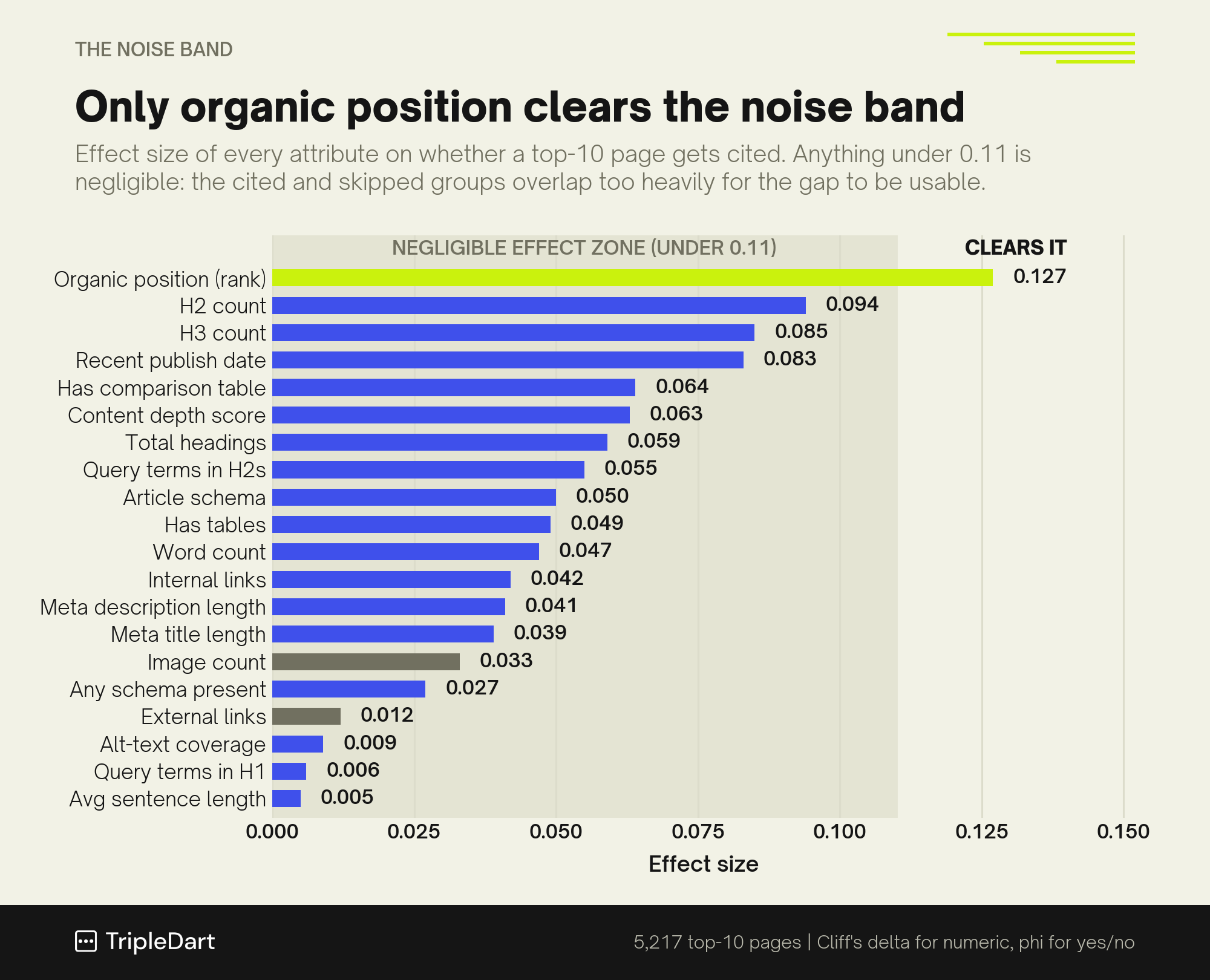
Look at the effect-size column below and ignore the averages, since with thousands of pages the averages make tiny gaps look important.
Sig.: *** p<0.001, ** p<0.01, * p<0.05, ns not significant. Effect size is |Cliff's delta| for numeric attributes and |phi| for yes/no attributes. Boolean rows show the share of pages carrying the feature. Position is reverse-coded, so cited pages rank higher.
Put every attribute into one logistic model and let it control for rank, and nothing moves. You get 59% accuracy against a 52% base rate, and a McFadden R² of 0.03. That's a fit score where 0 means the model explains nothing and 1 means it explains everything.
The biggest positive coefficient is having a comparison table. The biggest negative is a low rank.
Word Count and Outbound Links Both Run Against You
Cited pages average 2,924 words and skipped pages 3,055, so the longer group is the one Google skipped. Writing more does not get you cited.
Outbound links go the same way. Skipped pages carry 15.7 external links on average against 12.9 for cited ones, so loading a page with citations to look authoritative works against you if anything.
Everything that leans positive is structural: heading depth, H2 and H3 counts, tables, comparison tables, the depth score. They all do one job, which is to break a page into self-contained answers a model can lift out.
Only the comparison table survives the controls, though the rest does match how we structure content for AEO on client sites.
Domain Rating 79 Against 78: Authority Does Not Separate Cited From Skipped
We pulled Domain Rating, URL Rating, backlinks, referring domains and organic traffic for all 8,858 pages and ran the same comparison. The cited and the skipped look the same on every one.
Median Domain Rating is 79 for cited pages and 78 for skipped. URL Rating is identical at 4.7. Referring domains, backlinks and organic traffic clear significance at effect sizes around 0.045, which puts them in the noise band with everything else.
Adding them to the model does nothing either. Put all five on top of position and every on-page attribute and accuracy stays at 59%, with McFadden R² going from 0.032 to 0.033. Authority on its own predicts citation at 52%, the base rate.
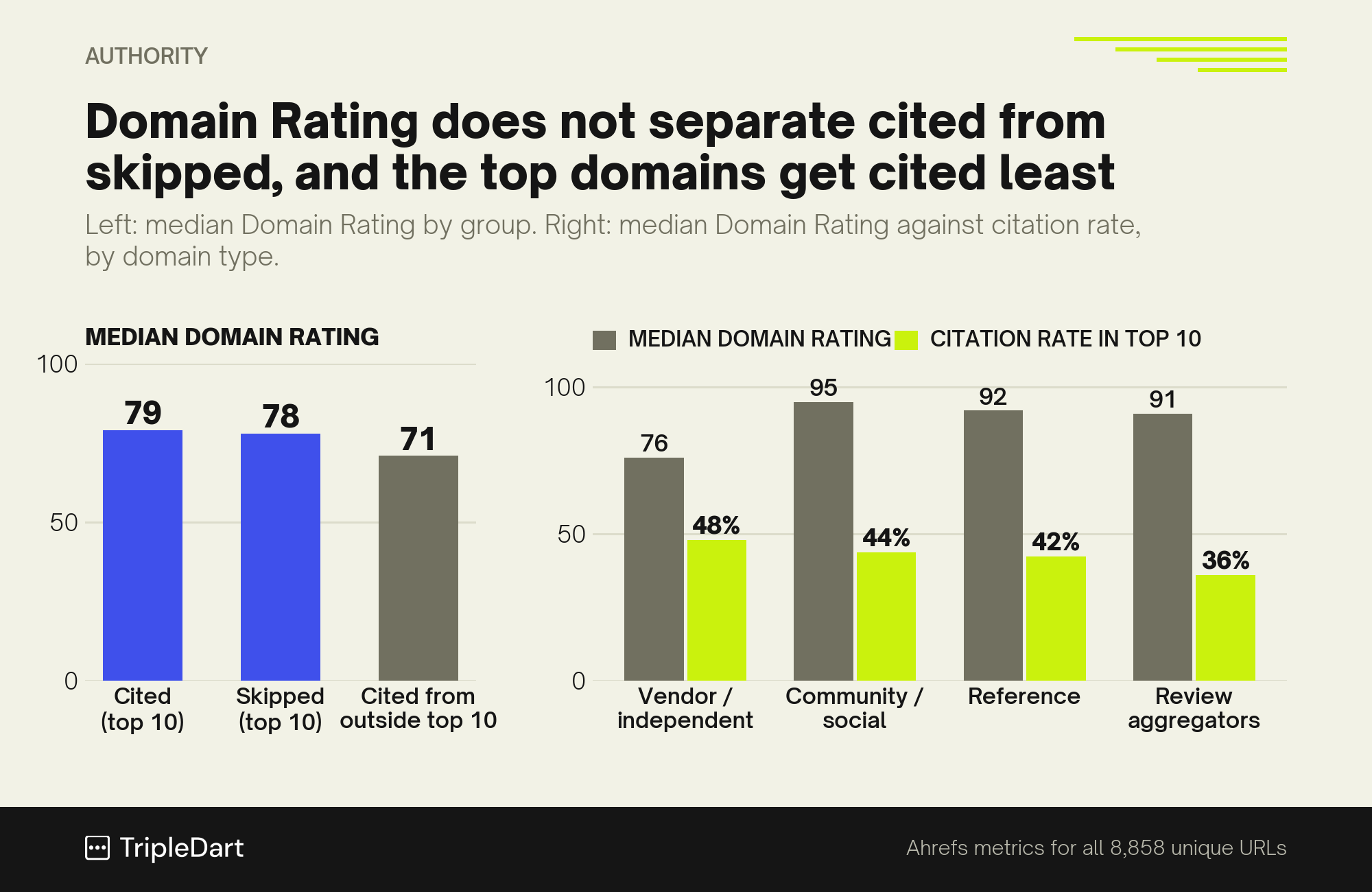
Across domain types the relationship runs backwards. Vendor and independent pages have the lowest median Domain Rating, 76, and get cited most, 48%. G2 and Capterra sit near the top at 91 and get cited least, 36%.
Links still earn you the ranking that gets you into the pool, so SaaS link building stays on the plan. Once two pages are ranking side by side, the link profile stops deciding which one Google picks.
Schema Markup for Answer Engine Optimization: 81% Against 78%, and FAQ Schema at Zero
We had markup on 70% of pages, enough to test it properly. 81% of cited top-10 pages carry some schema against 78% of skipped ones, and both groups average 3.2 types.
Article schema has the strongest tie of any type and it's still negligible. It probably just marks a page as an article, and articles already get cited a bit more.
FAQ schema is the one teams add hoping for AI features. It comes in at 19.5% on cited pages and 19.3% on skipped.
Markup is a little more common on the pages cited from outside the top 10 (84%), which makes sense, since those tend to be well-built vendor pages. Keep it for rich results in classic search and the rest of the answer engine optimization job it does well.
Sentence Length, Meta Length and Alt Text All Land in the Noise Band
Short Sentences Don't Win
Cited and skipped pages both average about 20 words a sentence. Pages that average under 12 words get cited less often, so 15 to 22 words is the norm among cited pages and short choppy sentences do not help.
Meta Length Sits in the Noise Band
Cited pages run a hair longer on titles (57.5 characters against 56.5) and a hair shorter on descriptions (149 against 150). Neither gap is big enough to act on.
Alt Text Does Nothing for Citation
Both groups tag about 69% of their images. Do it for accessibility and image search, and expect nothing from it here.
Query Terms in Your H2s Beat Query Terms in Your H1
Putting the keyword in your H1 does nothing we could measure. Cited and skipped pages both cover about 62% of the query's terms in the H1, and citation rate barely moves either way (49.6% against 48.3%). Nearly every page in the top 10 already does it, so it can't tell them apart.
Subheadings are different. Cited pages cover more of the query across their H2s, 0.62 against 0.59, at an effect size of 0.055. That's one of the bigger content signals here, so phrase your subheadings the way buyers ask the question.
Internal and external links both sit in the noise band too.
That's the on-page checklist accounted for. The next thing to know is that most of the citations were never coming off page one at all.
63% of AI Overview Citations Come From Outside the Organic Top 10
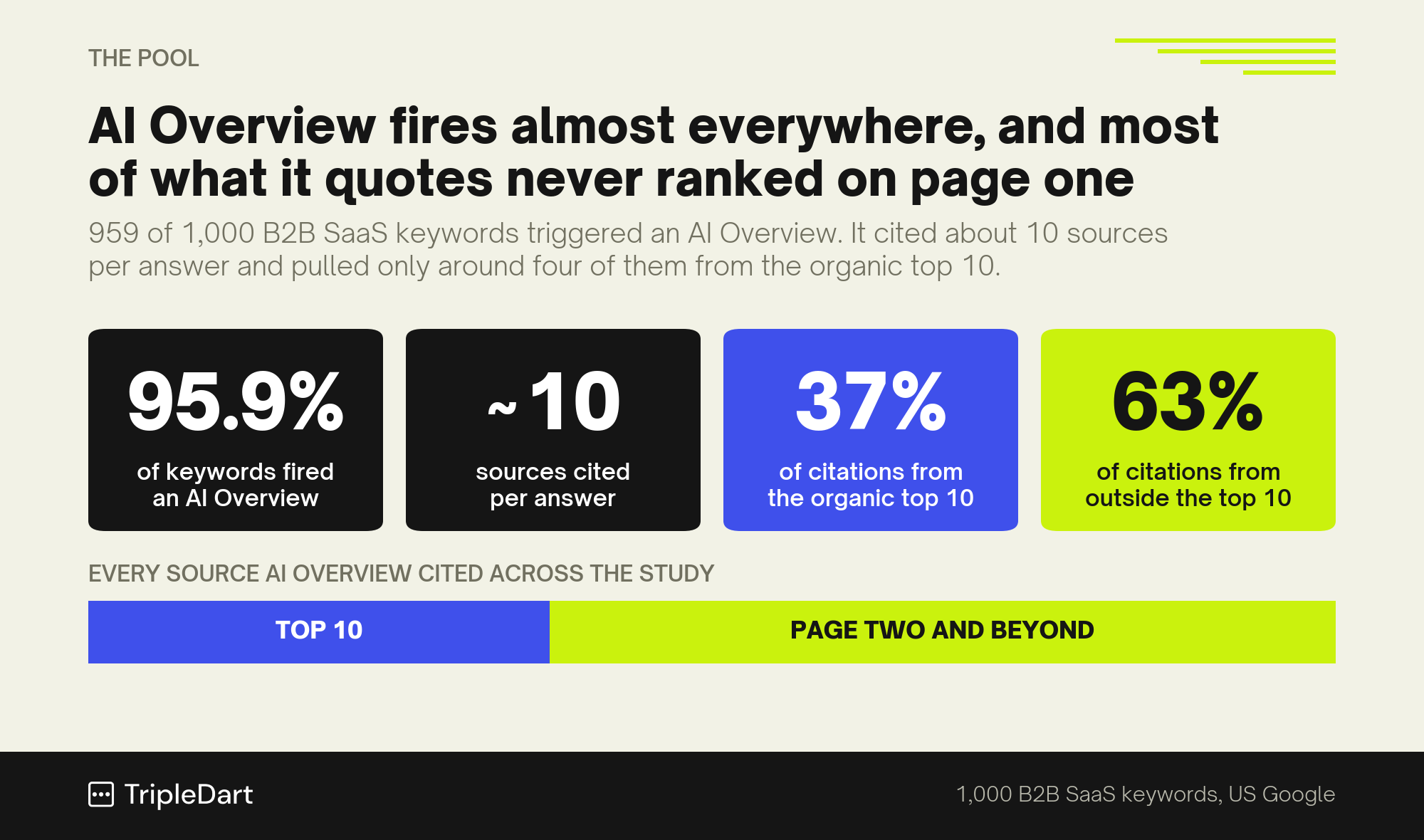
AI Overview showed up on 959 of our 1,000 keywords and cited about 10 sources each time. Only around four of those 10 were top-10 organic pages for the query, which puts 63% of all citations outside page one.
Start with how often it appears. The 41 queries that didn't get an AI Overview were mostly bottom-of-funnel, brand and pricing searches, where Google still sends people straight to a product page.
You can read the overlap two ways. From the organic side, 46% of the top-10 pages on an average query got cited somewhere in the answer, so page one is well represented.
From the AI Overview side, only 37% of what it cited was a top-10 page. Both are true, because it cites about 10 sources and takes four or so from the top 10, then goes looking elsewhere for the rest.
Our 37% is close to what a much bigger study got. The Ahrefs March 2026 update measured 38% overlap across 863,000 keyword SERPs and 4 million AI Overview URLs. The same team got 76% in July 2025.
Ahrefs is upfront about one thing: their citation parsing improved between the two runs, so part of that drop is better detection. Search Engine Journal covered the same numbers, and BrightEdge rank overlap data comes out in a similar range on a different method.
So two independent datasets agree, which makes 37% the number to plan around.
Ahrefs thinks the cause is query fan-out. The model breaks one query into several sub-queries and takes sources from those results, and the searcher never sees those results on their own SERP.
That explains most of what follows, and it's where we'd start on any generative engine optimization program.
So the top 10 is a smaller pool than it looks. Which raises the question of what a spot in it buys you.
Rank Is the Strongest Signal: Position 1 Gets Cited 55% of the Time, Position 9 Gets 34%
Organic position is the strongest single signal in the study, at an effect size of 0.127, and the only one that clears the noise band. Pages at position 1 get cited 55% of the time, pages at position 9 get cited 34%.
Cited pages sit at an average rank of 4.24, skipped pages at 4.76. The rate falls about one to two points per position, and it slips once: position 4 (46%) comes in a point above position 3 (45%).
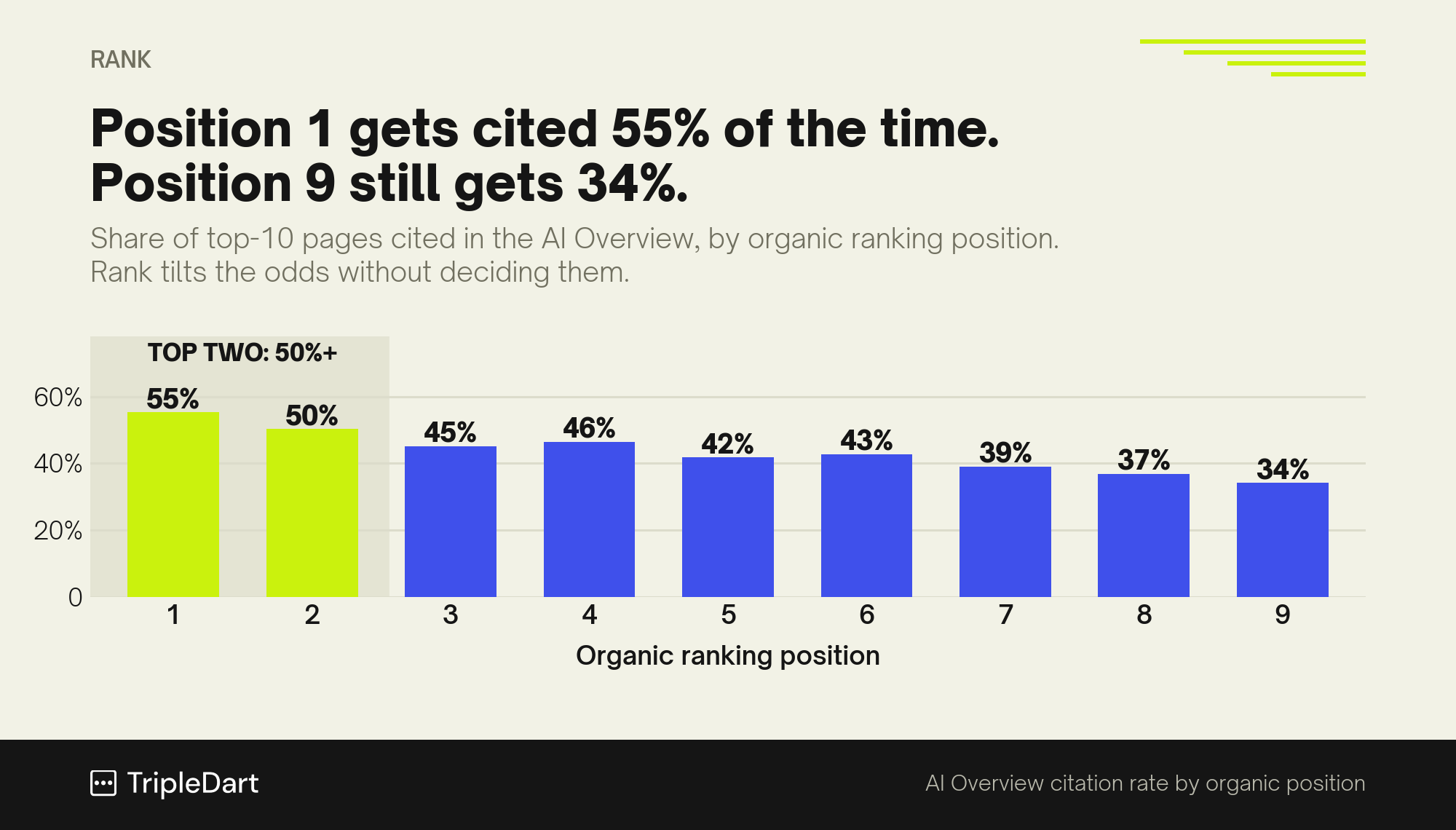
Neither end of that range is a guarantee. Position 1 gets left out of the answer 45% of the time, and position 9 still gets pulled in a third of the time.
So rank is worth chasing, and it won't decide the outcome on its own. Moving a page from position 6 to position 4 buys you a few points.
Getting it into the top two is where you see a jump, and that's a straight extension of any SaaS SEO strategy you already run.
The First-Listed Source Is Short, Well-Ranked and High-Authority
The citations inside an AI Overview come in an order, and the top slot behaves differently from the rest. The first-listed source ranks in the organic top 10 82% of the time, against 30% for the ones below it. It also sits on a stronger domain, median Domain Rating 87 against 74.
One thing surprised us: the first-listed page is usually shorter, median 1,694 words against 2,476 for the pages cited below it.
So AI Overview seems to open with something short, well-ranked and authoritative, then fill in with longer pages from further out. We couldn't measure clicks, so we know what gets a page into that slot. Whether the slot is worth more clicks, we can't say.
One more thing about coverage. Of the top-10 pages it cited, 3,278 were exact-URL matches. Another 233 were same-domain matches, where it cited a different page on the site than the one ranking. So having several pages ranking on a query gives it more of your pages to choose from.
Rank gets you into the pool. The next lever is where on the page you put the answer.
AI Overview Takes 64% of Its Citations From the First 40% of the Page
35% of citations come out of the first 15% of the page and 64% out of the first 40%. The median citation sits 27% of the way down, and only 13% come from the last third.
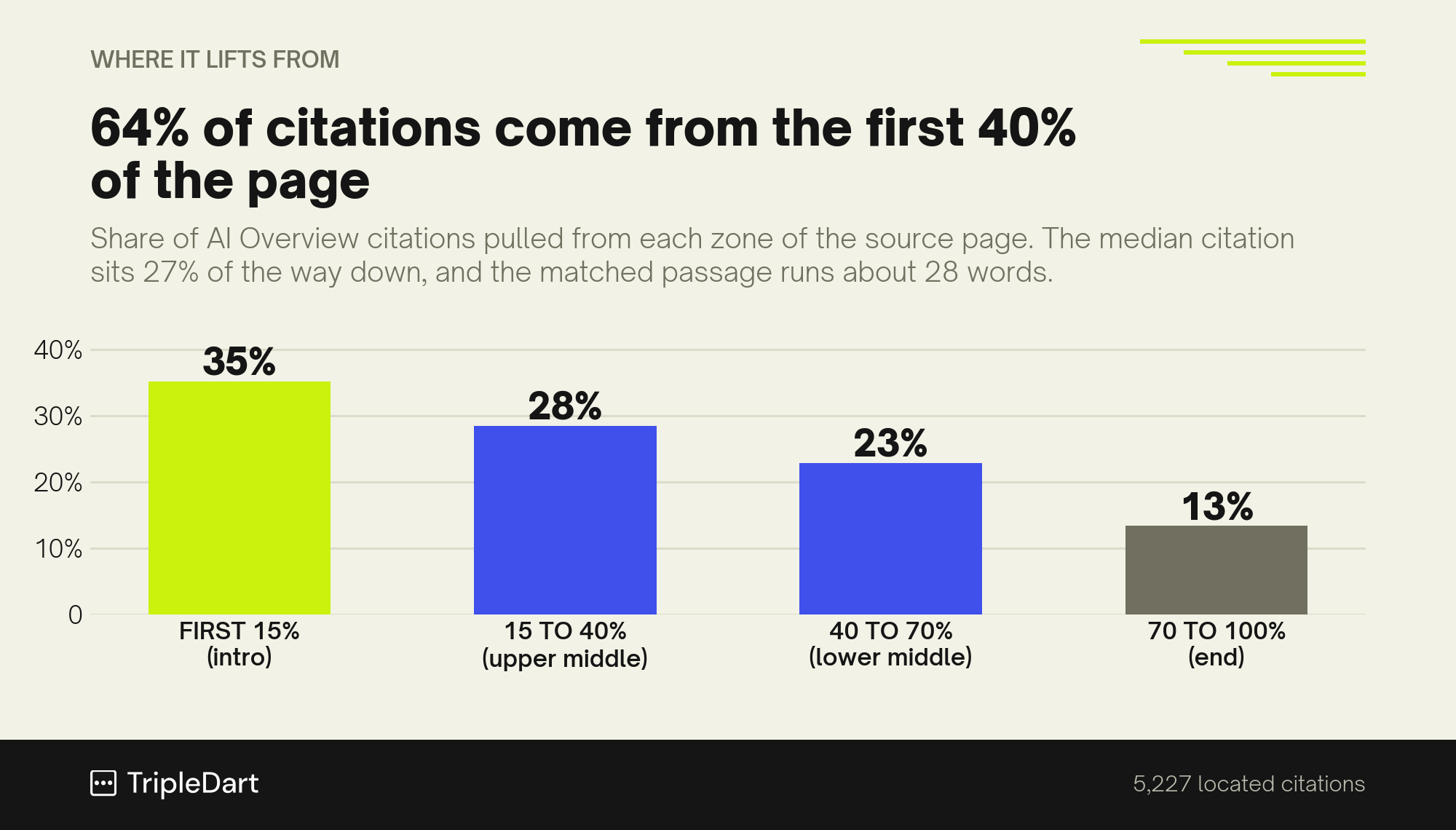
The passage it matched runs about 28 words at the median, so a sentence or two. AI Overview goes looking for one clean, quotable line, and it starts near the top.
The first 100 words are about 4% of a typical cited page and they produce 15% of the citations. Per word, that makes your opening roughly four times more likely to be the line that gets quoted than anything else on the page.
Keep a clear answer going through the first 300 words and you're at a third of all citations. The first 400 gets you close to 40%.
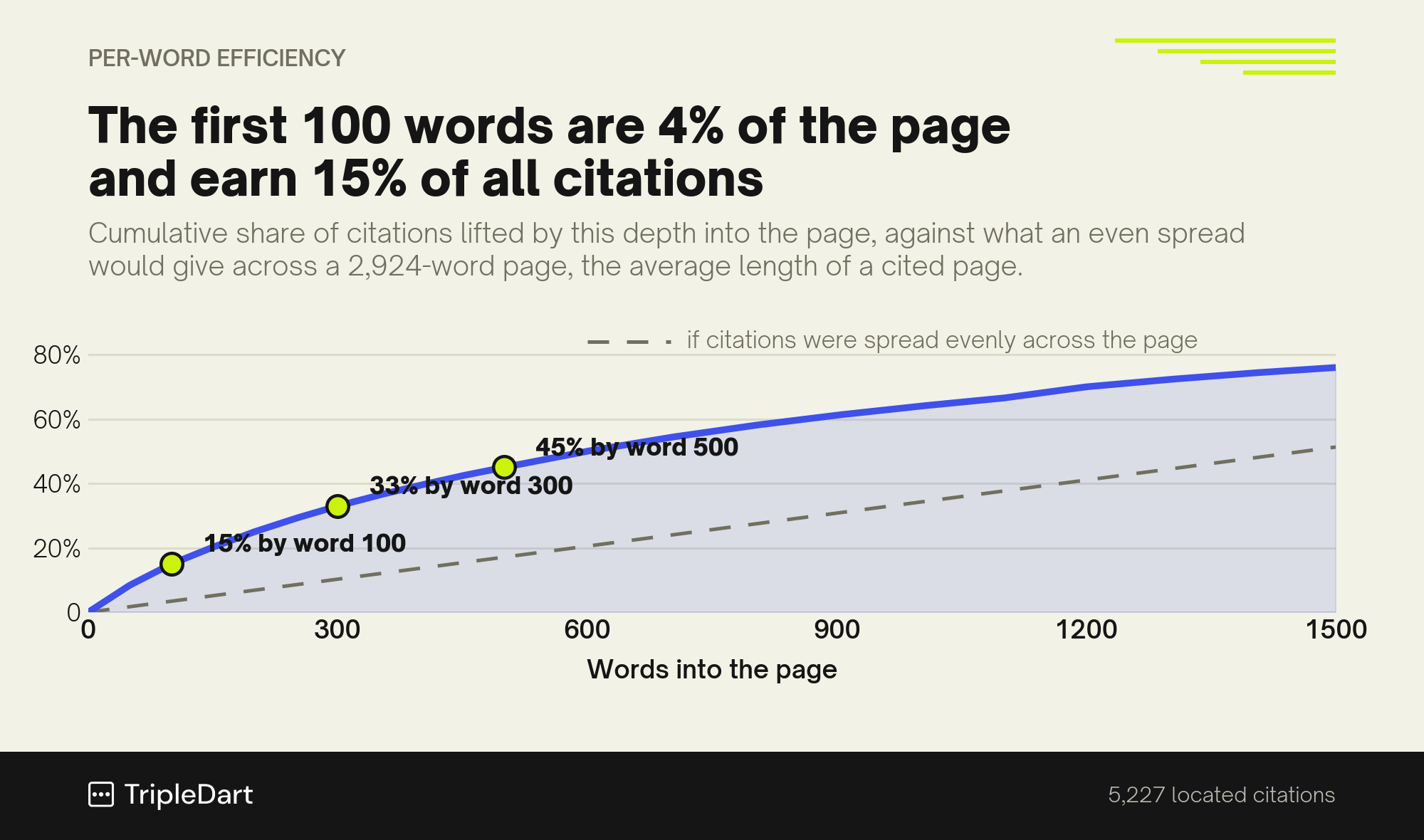
The rest of the page still does work. About half the citations come from past the 600-word mark, so a well-answered section further down does get pulled.
Which part of the page gets quoted also depends on the format.
On definition pages 46% of citations come from the first 15%, because that's where the definition is. On comparison and how-to pages they spread deeper, because that's where the table and the numbered steps are.
So put each answer where someone searching for it expects to find it, and put the definitional version in your opening two sentences.
Other people have found the same slope on smaller samples and other engines. The CXL citation-source study put 55% of citations in the top 30% of a page across 100 citations.
Kevin Indig looked at 1.2 million ChatGPT citations and found attention bunched in the same place. We tested it on 5,227 traced citations, a much bigger base, and it holds. The B2B SaaS AEO guide has the templates we write openings against.
Since placement changes with the format, we looked at format on its own next.
Page Type and Format: Comparison Pages Get Cited at 56%, Pricing Pages at 40%
Comparison pages get cited 56.2% of the time and definition pages 55.3%, both well above average, while pricing pages come last at 40.2%. Which makes sense: an AI Overview answers questions, and those two formats are written to answer questions.
Blogs get cited 52% of the time against 45% for formal articles. By funnel stage it goes the same way: informational top-of-funnel pages get cited 51% of the time and transactional bottom-of-funnel pages 42%.
Category moves the number more than format or funnel stage do. Citation rate for top-10 pages runs from 60% in product analytics down to 31% in SEO software, close to double.
Where the ranking pages are full of vendor blogs and comparison content, AI Overview has more to work with. Categories crowded with thin or heavily commercial pages give it less, which makes your category one of the GEO metrics to track before you pick a citation target.

Alternatives and Versus Queries: Long-Form Comparisons Take 90% of Citations
On alternatives and head-to-head queries, almost everything cited is editorial. 48% of citations went to blogs and 42% to articles, running a median of about 3,000 words, and templated comparison landing pages got 9%.
Comparison-format content gets cited 56% of the time on these queries against 34% for general pages. A detailed editorial comparison with a table in it will outcite a thin product-style page on the same query.
So build the long version for the citation, and let your competitor comparison landing pages keep doing the conversion work.
One more attribute cleared the noise band: how recently the page went up.
Freshness: Pages From 2023 Onward Get Cited Twice as Often as 2018 Pages
Publishing recency comes in at an effect size of 0.083, in a cluster just behind organic position with H2 count (0.094) and H3 count (0.085). Of those three, recency is the one you can change without rewriting the page.
Across the pages carrying a publish date, cited pages are a median of 373 days old and skipped pages 450. Citation rate climbs from about 26% for 2018 pages to between 50% and 54% for 2023 and later. There's a dip in the middle, where 2021 comes in at 36%.
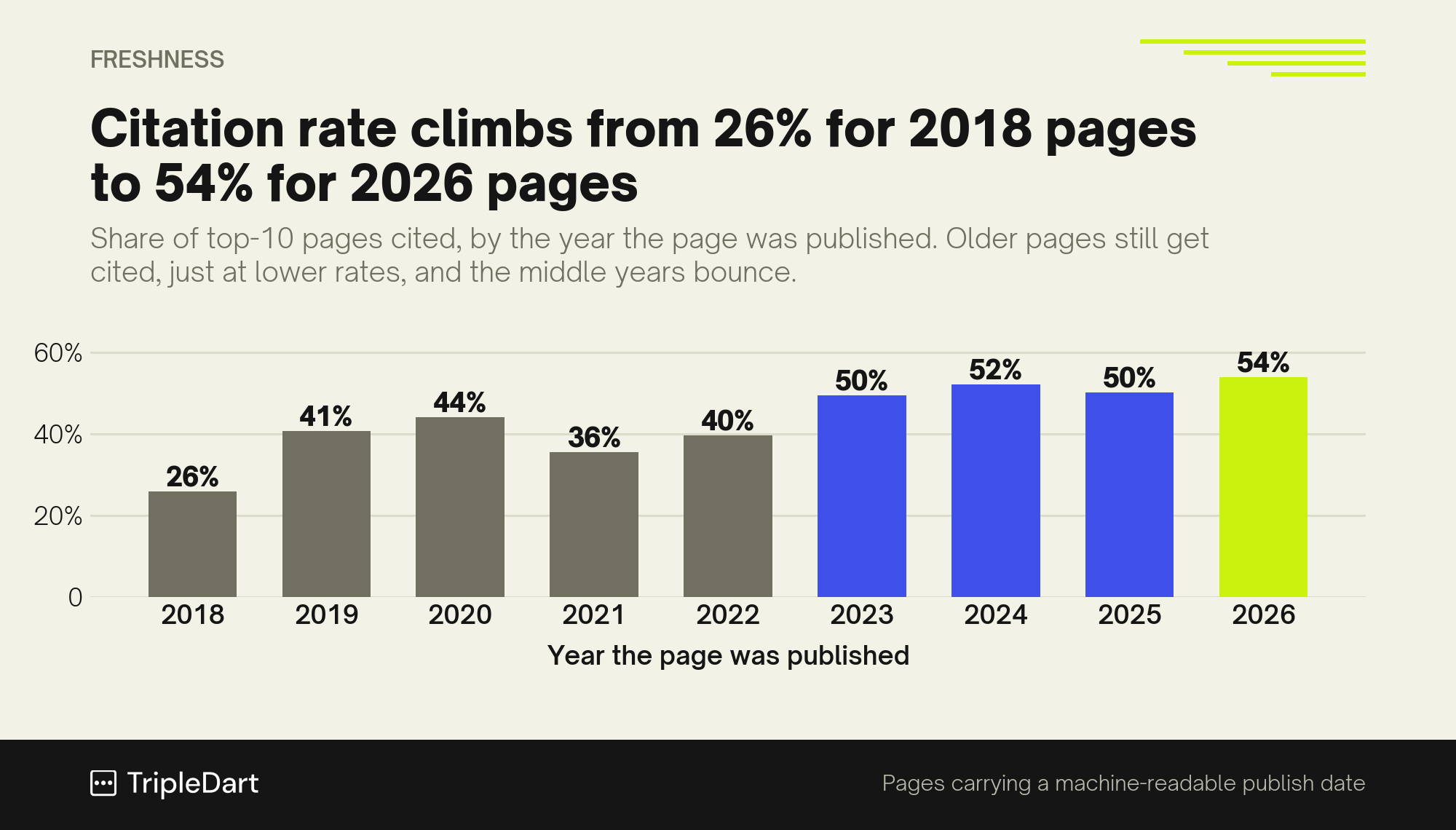
77% of cited pages with a date went up in 2024 or later, and about 7% came from 2018 to 2021.
Older pages still get cited. A 2018 page has roughly a 26% shot and a 2020 page 44%, so age is a disadvantage without being a cutoff. Refreshing helps too, just less than publishing something new, since the modified-date effect is smaller than the publish-date one.
That's all four levers, and every one of them is about a page on page one. The pages AI Overview cites from below rank 10 look different.
Below Rank 10: Richer Content on Weaker Domains, Led by Review and Community Sites
The 3,963 AI-Overview-only pages have more headings, more tables, higher depth scores and more words than the pages ranking on page one for the same queries. 44% of them have a table, against 33% of cited top-10 pages.
That is query fan-out again. AI Overview will go to page two or three for a page that answers a sub-question properly, even when Google's own ranking left it down there.
Those pages are also weaker on paper. Median Domain Rating 71, below the top-10 set, and median organic traffic of about 1. It reaches past page one for pages that barely rank and get almost no visitors, and picks them on how well they answer the question.
Vendor and independent sites make up 91.7% of the pool. The individual domains that come up most are review and community sites: YouTube, G2, LinkedIn, Capterra and Reddit lead, alongside vendor domains like Monday, Rippling and Zoho.
One more number in that table. Among top-10 pages, review aggregators get cited least of any domain type, 36.1%, well below ordinary vendor pages at 48%.
So when a G2 or Capterra page ranks organically, AI Overview is fairly likely to skip it. But review sites keep turning up in the pool below rank 10, where rank tracking that stops at position 10 can't see them.
That covers the findings. Here is the playbook.
The On-Page Playbook: Five Moves That Held Up and Six to Drop
Two of these five survived every statistical control we ran. Answer the query in your opening two sentences, and put a comparison table on any page that compares options. The other three came through weaker and pointed the same way.
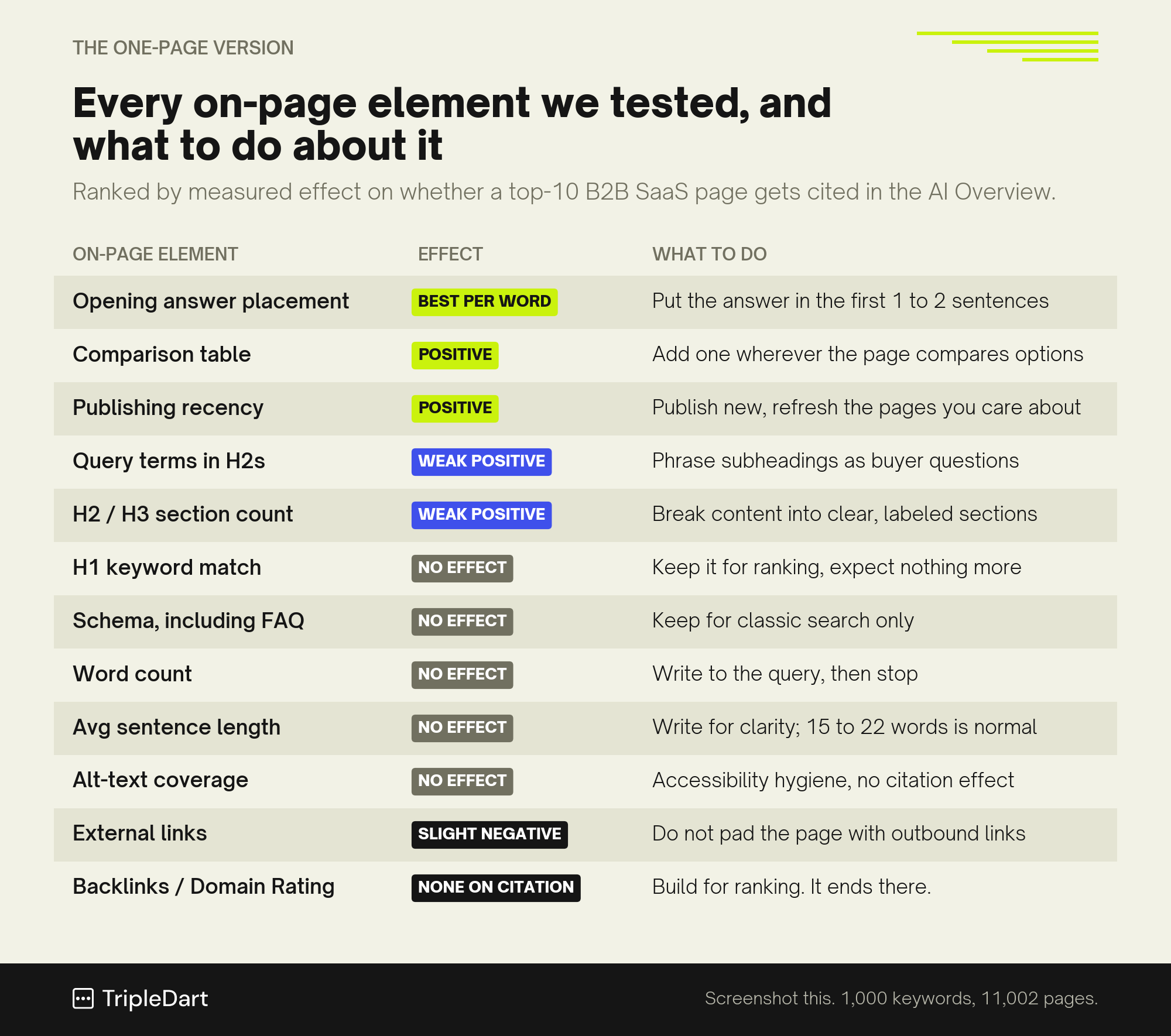
Five Moves That Held Up
• A comparison table. The only on-page feature that stayed positive once we controlled for rank, on 23.0% of cited top-10 pages against 17.8% of skipped ones. If a page compares options, build the table instead of describing the differences in prose.
• An opening that answers the query in one or two sentences. AI Overview takes about 28 words at a time, out of a stretch that produces 15% of citations off 4% of the words. Lead with a self-contained answer roughly that long.
• Recency. Citation rate goes from 26% for 2018 pages to 50-54% for 2023 and later. Publish new work and refresh the pages you care about, which is what the GEO tools worth paying for are for.
• Clear H2 and H3 sections phrased with the query terms. Covering the query across subheadings gives you a small measured edge (0.62 against 0.59) where covering it in the H1 gives you none. Put the answer straight under the heading so the section reads on its own.
• Self-contained passages. A sentence that stands on its own gets quoted more cleanly than one leaning on the paragraph around it. Write the key claims so they survive being lifted out of context.
Six Things to Drop
• Keyword-stuffed H1s. About 62% of both cited and skipped pages already cover the query in the H1, so it can't tell them apart. Keep a clean descriptive H1 for ranking and expect nothing further from it.
• More words for their own sake. Cited pages average 2,924 words against 3,055 for skipped. Write to the query, then stop.
• Padding the page with outbound links. Skipped pages carry more external links on average, so this works against you if anything.
• Chasing backlinks and Domain Rating to win the quote. They earn you the ranking that gets you into the pool. At the same rank, Domain Rating 79 and 78 behave identically.
• Adding schema to win AI Overview citations. FAQ schema comes in at 19.5% against 19.3%. Keep markup for rich results in classic search.
• Shortening every sentence. Both groups average about 20 words, and pages under 12 words a sentence get cited less often.
How the Work Splits by Role
The three roles read the same findings and act on different parts of them.
What the Study Cannot Tell You
Four limits, and two of them should temper how far you push the numbers above.
• Association, without proof of mechanism. We can describe what cited pages look like. We can't see inside Google's selection, so "comparison tables are associated with citation" is a correlation and a strong hint for testing.
• One snapshot in time. AI Overview is served live and changes, and the Ahrefs numbers are a single-date pull. These are US-English results from one window.
• Year-by-year freshness rates are directional. The publish-date findings run on the pages that expose a date, so read the direction as solid and the individual years as indicative.
• 11% of pages didn't fetch. Mostly 403 blocks and timeouts, spread evenly across the three groups. Social and video URLs in particular couldn't be scraped.
The Short Version: Four Levers, and a Pool Twice the Size of Page One
Four things move AI Overview citation for a B2B SaaS page:
• Rank in the top two, where citation rate crosses 50%.
• Publish and refresh recently, because citation rate climbs from 26% to 54% with recency.
• Open with one clean, quotable, 28-word answer, because 64% of citations come from the first 40% of the page.
• Put a comparison table on any page that compares options, since that's the only on-page feature that survived every control.
Two more things belong in the plan. Comparison and definition formats get cited at 56% and 55%, so build those for the queries that call for them.
And 63% of citations come from below rank 10, a pool thick with G2, Capterra, Reddit and YouTube, so your presence there counts as part of your footprint.
Everything else we tested sits in the noise band, and chasing it will cost you a quarter for nothing.
When you want this run on your own category and turned into a page-by-page plan, talk to our GEO team. We'll show you which of your pages AI Overview already cites, which ones it skips, and where the citations in your category are going instead.
Frequently Asked Questions
How Often Does AI Overview Appear for B2B SaaS Queries?
On 95.9% of the 1,000 keywords we tested, so 959 of 1,000. Top-of-funnel informational queries triggered it most at 97.9% and bottom-of-funnel transactional queries least at 92.2%. Plan on it being there.
If I Rank in the Top 10, Will I Get Cited?
About 45% of top-10 pages get cited overall. Position 1 pages hit 55% and position 9 pages 34%, so ranking clearly helps. On any given query, roughly half the top-10 pages get left out of the answer.
Does Making My Content Longer or Adding Schema Help?
Neither one moves citation. Cited pages average 2,924 words against 3,055 for skipped, so length runs the other way. With markup on 70% of pages, cited and skipped pages carry schema at 81% and 78%, and FAQ schema comes in at 19.5% against 19.3%.
Does It Matter How Recently the Page Was Published?
Yes, more than any other page attribute we could measure. Citation rate climbs from about 26% for 2018 pages to between 50% and 54% for 2023 and later. 77% of cited pages with a date went up in 2024 or later, so publishing new work and refreshing important pages both help.
Do Backlinks and Domain Authority Help?
Not with citation. Across all 8,858 pages, cited and skipped top-10 pages come in at Domain Rating 79 and 78. Adding every authority metric to the model leaves accuracy at 59%. The domain types with the highest authority, G2 and Reddit and Wikipedia, get cited least.
Does This Change How I Should Run Generative Engine Optimization?
It narrows the work. Ranking still earns you the pool, so the GEO vs SEO split most teams already run stays intact. The marginal hour moves out of schema and link volume, and into openings, comparison tables, refresh cadence and third-party presence.
What Is the Single Highest-Value Change I Can Make?
Two of them. Open the page with one clean sentence that answers the query, since 64% of citations come from the first 40% of the page. And add a comparison table where the topic supports one, since that's the only on-page feature that held up once we controlled for rank.
Where Does AI Overview Get the Sources It Cites?
Only 37% from the organic top 10, which lines up with the 38% Ahrefs measured across 863,000 keyword SERPs. The other 63% come from page two and beyond, heavily featuring G2, Capterra, Reddit, YouTube and vendor blogs that didn't rank.