
Creating a BOFU Content System That Ranks in AI Search
Contributor

Lashay Lewis
Founder, BOFU.ai

Glenn
Organic Growth Manager @ TripleDart
In this article
Most SaaS content teams are publishing a lot but not seeing leads. Paid is doing the heavy lifting, and the blog feels like a vanity metric machine. The problem isn't volume. It's that the content being produced isn't built for the bottom of the funnel.
Bottom-of-funnel content is hard to get right. It requires deep product knowledge, customer insight, and competitive positioning that most content marketers don't have access to. It's also the content most likely to drive demos, pipeline, and revenue.
This guide walks through a complete system for building BOFU content that converts in both traditional search and AI-powered search, based on insights from Lashay Lewis, Founder of BOFU.ai, during Episode 12 of Coach by TripleDart.
Lashay has spent over a decade as a content strategist, helping SaaS companies drive seven figures in attributable pipeline, increase conversion rates by 600%, and secure dozens of first-page rankings through her BOFU-first approach.
The Five Phases of the BOFU Content System
Lashay's system breaks down into five primary phases:
- Customer and Product Research
- Competitor Research
- Keyword Research and Content Strategy
- Content Creation and Publishing
- Tracking
What Makes Good BOFU Content
Before diving into the process, it's important to understand what separates effective BOFU content from the filler that most teams produce.
Good BOFU content is relevant to your persona. As Lashay puts it, content isn't written in a vacuum. If your company has multiple personas and ICPs, each article speaks to a specific person depending on the use case, not to everyone at once.
Beyond persona relevance, strong BOFU content is highly contextual and explains your product in the context of the use case.
- Explains what your competitors do well without talking them down
- Goes into detail about your capabilities with live examples
- Includes real prospect pain points
- Intentionally connects pains, benefits, and capabilities into a logical thread
The last point Lashay emphasizes is that good BOFU content prioritizes customer insight over search engines. There's an overindexation on optimizing for Google and now LLMs, but the paradox is this: in order to effectively show up in AI search, you need to know who your customer is and speak directly to them.
What Makes Bad BOFU Content
On the flip side, weak BOFU content tends to share a few common traits:
- It's focused on search engines over customer insight
- It briefly covers features with three bullet points about your product and then moves on to the next competitor
- It talks down on competitors, which not only feels wrong ethically but can actually hurt you in AI search (more on that later)
- It includes no contextual examples tying the product to the persona's workflow
- It copies from other websites or asks ChatGPT to generate an outline from a keyword
- And it has no logical connection from pains to capabilities
Why BOFU Content is Difficult to Create
The reason bottom-of-funnel content is so hard comes down to one thing: it requires input from every team.
Lashay illustrates this with what she calls the BOFU Venn Diagram. Sales, customer success, and product each hold critical pieces of information that need to come together for effective BOFU content.
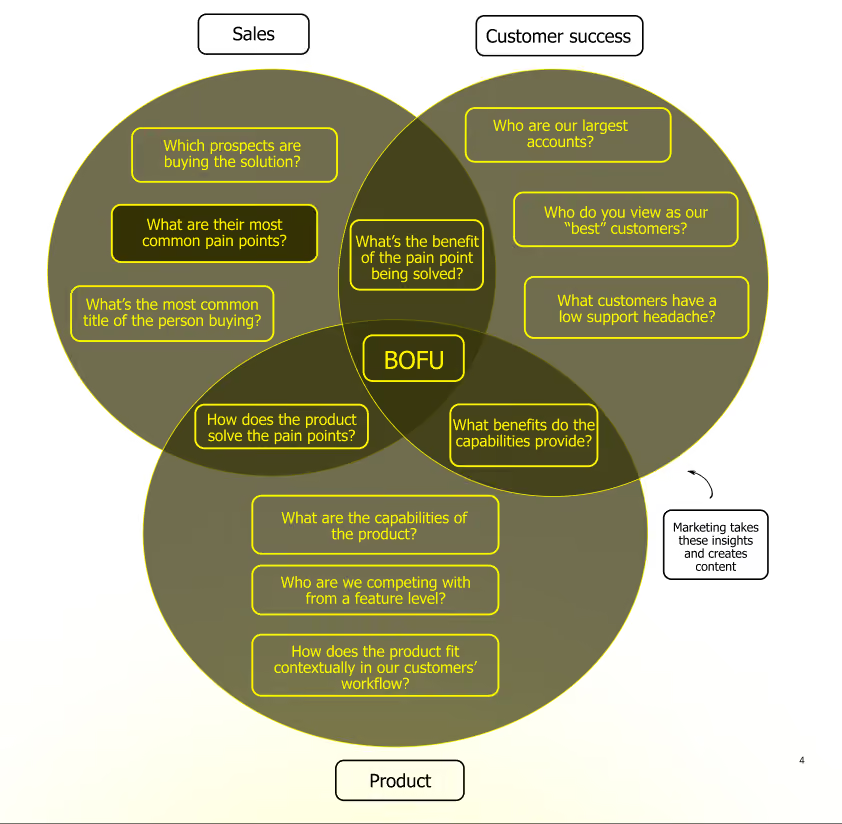
From sales, you want to know: Which prospects are buying the solution? What are their most common pain points? What's the most common title of the person buying?
From customer success: Who are our largest accounts? Who do you view as our "best" customers? What customers have a low support headache?
From product: What are the capabilities of the product? How does the product fit contextually in our customers' workflow? Who are we competing with from a feature level?
But it's not just the individual teams. There are overlapping questions that sit between each pair.
Between sales and customer success, it's "What's the benefit of the pain point being solved?" Between CS and product, "What benefits do the capabilities provide?" Between sales and product, "How does the product solve the pain points?"
Marketing's job is to take all of this and produce content from it.
The Silo Problem
The problem is that most in-house content teams operate in siloed environments.
Lashay is direct about this: as content marketers, it's not your job to develop a culture of cross-functional communication. Culture starts at the leadership level and drips from the top down, not the bottom up.
But you still need to be in a position to do your job well. Her workarounds include scheduling recorded calls with people on other teams, creating a Slack channel with one person from each team, and setting up a shared Google Drive folder between teams.
What you actually want is a connected flow where sales talks to marketing, marketing talks to product, product talks to CS, and CS talks to sales. That's how information flows from one team to the next.
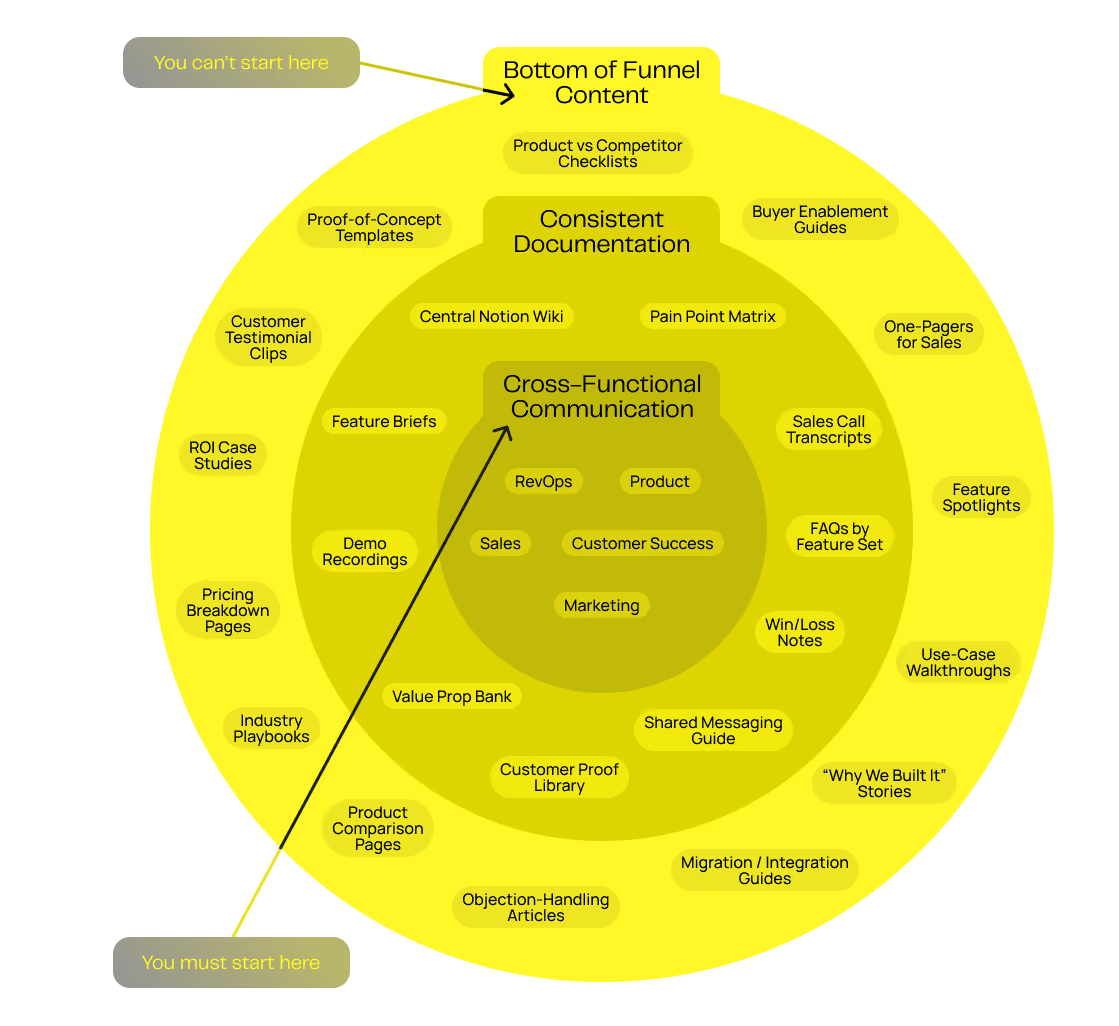
Phase 1: Customer and Product Research
This is where most teams skip ahead and pay for it later.
Lashay sees people jump straight to creating comparison pages, checklists, and buyer enablement guides. But to do any of that well, you need to start with internal alignment, building a knowledge base and then working outward from it.
Gathering Internal Documentation
The first step is gathering as much internal documentation as you can in one centralized place. This includes ICP documentation, persona documentation, feature-benefit pairings, positioning documents, battle cards, sales decks, and case studies.
A simple rule of thumb: if it describes what the product is, what it does, and who it serves, that's the internal information you want to gather.
This is harder than it sounds. Internal documentation is often spread across HubSpot, Notion, Google Drive, and multiple other platforms across different teams.
The first thing Lashay recommends is consolidating all of this into one centralized location.
Building a Knowledge Base with Claude
Lashay uses Claude Projects as her centralized knowledge base. You create a project, upload all your internal documents (even directly from Google Drive), and then work from that project context.
The process looks like this:
- Create a Claude project for your company
- Upload internal documents to the project
- Create a customer and product research chat within the project
- Upload a product market analysis markdown framework
- Prompt Claude: "Using the internal documentation, fill in this customer and product research framework for [your company]"
Claude goes through the internal documentation and produces a comprehensive product market analysis. This breaks down different personas with their basic profiles, responsibilities, daily activities, pain points, and challenges.
For a client like Oomnitza, Lashay had six different personas each getting this deep-dive treatment.
One feature Lashay calls out specifically: Claude's memory has access to multiple chats within a project and carries context. So if you're in a competitor research chat, you can reference information that's in the customer and product research chat.
Phase 2: Competitor Research
Competitor research is where many companies get squeamish. Executive leadership often pushes back: "We don't want to bring attention to our competitors" or "I don't want to talk down on them." Lashay's response is clear: you shouldn't talk down on them, but that's not what competitor research is about.
What You're Looking For
With competitor research, you're looking for where you win, your direct, niche, and broad competitors, your differentiators, competitor reviews, and market positioning.
The Competitor Rubik's
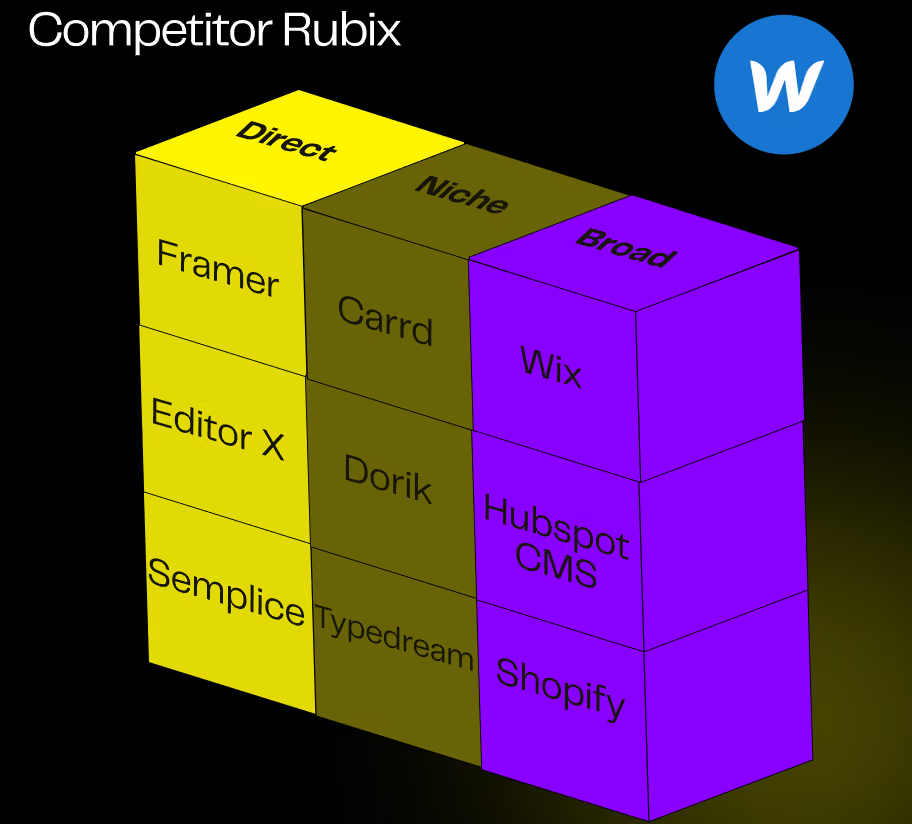
Lashay breaks competitors into three categories, which she calls the Competitor Rubik's:
Direct competitors are competitors who sit in the same category as you and have a similar feature set and similar use cases. Same category, same features, same use cases.
Niche competitors are competitors who sit in the same category but have fewer features and fewer use cases. They serve a smaller segment of the total addressable market.
Broad competitors are competitors who sit in the same category but have a larger feature set and serve a bigger portion of the market.
Using Webflow as an example: direct competitors would be Framer, Editor X, and Semplice. Niche competitors would be Carrd, Dorik, and Typedream. Broad competitors would be Wix, HubSpot CMS, and Shopify.
Lashay's rule of thumb:
Focus on direct competitors first, then niche. Stay away from broad competitors because it's an uphill battle.
Running Competitor Research with AI
Lashay runs four high-level phases of competitor intelligence: competitive landscape, competitive intelligence, gap analysis and strategic insights, and actionable competitive strategies.
Each of these has detailed sub-components covering everything from direct and niche competitors to market share, head-to-head competitive threats, pain points, and strategic positioning opportunities.
The process uses two key prompts: one for your own competitive positioning and one for your competitor's positioning.
For your company: Run a deep research query on Perplexity to understand how the market sees you externally. This matters because positioning is really the alignment between what you think about your company internally versus how the market sees you externally. When those two things are married, that's positioning.
"Positioning is when the internal perception of your company matches the external perception," says Lashay.
For competitors: Run a separate deep research query on each competitor in Perplexity. This produces detailed competitive intelligence including executive summaries, their own niche/direct/broad competitors, G2 reviews, Reddit information, customer complaints, and market gaps.
This competitor intelligence is valuable for two reasons beyond content creation:
- First, it helps you position your product to solve pain points that competitor customers are experiencing.
- Second, you can share it with the product team to help inform the product roadmap.
Once the research is downloaded as markdown, you upload it to Claude along with a competitor threat assessment template and prompt: "Take the competitor intelligence report from [competitor] and format it in the competitor threat assessment template." The result is a structured competitive threat assessment for each competitor.
Phase 3: Keyword Research and Content Strategy
With customer research and competitor intelligence in hand, you're now in a position to build a content strategy that's grounded in reality.
Guiding Keyword Research with Research
Lashay emphasizes that most people do this backwards. They talk to a company, look around the website, and immediately start doing keyword research based on assumptions about what category the company sits in. That's working backwards.
Instead, you take your customer and product research from Phase 1 and use it to guide keyword research.
Your audience talks about their problems differently than you think they do. If you pull sales call transcripts, you'll see the exact language prospects use, and that language is gold. You can pull it verbatim and see how they describe the problems they're having. Those descriptions map directly to how they'll search in an LLM.
You also use competitor research to guide keyword research. The Competitor Rubik's maps directly to "alternative" and "versus" search terms. And you use your positioning to understand which use cases to target. Your company sits in a specific category, and you're not going to target every single use case unless you're a Salesforce-sized platform.
Understanding features deeply also helps you understand use cases, which is why talking to the product team is essential. Once you understand how features operate in real workflows, you will better understand the use cases they solve.
Content Strategy Breakdown
There are three ways to break your content strategy down:
By product: If your SaaS has multiple products (like Salesforce with AgentForce, Slack, Tableau, and Salesforce itself), break the strategy out by product. Each product has its own top, middle, and bottom of funnel topics.
By industry: If you have one product but serve multiple industries (like manufacturing, financial services, technology, and retail), break it down by industry. Each industry has its own pain points, which means different search terms.
By topic: If you're a vertical company without multiple products or industry segments, break it down by the jobs-to-be-done topics relevant to your audience (like customer retention, sales enablement, onboarding, GTM execution).
Lashay recommends laying this out visually rather than burying it in spreadsheets. Seeing the strategy at a 30,000-foot view helps other team members conceptualize what content marketing is doing. Pillars, funnel stages, and keywords become clear at a glance.
A key rule of thumb for choosing how to break things down: If your company has multiple products, break down by product. One product but multiple industries, break down by industry. If neither applies, break down by topic.
Horizontal vs. Vertical Execution
Once your strategy is broken down, there are two ways to execute:
Horizontal execution: Start within one segment (say, manufacturing). Exhaust as many bottom-of-funnel keywords as you can for that segment. Then move horizontally to the next segment (financial services) and exhaust BOFU there. Repeat.
Vertical execution: Choose one segment and start at the bottom of the funnel. Once you exhaust BOFU keywords, move up to middle-of-funnel content within that same segment. Lashay notes that middle-of-funnel content converts too, but you just need to know how to write it, and making it more product-led helps significantly.
How to decide where to start: Look at where the revenue comes from. If 90% of revenue comes from manufacturing, that's where you start. You want to start where you're already capturing revenue and drill in further. The exception is if executive leadership has a specific quarterly focus. In that case, align with their initiative.
The BOFU Radar: Four Keyword Categories
Lashay breaks BOFU keywords across four categories:
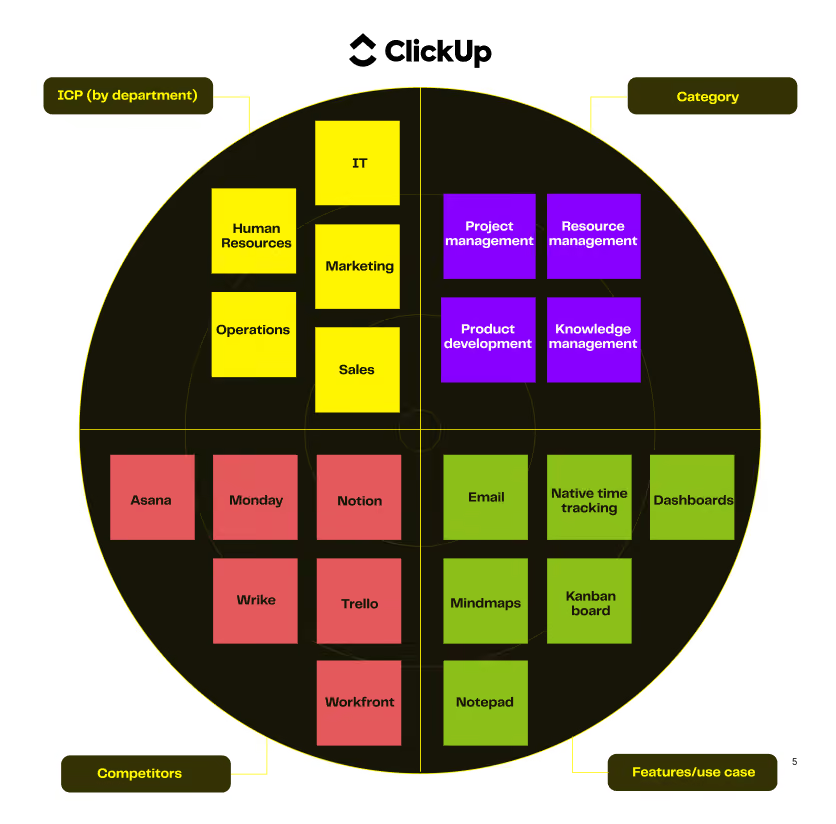
ICP-based keywords (by department): These follow patterns like [Department] + [software/tool/platform], [Department] + [specific pain point] + solution, [Job title] + [productivity/efficiency] + tool, and "Best [solution] for [department]." Example: "marketing manager productivity software."
Category keywords: What category does the tool sit in? Patterns include "Best [category] software," "Top [category] tools for [specific use case]," and "[Category] solution for [specific industry]." Example: "project management software."
Competitor keywords: Patterns like [Competitor] alternatives, [Competitor] vs [Your product], [Competitor] pricing, and "Switch from [Competitor] to [Your product]." Example: "Trello alternatives."
Feature and use case keywords: These follow patterns like [Specific capability] software/tool, "How to [solve specific problem] with [feature]," and "Best [product type] with [specific feature]." Example: "project management software with dashboards."
A caution on category keywords: watch for cannibalization. Keywords like "best software asset management software" and "best software asset management solution" are synonymous, so you don't need separate articles for each. Combine them.
Quick Keyword Generation Tactics
If you need keywords fast, take your direct and niche competitors from the Rubik's and match them with "alternative" and "versus." With just a few direct and niche competitors, you get 12+ search terms immediately.
Lashay also recommends some keyword formulas that go beyond the basics:
[Competitor] vs [competitor] vs your product: For example, "Gong vs Clari vs Outreach." This lets you insert yourself into a conversation between two competitors that has existing search volume.
[Competitor] vs [competitor] vs [competitor] vs your product: Don't go beyond four total. This captures search volume from established competitor comparisons.
The alphabet soup method: Go to Google and type "best [category] for A" then B, C, and so on. Google autosuggest reveals terms you wouldn't think of. If it's in autosuggest, somebody's searching for it.
Ahrefs filters: Use modifier filters (best, vs, alternative) to find BOFU terms. Filter by word count of 4+ to surface longer-tail, higher-intent queries.
Phase 4: Content Creation and Publishing
This is where everything comes together. Lashay spent two and a half years figuring out how to effectively integrate AI into this process because it's very productized and nuanced.
The Five BOFU Content Elements
All of Lashay's bottom-of-funnel content is built from five core modular elements:
Pain points: The struggles that prospects are facing.
Benefits: The benefit a user gets from having their pain point solved.
Features: What your product does.
Capabilities: How the feature works in a step-by-step fashion.
Current way: The current way your prospect is solving the problem without your solution.
Different BOFU articles are just these modular blocks stacked in different ways based on data that Lashay knows converts. Once she has a conversion data point, she adds that framework to her dataset and repeats it across client accounts.
Framework-Based Prompting
This is the key to getting solid first drafts with AI. Instead of going to Claude and saying "write me an article around this keyword," Lashay uses what she calls framework-based prompting. The framework itself is the prompt.
The framework has the core BOFU elements built into it: pains, features, capabilities, benefits, current way. Because you've already uploaded your internal documentation (if you've followed the process), the AI already has deep context on your company. When you start prompting, AI knows how to fill in each element.
The framework prompt includes variables like product name, target persona, pain points, current way the prospect solves the problem, product capability, and benefit. Claude fills these in using the internal documentation you've already uploaded to the project.
Lashay recommends breaking prompts down by section (introduction, body, and conclusion) and stringing context and logic from one section to another rather than generating everything at once.
Why this matters for AI search: Having these elements baked into your content creates clear associations between customer pains and your product's capabilities. The clearer that association is, the more likely you are to show up in AI search results.
Optimizing for Contextual Search and AI Visibility
This is where Lashay's approach produces results that go beyond traditional SEO.
How AI Search Differs from Google Search
When someone searches on Google, they type something like "best AI résumé builder." When someone searches in an LLM, it's different.
They describe their situation: "I'm looking for a job and I need a résumé builder. I'm struggling to show the impact of my work and managing my multiple résumés. I need a tool that lets me edit and manage in one place. Can you recommend a résumé builder that can help with this?"
Lashay breaks that query into four contextual elements:
Category: "résumé builder," the broader niche where the product sits.
Persona: "I'm looking for a job," meaning who the searcher is.
Pain points: "struggling to show the impact of my work and managing my multiple résumés," the specific problems they face.
Capability: "edit and manage in one place," what the product needs to do.
Every one of those elements maps directly to the content in her Teal article. The persona is mentioned in the first line ("Job seekers"). The pain points are listed in the introduction. The capability is covered in the feature breakdown. Everything is logically tied together.
Results from Contextual Optimization
When Lashay ran the query "What's the best résumé builder if I have multiple résumés?" in Perplexity, Teal showed up first. A synonymous search, "I'm having trouble keeping track of my résumés across different platforms. What tool can help me with this?" produced Teal again.
For another client, Conveyor, the query "I've been using Loopio for questionnaire automation, but I'm not happy with it. Can you recommend me an alternative?" surfaced Conveyor first in Perplexity results. A different, synonymous query produced Conveyor second.
The takeaway: AI understands synonymous search. You don't need to know the exact query someone will type. You just need to get topically relevant, articulate the problem your product solves, and AI is smart enough to make the association.
This ties back to sales call transcripts. The way prospects explain their problems to your sales team is how they'll type their problems into an LLM. That's the association you want to make between your article and LLM search.
Citations, Brand Mentions, and Third-Party Listings
Why You Shouldn't Talk Down Competitors
Here's the practical reason beyond ethics: AI uses your competitors to validate information about you.
Lashay demonstrates this with Teal and its competitor Rezi.
Rezi has Teal listed on their website with product information. AI tools like Perplexity pick up this information and use it when recommending Teal to users, citing the Rezi website as a source. The same pattern appeared with Conveyor. Included on a competitor website (SecurityPal), that information helped Conveyor surface in AI search results.
If your competitors are writing about you inaccurately or negatively, that hurts your AI visibility. And the reverse is true: competitors are probably using AI-generated product overviews about you in their listicle articles. Having accurate public information about your product is critical.
Brand Mentions vs. Backlinks
A backlink is a link on someone else's website that links back to yours. A brand mention is someone mentioning your brand on their website regardless of whether there's a link. Since AI understands context, you don't need a backlink for AI to pick up a mention. A competitor simply mentioning you is enough for AI to make the association.
Optimizing Third-Party Listings
LLMs frequently scan authoritative third-party websites like G2, Capterra, and Vendr to validate information about solutions they're recommending. Lashay demonstrates GPT using deep research mode and watching it reference G2 and Capterra during its thinking process.
Because LLMs use these sites to validate your product, it's imperative to have accurate product information on them. Outdated features, wrong pricing, or missing capabilities on your G2 listing can directly impact whether AI search recommends you.
Including FAQs
Lashay recommends including FAQs in BOFU content, ideally pulled directly from sales calls. Adding real customer questions to both BOFU articles and product pages tends to increase citations significantly. These are the actual questions prospects ask, phrased in their language, which aligns with how they'll prompt LLMs.
Scaling BOFU Content as a Lean Team
A common concern is maintaining originality when producing hundreds of BOFU pages. Lashay's answer: the originality comes from internal data, not from writing style tricks.
If you're pulling information from internal documents and using your customers' language from sales calls and CS conversations, everything you generate comes from actual first-party market data.
You're not looking at another website and borrowing their positioning. The information itself is original because it's pulled directly from your prospects and customers.
The frameworks are how you scale it. The same modular structure (pain points, features, capabilities, benefits, current way) gets applied across every article, but the customer insight filling those modules is unique each time.
For agencies trying to extract this information from clients, Lashay recommends building it into your onboarding process. Make gathering internal documents a natural step of the engagement.
Educate clients on how it ties to the broader initiative. Identify one person on each team (product, sales, CS) who can provide access to their respective information. Startups are easier because there are fewer silos. Mid-market companies may require spending 30 days on customer research before writing a single piece of content.
Once you have the information, document with the client what can and cannot be included publicly. The fear usually comes from not wanting to share specific internal information externally.
Conclusion
The biggest takeaway from Lashay's system is that everything is built on customer information. Once you have that foundation, you can start tailoring content to answer prospect queries more specifically, in both traditional search and AI-powered search.
Key actions to take immediately:
- Start gathering internal documentation from sales, product, and CS teams into one centralized location
- Build a knowledge base using Claude Projects and generate a product market analysis from your internal docs
- Map your competitors using the Rubik's framework (direct, niche, and broad) and focus your BOFU efforts on direct and niche
- Break your content strategy down by product, industry, or topic based on your company's structure, then choose one segment and exhaust BOFU keywords there first
- Adopt framework-based prompting with the five BOFU elements (pain points, benefits, features, capabilities, current way) to create content that AI search can match to user queries
- Optimize contextually by connecting customer pains to product capabilities in a logical thread, because this is what gets you surfaced in LLMs
- Ensure your third-party listings on G2, Capterra, and Vendr are accurate, because LLMs use them to validate recommendations
- Include real customer FAQs pulled from sales calls in both BOFU articles and product pages
Watch the full video here: