Running RevOps for a Global HR Leader as Their Outsourced GTM Engine

420+
RevOps requests delivered over twelve months
1 team
Outsourced RevOps function
12 mo
Embedded partnership (and ongoing)
The Client
Atlas HXM is a global Employer of Record (EOR) that helps companies hire, pay, and manage talent across 160+ countries. Their go-to-market spans multiple regions, channels, and buyer types: inbound demand, paid media, events and webinars, and a growing partner ecosystem, all feeding a single revenue engine.
As the business scaled, that engine outgrew the operational capacity available in-house. They needed a dedicated RevOps function that could both run the day-to-day and raise the ceiling on what their systems could do.
The Challenge
A large, fast-moving GTM organization was generating demand faster than its operations could keep up.
Attribution was unreliable, so leaders couldn’t trust which channels drove revenue. Lead qualification was inconsistent. A high-value partner channel had no system behind it.
Email was reactive and one-off. Events were run manually. And years of accumulated data debt quietly undermined every report and automation on top of it.
Atlas needed one partner to own all of it, and to think in systems.
The Engagement
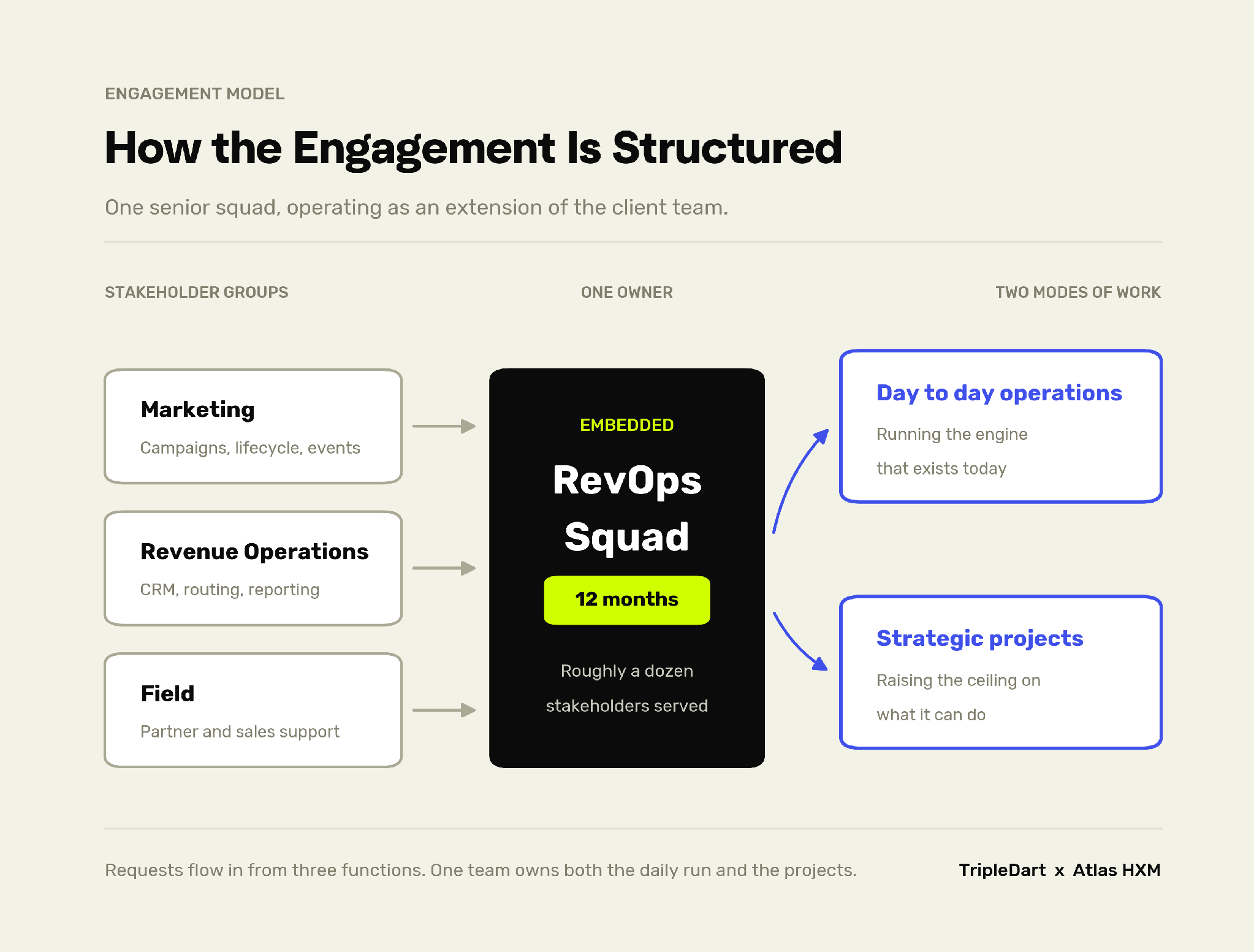
Timeframe: 12 months, embedded partnership, ongoing. Revenue Operations, Marketing Operations, and GTM Engineering.
TripleDart stepped in as Atlas’s outsourced RevOps team: a dedicated, senior squad operating as an extension of the client, running marketing, sales, and GTM operations day to day, while simultaneously driving the strategic projects that move the number. Over twelve months the team delivered 420+ requests for roughly a dozen stakeholders across Marketing, Revenue Operations, and Field, and matured from resolving isolated tasks into owning interconnected revenue systems.
What We Solved
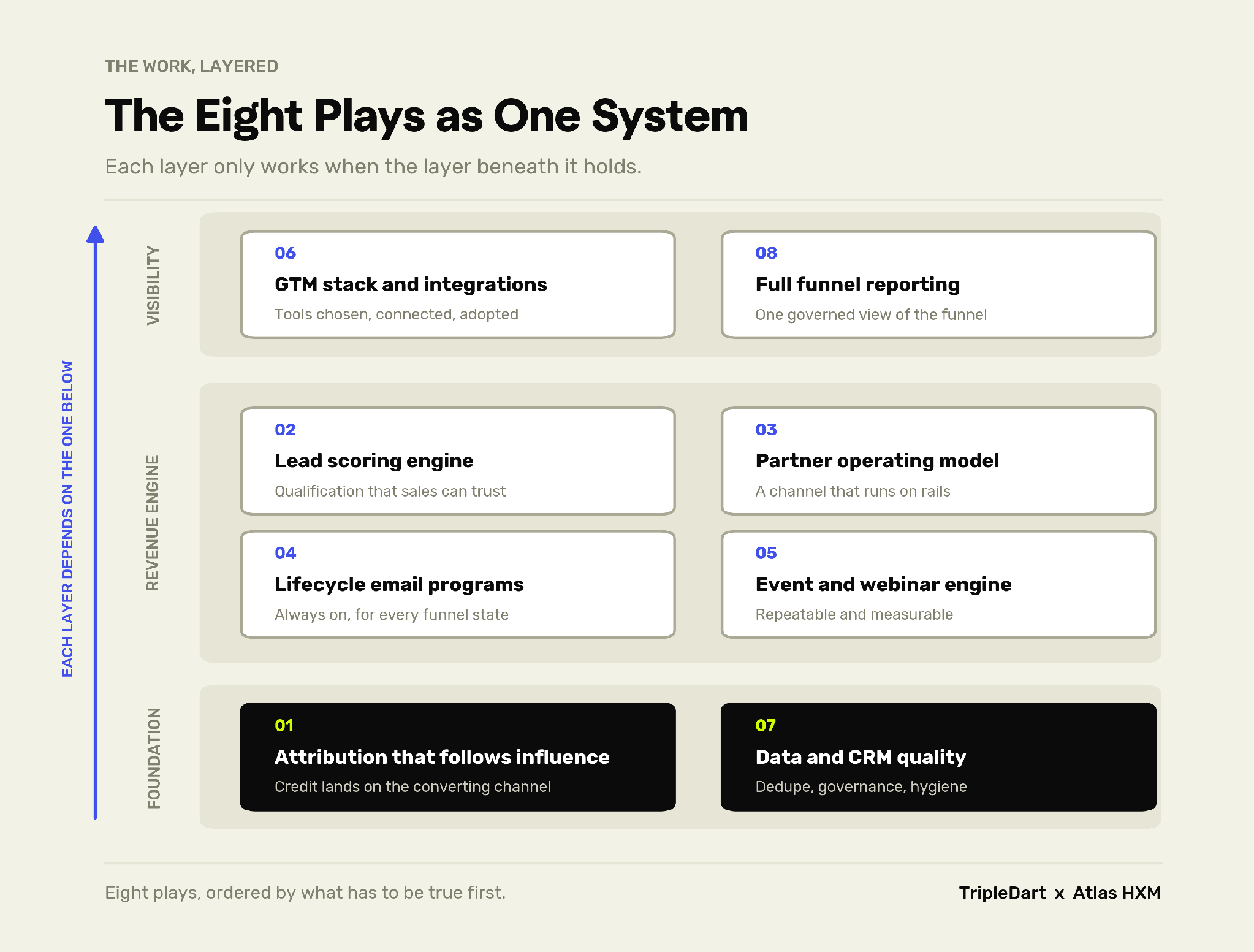
The work below is organized by the business problems we set out to solve. Each was a constraint on Atlas’s ability to see, trust, and grow revenue.
01. Attribution That Credits the Channel That Converts
The problem. The channel that first brings a lead in is rarely the channel that turns them into a qualified opportunity, yet standard CRM reporting only remembers the first touch. Atlas was over-crediting top-of-funnel sources and under-crediting the channels doing the work of pushing prospects to qualify, which quietly distorted every budget decision.
What we did. We engineered a custom multi-touch attribution layer that captures both the originating channel and the channel that drives qualification. It combines cookie-based tracking, disciplined UTM governance, and a series of automations that reconcile a prospect’s journey across the funnel, so credit follows influence.
The impact. Leadership finally sees which channels genuinely create qualified pipeline. Channels that were previously invisible were credited materially higher than before, letting Atlas move budget toward what converts and defend spend with data.
02. A Lead-Scoring Engine Sales Can Trust
The problem. Sales received an undifferentiated mix of inbound, with no consistent, evidence-based way to tell a ready-to-talk buyer from someone who needed nurturing, so good-fit leads slipped through and reps burned time on the wrong ones.
What we did. We designed and now own an end-to-end scoring engine that blends how well a lead fits the ideal customer profile with how they engage, including negative signals that filter out low-intent activity. Scores drive automated qualification and routing, so the right leads reach sales at the right moment.
The impact. A clean, shared definition of a qualified lead: sales focuses on best-fit prospects and marketing is measured on quality.
03. Turning Partnerships Into a Run-on-Rails Revenue Channel
The problem. Partnerships were a sizable revenue opportunity with no standard way to operate them inside the CRM. Partner leads, referrals, and payouts were handled ad hoc, so partner-sourced revenue was hard to see, harder to manage, and impossible to scale.
What we did. We stood up the entire partner operating model in the CRM: multilingual partner intake across six languages, a two-way referral engine (partners sending leads to Atlas, and Atlas routing leads out to partners), structured partner records and pipeline, automated routing and notifications, and commission tracking.
The impact. Partnerships now run on a repeatable system. Partner-sourced pipeline is fully visible and attributable, partners can be onboarded in their own language, and a channel that was previously off-the-books became a managed, measurable part of the revenue engine.
04. Lifecycle Email Programs for Every Stage of the Funnel
The problem. Email was reactive and one-off, with no orchestrated programs for the different states a contact can be in: new prospect, dormant account, or lost opportunity worth winning back.
What we did. We brainstormed, designed, and built orchestrated email programs mapped to distinct use cases: cold acquisition, customer reactivation, closed-lost win-back, and event-driven follow-up, alongside always-on nurture, all with deliverability safeguards, suppression logic, and ongoing list hygiene built in.
The impact. Email became a dependable, always-on revenue channel, reactivating dormant and lost accounts and protecting sender reputation as volume scaled.
05. A Repeatable, Measurable Webinar and Event Engine
The problem. Events and webinars were a core demand channel, but the operations behind them were manual and inconsistent, which made them hard to scale and even harder to measure.
What we did. We built the end-to-end engine: registration flows, reminder and follow-up sequences, automatic lead capture and qualification tagging, and performance dashboards, turning every event into a repeatable, instrumented motion.
The impact. Atlas can run more events with less effort and see exactly what each one contributes, increasing webinar cadence and the volume of qualified, event-sourced demand
06. GTM Engineering: Choosing, Integrating, and Owning the Stack
The problem. A growing go-to-market stack meant new tools to evaluate and connect, and specialized platforms that were being considered but not yet delivering value. Buying tools is easy; getting full ROI from them is not.
What we did. We act as Atlas’s GTM engineering team. We joined the evaluation of specialized platforms while they were still being scoped, helped identify the right tools for the job, then owned the integrations end to end and drove adoption, plus built custom automations to connect the stack and an AI-assisted reporting framework on top.
The impact. Atlas extracts maximum value from its investments: a connected, well-adopted stack where every tool earns its place and manual work is engineered out.
07. A Trustworthy Data and CRM Foundation
The problem. Years of growth had left the CRM carrying data debt, including duplicate records, ungoverned automations, and inconsistent forms, and that debt silently undermined every report, score, and workflow built on top of it.
What we did. We run a continuous data-quality program: systematic deduplication (audit, classification, and prevention), governance and cleanup of a large sprawl of automations, form audits, and recurring hygiene, treating the data layer as the foundation everything else depends on.
The impact. Clean, reliable data that leaders and systems can trust, so scoring, attribution, reporting, and automation all operate on a solid base.
08. One Trusted, Full-Funnel View of the Business
The problem. Leadership lacked a single source of truth spanning marketing, sales, partners, and events, so reporting was slow, fragmented, and open to interpretation.
What we did. We built full-funnel dashboards and reporting for stakeholders across the organization, covering pipeline, funnel conversion, channel and campaign performance, events, and partner contribution, all reading from the same governed data.
The impact. Decisions are now made from one trusted view of the funnel, with reporting that’s faster to produce and easier to act on.
The Business Impact
Individually, each initiative solved a problem. Together, they reshaped how Atlas sees and grows revenue:
- Smarter spend: leaders can finally trust which channels drive qualified pipeline, and reallocate budget toward what converts.
- A cleaner, higher-quality pipeline: sales spends time on best-fit leads, and marketing is accountable to quality.
- A brand-new, fully-tracked revenue channel: partnerships now run on a system and contribute visible, attributable pipeline.
- Recovered revenue: dormant and lost accounts are systematically re-engaged instead of forgotten.
- An event machine that runs at volume: more events, less manual effort, and clear ROI on each one.
- A GTM stack that earns its keep: the right tools, properly integrated and adopted, with manual work automated away.
- A foundation that keeps paying off: trustworthy data and reporting that make every future initiative faster and safer to launch.
- Operating leverage: 420+ RevOps initiatives delivered in twelve months, the output of a full in-house team, without Atlas having to build one.
"We get deep expertise across performance marketing, SEO, and CRM operations. Everything is an ecosystem, and there's a fluid connection between all these experts with senior oversight ensuring it comes together."
"What's different about TripleDart is they're really bringing that mix of both strategic and executional expertise. You listen to our business challenges, understand the industry, develop strategies, implement them efficiently, measure performance, and optimize results. That's pretty unique for an agency."
"When we ask for something, you give us what we ask for, but you also say, 'Just so you know, here's what I also found' or 'I think this would be a better way to do it.' An agency that can tell you things you don't know and elevate the client's ideas is very hard to find."
— Tina Robertson, VP of Global Growth Marketing at Atlas HXM
Why It Worked
Atlas gained a senior RevOps team that thinks in systems, one that understands how attribution, lifecycle, scoring, partnerships, campaigns, and reporting connect, and how a change in one ripples across the rest. Because the team runs the day-to-day and the strategy, it spots and solves problems before they’re escalated, and builds on its knowledge of the business month after month.
That is the difference between outsourcing tasks and outsourcing an operation. Atlas outsourced the operation, and got the capability of an in-house RevOps function without the time and cost of building one.