
An AI GTM strategy is a go-to-market operating model that uses artificial intelligence to improve how teams research markets, define ICPs, prioritize accounts, personalize messaging, route leads, tune campaigns, and measure revenue impact. It combines AI workflows with trustworthy data, human governance, and shared pipeline goals across marketing, sales, and RevOps.
The distinction matters because most teams we talk to have already bought the AI. They have licenses, prompts saved in a shared doc, maybe an SDR agent running outbound nobody reviews. What they don't have is a connected system where AI output lands in the CRM, gets acted on by a named owner, and shows up in pipeline reporting.
That gap explains a lot of stalled programs. When AI strategy sits disconnected from GTM workflows, you get activity without accountability.
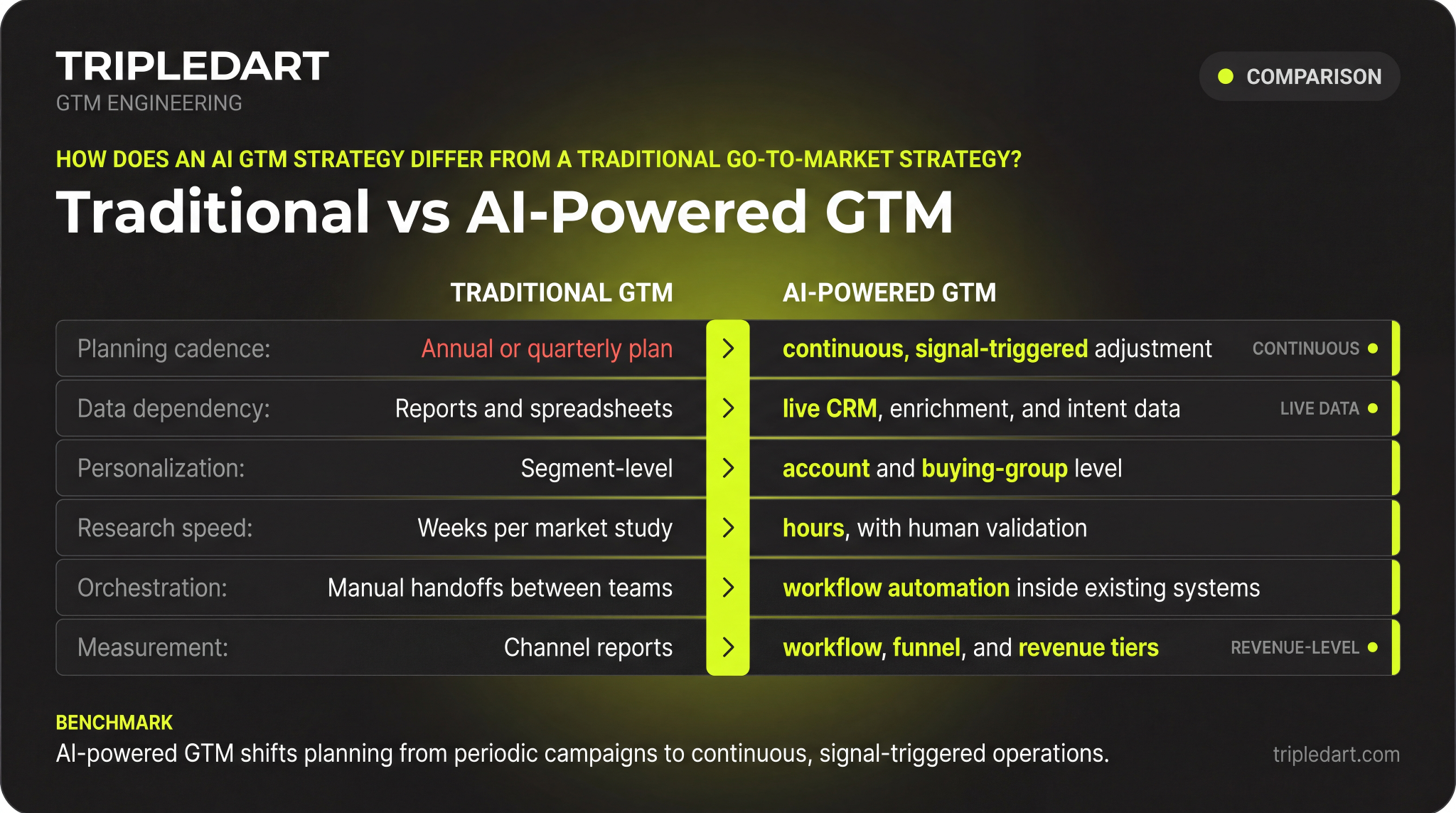
How Does An AI GTM Strategy Differ From A Traditional Go-to-Market Strategy?
Traditional GTM planning runs on annual cycles and lagging indicators. AI-powered GTM runs continuously on live signals, which changes how you plan, staff, and measure.
How Do You Prioritize AI GTM Use Cases With A Scoring Model?
What Is Not An AI GTM Strategy?
- A chatbot rollout or a single agent license.
- A one-time pilot that never gets an owner.
- A replacement for positioning, pricing, or GTM leadership.
- A permission to publish unreviewed brand content or run ungoverned outreach.
- A substitute for clean CRM data and working attribution.
Why AI In GTM Strategy Matters for B2B SaaS Growth in 2026
AI matters in GTM because the old playbook keeps getting more expensive to run. AI compresses research and execution cycles when the underlying data and positioning are sound.
The economics are unforgiving. According to Benchmarkit's 2025 SaaS benchmarks, the median SaaS company spent $2.00 in sales and marketing to acquire $1.00 of new customer ARR, a 14% increase from the previous year. Meanwhile Gartner's 2025 CMO spend survey found marketing budgets flatlined at 7.7% of overall company revenue.
Flat budgets, rising acquisition costs. That's the squeeze AI is being asked to solve.
How Is AI Changing GTM Execution From Static Plans To Continuous Operations?
You move from planning in batches to operating in loops. You get scoring that updates as signals change.
- Market and competitor research cycles measured in hours instead of weeks.
- Near-real-time monitoring of intent signals, mentions, and campaign anomalies.
- Faster speed-to-lead through automated research and routing.
- More consistent follow-through on the operational work people skip when busy.
Why Does Reliable Data Matter For An AI-Powered GTM Strategy?
AI amplifies what you feed it. A vague ICP definition produces confidently incorrect scoring at volume, which is worse than no scoring at all. If your lifecycle stages mean different things to marketing and sales, an agent trained on that data will encode the confusion and scale it across every account in the database.
How Is AI Search Redefining B2B SaaS Buyer Discovery?
AI changes GTM internally through execution and externally through how buyers find and validate you. Search Everywhere Optimization is our term for building visibility across every surface where evaluation happens:
- Google, plus AI Overviews and AI Mode
- ChatGPT, Perplexity, Gemini, and Claude
- LinkedIn and category communities
- Reddit threads and peer discussions
- Review sites and comparison pages
- YouTube and video search
How Can You Modernize A GTM Strategy With AI Using Audit, Deploy, And Scale?
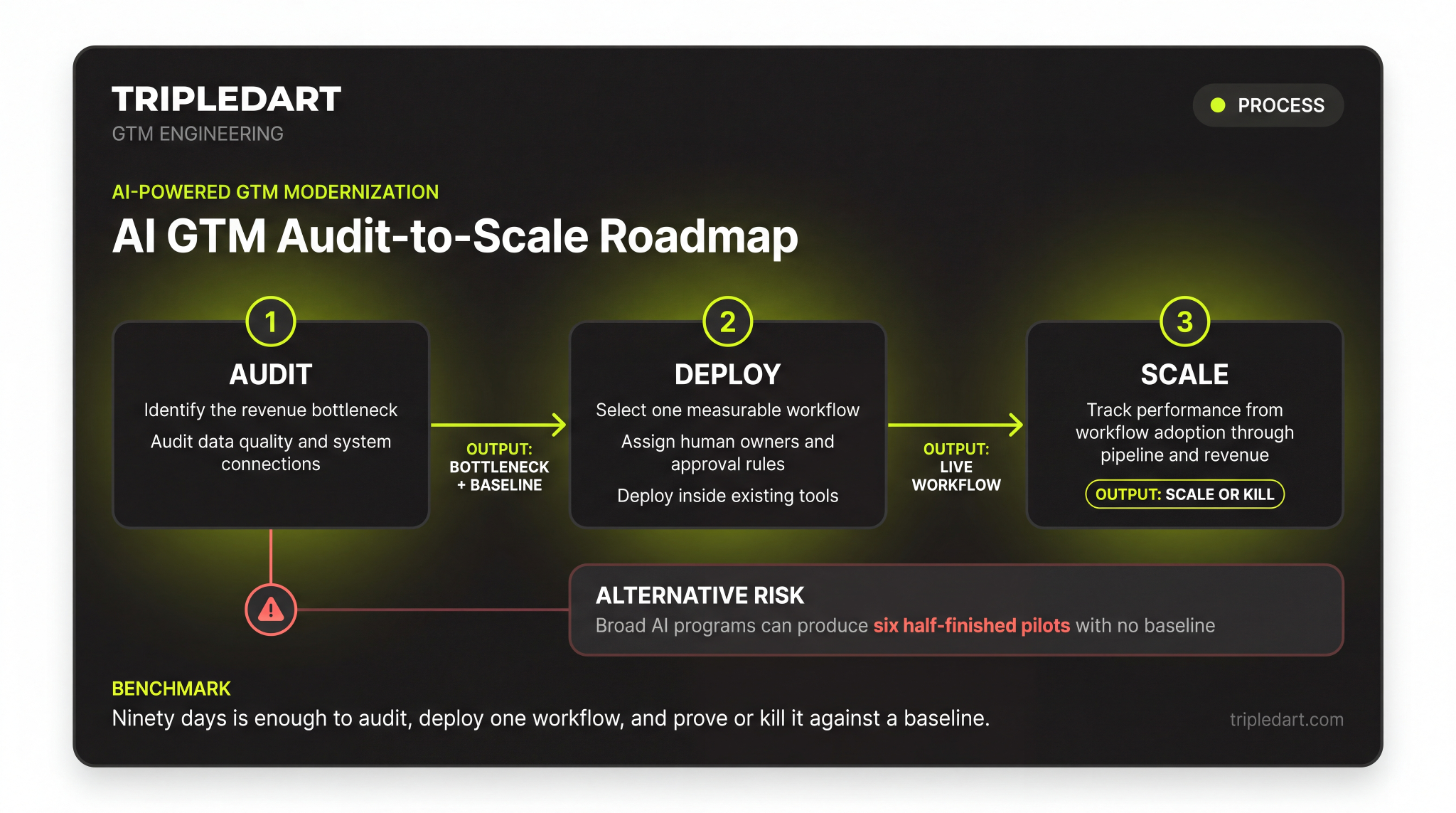
Build an AI-powered GTM strategy by identifying the revenue bottleneck first. Then, audit data quality and system connections, select one measurable workflow, assign human owners and approval rules, deploy outputs inside existing tools, and track performance from workflow adoption through pipeline and revenue.
That's the Audit, Deploy, Scale sequence we run at TripleDart. It exists because the alternative, launching a broad AI program across every function at once, produces six half-finished pilots and no baseline to judge them against.
How Do You Audit The GTM Engine And Locate The Revenue Bottleneck?
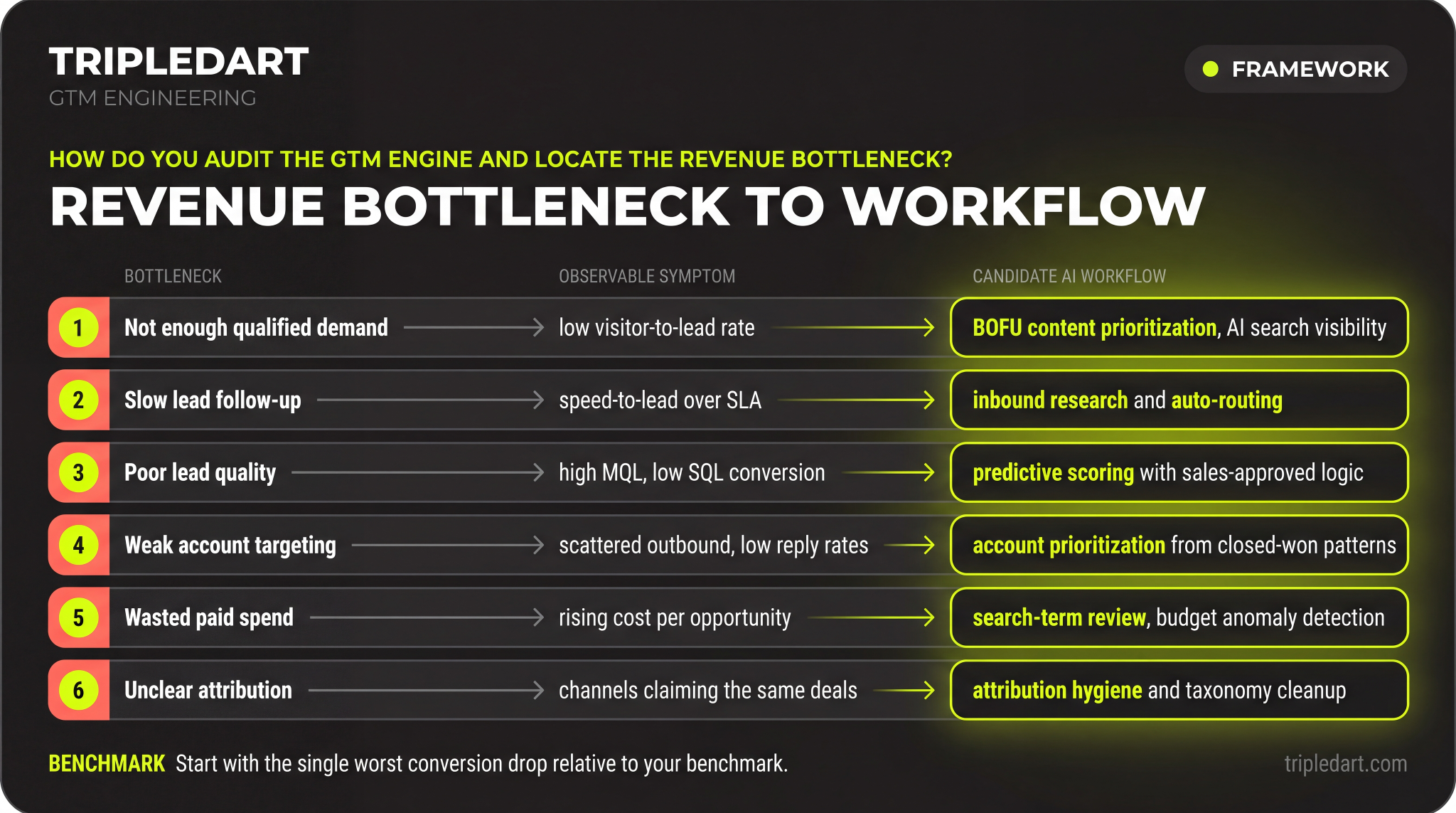
Start by mapping where revenue leaks. Pull conversion rates at every stage, then find the single worst drop relative to your benchmark. That's where the first AI workflow goes.
How Do You Audit CRM Data, Customer Data, And Workflow Readiness For AI?
Before you automate anything, confirm the inputs are trustworthy. This is the step most teams skip and later blame the AI for.
- Account, contact, lead, and opportunity records are consistent and deduplicated
- Lifecycle stage definitions are documented and agreed by sales and marketing
- Enrichment coverage and refresh cadence are known
- Lead source and campaign taxonomy follow a standard
- UTM governance exists and is enforced
- Conversion events are defined the same way everywhere
- Account matching rules are in place
- Intent data is ingested and validated
- Consent and permission status is tracked per contact
- Tool and API access is provisioned
- Approved brand context and claims are documented
How Do You Prioritize AI GTM Use Cases With A Scoring Model?
Score every candidate workflow before committing. The goal is to surface the one with high impact and low risk, and the one that sounds most impressive in a board deck is usually neither.
What Should Operators And AI Agents Own In An AI-Driven GTM Model?
Operators govern commercial decisions while agents execute repeatable, supervised workflows.
Our operating principle is simple: Operators govern, agents execute. Every decision with commercial or legal consequence stays with a person.
What Are The Best AI-Powered GTM Strategy Use Cases Across the Revenue Engine?
The strongest AI use cases for B2B GTM are account prioritization, ICP refinement, market and competitor research, lead scoring and routing, sales research, content personalization, campaign tuning, attribution analysis, and customer-health monitoring. Prioritize repeatable workflows with clear data inputs and a measurable pipeline outcome.
How Can AI Improve Market Research, Competitive Intelligence, And Positioning?
AI is good at synthesis work: competitor monitoring, review mining, category trend tracking, buyer-language extraction, community listening, and win/loss synthesis.
Deciding your value proposition still rests on a human. AI surfaces what buyers say and what competitors claim. Our walkthrough of AI-assisted B2B competitor analysis shows the division of labor in practice.
How Can AI Improve ICP Definition, Buyer Personas, And Market Segmentation?
Pattern analysis across closed-won and closed-lost deals is where AI earns its keep. Feed it your opportunity history and it will find firmographic and behavioral clusters your team assumed but never proved.
- Closed-won and closed-lost pattern analysis
- Firmographic and behavioral clustering into account tiers
- Buying-group mapping across the committee
- Dynamic micro-segments for campaign targeting
Pair this with a documented SaaS ideal customer profile and a jobs-to-be-done framework so the clusters map to buying motivations.
How Can AI Improve Account Prioritization, Intent Data, And ABM?
Signal quality beats signal quantity every time. More intent feeds means more false positives, and account-level intent rarely tells you which contact to call. Treat intent as an input to seller judgment. Sales leadership should approve the scoring logic before it routes a single account. Our B2B ABM strategy guide covers the targeting layer.
How Can AI Support Content Marketing Strategies For B2B GTM Demand Generation?
AI-driven content marketing for B2B GTM works best on research, prioritization, and maintenance. The volume problem is already solved. Quality and relevance are not.
Content Marketing Institute's 2025 technology research found 96% of technology marketers have a content strategy, and only 29% rate it as highly effective. AI can help audit the following to strengthen your strategy
- Topic and BOFU page prioritization
- Content gap analysis and decay detection
- Refresh sequencing and internal linking
- AI-answer visibility analysis
- Nurture sequencing and landing-page research
Format choice matters too. NetLine's 2025 report found B2B content demand grew 26.9% year over year, and registrants for playbooks were 115.1% more likely than other-format registrants to make a purchase decision within the measured period. Build for the formats buyers use to decide.
Our SaaS content marketing strategy and B2B demand generation framework go deeper.
How Can AI Improve Lead Scoring, Routing, And Revenue Operations?
This is usually the highest-return starting point because the data already lives in one system. An AI RevOps agent can run these continuously, so hygiene stops being a monthly cleanup sprint.
- Predictive scoring reviewed and approved by sales
- Routing logic tied to territory and SLA rules
- Enrichment on inbound records before assignment
- Duplicate prevention at form submission
- SLA monitoring with escalation alerts
- Ongoing CRM hygiene maintenance
How Can AI Support Sales Enablement, Outbound, And Customer Expansion?
Sellers lose hours to preparation work that AI handles well: account briefs, meeting prep, call summaries, battlecards, and follow-up recommendations.
The bigger opportunity sits post-sale. Deal-risk monitoring, churn signals, and expansion identification tie AI to CLV, which is where SaaS economics pay off over a long enough horizon. See how TripleDart automates your outbound engine.
How Do You Measure AI-Driven GTM Strategy Performance?
Measure AI GTM performance at three levels: workflow, funnel, and revenue. Track adoption and recommendation-acceptance rates, data completeness, and exception rates; then conversion rates, cost per opportunity, and pipeline velocity; then win rate, CAC, CLV, and sourced or influenced revenue. Compare every result against a documented pre-implementation baseline.
Which Workflow And Adoption KPIs Should You Track For AI GTM?
- Adoption rate by intended user
- Recommendation acceptance rate
- Workflow completion time
- Data completeness on required fields
- Error and rework rate
- Exception volume and escalation frequency
Which Funnel And Demand Generation KPIs Should You Track For AI GTM?
- Visitor-to-lead and lead-to-meeting conversion
- Meeting-to-opportunity and MQL-to-SQL rates
- Speed-to-lead against SLA
- Cost per qualified opportunity
- Pipeline velocity and pipeline created
Our guide to SaaS marketing metrics and revenue operations metrics covers definitions and calculation methods.
Which Revenue And Efficiency KPIs Should You Track For AI GTM?
- Opportunity rate and win rate
- Average contract value
- CAC and CAC payback where applicable
- CLV and net revenue retention
- Pipeline sourced versus influenced
- Revenue attribution by workflow
How Should You Set A Baseline Before Deploying AI GTM Workflows?
Capture a like-for-like baseline by segment, channel, and period before the pilot starts. Without it, every result becomes a debate.
One caveat worth stating in your reporting: AI-assisted workflows are usually a contributing input to pipeline change. Say so before someone else does.
What Are The Best Practices For Integrating AI Into GTM Strategies In A 90-Day Roadmap?
90 days is enough to audit, deploy one workflow, and prove or kill it against a baseline. It won't remake your entire GTM motion, and treating it that way is how programs collapse.
*Truth files are core internal documents such as brand guidelines, target ICP profiles, messaging and positioning documents, etc
What Should You Do After The First 90 Days Of An AI GTM Strategy?
- Expand to adjacent workflows on the bottleneck map
- Remediate the next data gap in priority order
- Standardize governance decisions into written policy
- Add workflow-level reporting to the revenue dashboard
- Retire tools that duplicate a now-operational workflow
Is it worth the investment? Only if the workflow you chose sits on a genuine bottleneck and reports into pipeline. Otherwise you've bought a faster way to produce things nobody uses.
How Can TripleDart Help Build Your AI GTM Strategy?
AI pays off when it connects to clear positioning, clean workflows, verified customer insight, and revenue accountability.
TripleDart is the GTM Operating System that helps B2B brands unify strategy, execution, and intelligence into one compounding growth engine. Organic growth, paid media, and GTM engineering run on one engine with one source of truth, so AI execution reports into pipeline.
Our GTM engineering services locate the revenue bottleneck first, then build the workflow, assign the owner, and wire it to attribution. Senior operators set the strategy, and AI-powered workflows carry the repeatable execution.
Book an Intro Call to scope an audit, or start with our free AI visibility report.
The Most Common AI GTM Strategy Questions
What is an AI GTM strategy?
It's a human-governed operating model that applies AI across market research, targeting, execution workflows, and revenue measurement. The defining elements are trusted data, named human owners, and shared pipeline goals across marketing, sales, and RevOps.
What is the first AI workflow a B2B company should implement?
Choose the workflow tied to your current revenue bottleneck with the cleanest available data and a named owner. Common first choices are inbound-lead research and routing, account prioritization, or paid campaign search-term review.
Do you need a data scientist to build an AI-powered GTM strategy?
No. You need a RevOps or marketing operations owner who understands CRM data, lifecycle definitions, and attribution. Data science becomes relevant later, once you're building custom predictive models.
What data is required for AI in GTM strategy?
Accounts, contacts, leads, opportunities, lifecycle stages, campaign engagement, conversion events, and closed revenue. Advanced use cases add intent data, enrichment, product usage, and support history.
How do AI agents fit into sales, marketing, and RevOps workflows?
Agents execute repeatable research, monitoring, production, and tuning inside CRM, Slack, and ad platforms. They queue recommendations for human approval before any budget, brand, CRM, or outreach action executes.
How do you measure AI GTM ROI?
Measure workflow adoption and accuracy, funnel conversion and cost per opportunity, then revenue metrics including win rate, CAC, CLV, and sourced pipeline. Compare all of it against a documented pre-implementation baseline.
Can AI improve account-based marketing and account prioritization?
Yes, when firmographic fit, intent signals, engagement history, and closed-won patterns combine into transparent scoring logic that sales leadership has reviewed and approved. Opaque scoring gets ignored by sellers.
How does AI search visibility affect go-to-market strategy?
Buyers increasingly research and shortlist SaaS vendors through ChatGPT, Perplexity, Gemini, Claude, and Google AI. Brands absent from relevant answer-engine, comparison, and use-case surfaces may be missing from part of the evaluation journey entirely.
What should humans continue to own in an AI-driven GTM model?
Positioning, pricing, ICP and qualification criteria, budget decisions, brand claims, legal and compliance review, exception handling, and interpretation of performance results.
How does TripleDart help with AI GTM strategy?
TripleDart is the GTM Operating System for B2B tech, delivered as a service, and we run Audit → Deploy → Scale as one system, owned end to end and measured against outcomes. We locate the revenue bottleneck, remediate the data, build governed workflows inside your existing stack using Slate and Truth Files, name human owners, and connect every workflow to pipeline reporting. Working with us is closer to hiring a VP of Growth and a full execution team, instantly, accountable to the number. Book an Intro Call to start with an audit.