Claude marks every draft now. Here's what still ranks and gets cited.
The unhelpful takeaway would be: “AI content is now detectable, so Google will punish it.” That is not what any of these announcements say.
Contributor

Manoj Palanikumar
Head of SEO & Content
In this article
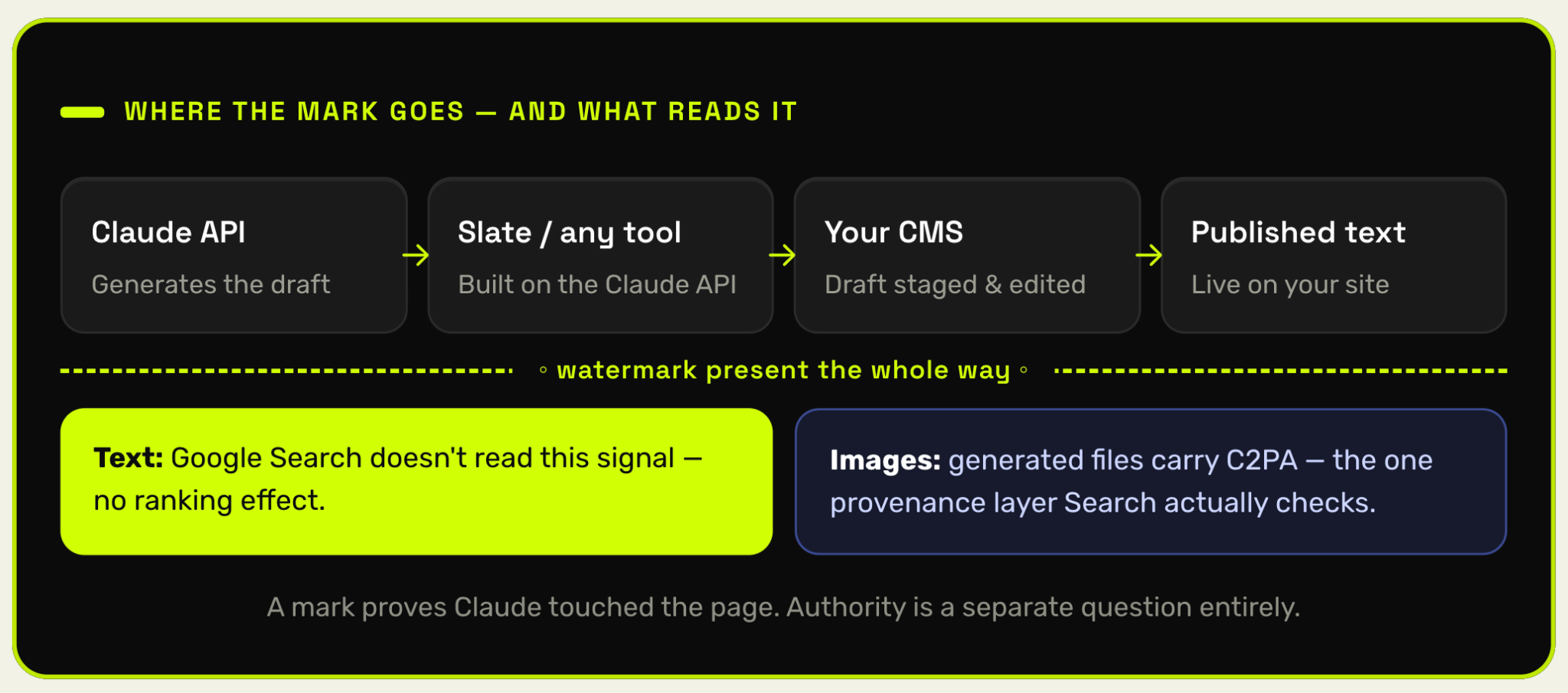
From 2 August 2026, Claude models launched after that date mark what they generate. For text, it's a model-level statistical watermark — during generation the model nudges its token choices toward a pattern a matching detector can recognise but a reader can't perceive. For image files, Claude attaches C2PA provenance metadata. Because the marking is applied inside the model, it's present through the API too. So the output of any tool built on Claude — Slate included — carries it.
That sounds like it ought to matter for SEO. It mostly doesn't. Here is the precise version.
A watermark is a first-party signal
A statistical token watermark can only be read by the party that keyed it. Anthropic's detector can find Anthropic's mark — it is not a universal “was-this-AI” detector, and no one else's tooling reads it by default. Google cannot read Anthropic's text watermark, and there is no mechanism by which that mark feeds Google's ranking. The two systems simply don't touch.
Google's stance on AI text hasn't moved
Since its 2023 guidance, Google has judged content on quality, usefulness and trustworthiness — not on how it was produced. Using AI to mass-produce pages that add nothing is spam; using AI as part of making genuinely helpful content is fine. A watermark doesn't change that calculus, because Google was never grading the production method in the first place.
What Google shipped is about media, not text
At I/O 2026, Google added in-Search provenance checks: through Lens, AI Mode and Circle to Search you can ask whether an image is AI-generated, and Search reads Google's SynthID watermark plus the open C2PA standard to answer. Its Gemini-app verification covers image, video and audio. Notice the scope — images, video, audio. Google did not announce any signal that detects or penalises AI-written text in ranking. The whole provenance push is aimed at synthetic media, where the trust problem is sharpest.
Table 1 · What the watermark is — and isn't
The advertising side points the same way. In July 2026 Google began permitting AI labels on image and video ad creatives to help advertisers meet EU, India and New York transparency rules. Again: disclosure of media, a compliance affordance — not a text-ranking lever.
So where does the mark actually matter?
Three places — none of them your organic text rankings:
- Compliance. The mark exists to satisfy transparency regimes like the EU AI Act. If you operate there, it helps you meet disclosure duties. Treat it as a feature, not a threat.
- Media provenance. The one place Search does read provenance is images. If you generate visuals, the C2PA credential travels with the file and is exactly what Lens and AI Mode inspect — so keep credentials intact on your originals.
- Trust, not ranking. A detectable mark tells a reader or an auditor that Claude touched the content — even for a proofread or a translation, which leave the same trace. That's an editorial and reputational question, not an algorithmic one.
Table 2 · What actually moves rankings & AI citations
The honest reading
The unhelpful takeaway would be: “AI content is now detectable, so Google will punish it.” That is not what any of these announcements say. The accurate reading is narrower and more useful — watermarking makes AI transparent, and transparency is orthogonal to quality. Your page still competes, to rank and increasingly to be cited inside an AI answer, on depth, first-party data and demonstrated experience. Those are the inputs both the ranker and the model reward, and they are the one thing a watermark can neither add nor imitate.
TripleDart's opinion
Treat it as a non-event — and keep doing the only thing that compounds.
The watermark is a transparency milestone, not an SEO event. Teams that treat it as a threat will burn a quarter trying to scrub a mark Google never reads. Teams that treat it as a non-event will keep shipping pages with a real point of view and first-party data no model can invent — the only input that has ever compounded in search, and now in AI answers.
So our read is simple: let agents run the drafting and the volume, and keep humans governing the parts that create authority — the proprietary data, the argument, the judgement. Watermarks make the machine visible. They don't make the work good. That's still your job.