Fintech buyers no longer start their research on Google. They open ChatGPT, Perplexity, or Google AI Overviews, ask a pointed question about spend management software or embedded lending infrastructure, and form a shortlist. All this before they ever land on your site.
If your brand isn't cited in those answers, you don't exist in that buyer's consideration set. That's a pipeline problem.
AEO for fintech makes this challenging in ways generic optimization can't solve. AI engines classify financial content as YMYL (Your Money or Your Life), which means they apply a higher trust threshold before citing a source. You need documented entity authority and defensible claims. 94% of B2B buyers now use generative AI in their purchasing process, and Forrester expected AI-generated traffic to reach 20% or more of total B2B organic traffic by the end of 2025. For regulated fintechs, that shift arrives with compliance review cycles, multi-stakeholder buying committees, and category volatility already baked in.
This is a ranked, evidence-first evaluation of the best AEO agency for fintech companies in 2026. Every entry is assessed against the same five criteria. Scan the methodology section to understand the logic, jump to the sub-vertical matrix if you already know your niche, and use the buyer checklist before you sign anything.
Gartner warns that marketing leaders must adjust web content to succeed with GenAI-powered search, framing it as a strategic content risk, not a future consideration. For fintech CMOs watching organic clicks erode, this list is the place to start.
Why Is Fintech AEO Harder Than Any Other Category?
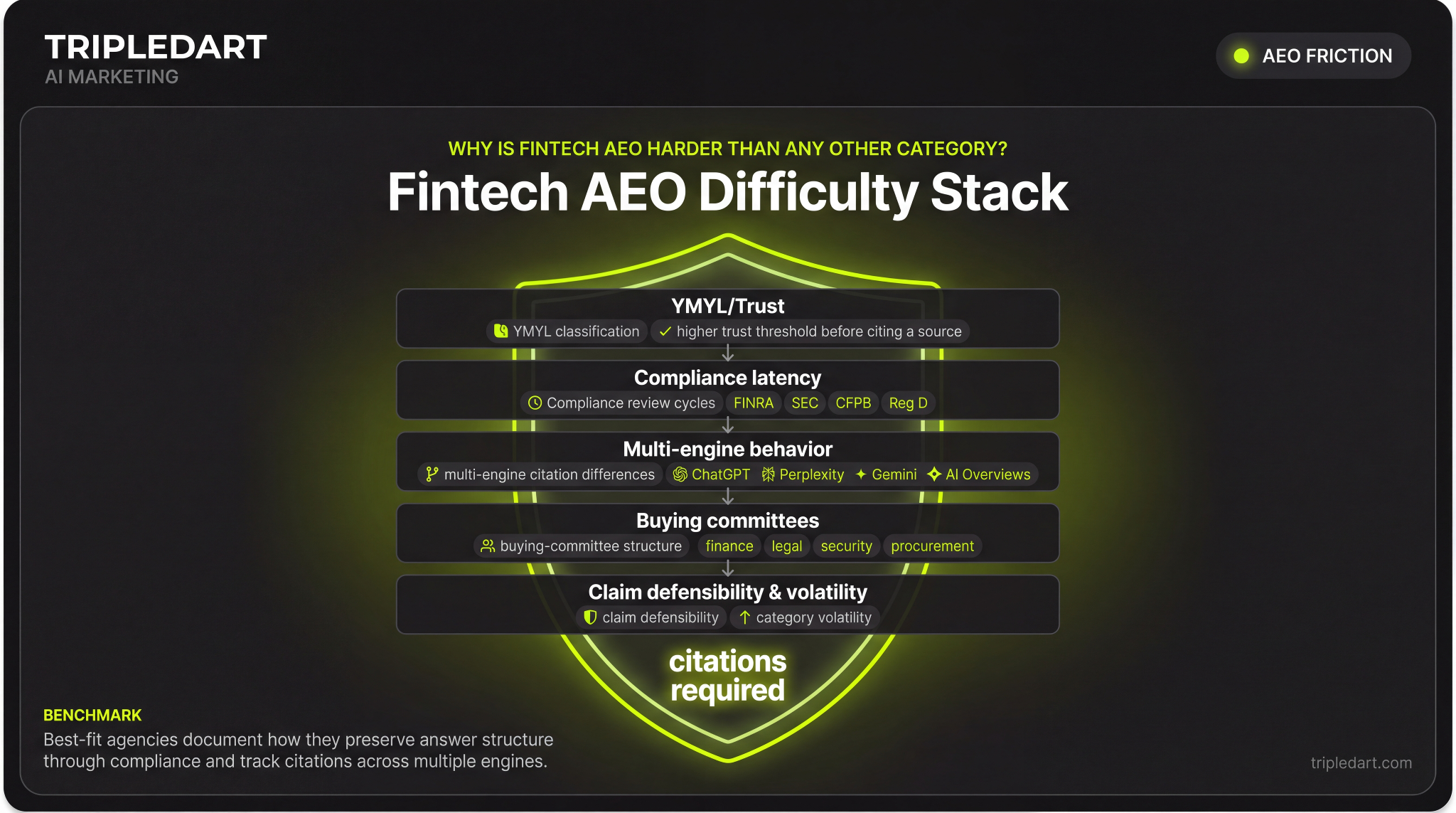
YMYL classification is the first factor. When a buyer asks ChatGPT "what's the best AP automation software for a Series B company," the engine doesn't treat that query the same way it treats "best project management tool."
Financial queries trigger higher authority thresholds. An agency that earns citations for a SaaS HR tool may not have the domain-authority depth or the third-party consensus signals to earn citations for a lending or payments product.
Compliance review cycles are the second. FINRA, SEC, CFPB, and Reg D constraints mean a piece of content designed to earn an AI citation can sit in legal review for three to six weeks before it is published. Generic AEO shops chase citation mechanics at publishing speed. They don't build content workflows that survive a compliance queue without losing their structural integrity.
The buying committee structure is the third factor. Enterprise fintech deals involve finance, legal, security, and procurement stakeholders, each searching for different answers in different AI engines. AEO that earns a citation on a payment-security query won't necessarily surface your brand when the CFO runs a separate search on pricing and total cost of ownership. Coverage breadth and claim defensibility both matter.
Specific fintech AEO challenges worth noting:
- YMYL scrutiny: raises citation thresholds above standard B2B categories
- Compliance review latency: slows content velocity and citation-building momentum
- Multi-engine citation: behavior differs for financial queries across ChatGPT, Perplexity, Gemini, and AI Overviews
- Buying-committee complexity: requires breadth of answer coverage
- Claim defensibility: eliminates the kind of aggressive positioning that might work in less regulated categories
- Category volatility: cited claims can become outdated or legally problematic within months
Users under a thread on r/seogrowth described this plainly: "The agencies that actually get fintech compliance are rare, most SEO shops will say they understand it but then write content that legal has to rewrite anyway."
That gap is what this methodology was designed to identify.
Ranking The Top Fintech AEO/GEO Agencies In 2026?
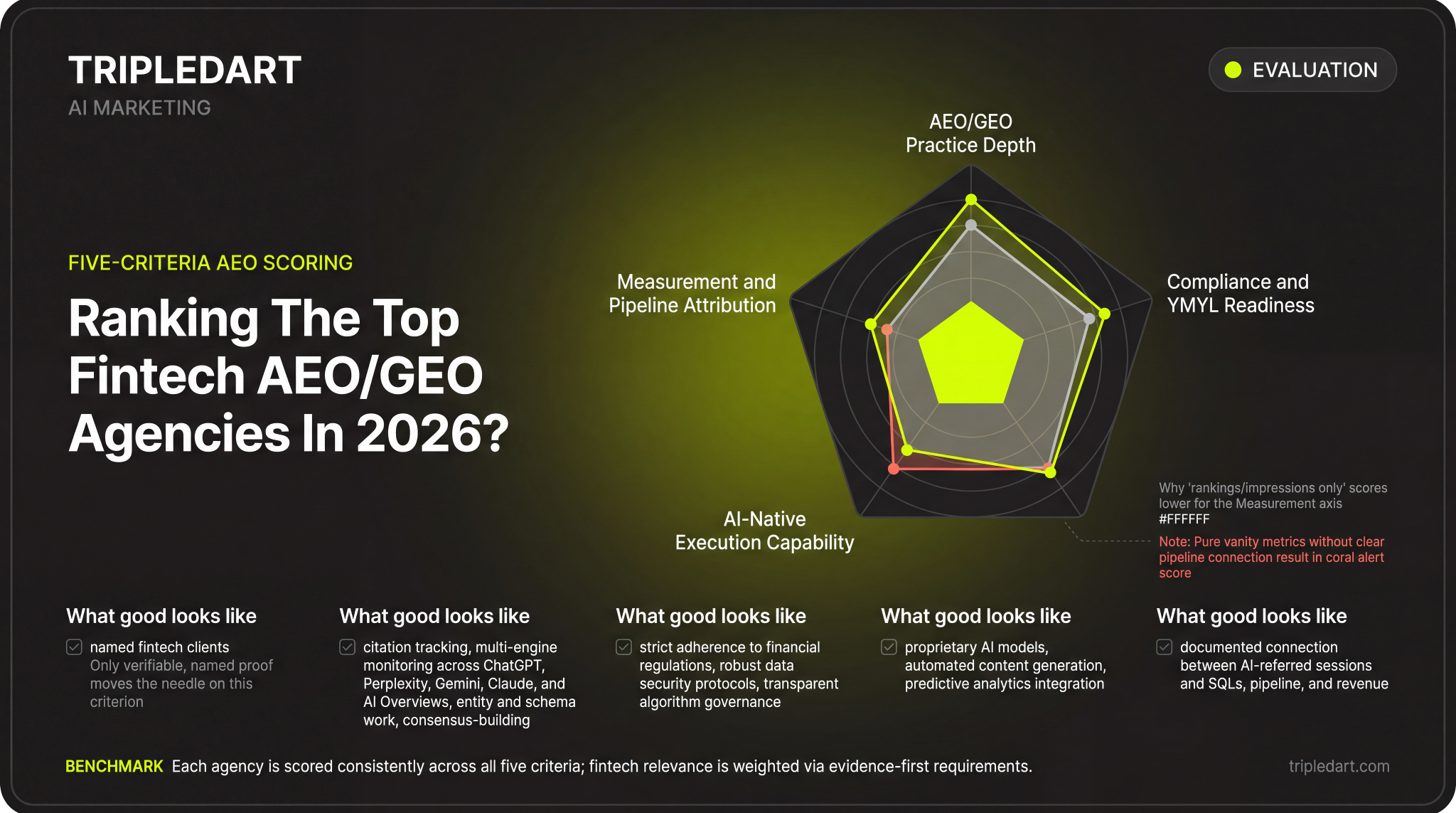
Every agency on this list was assessed against five criteria. The ranking reflects fintech-relevant AEO evidence first.
Criteria:
Verified Fintech Evidence
AEO/GEO Practice Depth
Compliance and YMYL Readiness
AI-Native Execution Capability
Measurement and Pipeline Attribution
Verified Fintech Evidence
Named fintech clients with documented AEO, GEO, or organic outcomes. Unnamed "financial services experience" doesn't count. Only verifiable, named proof moves the needle on this criterion.
AEO/GEO Practice Depth
Citation tracking, multi-engine monitoring across ChatGPT, Perplexity, Gemini, Claude, and AI Overviews, entity and schema work, and consensus-building. Does the agency run this as a practice or offer it as an add-on rebranded from existing SEO work?
Compliance and YMYL Readiness
Experience moving content through regulated financial review, familiarity with FINRA, SEC, CFPB, and Reg D constraints, and documented legal-review workflows integrated into content production.
AI-Native Execution Capability
Does the agency own AEO monitoring and execution technology, including proprietary tooling or agentic workflows, or does it rely entirely on manual processes and third-party platforms? Agencies with proprietary AI-search monitoring can track citation behavior across engines in near real time, which matters for regulated categories where content must be updated quickly.
Measurement and Pipeline Attribution
Share of answer, citation rate, multi-engine visibility, and a documented connection between AI-referred sessions and SQLs, pipeline, and revenue. Agencies that report on rankings and impressions only scored lower on this criterion.
Which Are The Top Fintech GEO/AEO Agencies In 2026?
Each entry below, listed in no particular order, was assessed against the methodology above. Descriptions reflect the best available verifiable information about each agency's fintech-relevant AEO positioning and evidence.
1. LoudFace
Best for: Fintech companies that want a dedicated AEO/GEO partner with published sub-vertical evidence.
LoudFace has named fintech proof plus sub-vertical fit mapping. They rank first on published fintech-specific AEO evidence and transparency. Their positioning is built around citation-earning methodology for financial brands, with documented work across payments, lending, and wealthtech sub-verticals. They map client positioning to specific AI engines by query type, which is more granular than most agencies in this space. Their compliance awareness shows in how they structure content review workflows for regulated clients.
2. TripleDart
Best for: Fintech scaleups and enterprises that want AEO built into a full GTM engine with pipeline attribution, rather than a standalone AEO point solution.
TripleDart runs organic and AI-search visibility as one connected discipline through our Search Everywhere Optimization methodology. Senior operators govern strategy, compliance positioning, and final judgment on every piece of content. The proprietary AI Search Tracker monitors brand citation behavior across ChatGPT, Perplexity, Claude, Gemini, and Google AI, giving fintech clients real-time visibility into where they appear and where competitors are being cited instead. Our Truth Files provide governed brand context so AI-native agents execute content within compliance-aware guardrails.
TripleDart’s documented fintech proof includes Airbase (spend management), where paid media and ABM work grew pipeline 6x. The integration angle is the differentiator: AEO is built into a full GTM engine with pipeline attribution.
Our deepest fintech documentation is paid and ABM rather than a named AEO citation case study. Teams wanting a pure-play fintech AEO specialist with a long citation portfolio should weigh that honestly against the integration benefits.
3. First Page Sage
Best for: Fintechs that want thought-leadership content as the primary citation-earning mechanism.
First Page Sage’s content model is built around long-form, authoritative thought leadership that earns both traditional rankings and AI citations. Their published ROI methodology for SEO is more transparent than most competitors. The content-authority approach suits AEO for financial queries well, where third-party consensus and demonstrated expertise carry more weight than structural optimization alone. Less differentiated on compliance workflow depth.
4. Omnius
Best for: B2B SaaS fintech companies, particularly those at the intersection of SaaS and financial infrastructure.
Omnius has a GEO practice built on top of its SaaS SEO work. Their focus on SaaS-fintech makes them a reasonable fit for companies like embedded finance platforms or fintech-adjacent developer tools. They document content outcomes for SaaS clients clearly. Their compliance experience is less extensive than fintech-first agencies, which matters for heavily regulated sub-verticals like wealthtech or lending.
5. CSTMR
Best for: Fintechs that need full-funnel marketing alongside AEO, including creative and performance.
CSTMR is a fintech marketing specialist, which is a meaningful differentiator at this stage of the list. They understand the regulatory vocabulary and buyer psychology specific to financial products. Their AEO capability is layered onto a broader fintech marketing practice rather than built as a standalone discipline. That makes them a strong fit for growth-stage fintechs that need brand, demand generation, and AEO moving in parallel.
6. Directive Consulting
Best for: Performance-driven B2B fintech teams that want AEO tied to pipeline metrics from day one.
Directive Consulting's measurement-led model is its clearest strength. They build campaigns around SQL quality and pipeline contribution rather than traffic volume. This aligns with how fintech marketing leaders are now expected to report. Their fintech SaaS applicability is strongest in B2B payments and spend management. Less specialized in compliance-heavy sub-verticals.
7. Skale
Best for: SaaS fintech companies that want productized SEO with a revenue-focused model.
Skale runs a revenue-first organic model where deliverables are tied to pipeline outcomes rather than content volume. Their productized SEO approach works well for fintech companies with clear ICP definitions and existing content foundations. AEO is integrated into their broader organic model. They're a stronger fit for SaaS fintech than for regulated consumer finance, where compliance requirements exceed their documented workflow depth.
8. Siege Media
Best for: Fintechs that need citation-building through high-authority content and link acquisition.
Siege Media's strength is original-data content and editorial link acquisition that feeds AEO citation signals over time. Authority building through third-party editorial mentions is a core input to earning AI citations for financial queries. Less differentiated on multi-engine AEO monitoring and pipeline attribution.
9. NoGood
Best for: Growth-stage fintechs running experimentation-led acquisition alongside AEO.
NoGood runs an AI-search practice alongside its growth and performance work. Their B2B and fintech experience is documented, and their growth-experimentation model can surface AEO wins faster than content-only approaches. Pipeline attribution is part of their reporting framework. But their fintech compliance depth should be validated directly during the pitch process.
10. SeoProfy
Best for: Fintechs that want process-rigorous SEO and AEO with documented technical auditing.
SeoProfy has expanded its SEO practice into AEO with a focus on process documentation and technical rigor. Their audit methodology is detailed and repeatable. Fintech applicability is strongest in areas with lower compliance complexity, such as B2B payments infrastructure and fintech SaaS tools.
11. Stratabeat
Best for: B2B fintechs with a content-authority gap and a need for AEO methodology.
Stratabeat brings B2B SEO and AEO methodology with documented financial-services experience. Their focus on content-driven authority-building aligns with what AEO for financial queries requires. A reasonable option for mid-market fintechs that want to build entity authority alongside traditional SEO.
12. Breaking B2B
Best for: Fintechs that want bottom-of-funnel content as the primary AEO lever.
Breaking B2B, led by Sam Dunning, is built around BOFU content that earns citations at the decision stage of the buying journey. For fintech, that means comparison pages, use-case content, and alternatives content structured to earn AI citations when buyers are close to a purchase decision. A strong niche fit for fintechs with clear competitive positioning.
13. Mint Studios
Best for: SaaS fintech companies that want answer-first content built for AI citation.
Mint Studios runs an answer-first content model that maps well to AEO requirements. Their fintech relevance is strongest in B2B SaaS, where the compliance complexity is lower than regulated consumer finance. A practical option for fintech companies at Series A or B that want to build AEO foundations before the category's AI answers fill with established incumbents.
14. Optimist
Best for: ROI-led fintech teams with a clear content investment mandate.
Optimist's CORE framework is built around content ROI, which matches how fintech marketing leaders are now expected to justify organic investment. Their AEO integration sits inside a broader SEO strategy. Less differentiated on compliance workflow depth or multi-engine citation monitoring.
15. The ABM Agency
Best for: Enterprise fintechs with buying committees where account-based GEO is the right motion.
The ABM Agency runs an account-based GEO model that's genuinely differentiated for enterprise fintech selling. When a buying committee has six to 10 stakeholders each running separate AI queries, broad AEO alone won't cover the gap. Their account-targeted approach maps GEO coverage to the specific queries enterprise buyers ask, which is a meaningful advantage for banking infrastructure and wealthtech deals.
16. Croton Content
Best for: Financial-brand specialists that need compliance-aware AEO and consensus-engineering depth.
Croton Content focuses specifically on financial brands and has built AEO methodology around building the third-party citation signals that AI engines rely on for YMYL queries. Their compliance guidance depth is among the strongest on this list. A strong option for fintechs in heavily regulated sub-verticals where content review requirements are strictest.
Which Agency Is The Best Fit For Each Fintech Sub-Vertical?
Sub-vertical context changes the agency calculus. A payments infrastructure company and a wealthtech platform face different YMYL thresholds, compliance constraints, and buying-committee compositions. This matrix maps the ranked agencies to specific fintech niches.
Payroll And Spend Management
TripleDart’s paid media and ABM work for Airbase (spend management) produced measurable pipeline growth and increased average contract value. For fintechs in this sub-vertical, the spend-management category expertise transfers directly to AEO content strategy, buyer-persona coverage, and entity authority building.
Struggling with fintech AI search visibility and compliance-aware AEO? We've helped 300+ B2B SaaS companies build organic and AI-search pipelines that move revenue.
How Do You Choose a Fintech AEO/GEO Agency?
Most fintech marketing leaders buying AEO services for the first time will evaluate agencies the same way they'd evaluate a traditional SEO shop. That's a mistake. The criteria that matter for fintech AEO are distinct, and the red flags are different too.
Questions to ask in the pitch
- How do you handle regulated content review, and how do you keep AEO content structurally intact through a legal sign-off cycle?
- Which AI engines do you monitor, and how do you track citation rate changes over time?
- Do you own citation-monitoring technology or rely entirely on third-party tools?
- Who owns the data, tooling, and documented workflows if we end the engagement?
- How do you connect AEO performance to SQLs and pipeline?
- Can you show named fintech clients and documented citation outcomes?
- How do you handle YMYL content that requires a conservative claims posture?
- What does your content production workflow look like for a heavily regulated sub-vertical?
- How do you approach multi-engine coverage when citation behavior differs between ChatGPT and Google AI Overviews?
- How quickly can you adapt content when a regulatory update changes the defensibility of an existing claim?
Red flags to avoid
- Generic SEO shops that have added "AEO" to their service menu with no fintech client evidence
- No multi-engine tracking, meaning they measure citations only in one engine
- No compliance or regulated-content experience documented anywhere in their work history
- Reporting that leads with rankings and impressions and mentions pipeline as a footnote
- No named fintech clients, only anonymized financial-services references
- If you can't take your citation data and monitoring setup with you, you're renting a black box
- Agencies that treat AEO as a standalone content exercise with no connection to SEO technical foundations or entity authority
How To Run A 90-Day AEO Pilot
A structured pilot gives you enough signal to evaluate an agency before committing to a full retainer. The structure below reflects what reasonable timelines look like for regulated fintechs.
Weeks one to two: Baseline audit. Map current AI-search visibility across your priority engines, document entity authority gaps, and establish compliance guardrails with the legal team before content production begins.
Weeks three to eight: Entity and schema fixes alongside the first batch of answer-first content. Content should move through your legal review process with the agency's workflow intact. If the agency's workflow breaks under compliance review, you've learned something important.
Weeks nine to 12: Measure citation rate and share of answer across engines, review AI-referred session data, and connect to pipeline signal in your CRM. Note that regulated-content review can extend timelines. Factor that into your evaluation criteria before the pilot ends.
How Is Fintech AEO Performance Measured In 2026?
The most common mistake in fintech AEO measurement is using traditional SEO metrics as a proxy. Rankings and impressions tell you nothing about whether your brand is being cited when buyers ask AI engines questions.
TripleDart has found that citation behavior differs across engines. Google AI Overviews tends to lean on established domain authority and editorial consensus signals. Perplexity retrieves and cites sources more transparently, making fresh, well-structured content visible faster. ChatGPT draws on training data and retrieval simultaneously, which means new content can surface in some queries but not others depending on when the model last updated. Claude applies relatively conservative citation standards for financial claims. Tracking all major engines isn't optional for a serious fintech AEO program.
According to a 2025 MARKETER report, fintech digital advertising budgets have increased approximately 45% over three years, reflecting how competitive fintech AI search visibility has become. That budget pressure makes measurement discipline more important.
Why TripleDart Is The Right Partner For You Fintech AI Visibility?
TripleDart is the GTM Operating System for B2B tech, delivered as a service. We built our fintech practice around the same thesis: organic search and AI-search visibility have to run as one connected system, not two separate workstreams. Our proprietary AI workflows, including Slate, handle citation monitoring, content operations, and multi-engine tracking at scale. Human operators govern strategy, compliance positioning, and final judgment on every piece of content.
The strongest fintech AEO partners in 2026 combine verifiable fintech evidence, compliance and YMYL readiness, AI-native execution capability, and pipeline-level measurement. The right match for you depends on your stage, your sub-vertical, and whether you need a specialist or an integrated partner.
Use the sub-vertical matrix to narrow your shortlist, and use the buyer checklist before you enter any pitch process. For fintechs that want AEO built into a full GTM engine with pipeline attribution, rather than a standalone AEO retainer, evaluate TripleDart as part of your process.
Our fintech marketing practice brings the same pipeline-attribution discipline we apply to paid and ABM into organic and AEO.
Frequently Asked Questions
What is the difference between AEO, GEO, and traditional SEO for fintech?
AEO (Answer Engine Optimization) is about earning citations inside AI-generated answers on platforms like ChatGPT, Perplexity, and Claude. GEO (Generative Engine Optimization) is about structuring content so generative models synthesize and surface your brand in their responses. Traditional SEO is about ranking in classic search results on Google and Bing. For fintech companies, all three need to work together. SEO provides the authority foundation; AEO and GEO ensure that foundation translates into citation presence where buyers now research.
How long does AEO take to show results for a fintech company?
It depends on the engine. Retrieval-based engines like Perplexity can surface new content relatively quickly, sometimes within weeks of publication. Training-data-dependent models like ChatGPT update less frequently, so new content may not appear in responses for months. As a general baseline, expect early citation signals within 90 days of a structured program and meaningful, measurable results between three and six months. For regulated fintechs, compliance review cycles can add four to eight weeks to content timelines, which extends the measurement window accordingly.
How much does a fintech AEO/GEO agency cost in 2026?
Ongoing fintech AEO and GEO programs typically run from $5,000 to $20,000 per month depending on scope, sub-vertical complexity, and whether the engagement includes multi-engine monitoring, content production, and compliance workflow integration. Project-based engagements such as a 90-day pilot or a baseline audit cost less upfront but provide limited sustained citation-building. Fintech compliance and legal-review overhead adds cost relative to unregulated categories, because content production timelines are longer and quality standards are stricter.
How do regulated fintechs handle compliance in AEO?
Compliance in AEO is a workflow. Regulated fintechs need legal review integrated into their content production process from brief stage through publication. FINRA, SEC, CFPB, and Reg D constraints mean claims must be defensible. Agencies with documented regulated-content experience build review stages into their workflows and know how to maintain AEO structural integrity (answer-first structure, schema, entity signals) through revision cycles. The right agency will ask about your legal review process in the first conversation.
How do agencies measure AI citation rates and AEO ROI?
The core metrics are share of answer (what percentage of relevant AI answers cite your brand), citation rate (how often your content is referenced per query cluster), and multi-engine visibility tracked across ChatGPT, Perplexity, Gemini, Claude, and AI Overviews. Pipeline ROI connects AI-referred sessions to SQLs and revenue through CRM integration and attribution modeling. Some agencies use proprietary monitoring tools to track citation behavior in near real time; others rely on manual sampling and third-party platforms with limited engine coverage. Ask specifically how citation data is collected and how often it's reviewed.
Which AI engines matter most for fintech AEO?
All major engines matter: ChatGPT, Perplexity, Google AI Overviews, Gemini, Claude, and Copilot. Citation behavior for financial and YMYL queries differs across engines. Google AI Overviews leans on established domain authority and editorial consensus. Perplexity cites sources transparently and retrieves fresh content faster. ChatGPT blends training data with retrieval, creating variable freshness by query. Claude applies conservative citation standards for financial claims. Copilot is growing in enterprise Microsoft environments where fintech buyers often operate. Tracking citation presence across all major engines is the only way to get an accurate picture of your fintech AI search visibility.
Can an early-stage fintech benefit from AEO, or is it only for enterprises?
Early-stage fintechs have a genuine first-mover advantage in AEO. AI answer engines are still forming their citation patterns for many fintech sub-verticals, and the companies that build entity authority and structured content now will be harder to displace as the category matures. For seed and Series A fintechs with lean budgets, the practical approach is to focus on entity and schema foundations, a small set of high-intent BOFU queries, and one or two priority engines. The investment required to establish a citation presence is meaningfully lower before incumbents crowd the answer space.
Should fintechs hire a specialist AEO agency or an integrated GTM partner?
It depends on what the gap is. If the gap is narrow and well-defined, for example, you have strong SEO foundations but zero AI-citation visibility, a specialist AEO agency may close it faster. If AEO needs to connect to pipeline attribution, paid media signals, and CRM data to be meaningful to your board, an integrated GTM partner that manages organic, paid, and attribution together will produce more coherent outcomes. The staged decision is straightforward: specialists for isolated AEO gaps, integrated partners when AEO must connect to a broader revenue number.
As an AI-native SEO agency for B2B SaaS, TripleDart sits in the integrated partner camp, using proprietary AI workflows to connect citation monitoring, content operations, and pipeline attribution into a single reporting loop, so your board sees AEO as a revenue input