Most marketing leaders TripleDart talks to know they need to show up in ChatGPT, Perplexity, Gemini, and Google AI Overviews. What stops them is the absence of a number. Nobody publishes a generative engine optimization budget guide with dollar ranges segmented by company size and delivery model, so the line item either gets guessed or ignored.
We'll give you concrete 2026 GEO budget benchmarks across startup, mid-market, and enterprise stages, break down the five cost centers inside a GEO program, and show you how to tie every dollar to pipeline. Worldwide generative AI spending is forecast to reach $644 billion in 2025, up 76.4% from 2024, and the marketing slice of that number is growing fast. Your buyers are already using AI to research software. The question is whether your brand shows up when they ask.
GEO, or generative engine optimization, is the practice of making your content citable and your brand visible inside AI-generated answers. It's measured on citation rate and AI share-of-voice, not traditional click-through. That measurement shift changes how you staff, tool, and allocate a program, which is why GEO budgeting looks different from SEO budgeting even when the two overlap heavily in practice.
Why Is GEO Budgeting Different From SEO Budgeting?
SEO budgets have 20 years of benchmarks behind them. GEO has two. That gap is the core problem for anyone trying to defend a line item in a 2026 planning cycle.
The deeper difference is structural. A traditional SEO budget pays for rankings on one engine. A GEO budget pays for citation presence across at least five distinct AI surfaces: ChatGPT, Google AI Overviews, Gemini, Perplexity, and Claude. Each surface has different retrieval logic, different content preferences, and different monitoring requirements.
GEO also overlaps with existing SEO investment in ways that make it hard to price in isolation. A company with strong technical SEO and high-authority backlinks needs far less incremental GEO spend than one starting from scratch. That dependency means your GEO budget is partly a function of how mature your organic program already is, which is why the benchmarks in this guide carry ranges rather than single figures.
According to Gartner's 2025 CMO Spend Survey, marketing budgets remain flat at 7.7% of overall company revenue. GEO needs to come out of that same pool. The framing that works with a CFO isn't ‘new channel spend’ but ‘organic investment that extends into the surfaces our buyers now use.’
What Are You Paying For In A GEO Budget?
A GEO budget is five cost centers.
AI Visibility Tooling And Monitoring
Tracking brand mentions and citations across AI surfaces is the cost floor for any GEO program, and price scales with the number of tracked prompts, competitor brands, and surfaces.
Dedicated tools in this space include Profound, Ahrefs Brand Radar, and Semrush's AI Optimization suite. Entry-level monitoring starts around $50 to $200 per month for limited prompt sets. Mid-tier plans with broader surface coverage and competitor tracking run $500 to $2,000 per month. Enterprise-grade platforms with API access and custom dashboards can reach $3,000 to $6,000 per month or higher.
For teams just starting out, manual monitoring across two or three surfaces is a valid free option, but it doesn't scale. Users on the SEO subreddit have noted that Semrush's AI Optimization tools are effective for brand visibility and citation tracking from popular LLMs but may exceed the budget of smaller teams. That's a trade-off worth planning around.
Content Creation And Optimization
The content that LLMs cite has a specific profile: direct answers, structured comparisons, entity-rich pages, TL;DR blocks, and first-person evidence like original data or client results. Producing it at the velocity GEO requires is often the largest single cost center.
Net-new content costs more than optimizing existing assets. If you have a mature SEO blog with 200 published posts, a meaningful share of your GEO content budget goes to reformatting and enriching what already exists. Cost drivers include:
- Writer and editor time per piece ($300 to $1,500 per page depending on depth)
- Subject-matter expert input, which matters for technical or regulated categories
- Formatting and optimization labor for answer-ready structure
TripleDart found that companies with weak content libraries pay two to three times more in this cost center than those with a strong SEO foundation.
Technical GEO Foundations
The technical prerequisites for being citable by an LLM overlap heavily with technical SEO: clean crawlability, schema markup at scale, HTTPS, site speed, and llms.txt implementation. For companies with mature technical SEO, this is largely a one-time audit-and-fix cost rather than an ongoing line item.
TripleDart’s technical SEO team typically categorizes these as front-loaded costs that run $2,000 to $8,000 for an initial audit and implementation, then drop to light ongoing maintenance. For companies with significant technical debt, the number is higher. Schema work in particular can be substantial for large sites. Our post on schema markup for AI SEO covers the specific markup types that matter most for LLM retrievability.
Digital PR And Authority Building
This is the most variable and highest-ceiling cost center in a GEO budget. LLMs cite sources they trust, and trust is built through third-party editorial placements, authoritative backlinks, Wikipedia and Wikidata presence, and brand mentions in publications that AI systems are trained on.
Digital PR retainers for GEO-focused authority building typically run $2,000 to $8,000 per month. Individual authoritative placements can cost $500 to $3,000 each when pursued through editorial outreach. In competitive categories like cybersecurity or fintech, the ceiling is higher because every competitor is fighting for the same citations.
Authority built through editorial relationships continues paying into future LLM training cycles. Our digital PR team runs this as an ongoing program.
Measurement, Reporting, And Governance
Measuring GEO means tracking reference rate, AI share-of-voice across surfaces, and AI-referred pipeline in your CRM. The last metric separates a measurable program from a vanity-metric one, and it requires coordination between content, PR, and RevOps that many organizations haven't built yet.
Reporting cadence costs rise with company size. A startup can manage GEO measurement with one person and a $200/month tooling stack. An enterprise team with multiple business units needs dedicated ownership, custom dashboards, and a governance structure to keep surface coverage consistent. Budget 5% to 15% of total GEO spend for this cost center, and don't skip it. The pipeline attribution question will come up in every budget review.
What Are The 2026 GEO Budget Benchmarks By Company Size?
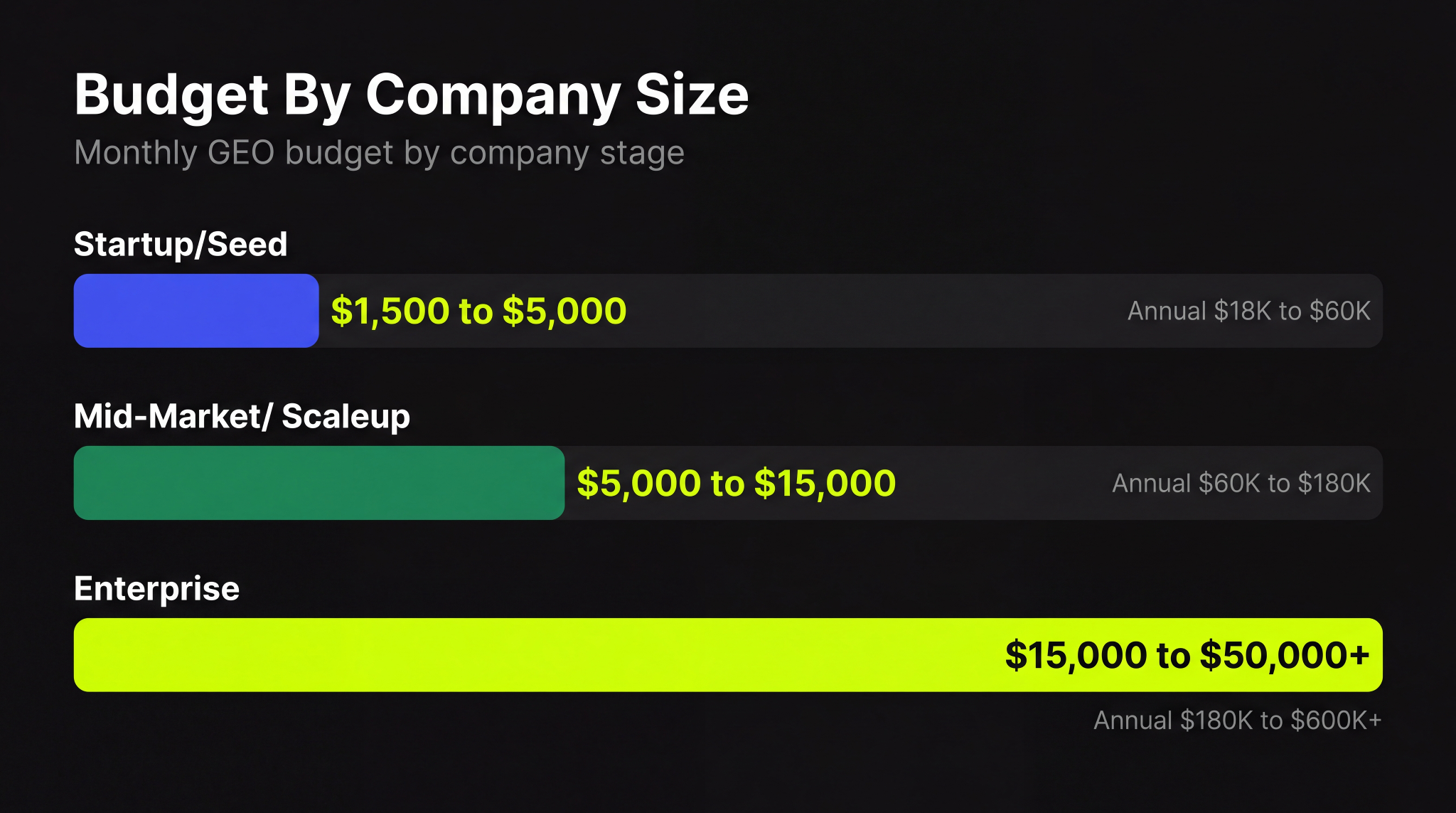
GEO spend varies by stage because the underlying cost drivers, content volume, surface coverage, and authority gap, scale with company size and competitive intensity. These ranges reflect what TripleDart has seen across our portfolio of 300+ B2B brands in 2026.
Startup And Seed-Stage GEO Budget
At $1,500 to $5,000 per month, the priority is maximizing signal per dollar. That means technical foundations first (mostly a one-time cost), a handful of high-intent content pieces per month formatted for AI citation, and monitoring on one or two surfaces where your buyers research.
Skip heavy digital PR retainers at this stage. You don't have the content depth to amplify yet, and authority-building grows faster once there's a content library worth citing. The focus is on getting the technical foundation right and producing two to four citation-worthy pages per month around your highest-intent queries.
What to prioritize:
- llms.txt and schema markup implementation (one-time, $500 to $2,000)
- Two to four high-intent content pieces per month
- Monitoring on ChatGPT and Perplexity at minimum
What to skip for now:
- Enterprise monitoring platforms above $500/month
- Digital PR retainers before content is in place
Mid-Market And Scaleup GEO Budget
At $5,000 to $15,000 per month, the typical blend is full tooling, consistent content velocity of six to 12 pieces per month, and an emerging digital PR program targeting five to 10 placements per quarter.
The over-spend pattern we see most at this stage is too many monitoring tools without a single owner responsible for acting on the data. The under-spend pattern is skipping authority-building entirely, so teams plateau at good content that never gets cited because no credible third party references it. Hybrid delivery, an in-house owner plus an external execution partner, works best here because it balances cost and control.
Common mid-market mistakes:
- Running three tooling subscriptions with no unified reporting
- Publishing content without reformatting for answer-ready structure
- No coverage on Wikidata, which affects Gemini and Claude retrieval
Enterprise GEO Budget
At $15,000 to $50,000+ per month, the extra spend buys multi-surface coverage, dedicated program ownership, cross-functional alignment with RevOps and PR, and the deeper digital PR and work needed to defend category share-of-voice. Three-quarters of enterprise AI decision-makers say their organization has invested more than $300,000 in generative AI to date. GEO sits inside an already-growing GenAI budget line.
Enterprise GEO is a program. The recurring investment is what defends visibility as competitors ramp up their own citation strategies. Enterprise-specific cost drivers include:
- Multi-BU content governance
- Multilingual surface coverage
- Dedicated AI share-of-voice reporting tied to pipeline
- Legal and compliance review on regulated content
How Does GEO Cost Vary By Delivery Model: In-House, Tools, Agency, Or Hybrid?
Building GEO In-House
The cost of in-house GEO is the fully loaded salary of a specialist who understands LLM retrieval, content optimization, management, and digital PR coordination. In 2026, a GEO or AI search specialist in the US earns $90,000 to $140,000 annually, which is $7,500 to $11,700 per month before adding tooling ($500 to $2,000/month) and ramp time (typically three to six months before they're fully productive).
In-house makes sense for large organizations with steady content volume and the budget to absorb a specialist salary before results arrive. For early-stage teams, that ramp cost is the killer. You're paying for expertise before it shows results. TripleDart’s comparison of in-house and agency SEO covers this trade-off across channels.
DIY With GEO Tools Only
A minimal tool stack for DIY GEO monitoring costs between $200 to $600 per month, covering basic citation tracking across two or three surfaces. The ceiling is the problem: tools show you where you're mentioned but don't produce content, earn citations, or build authority. This path is fine for establishing a baseline and understanding where your gaps are, but it's not a strategy.
The Reddit r/GEO__AI__SEO community confirms this, noting credit-based AI visibility tools starting around $24.50/month for 50 credits as the most affordable entry point, but explicitly for tracking.
Hiring A GEO Or GTM Partner
External GEO retainers run $3,000 to $15,000 per month depending on scope. The critical distinction is what's included. A GEO-only shop handles citation monitoring and content optimization but hands off digital PR and attribution to you. A fragmented stack of point vendors means you're coordinating three separate retainers with no shared data.
The integrated model, where GEO and AI search optimization run alongside SEO, paid, and RevOps with unified attribution, is where pipeline accountability comes from. TripleDart runs GEO programs for B2B SaaS companies where every AI citation traces back to a pipeline dollar, because the reporting infrastructure connects content activity to CRM outcomes.
According to Forrester's State of AI Inside US Marketing Agencies 2026, nine in 10 agencies now use generative AI, and half use agentic AI for marketing execution. This is driving execution costs down and quality expectations up. If you're evaluating an external partner, ask specifically how they tie GEO activity to pipeline.
Hybrid Model (Most Common Landing Spot)
The hybrid setup, an in-house owner who drives strategy and stakeholder alignment, plus an external partner handling content production, digital PR, and monitoring execution, is where most B2B SaaS companies land. It balances cost, control, and speed in a way neither pure model can match.
Typical responsibility split:
- In-house: ICP definition, brand voice governance, stakeholder reporting, and content approval
- External: Content production and formatting, citation monitoring, digital PR outreach, management, and pipeline attribution reporting
At $4,000 to $12,000 combined per month, the hybrid model is the default recommendation for Series B and Series C companies building GEO for the first time.
What Drives Your GEO Budget Up Or Down?
Understanding the variables lets you self-estimate rather than defaulting to the middle of any range. Each driver below pushes your budget in a meaningful direction.
Category competitiveness (up): Software categories with eight or more active competitors all chasing AI citations, like HR tech, cybersecurity, and fintech, require heavier digital PR investment to achieve and maintain citation share. Categories with three or fewer significant players generally spend 30% to 50% less on authority-building.
Existing SEO foundation (down): A company with DR 60+ and 500+ indexed pages is already positioned for LLM retrieval. The incremental GEO cost is tooling and reformatting. A company starting with DR 20 pays more because authority-building is a prerequisite before GEO content does anything.
Number of AI surfaces targeted (up): Running GEO on ChatGPT and Perplexity is cheaper than covering five surfaces including Gemini, Claude, and Google AI Overviews. Each additional surface requires monitoring coverage, content optimization for different retrieval patterns, and authority signals that each engine weights differently.
Content velocity required (up): Competitive categories reward content freshness. We've observed that brands appearing consistently in LLM answers tend to publish or refresh content within 90-day windows. Higher velocity means higher content cost.
Geographic and vertical complexity (up): Regulated verticals like fintech, healthcare tech, and cybersecurity require legal review on published content, which adds cost per piece. Multilingual requirements also multiply content production costs.
Strength of existing content library (down): A company with 300+ blog posts has more reformatting opportunities and fewer net-new content requirements. That directly reduces the content cost center.
How Should You Allocate GEO Within Your Marketing Budget?
Gartner's 2025 CMO Spend Survey puts marketing budgets at 7.7% of company revenue. GEO, in 2026, should sit at 10% to 20% of your total organic/SEO budget, or 5% to 10% of total marketing spend at companies with a strong paid mix. For companies where organic is the primary acquisition channel, that share rises.
The phasing framework that works for most B2B SaaS companies:

Phase 1 (months one to two): Audit
Fund an AI visibility audit and technical GEO assessment. Cost: $2,000 to $5,000 one-time. Output: baseline citation rate, surface gaps, technical blockers, and content opportunities. TripleDart’s free AI visibility report is a starting point for this phase.
Phase 2 (months two to four): Foundations
Fix technical prerequisites, publish six to 12 high-intent content pieces, and set up monitoring. Cost: $3,000 to $8,000 per month. Output: indexed, citable content and a measurement baseline.
Phase 3 (months five and beyond): Scale
Increase content velocity, launch digital PR, expand surface coverage, and tie reporting to pipeline. Cost: $6,000 to $20,000 per month depending on stage. Output: measurable AI share-of-voice and AI-referred pipeline in CRM.
Most companies who skip Phase 1 and go straight to Phase 3 end up spending more in total because they're doing so without a baseline. If you can't prove what's working, you can't defend what you're spending.
How Do You Measure GEO ROI?
The metrics that matter for GEO ROI are reference rate (how often your brand or content appears in AI answers for target queries), AI share-of-voice (your citation percentage versus competitors on the same surface), and AI-referred pipeline (demos and SQLs where the first or recent touch was an LLM referral).
That last metric is the one CMOs and CFOs care about. Gartner's CMO survey found that GenAI investments deliver ROI primarily through improved time efficiency (49%), improved cost efficiency (40%), and increased content capacity (27%), with just 1% of CMOs saying GenAI is not a priority. GEO fits inside that efficiency framing, but pipeline attribution is what makes the budget defensible year over year.
If your category has five competitors and two of them are consistently cited in AI answers for your highest-intent queries, those two are collecting the research-stage intent you're not capturing. Buyers who get a recommendation from an LLM convert at a higher rate than those who find you through a generic search result.
FlowForma improved AI-attributed traffic by 5.5x within nine months of strategic GEO implementation with TripleDart. It achieved consistent visibility in process automation recommendations across ChatGPT, Perplexity, and Gemini.
Signeasy grew to 800 monthly LLM sessions with 60% to 68% monthly growth over six months with TripleDart. Both results came from programs where AI visibility was treated as a pipeline metric.
The practical measurement cadence: audit AI visibility monthly, report AI-referred pipeline quarterly, and review of share-of-voice against competitors every six weeks. That rhythm gives you enough data to adjust spend allocation before a quarter goes sideways.
For teams tracking these numbers, TripleDart’s GEO metrics guide covers the reporting infrastructure in detail.
How Do You Build Your 2026 GEO Budget Step By Step?
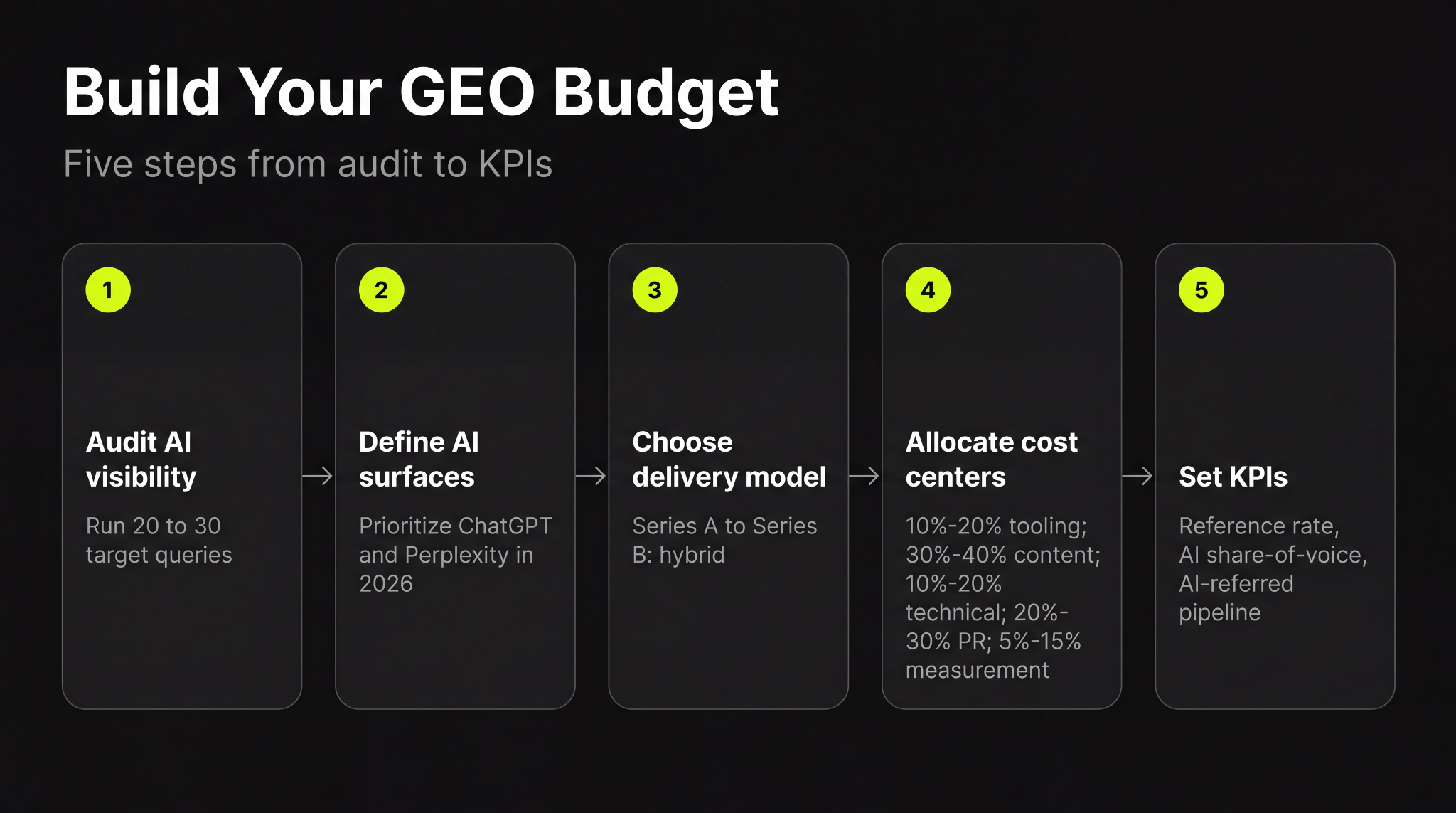
A GEO budget built without a process is a guess.
Step 1: Audit your current AI visibility
Run 20 to 30 target queries across ChatGPT, Perplexity, and Google AI Overviews. Track which competitors appear and which sources they cite. This gives you the citation gap you're trying to close. TripleDart’s AI SEO playbook covers the audit methodology.
Step 2: Define your target AI surfaces
Prioritize based on where your ICP researches, not where you want to be. For most B2B SaaS buyers, ChatGPT and Perplexity are the highest-priority surfaces in 2026. Add Gemini if your buyers are in Google Workspace environments. Add Claude if they're in developer or technical roles.
Step 3: Choose your delivery model
Use the benchmark table above to match your stage to the right model. If you're Series A to Series B, hybrid with an external partner handling execution is almost always cheaper than building in-house and faster than DIY.
Step 4: Allocate across the five cost centers
Start with tooling (10% to 20%), add content (30% to 40%), layer in technical (10% to 20%), then digital PR (20% to 30%), and close with measurement (5% to 15%). Adjust based on your category competitiveness and existing SEO foundation.
Step 5: Set KPIs and reporting cadence
Define reference rate targets, AI share-of-voice targets, and AI-referred pipeline targets before you spend a dollar. Without targets, you can't prove ROI and you can't justify the budget in the next planning cycle.
An integrated GTM partner can run Steps 1 through 5 as one workflow with shared data across all channels, which is faster than building each step independently.
Partner With TripleDart To Optimize Your GEO Program
TripleDart is the GTM Operating System for B2B tech, delivered as a service. We've built GEO programs for 200+ companies using proprietary AI workflows (including Slate, our AI research and content intelligence layer) to surface citation gaps, prioritize content, and connect AI mentions to CRM outcomes. The programs that produce measurable pipeline share a consistent structure: strong technical foundations, consistent citation-worthy content, authority-building through editorial relationships, and attribution that ties AI mentions to revenue. The ones that struggle treat GEO as a content project with no measurement attached.
Our GEO and AI search team runs GEO alongside SEO, paid, and RevOps as one system with one source of truth. That means the citation work we do in month two traces to a pipeline dollar in month five. If you want to evaluate what a pipeline-accountable GEO program costs for your stage and category, we'll tell you honestly, including where your existing foundation reduces the number.